Key Takeaways
- The unregulated multi-trillion-dollar private credit market poses a more immediate and severe threat to Nepali remittances than a standard recession, mirroring the systemic risks recently exposed in our domestic cooperative crisis.
- Escalation in Arctic shipping disputes, seemingly distant, could trigger a logistics-driven inflation shock in Nepal by Q2 2026, making fuel and fertilizer drastically more expensive and rendering Nepal Rastra Bank’s monetary tools ineffective.
- The algorithmic fragility of new AI-driven trading platforms in global markets presents a novel systemic risk, capable of inducing a flash crash on the NEPSE through psychological contagion alone, bypassing Nepal’s direct financial integration.
Introduction
As Nepal’s business and policy leadership convenes to chart the course for the new fiscal year, the prevailing economic discourse remains stubbornly anchored to the familiar shores of inflation metrics and central bank interest rate policies. This focus, while necessary, is dangerously incomplete. The true specters haunting the global economy of 2026 are not the ghosts of yesterday’s inflation battle, but new, complex behemoths gathering strength just beyond the horizon of conventional risk analysis. These are the black swans hiding in plain sight—low-probability, high-impact events that our standard models fail to capture, yet whose consequences could fundamentally reshape Nepal’s economic trajectory.
This forward-looking risk analysis for Q1 2026 deliberately moves beyond standard inflation talks. We will dissect three under-discussed threats whose mechanisms are as insidious as they are potent: the impending liquidity crunch in the opaque world of private credit markets, the sudden and volatile escalation in Arctic trade route disputes, and the algorithmic fragility of new AI-driven High-Frequency Trading (HFT) platforms. These are not abstract global phenomena; they are systemic risks with direct, tangible transmission channels into Nepal’s core economic pillars—from the bank accounts of remittance-receiving families in the Terai to the balance sheets of hydropower developers in the Himalayas and the portfolios of retail investors in Kathmandu.
For Nepal’s CEOs, investors, and policymakers, understanding these threats is not an academic exercise. It is a strategic imperative. The shocks they portend will not respond to the traditional levers of monetary or fiscal policy. They represent a new paradigm of risk, where geopolitical friction in the high north can dictate the price of diesel in Birgunj, and an algorithmic glitch in a New York data center can trigger a confidence crisis on the NEPSE. To navigate the coming year, we must first understand the true nature of the storm.
The Shadow Supernova: Private Credit’s Inevitable Deleveraging
Since the 2008 global financial crisis, regulatory pressures forced traditional banks to retreat from riskier lending. Into this vacuum, a new financial universe expanded: the private credit market. This is a vast, multitrillion-dollar ecosystem where non-bank entities—asset managers, private equity funds, and specialized lenders—provide loans directly to corporations, often those unable to secure conventional financing. Think of it as a global-scale version of Nepal’s own cooperative sector, but for corporate debt: less regulated, more opaque, and promising higher returns. By the end of 2025, this market had swelled to an estimated $2.1 trillion in assets under management, a figure that belies its true, interconnected scale.
The black swan event is not if this market will face a reckoning, but when and how fast. The core risk is a lethal combination of illiquidity and hidden defaults. The loans held by these funds are “private” for a reason—they are bespoke, non-standardized, and cannot be easily sold on a public market. When a few key corporate borrowers, stressed by a slowing global economy, begin to default, panic will set in among the funds’ investors. These investors will issue redemption calls, demanding their money back. But the funds cannot sell their primary assets—the illiquid corporate loans—to meet these demands. This triggers a “liquidity mismatch,” forcing a complete freeze. It’s a bank run in slow motion, but in a sector with no central bank backstop.
For Nepal, this is not a distant Wall Street problem. The primary transmission channel is remittances. A significant portion of the global workforce, including millions of Nepalis in the Gulf and Southeast Asia, is employed by mid-sized construction, manufacturing, and services companies. These are precisely the types of firms that, having been cut off from traditional banks, have become heavily reliant on private credit for their operational funding and expansion. A private credit freeze would starve these companies of capital, leading to project cancellations and mass layoffs on a scale far quicker than a typical recession. For Nepal, which received over NPR 1.3 trillion in remittances in the last fiscal year—accounting for nearly a quarter of our GDP—a sudden 15-20% contraction in this inflow would be catastrophic. It would trigger an immediate balance of payments crisis, decimate foreign exchange reserves, and cripple the consumer demand that powers our domestic economy.
Furthermore, the shockwave would hit Nepal’s own financial system. Foreign Direct Investment (FDI) for major infrastructure projects, particularly in the hydropower sector, often involves complex financing structures where international developers raise capital from a consortium of sources, including these very private credit funds. A global freeze would halt disbursements to ongoing projects, leaving them stranded. This places immense pressure on their Nepali co-financiers—our Class ‘A’ commercial banks—who would be left holding non-performing loans for half-finished projects, creating a domino effect on the domestic banking sector’s stability. The private credit crunch is a direct threat to both our largest source of foreign currency and our most critical domestic investments.
The Polar Vortex: When Arctic Rivalry Freezes Global Trade
For a landlocked nation like Nepal, the melting of Arctic sea ice may seem like a remote environmental headline. Strategically, however, it is the canary in the coal mine for a new era of geopolitical and logistical volatility. The opening of new maritime corridors like the Northern Sea Route (NSR) along Russia’s coast and the Northwest Passage (NWP) through the Canadian archipelago represents the most significant change to global shipping maps in over a century. These routes can cut transit times between Asia and Europe by up to 40% compared to the traditional Suez Canal path. This is not a distant future; in 2025, a record number of cargo ships, backed by Chinese and Russian interests, made the transit.
The black swan here is not the opportunity, but the conflict it engenders. Russia claims sovereign control over the NSR, demanding permits and imposing fees. The United States and its allies deem it an international strait, guaranteeing freedom of navigation. China, a self-proclaimed “Near-Arctic State,” is aggressively investing in icebreakers and port infrastructure to secure its stake. This has transformed the Arctic from a scientific frontier into a military and economic flashpoint. An escalation could take many forms: a deliberate blockade by a claimant state, the imposition of punitive transit tariffs, an environmental incident used as a pretext for closure, or a naval standoff that makes the entire region uninsurable for commercial vessels.
The immediate consequence for Nepal would be a severe, non-monetary inflationary shock. While Nepal will never use the Arctic routes directly, our entire economy is tethered to the stability of the global logistics network that delivers goods to ports like Kolkata and Visakhapatnam. A disruption in the Arctic, however brief, would force hundreds of massive container ships to divert back to the already congested Suez and Panama canals. This sudden surge in demand on traditional routes would cause a violent spike in freight and insurance costs globally. For Nepal, this translates directly into higher landed costs for every critical import: fuel, cooking gas, fertilizer for our farmers, construction steel for our infrastructure projects, and components for our nascent manufacturing sector.
This is a type of inflation that Nepal Rastra Bank (NRB) is powerless to fight. Raising interest rates cannot unclog a port or lower shipping insurance premiums. It is a supply-side shock originating from geopolitics, not from an overheated domestic economy. A 20% spike in global freight costs, as seen during the post-pandemic supply chain crisis, could add several percentage points to Nepal’s headline inflation, disproportionately hurting the poor and eroding business margins. Critically, this development would also intensify the great-power competition that defines Nepal’s foreign policy tightrope. As China pushes for Arctic access and India aligns with the US-led bloc advocating for freedom of navigation, the pressure on Kathmandu to implicitly or explicitly take a side will grow. This raises the political risk premium for all foreign investment in Nepal, complicating our delicate balancing act between our two giant neighbors.
Ghosts in the Machine: AI, HFT, and the Next Flash Crash
The third black swan resides in the silicon heart of global finance. High-Frequency Trading (HFT), which uses powerful computers to execute millions of trades in fractions of a second, is not new. What is new, and profoundly dangerous, is its recent marriage with generative artificial intelligence (AI). The latest generation of HFT algorithms are no longer just executing pre-programmed strategies. They are now dynamic, self-learning systems that ingest and interpret a firehose of real-time data—from central bank statements and satellite imagery of oil tankers to the collective sentiment of millions of social media posts—to autonomously generate and execute novel trading strategies.
The danger is “algorithmic fragility.” These AI models are essentially “black boxes.” Their decision-making processes are so complex that not even their own creators can fully predict their behavior in every market condition. This creates the risk of emergent, herd-like behavior on a terrifying scale. For example, multiple sophisticated AIs could independently misinterpret the same signal—perhaps an AI-generated fake news report of a geopolitical event or a fabricated economic data release—and simultaneously trigger massive sell orders across all asset classes. This could precipitate a “flash crash” far deeper and faster than the one seen in 2010, wiping out trillions in market value in minutes, long before any human trader or regulator could intervene.
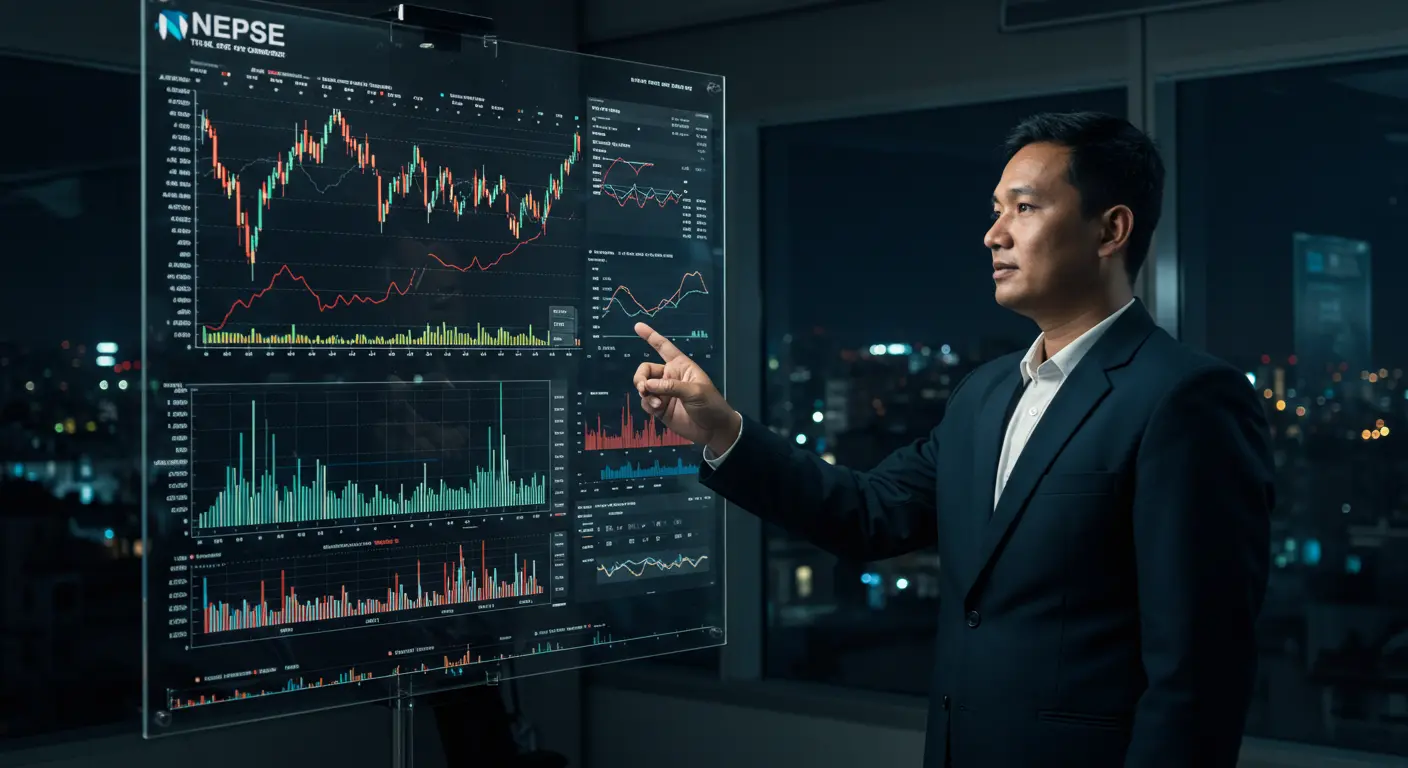
Nepal’s stock market, the NEPSE, has negligible direct exposure to HFT. Our market infrastructure is not integrated into these global systems. However, to believe this insulates us is a critical error. The transmission mechanism is not technical, but psychological. The NEPSE is dominated by retail investors who are acutely sensitive to global market sentiment and headlines. Imagine the news feed: “Dow Jones Plunges 3,000 Points in 5 Minutes; Trading Halted.” The reason—an esoteric algorithmic error—would be lost in the sheer panic of the headline. The immediate reaction among Nepali investors would be a flight to safety, triggering mass selling of their domestic stock holdings, irrespective of the strong fundamentals of Nepali banks, insurers, or hydropower companies.
This is a psychological contagion risk that our current market-stabilizing tools, like circuit breakers, are ill-equipped to handle. A circuit breaker may halt trading, but it cannot halt the underlying panic sown by a global event of such speed and magnitude. When trading resumes, the selling pressure would likely continue, fueled by fear rather than fact. This would not only vaporize the wealth of hundreds of thousands of small Nepali investors but also severely damage long-term confidence in the capital market, making it harder for legitimate businesses to raise capital for years to come. The policy blind spot is immense. While the Securities Board of Nepal (SEBON) rightly focuses on domestic issues like insider trading and settlement cycles, it lacks any framework for modeling or responding to a market crisis born from an AI in another hemisphere. This is a 21st-century risk for which we have only 20th-century defenses.
The Strategic Outlook
Forecasting the future is an exercise in probabilities, not certainties. However, by understanding the mechanisms of these three emergent risks, Nepal’s leaders can move from a reactive to a preparatory stance. The strategic outlook is not a single path but a series of branching scenarios.
Scenario A: The Credit Freeze. If a liquidity crunch grips the global private credit market by mid-2026, the primary indicator for Nepal will be a sharp, unseasonal drop in remittance inflows from the Gulf and Malaysia, preceding official reports of economic distress in those regions. Expect a 10% quarter-on-quarter decline. NRB’s immediate response will likely be a drastic tightening of import restrictions on non-essential goods to preserve foreign currency reserves. Businesses reliant on imported raw materials or finished goods will face a severe supply squeeze and soaring input costs, forcing them to scale back operations. The government will face immense pressure to expand social safety nets as household incomes fall.
Scenario B: The Arctic Standoff. Should a significant military or diplomatic escalation occur over Arctic transit rights, the first signal will be a spike in the Baltic Dry Index and global container freight indices. Within 30 days, Nepali importers will face freight surcharges of 25-40%. The government’s carefully balanced budget for fuel and fertilizer subsidies will become fiscally untenable. The inevitable decision will be to pass these costs onto the consumer, leading to double-digit inflation in transport and food prices and risking significant social and political unrest.
Scenario C: The Algorithmic Crash. In the event of a major AI-driven flash crash on the NYSE or London Stock Exchange, the NEPSE index will likely hit its upper limit of negative circuit breakers within the first hour of the next trading day. This will be driven entirely by panic selling from retail investors reacting to global headlines. The immediate policy challenge for SEBON and the Ministry of Finance will not be stabilizing the market—which will be impossible in the short term—but managing a crisis of confidence that could lead to a prolonged bear market, crippling the ability of Nepali firms to raise equity capital for at least the subsequent 18-24 months.
The Hard Truth: Nepal’s perceived economic resilience is largely a function of two decades of relative stability in global remittances and trade logistics. Our policy toolkit, focused on managing domestic credit cycles and fiscal spending, is fundamentally misaligned with the nature of these new external shocks. Each of these three black swans attacks a foundational pillar of our economy in a way that our current analytical models do not capture and our policy levers cannot influence. The greatest risk facing Nepal in 2026 is not a downturn, but a paradigm shift—one for which our institutional imagination remains dangerously unprepared. We are meticulously waterproofing the house against rain, while a tsunami forms just over the horizon.