From 18-hour blackouts to power in every home
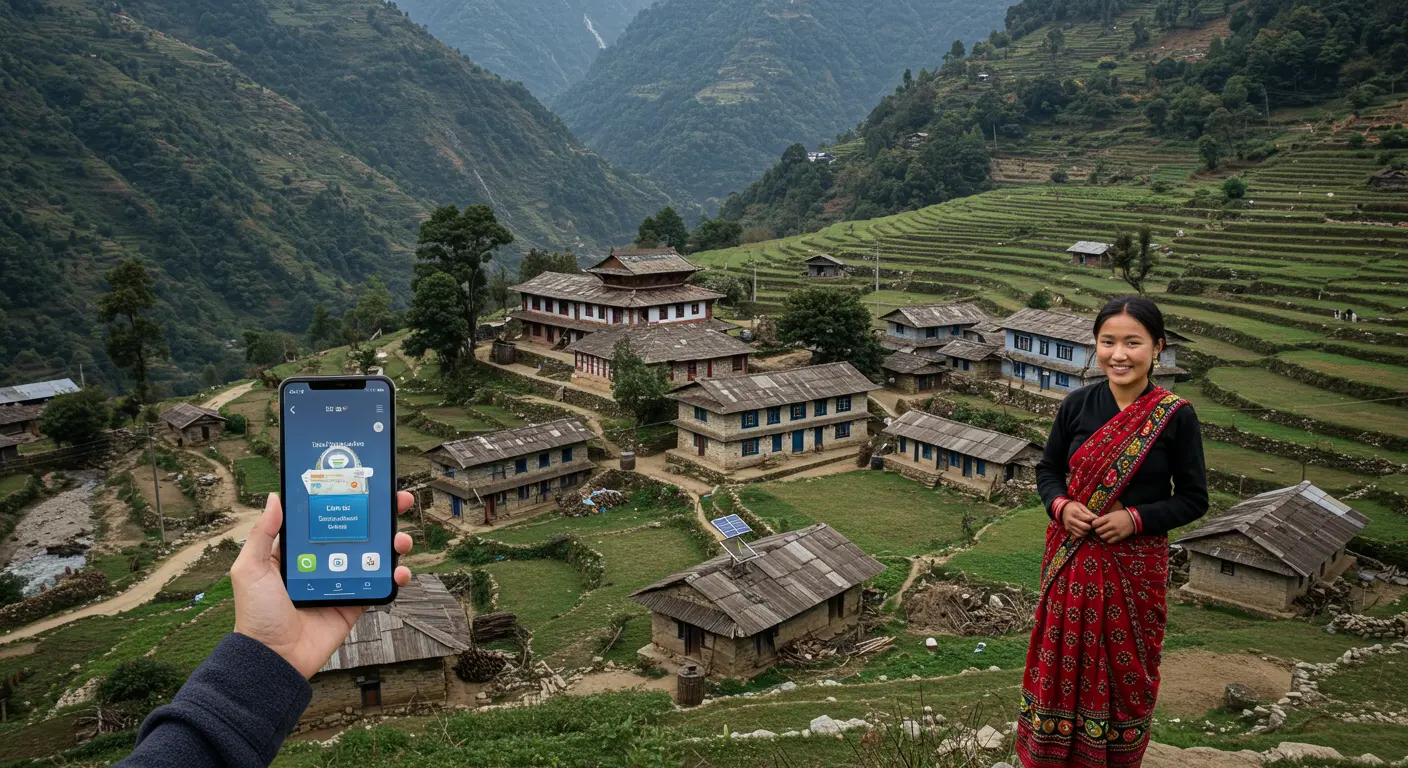
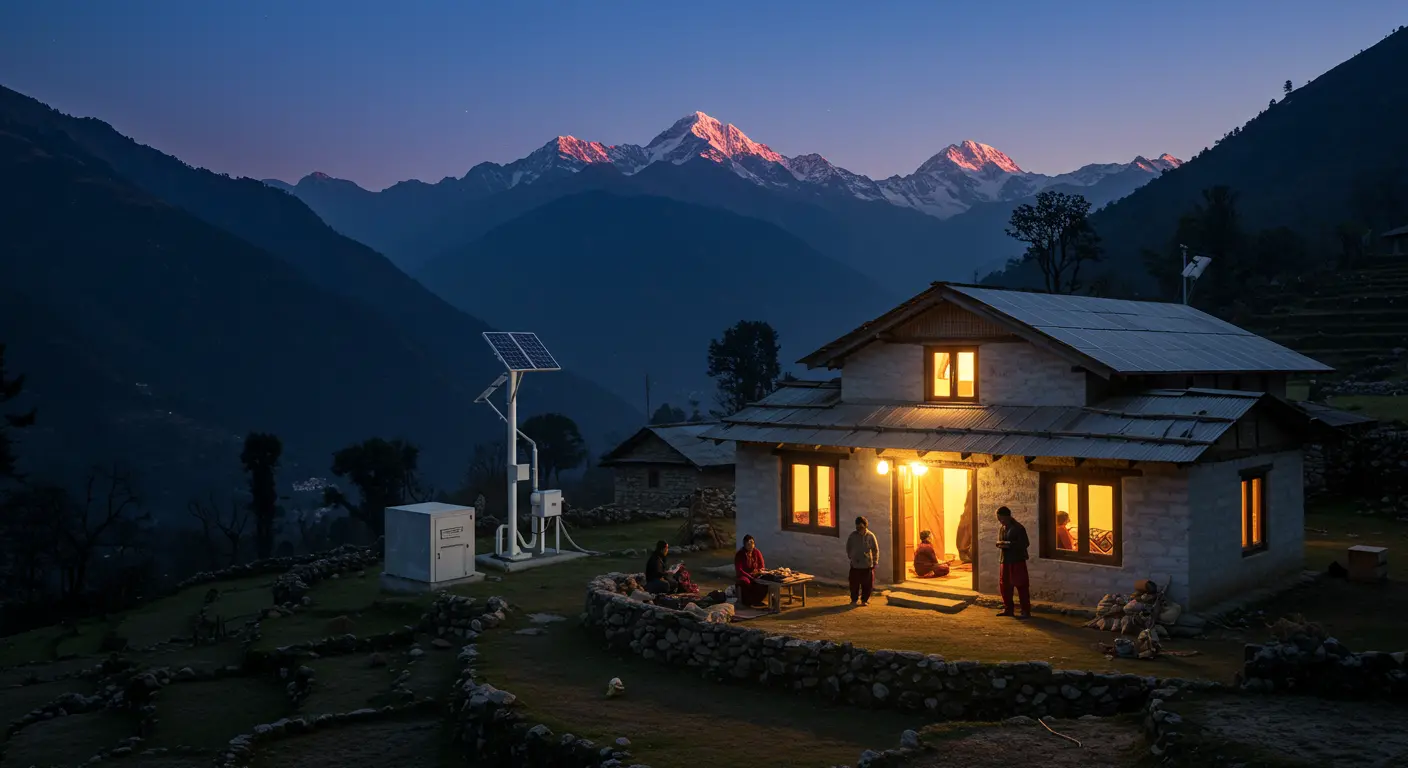
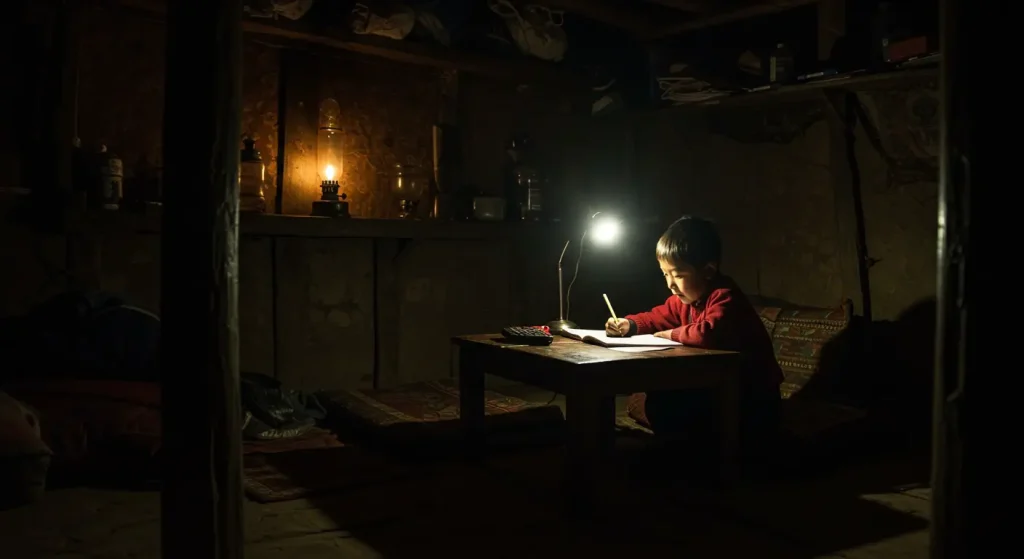
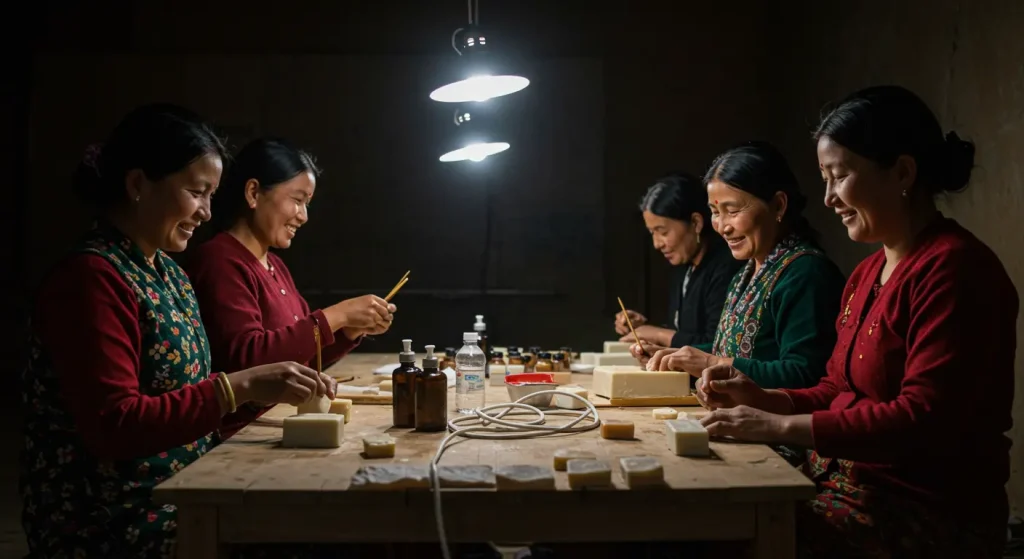
For Pabitra Giri, a widow from Kharbang village in western Nepal, life before 2007 was an endless cycle of toiling on the farm from dawn to dusk. Evenings were spent in semi-darkness, with her cooking dinner by the dim light of a kerosene lamp and her children trying to do their homework, straining their eyes over the flickering flame. Then everything changed. The launch of the local micro hydropower plant (SHP) brought light into her home.1“With electricity, my children were able to study in the evenings, our home was equipped with modern amenities, and I, along with other women from the cooperative, started a small soap making business, providing a stable income for my family’s future,” recalls Pabitra.1
Her story is a shining example of transformation that contrasts with the harsh reality of Nepal’s recent past. Even before 2017, the country was living through a severe energy crisis, with rolling blackouts lasting up to 18 hours a day.2This has paralysed the economy, education and daily life of millions of people. But in the last two decades, Nepal has made a real energy breakthrough. Electrification rates in rural areas, where more than 80% of the population lives, have soared from less than 35% in 2000 to an impressive 93.4% by 2023.2Overall electricity coverage in the country has reached 94%, one of the fastest growing rates in the world.5
This “Nepal Leap” is not the result of giant power plants and central planning. It is the story of a grassroots, decentralized revolution built on two pillars: the energy of small mountain streams, captured by micro-hydropower plants, and the power of the sun, collected by affordable solar panels. Instead of waiting decades for an unreliable national grid, communities faced with its limitations began to build their own, more flexible and resilient energy systems. They made the technological leap, moving straight from kerosene lamps to renewables. It is a story of innovation not just in technology but in governance, financing, and public policy models that have brought energy to the remotest corners of the Himalayas.

The Power of Small Rivers: How Micro Hydropower Plants Became the Heart of Rural Energy
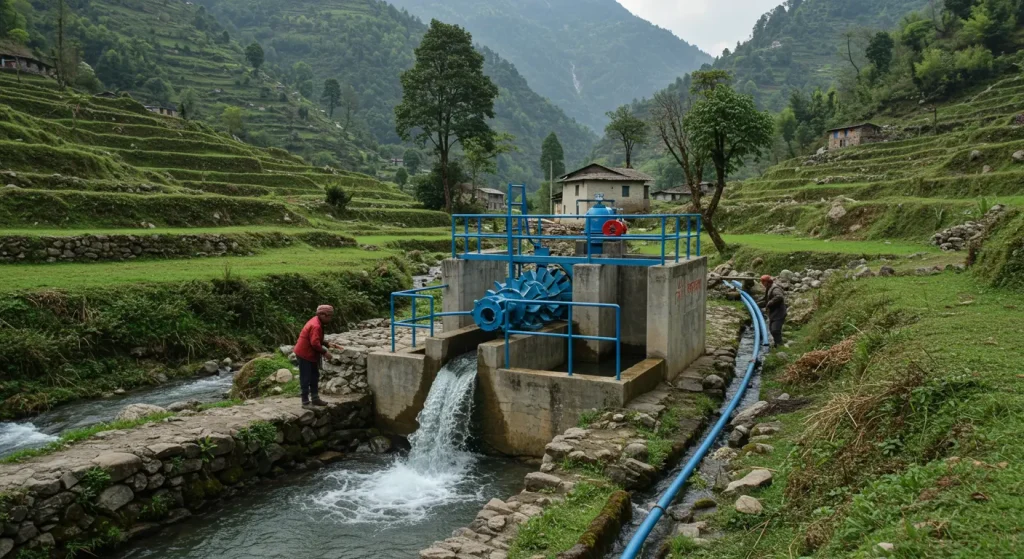
The key to energy independence for hundreds of Nepalese villages has become microhydropower (SHP). In Nepalese conditions, these are installations with a capacity of 10 to 100 kW, which use the energy of small rivers and streams that flow in abundance from the slopes of the Himalayas.7This is not just a technology, but an entire ecosystem built on a unique partnership between the state, international organizations and, most importantly, local communities.
“The Nepal Model”: State as Catalyst, Community as Driving Force
The Alternative Energy Promotion Center (AEPC), established in 1996, plays a central role in this process.9AEPC does not build the plants itself, but acts as a catalyst and coordinator. Its functions include conducting feasibility studies for future projects, providing subsidies and grants, training local personnel to operate and manage the plants, and monitoring the quality of the equipment.8
But the real secret to the success of the “Nepal model” is the principle of community ownership. Micro hydropower plants are built and managed by the villagers themselves. The community is actively involved from the start: contributing free labor during construction, helping to raise funds, and then forming management and operating committees.10This model ensures not only low operating costs, but also long-term sustainability of projects, since people perceive the station as their property and are directly interested in its smooth operation.
Case: Darbhang – the birth of a new economy
The story of Darbhang and five neighbouring villages illustrates the transformative power of this approach. In 2009, the 51 kW Ruma Khola hydroelectric power plant was launched, providing electricity to 700 households.10This event caused a real economic explosion. In four years, 22 new enterprises appeared in the region, where there was almost nothing before: furniture and metalworking workshops, poultry farms, dairy farms and even a noodle factory.10
Behind these numbers are real people’s stories. Lakshmi Rasalli, a 27-year-old woman, was able to open a chicken farm with 300 chickens and a butcher shop. “I wouldn’t have been able to start raising chickens if we didn’t have electricity,” she says.10Brothers Lak and Jug Bahadur Kunwar moved from a nearby village and set up a furniture workshop that now employs seven people. “With the electric machines, the quality of our furniture has improved significantly and we can make more complex designs,” explains Lak Bahadur.10
Socio-economic impact: More than just light
The impact of micro hydropower goes far beyond a single city. Across Nepal, rural electrification has led to profound socioeconomic changes:
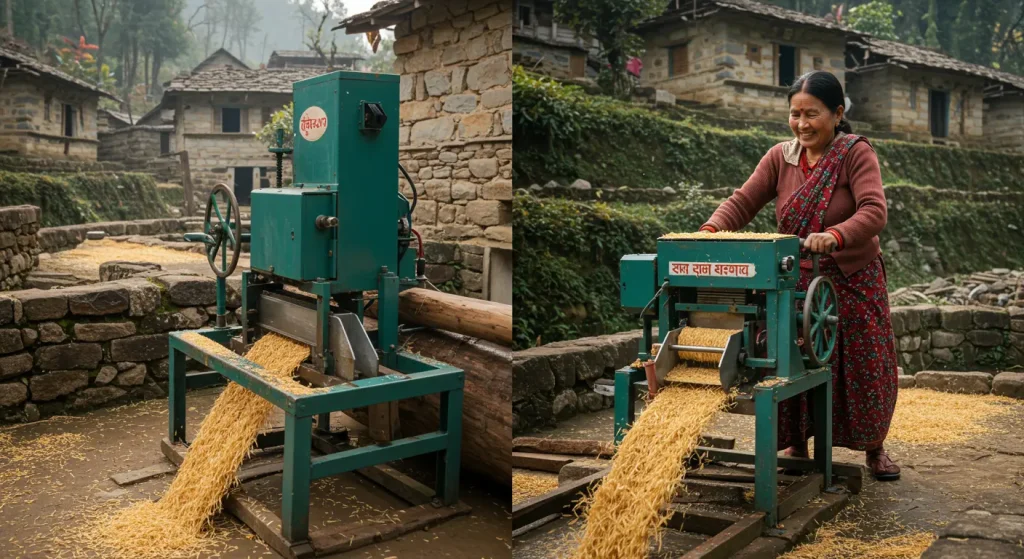
- New jobs and income: Electricity has made it possible to mechanize hard labor (for example, using electric rice mills and sawmills instead of hand ones), extend the working day for small businesses, and create entirely new types of activities, such as mobile phone repair shops. Research shows that more than 75% of residents in electrified villages report an increase in their income.12
- Women’s Empowerment: The advent of electric mills freed women from the grueling, hours-long manual grinding of grain and long trips to traditional water mills. They were able to devote their freed time to education, social activities, childcare and small gardening, which strengthened their economic independence.12
- Education and Healthcare: Children were given the opportunity to do their homework in the evenings in bright and safe light.14Computer labs began to appear in schools, and rural medical centers were able to operate around the clock, use modern equipment, and store vital vaccines in refrigerators.1
- Improving quality of life: Villagers gained access to information via television and the Internet. Street lighting increased safety at night.10The widespread rejection of smoky and unhealthy kerosene lamps and the reduction in the consumption of firewood for lighting have led to improved public health and the preservation of forests.10
Solar Energy: New Hope for the Remotest Places
If micro hydropower plants have become the heart of the energy revolution in Nepal’s hilly regions, solar power has become its universal tool, capable of reaching the most isolated corners of the country. Unlike micro hydropower plants, which require rivers with a certain slope and flow, solar panels can be installed almost anywhere. This makes them ideal for high plateaus, arid plains, and remote settlements where it is not economically feasible to extend either power lines or even a canal for micro hydropower plants.11
The flexibility of solar technology is evident in the variety of solutions being used across Nepal:
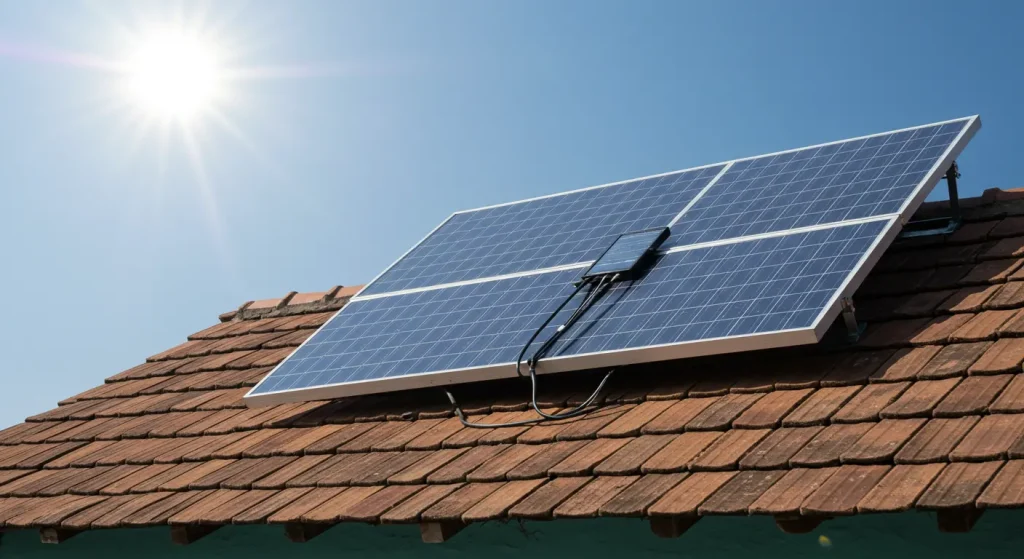
- Solar Home Systems: Small panels with a power of 10 W, designed for lighting a single household and charging mobile phones. They have made a huge contribution to the rapid growth of electrification statistics.6
- Solar Mini-Grids: More powerful installations capable of powering entire villages, schools and medical centers, creating local energy hubs.2
- Solar Water Pumps: A revolutionary solution that simultaneously addresses energy, water and food security issues by providing irrigation for fields and access to clean drinking water.17
- Institutional systems: Targeted energy supply to critical facilities such as hospitals, schools and administrative buildings, ensuring their uninterrupted operation.8
The Nepalese government, with the support of international partners such as the World Bank, which provided a $20 million grant, is actively promoting solar energy development by providing subsidies and incentivizing private investment.19This support enables us to move beyond simply providing light to creating systems that generate income and increase productivity.
Case: Tinghare – agroenergy of the future
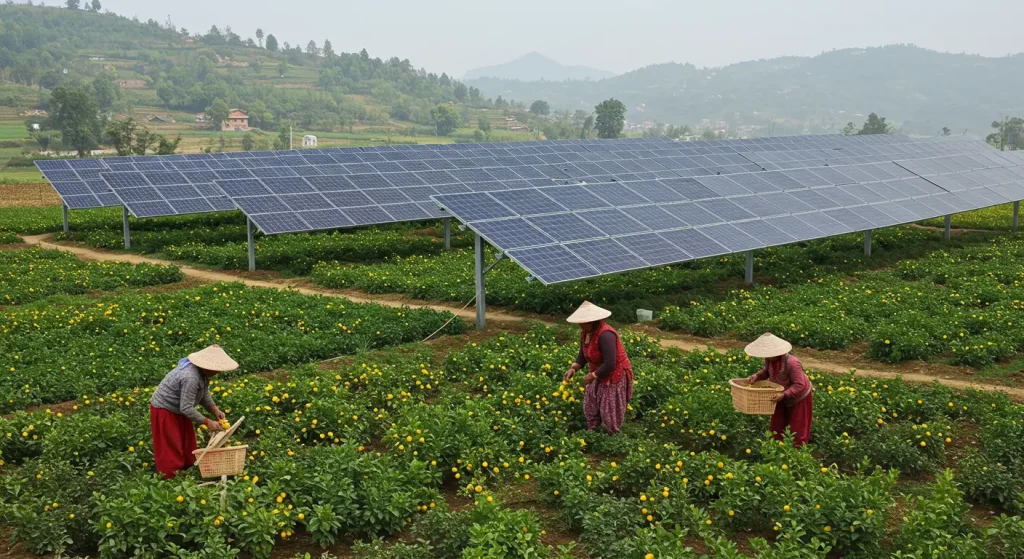
A pilot project in Tinghare village in southern Nepal, implemented by UNDP, AEPC and with financial support from the Government of Japan, is a shining example of such an integrated approach.17A 40 kW solar power plant (consisting of 74 panels) was built here, but its purpose is not just to generate electricity.
The station’s energy powers an integrated system: a pump lifts water from a well into a large reservoir, from where it is filtered and fed into homes and the irrigation network. The project’s uniqueness lies in the concept of agrovoltaics: the land under the tall solar panels does not sit idle, but is used to grow vegetables, fruit and flowers. The system can even be used to distribute fertilizers and seeds.17
The results have exceeded all expectations. The project has provided clean drinking water to over 450 households suffering from water shortages. The local school and maternity centre have received reliable 24-hour electricity supply. The previously abandoned agricultural land has come to life, giving the residents a new source of income – they are already growing lemons and plan to cultivate exotic dragon fruit for sale at the market.17The Tinghara project is an innovation that simultaneously addresses three fundamental development challenges: energy, water and food insecurity, demonstrating a shift from simply ‘access to energy’ to ‘productive use of energy’.
Innovation at the Crossroads: From Competition to Collaboration
As Nepal made progress in decentralized electrification, a paradoxical problem emerged. The national electricity grid, slowly but surely expanding, began to reach villages that had been getting electricity from their own micro-hydro plants for years.11Since the central grid could potentially offer greater capacity and connection to the national grid, many residents chose to switch to it. As a result, the public small hydropower plants, in which huge amounts of money and effort had been invested, began to stand idle, deteriorate, and eventually were abandoned.20
This threat gave rise to one of the most elegant and important policy innovations in Nepal’s energy sector. Instead of treating small hydropower plants and the national grid as competitors, they were forced to work together. AEPC and the Nepal Electricity Authority (NEA) worked together to develop technical standards and policies that would allow small hydropower plants to connect to the grid and sell their surplus power.16
This solution was a win-win for everyone. For the communities that owned the SHPPs, it meant a new, stable source of income that ensured the financial stability of the plant and covered its maintenance costs. For the national grid, it meant additional generation directly in remote areas, reducing transmission losses over long distances and increasing the overall stability of the system.16
Case: Syaurebhumi – a precedent for the entire country
The pioneer in this matter was the 23 kW Syaurebhumi small hydroelectric power station in Nuwakot district. Built in 2013, it was almost immediately threatened with closure due to the arrival of the national power transmission line.20However, thanks to the new policy, in 2017-18 it became the first plant in Nepal with a capacity of less than 100 kW to be successfully connected to the national grid.16
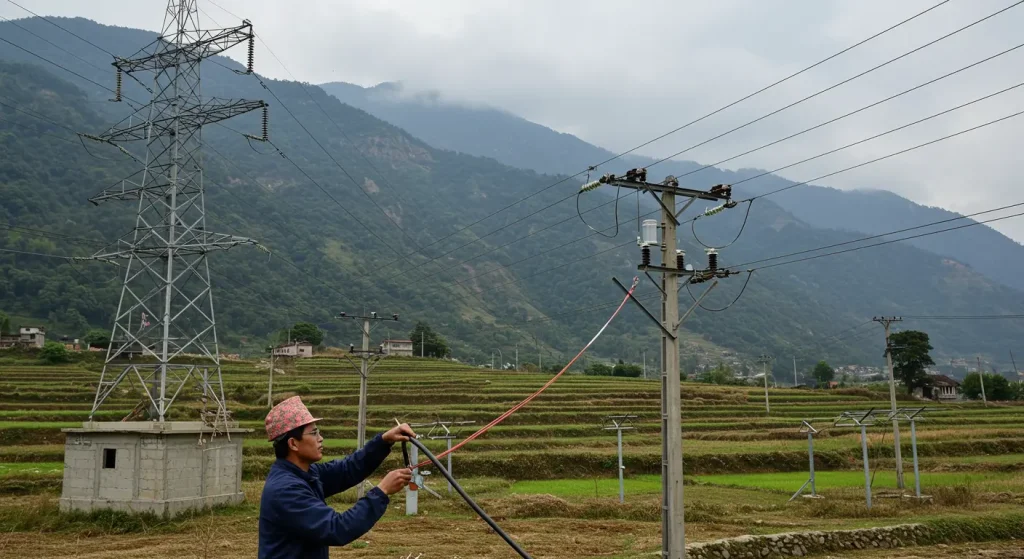
Connecting to the grid literally saved the project. Now the station can export up to 178,245 kWh of electricity per year to the grid, which is estimated to bring in about $10,600 in annual income for the community.16This pilot project, implemented with the support of UNDP, demonstrated that such integration is technically and economically possible and beneficial.
Syaurebhumi’s success paved the way for others. Soon, the 68 kW Jumsa Khola III hydropower plant followed in its footsteps and was also integrated into the grid. Selling surplus power is expected to earn the community up to 200,000 Nepalese rupees (about $1,500) per month, which can be reinvested in local schools, health care, and infrastructure.22This shift from competition to cooperation is a clear example of how political and institutional innovations are sometimes as important as technological ones.
Challenges to 100%: The Last Mile
Despite impressive national progress, Nepal’s journey to full electrification is not yet complete. Success is highly uneven across the country, with the last 5-10% of the population without power representing the greatest challenge – the so-called “last mile problem.”
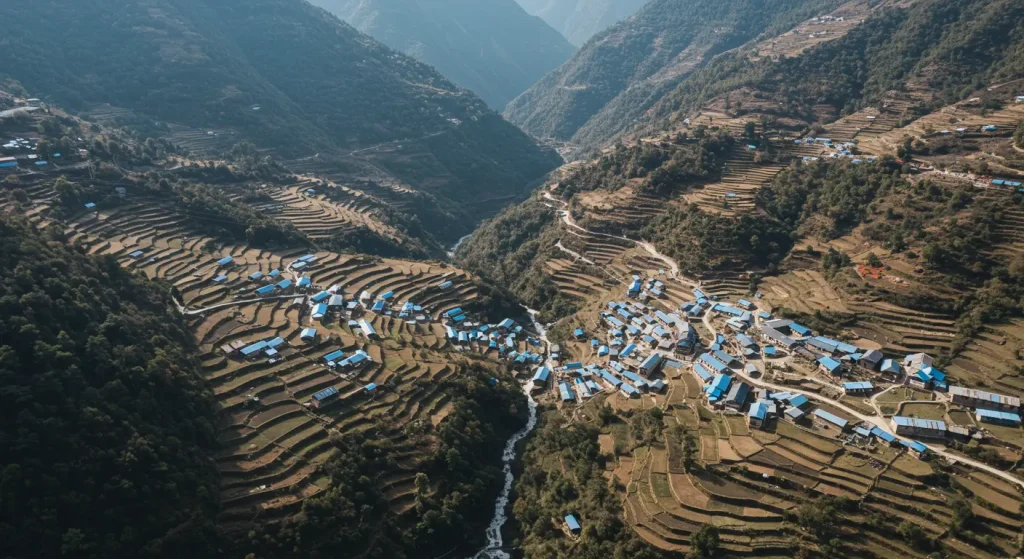
The main challenge is geographical inequality. While most provinces have electrification levels of over 90%, in remote and hard-to-reach western regions like Karnali province, the figure is barely 49.63%.2The reason lies in the harsh mountainous terrain, extreme isolation of settlements and the enormous cost of building any infrastructure. Laying power lines or even building small hydroelectric power plants in such conditions becomes economically inexpedient, and standard “universal” approaches do not work here.2
The second set of problems is related to the long-term sustainability of already created systems.
- Maintenance: Thousands of small hydroelectric power plants built in recent decades are aging and require regular maintenance. Villages often lack skilled technicians, and failure of imported components such as generators or bearings can put a plant out of service for a long time.23
- Low efficiency: Many older plants operate with low efficiency, and the country’s lack of research, development and equipment testing centers slows down technological advancement across the industry.23
Finally, there are significant financial barriers. The World Bank estimates that Nepal will need a huge investment of between $29 billion and $46 billion between 2018 and 2040 to achieve 100% electrification and fully modernize its power system.27The country’s domestic financial market is limited: banks are reluctant to issue long-term loans for energy projects due to high risks, and the stock market is not developed enough to mobilize large capital. Attracting foreign investment, in turn, is difficult due to currency risks and complex bureaucracy.27
To address these issues, the Nepalese government plans to rely on the same technologies that have already proven their effectiveness: small hydroelectric power plants, solar and wind energy, as well as the introduction of hybrid systems and smart grids.2It is these decentralised solutions that should help overcome the “last mile” and bring light to the most inaccessible corners of the country by 2025/26.2

Conclusion: Lessons from Nepal for the World
Nepal’s energy transformation story is not a miracle, but the result of a pragmatic, multi-year, multi-layered approach that can serve as a roadmap for many developing countries. The success of this Himalayan nation rests on three key principles:
- Decentralization and community-based: Instead of waiting for decisions from above, Nepal has transferred power, responsibility and, most importantly, ownership of energy assets to the local level. This has created a sense of ownership and ensured the long-term sustainability of the projects.
- Technological flexibility: Nepal did not rely on one technology. It used a portfolio of solutions, using micro hydro where there was water and solar panels where there was sun, adapting the technology to the local context.
- Political adaptability: Faced with new challenges such as competition between local and national grids, the country’s energy sector has demonstrated its ability to change the rules of the game, turning threats into opportunities for all participants.
Nepal’s experience proves that mega-projects and billion-dollar centralized investments are not always needed to electrify remote regions. Often, it is more effective to support local initiatives, combine different technologies, and create a flexible regulatory environment.
Nepal’s journey to 100% electrification is not yet complete, and it faces significant challenges along the way. But its innovative spirit, powered by the power of small rivers, the sun, and above all, the energy of its people, is already lighting the way not only for its own citizens, but for the world. After all, energy is more than just kilowatt-hours on the books. It is the foundation for human dignity, education, health, and economic prosperity.drive to save every life – offer a powerful and inspiring example for other vulnerable nations around the world.21
[elementor-template id=”1573″]
Source used
- Lighting Up Lives in Nepal’s Mountains
- Rural Electrification in Nepal: Progress and Challenges – Nepal …
- Energy for Off-grid Villages in Nepal and The Role of Minigrids
- Nepal – Access To Electricity, Rural (% Of Rural Population) – 2025 Data 2026 Forecast 1990-2023 Historical
- Nepal Electricity Access | Historical Chart & Data
- 95.5 percent of Nepalis have an electricity connection, report says
- Micro Hydro-AEPC
- Mini/Micro Hydro – Alternative Energy Promotion Centre
- Alternative Energy Promotion Centre
- Renewable Energy Powers Rural Nepal Into the Future
- In Afghanistan, Bhutan and Nepal, Off-Grid Renewables Bring Power to Remote Villages
- Socio-economic impact of renewable energy-based power system in mountainous villages of Nepal
- Socio-economic and environment impact on small hydro power project in Nepal
- Socio-economic impacts of a micro-hydropower plant on rural livelihoods
- Micro Hydro transforms rural lives in Nepal
- Power to the people: Breakthrough in micro-hydro prospects
- Nepal: Transforming Lives with Agrovoltaic Farming
- Build Resilient Communities With Solar in Nepal
- Nepal solar power grant: $20 Million for Extraordinary Energy Expansion
- IMPACT OF PRACTICE-TO-POLICY DIALOGUE: NEPAL’S FIRST GRID INTERCONNECTED MICRO HYDRO PROJECT
- 分类: Grid Interconnectivity – Hydro Empowerment Network
- Jhumsa Khola III Micro Hydro Project: A Community Energy Enterprise Successfully Integrated into Nepal’s National Grid
- Present status and technical challenges of micro hydropower plants in Nepal
- Micro-Hydropower in Nepal: Analysing the Project Process to Understand Drivers that Strengthen and Weaken Sustainability
- Problems identification and performance analysis in small hydropower plants in Nepal
- Technical Problem Analysis of Micro Hydro Plants: A Case Study at Pokhari Chauri of Kavre District
- NEPAL – Energy Infrastructure Sector Assessment – World Bank …
- Applications of smart grid technology in Nepal: status, challenges, and opportunities
- Alternative Energy Promotion Centre