
Nepal at IT crossroads
Nepal, a country of majestic Himalayas and ancient culture, is on the cusp of a technological transformation. With all the ingredients for success in the global digital economy – a young, ambitious and English-speaking population, low skilled labor costs, and a strategic geographic location between two tech giants, India and China – the country has a unique opportunity to make an economic leap. The global trend towards digitalization and the growth of the IT outsourcing market opens an unprecedented window of opportunity for developing countries, allowing them to integrate into global value chains without the need for large-scale industrial investments.1
But between the Nepalese government’s ambitious declarations and the harsh reality lies a chasm. This article explores why dreams of technological breakthroughs are systematically dashed by poor governance, political instability, and a lack of coherent strategy. At the center of our analysis is the story of the Kavrepalanchok IT Park. Built at great expense more than two decades ago, it remains empty, a silent monument to lost opportunities and dashed hopes.

Why did this multi-million dollar project, intended to be the flagship of Nepal’s IT industry, become a ghost town? The answer reveals deep systemic problems that are holding back the country’s entire tech industry. We analyze the tech park’s failure as a symptom of broader problems, assess the disconnect between progressive policies on paper and barriers in practice, explore the phenomenon of a hidden IT economy that thrives despite, rather than because of, government support, and finally offer a concrete roadmap for reform. Drawing on the successful experiences of neighboring countries, we show how Nepal can turn its enormous potential into reality by moving from empty buildings to a vibrant, policy-proof tech ecosystem.
A Symbol of Unfulfilled Hopes: The History of the IT Park in Kavrepalanchok
The story of the Kavrepalanchok IT Park, just outside Kathmandu, is more than just a tale of infrastructure failure. It is a chronicle of systemic failure, demonstrating why good intentions and even significant investment fail in an environment of political instability and the absence of the rule of law.
The project was completed back in April 2003, with a cost of 270 million Nepalese rupees (about 2 million US dollars at the exchange rate at that time).2This highlights an important fact: the problem was not a lack of initial investment, but a complete failure of subsequent management and operation. The history of the park is a series of failures, each one deeper than the last.
The first failure occurred almost immediately. The American corporation IBM, which formally initiated the launch of the park, left the project just nine months after its completion.2Shortly after, Dutch company Javra Software came to the park, but it didn’t stay long either. Citing unspecified “technical reasons,” the company left the park and moved its operations to Kathmandu.2These early failures already signaled serious problems with the infrastructure support, management or general business environment within the park.
The most spectacular and devastating failure, however, occurred only recently. After more than 14 years of virtual inaction, hope began to glimmer in 2021. The government signed a memorandum of understanding with a consortium consisting of the respected Kathmandu University (KU) and two private Nepalese IT companies, Cloud Himalaya and Soft Tech Foundation.3The plan was simple and logical: the university would develop educational and research programs on the park’s basis, and private companies would locate their operations, creating jobs and export revenue. It seemed that a working model of public-private partnership had finally been found.

However, this optimism was short-lived. Soon after the agreements were signed, then Prime Minister K. P. Oli personally gave a “direct order” to stop all work.3The decision was based on the “bizarre” fear that if the consortium successfully occupied the three blocks allocated to it, it might eventually demand the rest of the park, according to people familiar with the matter.3This arbitrary act of intervention, based not on law or policy but on the personal fears of the official, ruined the almost-implementation of the park. As Professor Manish Pokharel of Kathmandu University put it, the decision “destroyed their plans and programmes” and they have “remained silent” ever since.3
This case demonstrates that the failure of the IT park is not the result of passive neglect or oblivion. It is the result of active, unpredictable and destructive state intervention. For any investor, both local and foreign, the risk of active sabotage by the authorities is a much stronger deterrent than the risk of bureaucratic delays or lack of support. It is evidence of a deep systemic failure of governance, where there are no guarantees and protection from the voluntarism of officials.
As a result, the Kavrepalanchok IT Park has become a “toxic asset.” Each failed attempt to launch it—with IBM, Javra Software, and now Kathmandu University—has become public knowledge, reinforcing the narrative in business circles of Nepal as a highly risky jurisdiction for long-term tech investment. As Shekharnath Dulal, a member of the Computer Associations of Nepal (CAN Federation), aptly puts it, “Whoever comes with the intention of working on this, they leave because of the government’s lackadaisical approach.”3The park’s empty buildings today are not just a lost opportunity. They are active negative advertising that scares away new investors and undermines confidence in any future government initiatives in the high-tech sector. “The status quo is due to government inaction. This is a huge loss for the IT sector,” the expert concludes.3
Policy on paper and barriers in practice

When examining Nepal’s IT and investment legislation, one gets the impression that the country is actively seeking to create the most favorable conditions for business. However, this progressive façade stands in stark contrast to the reality of bureaucratic hurdles, political risks, and non-enforcement of its own laws.
Nepal’s IT ambitions are not new. The IT Policy 2000 set a goal to “place Nepal on the global IT map” within five years.5This document declared IT as a priority sector and envisaged a wide range of measures: the creation of technology parks, the attraction of private investment, the development of human capital, the computerization of government agencies, and even the construction of a national “info-super highway.”5Subsequent documents, including the ICT Policy 2015, have only confirmed and expanded these intentions, setting targets to achieve 90% broadband penetration and increase the share of ICT in GDP to 7.5% by 2020.7
The current regulatory framework, in particular the Foreign Investment and Technology Transfer Act of 2019 (FITTA), looks even more attractive to investors.8The law offers a number of incentives:
- Tax holidays: Companies established in Special Economic Zones (SEZs) can receive a full exemption from profit tax for up to five years, while IT services exporters can receive a 50% tax discount on export income.10
- Customs privileges: Duty-free import of equipment, machinery and raw materials necessary for production is provided.10
- Simplification of procedures: The government has established a One Stop Service Centre and enshrined in law a promise to process foreign direct investment (FDI) applications within seven days.9Moreover, an “automatic” online route for approving investments of up to NPR 500 million (approx. USD 37.6 million) was introduced in October 2023. Notably, the minimum investment threshold for the IT industry using this channel was waived, which was meant to send a strong signal to startups and small businesses.9
In practice, however, this carefully constructed façade crumbles. Investors are confronted with a reality where laws do not work and promises are not kept.
- Bureaucracy and corruption: Despite the declarations of a “single window,” the permitting process remains complex and opaque, requiring approvals from multiple agencies. This creates fertile ground for delays and corruption. It is no coincidence that Nepal ranks low, 108th out of 180, in Transparency International’s Corruption Perceptions Index.9
- The gap between policy and implementation: The story of the Kavrepalanchok IT Park is a textbook example of this disconnect. The government can declare support for IT at the highest level, but in practice act contrary to its own laws and strategies, canceling already signed agreements at the whim of one person.3
- The main barrier is political risk: This is the key problem, which outweighs any tax incentives. Frequent changes of government and the lack of institutional continuity mean that the rules of the game can change at any moment. Investors, especially foreign ones, cannot engage in long-term planning in such an environment.3
What we are witnessing in Nepal, then, is what we might call “policy schizophrenia.” There is a façade of modern, pro-investment laws that, on paper, look as good as those in the region’s most successful countries. Behind this façade is an archaic, unpredictable, and manually managed system where personal connections and political loyalty matter more than the law. This creates cognitive dissonance among investors: they see attractive terms, but hear from experts and see in real-life examples that these terms do not guarantee anything. Nepal’s problem is not the absence of good laws, but the absence of the rule of law and strong, independent institutions capable of enforcing them. Investors are not afraid of laws, but of lawlessness.
Hidden Giant: The Real Scale and Problems of IT Export

Behind the facade of official statistics and failed government projects, Nepal has a vibrant but largely invisible IT sector. Its true size is likely much larger than government estimates, but it faces fundamental challenges that are holding it back from evolving from a cottage industry into a full-fledged high-tech industry.
The first thing that strikes you when analysing Nepal’s IT exports is the huge discrepancy in the numbers. On the one hand, there are the official figures. For example, a study by the Institute for Integrated Development Studies (IIDS) found that IT services exports reached US$515 million in 2022, showing an impressive 64.2% growth compared to 2021.13However, data from the Nepal Central Bank (NRB) for the first seven months of the 2024/25 fiscal year shows a much more modest figure of about US$92 million from software and telecom services exports.15
On the other hand, there are estimates from market participants themselves. IT entrepreneurs and industry experts unanimously claim that the real annual export volume is no less than 1 billion US dollars.15The reason for this stark discrepancy lies in the structure of the IT sector and the way it is paid. Much of the industry consists of thousands of freelancers and small companies who work directly with overseas clients. To avoid complex bureaucracy, bank fees, and taxes, they are paid not as income from the export of services, but as private remittances from relatives or through unofficial channels.15
This massive “gray” economy has two devastating consequences. First, it creates strategic blindness of the government. Without accurate data, officials underestimate the real contribution of the IT sector to GDP and its potential. As a result, the industry does not receive due attention, priority in state policy and adequate funding. Secondly, the state budget is missing out on millions of dollars in tax revenue, which could be reinvested in the development of critical infrastructure and education.15
This hidden growth occurs despite, not because of, and is constrained by a number of fundamental challenges:

- “Brain Drain”: This is the most acute and existential threat to Nepal’s IT industry. It is estimated that about 10% of IT graduates leave the country every year in search of better opportunities.16In 2024 alone, 1.674 million people left Nepal to travel abroad.17The reasons are obvious: low salaries (the average annual salary of an IT specialist in Nepal is about US$7,200), lack of clear career prospects, chronic political instability, corruption, nepotism in employment, and the dismal state of infrastructure.16
- Infrastructure deficit: Unstable electricity supplies and slow, unreliable internet are major obstacles to the development of the digital economy. The problem is particularly acute outside the Kathmandu Valley, where only 14% of rural areas in the country have internet access.16
- Skills Gap: Despite the large number of graduates, their training often does not meet the requirements of the modern IT market. Educational programs at universities are focused on theory and do not keep up with rapid changes in technology.1As a result, 72% of IT companies in Nepal have difficulty finding qualified candidates in the local market, according to an IIDS study.16
These problems are closely interrelated and create a vicious cycle. IT professionals and companies go underground because the formal system is inefficient and unprofitable. This prevents the government from seeing the true scale of the sector and investing in its development. Lack of investment in infrastructure and education makes working in Nepal unattractive for the best talent, causing a brain drain. The remaining companies face a talent shortage and weak infrastructure, further pushing them to remain in the grey zone to survive.
Ultimately, Nepal finds itself in a paradoxical situation. Instead of exporting high-tech products and services, creating added value and intellectual property at home, it unwittingly exports its most valuable resource: human capital. In return, the country receives only remittances, which are mostly used for consumption rather than investment in development.15This model perpetuates economic backwardness. The strategic transition from labor export to digital services and products export is a key task that requires immediate and decisive action.14
The Path to Reality: From Technopark to Techno-Ecosystem
The challenges Nepal faces are not unique. Neighbouring countries like India and Bangladesh have faced similar challenges – bureaucracy, lack of infrastructure and the need to boost exports. However, they have found effective solutions, creating working models that have turned their IT sectors into powerful drivers of economic growth. Nepal does not need to reinvent the wheel – it just needs to learn and adapt time-tested approaches. The key to success lies in a paradigm shift: from building isolated “boxes” (technopark buildings) to creating a holistic, dynamic and, most importantly, politically immune technology ecosystem.

Proposal 1: Create an autonomous governing body based on the STPI and BHTPA model
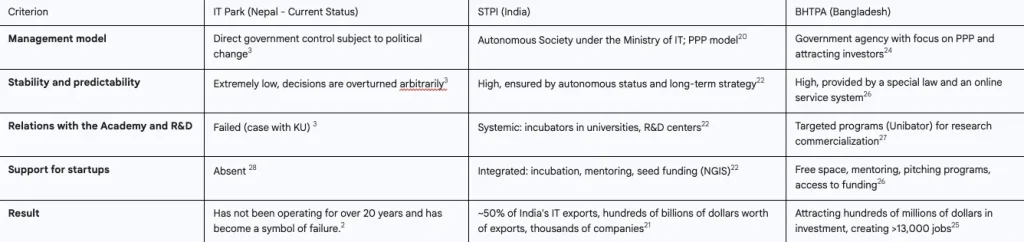
Direct government control over the IT park in Kavrepalanchok has proven to be completely ineffective and destructive.3Any long-term plans can be destroyed by a single stroke of an official’s pen. To break this vicious circle, it is necessary to create an institutional “shield”.
Solution: Establish on the basis of a special law“Nepal Hi-Tech Park Authority” (NHTPA). This should be an independent, autonomous body with a board that will include representatives of relevant ministries, leaders of private IT businesses, and representatives of leading technical universities. Such a structure will ensure a balance of interests, continuity of policy, and professional management.
Role models:
- India – Software Technology Parks of India (STPI): Set up in 1991 as an “autonomous society” under the Ministry of Electronics and Information Technology, STPI became the catalyst for the Indian IT miracle.20STPI acts as a single window for exporters, providing ready-made infrastructure, incubation services, mentoring and market access. STPI-registered companies account for about 50% of India’s total IT exports, which run into hundreds of billions of dollars.22Importantly, STPI has established 67 centres across the country, 59 of which are in small and medium-sized cities (Tier-II/III), promoting decentralization and inclusive growth.22
- Bangladesh — Bangladesh Hi-Tech Park Authority (BHTPA): Established in 2010, BHTPA is a key government body responsible for the development of the IT industry.24The Authority provides investors with comprehensive incentive packages (tax and customs benefits), has created a one-stop online portal for 148 different services, is actively developing innovation hubs and incubators at universities (the Unibator program), and has already helped create more than 13,000 jobs and attract hundreds of millions of dollars in investment.25
The creation of such an autonomous body in Nepal will help to gain the trust of investors, ensure stability of the “rules of the game” and move from chaotic one-off actions to the systematic and professional development of the entire IT ecosystem.
Table 1: Comparative Analysis of Technology Park Management Models: Nepal, India and Bangladesh
Proposal 2: Build an ecosystem, not just infrastructure
Having a modern IT park building does not create value in itself if it is isolated from three key components: talent, business and capital. The future NHTPA should focus not on building but on creating connections between these components.
Solution:
- Integration with universities: The idea of partnership with Kathmandu University and other leading universities should be revived. R&D centers, laboratories and business incubators of universities should be located on the basis of the IT park. NHTPA should finance joint educational programs, internships and projects to reduce the gap between academic knowledge and industry requirements.16
- Incubation and acceleration: A full-fledged world-class business incubator should be created on the territory of the park. It should provide startups not only with office space, but also with comprehensive support: mentoring programs, legal and accounting advice, assistance in entering international markets and access to seed funding. Models of the Indian Next Generation Incubation Scheme (NGIS)22and the Bangladesh Startup Support Program27can serve as an excellent example.
- Providing basic infrastructure: This is the hygienic minimum. NHTPA must guarantee park residents uninterrupted power supply (possibly through their own solar panels and generators) and high-speed, reliable Internet access at competitive prices. Without this, no serious IT company can operate.14
Proposal 3: Income Laundering and Closing the Data Gap
The “gray” economy of IT freelancers and small companies is not a cause, but a consequence of an unfriendly and complex regulatory environment.15To bring this sector out of the shadows, it is necessary to offer it a profitable and simple alternative.
Solution: Develop and implement a special tax regime for IT service exporters. Instead of complex administration of income tax and VAT, a “tax amnesty” can be offered for those who legalize their income, and a simple, low turnover tax can be introduced (for example, 1-2%). The registration and reporting procedure should be simplified as much as possible and completely transferred online.
Expected result: This step will achieve two goals simultaneously. Firstly, the government will receive much more accurate data on the real volume of IT exports, which will allow it to make informed strategic decisions. Secondly, the budget will receive additional tax revenues. For the companies and freelancers themselves, legal status will open access to bank loans, state support programs and, importantly, to large international corporate clients who do not work with “gray” contractors.
Proposal 4: Turning the “brain drain” into a “talent circulation”
It is impossible to stop the emigration of talented specialists in the near future; this requires years of stable economic growth and improved quality of life.16Instead of struggling in vain against this phenomenon, we need to learn to work with it and benefit from it.
Solution:NHTPA should launch a comprehensive programme to work with the Nepali IT diaspora to turn the “brain drain” into “circulation of talent, ideas and capital”.
- Remote mentoring and expertise: To create a database of successful Nepalese IT professionals working in leading global companies and engage them as remote mentors, consultants and lecturers for startups and students in Nepalese incubators.
- Diaspora investment funds: Encourage the establishment of venture capital funds focused on investing in Nepali IT startups, with capital from the diaspora. The government can act as a co-investor in such funds to reduce the risks for private investors.
- Programs for “digital nomads”: Develop a special visa and tax program to attract Nepalese working remotely for foreign companies. By offering them favorable conditions, you can motivate them to live and spend their earnings in Nepal, while simultaneously participating in the life of the local IT community.
This approach will make it possible to use the knowledge, experience and financial resources of the diaspora to accelerate the development of the IT sector within the country, turning one of the main problems into a valuable resource.
Conclusion: From Dream to Roadmap
Nepal’s dream of a tech-future, symbolized by the Kavrepalanchok IT Park, remains elusive. But the reason is not a lack of talent, money, or ambition. It lies deeper, in the fundamental flaws of the country’s governance system: chronic political instability, the absence of the rule of law, and a strategic blindness that prevents it from seeing the real potential behind distorted statistics. The tech park, empty for more than two decades, is not the root cause, but the most vivid and painful symptom of this systemic disease.

The analysis shows that attempts to revive the IT sector with targeted measures or yet another declaration are doomed to failure. A change of the entire paradigm is necessary. The government must stop being an unpredictable and capricious controller, interfering in business processes at its own discretion. Its role is to become a predictable, reliable and effective facilitator, creating conditions in which private initiative can flourish.
This requires a bold and far-sighted political decision: delegating the responsibility for developing the IT ecosystem to a new, truly independent, professional and empowered body, modeled on successful agencies in India and Bangladesh. Such a body should be protected from political storms and focused on long-term strategy rather than short-term interests. Its task is not to build walls, but to build bridges: between universities and businesses, between startups and investors, between the gray economy and the legal field, between Nepal and its global diaspora.
If Nepal continues on its current path, its IT sector will continue to grow in spite of itself, in the shadows, losing its best minds and missing out on a historic opportunity for technological breakthrough. However, if the reforms proposed in this study are implemented, the country will be able to turn its latent potential into a real and powerful driver of economic growth within 5-10 years. And then the Kavrepalanchok IT Park can finally become what it was meant to be – a symbol not of failure, but of long-awaited renaissance.ost valuable resource for the 21st-century global economy. have every chance of conquering it.
Source used
- Nepal Development Update, April 2024: Nepal’s Economy on a Recovery Path but Private Investment Remains Low
- Information Technology Park, Nepal – Wikipedia
- 14 years on IT Park still not functional – myRepublica – The New York …
- 14 years on IT Park still not functional – myRepublica
- IT Policy in Nepal | PDF | Information Technology | Infrastructure – Scribd
- Technology and IT Policy of Nepal
- National Information and Communication Technology Policy, 2015 Ministry of Information and Communication, Government of Nepal, S
- Foreign Investment in IT/Tech Sector of Nepal | TCN
- 2024 Investment Climate Statements: Nepal – State Department
- Foreign Direct Investment and Company Incorporation in Nepal: What’s Allowed
- Foreign Investment in IT Sector in Nepal – Imperial Law Associates
- Nepal – Introduced automatic route for foreign investment approvals up to $ 38 million
- INFORMATION AND COMMUNICATION TECHNOLOGY – Investment Board Nepal
- Unleashing it: advancing Nepal’s digital economy – Institute for Integrated Development Studies
- IT Exports: Nepal Rastra Bank and entrepreneurs clash over true figures
- The Exodus of Minds: Nepal’s Brain Drain in STEM Fields – A Data-Driven Analysis
- Breaking The Cycle Of Brain Drain – The Rising Nepal
- Tackling the Brain Drain Trend in Nepal: Causes, Impact, and Solutions
- No computers and fresh air. How they study in Nepal – Tina Kandelaki
- Software Technology Parks of India (STPI) – Digital India | Leading the transformation in India for ease of living and digital economy
- Software Technology Parks of India – Wikipedia
- About STPI | Software Technology Park of India
- About Software Technology Parks of India (STPI)
- Bangladesh High-Tech Park Authority (BHTPA)
- About-us – Bangladesh Hi-Tech Park Authority
- Hi-Tech-Park-of-Bangladesh-for-Investment.pdf
- Development Activities – BHTPA – Bangladesh Hi-Tech Park Authority
- IT Park – NASC Document Management System
- Rethinking Bangladesh’s hi-tech parks – The Daily Star