Vision of a “New Nepal”
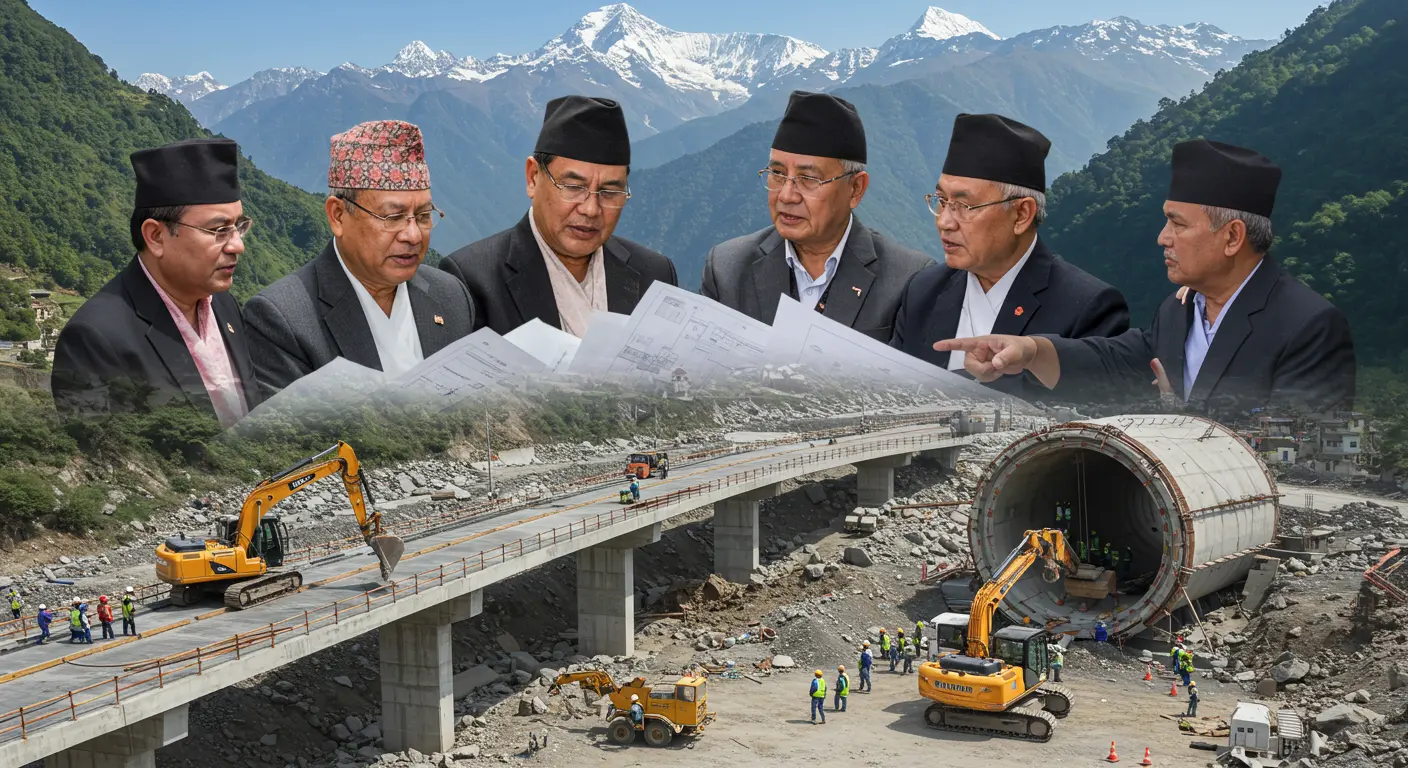
In the heart of the Himalayas, a grand nation-building project is unfolding. Nepal, a country that has survived a decade of civil conflict and a devastating earthquake, is now seeking to rewrite its destiny. This ambition is embodied in a national development strategy with the inspiring slogan “Prosperous Nepal, Happy Nepalis.”1Central to this strategy are infrastructure megaprojects, officially called “National Pride Projects.”3These are not just concrete and steel; they are powerful symbols of the nation’s quest for economic independence, modernization and a final break with the country’s legacy as being caught between two giants.
The scale of these plans is astounding: new international airports are being built, trans-Himalayan highways and railways are being designed, giant hydroelectric power stations are being erected that are capable of not only providing energy to the entire country, but also exporting its surplus.3These projects are intended to be engines of economic growth, creating jobs, improving transport connectivity and opening up new opportunities for trade and tourism. But behind this façade of national revival lies a complex and ambiguous reality.
The central questions this article seeks to answer go to the heart of the decision-making process. Who actually has the power to launch these multi-billion dollar initiatives? Are these decisions based on sound economic calculations or driven by short-term political expediency and geopolitical considerations? And what is the ultimate price paid by the fragile ecology of the Himalayas and the local communities that stand in the way of progress? Analyzing these questions helps us understand who is shaping Nepal today and how, for decades to come.
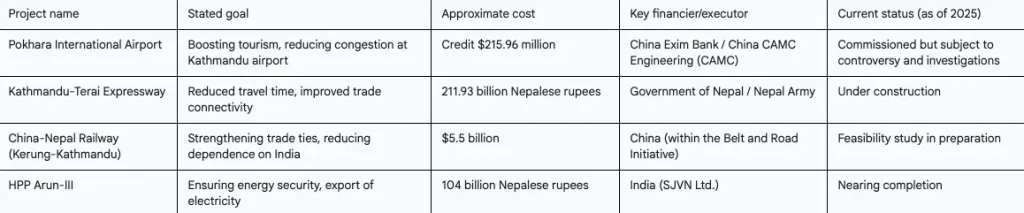
Table 1: Brief overview of Nepal’s flagship mega projects
Architects of Ambition: Whose Hands Are the Blueprints?
To understand how megaprojects are born and implemented in Nepal, it is necessary to analyze the internal power structure responsible for their approval and implementation. Far from being a linear and transparent model, the process is a complex system of overlapping powers, where technical expertise often gives way to political interests.
Designers and Controllers: A Fragmented System
At the top of the planning hierarchy is National Planning Commission (NPC)This highest advisory body is responsible for formulating periodic national plans such as the Fifteenth Plan and formulating an overall vision for the country’s development.2It is the NPC that plays a key role in conceptualising and selecting National Pride Projects, assessing their alignment with long-term national goals.7
However, when it comes to large foreign investments, another powerful player comes into the picture – Investment Board of Nepal (IBN) Designed as a single window for investors, IBN is mandated to approve foreign direct investment of over NPR 6 billion and hydropower projects of over 200 MW capacity.8This gives him enormous power over projects like Arun-III, Upper Karnali and Western Seti.8
In practice, this two-tier system is inefficient and confusing. The decision-making process is not consistent: a project conceived by the NPC requires IBN approval if there is significant foreign investment, but the final decision often rests with the Cabinet of Ministers, headed by the Prime Minister.7This creates a system with multiple veto points and overlapping functions. For example, to implement a single hydroelectric project, a developer may need to study 36 different laws and interact with 23 departments and at least 7 ministries.10
This institutional fragmentation is exacerbated by chronic political instability. Frequent changes of government lead to policy disruptions, reprioritization, and excessive politicization of project decision-making.5As a result, the system that should ensure careful selection and efficient implementation of projects is in fact a source of delays, cost overruns, and corruption risks. The decision-making structure itself, not just the actions of individual officials, is one of the root problems hampering infrastructure development in Nepal.
Performers: The Rise of the Development Army
The army occupies a special place in the implementation of Nepal’s infrastructure strategy. The government has entrusted Nepalese Army managing the construction of the strategically important 71-km Kathmandu-Terai Expressway (Fast Track).12The official rationale for this decision is the army’s reputation for delivering complex projects in difficult terrain in a timely and cost-effective manner, and its high level of trust compared to civilian agencies.14
However, even under the army’s control, the project has faced serious challenges. Its completion date has been pushed back from 2021 to 2027, and the cost has increased from 175 billion Nepalese rupees to more than 211 billion Nepalese rupees.13It is important to note that the army acts as a manager, while the actual construction is carried out by contractors, including six Chinese companies.16
The transfer of such a large civilian infrastructure project to the military sends a powerful signal and, indeed, a symptom of a systemic failure of governance. This move reflects a deep mistrust of the ability and integrity of civilian government bodies to manage large-scale construction without corruption and delays. This decision closely intertwines national development with national security, giving the project the status of a matter of national prestige and strategic importance.
The question naturally arises: does a military-led project operate with the same level of public transparency and accountability as a project led by a civilian ministry? While this approach may seem pragmatically justified in achieving the objective, it carries the risk of “securitizing” the development and potentially shielding the project’s governance from strict public and parliamentary scrutiny. For a decision analysis report, this is a key aspect that requires attention.
Geopolitical Chessboard: Funding Dreams and Building Alliances
Megaproject decisions in Nepal are not made in a vacuum. They are closely linked to global and regional geopolitical processes. External forces and funding mechanisms often determine not only which projects will be implemented, but also under what conditions, turning infrastructure into an instrument of big politics.
A Tale of Two Giants: Infrastructure as a Battlefield
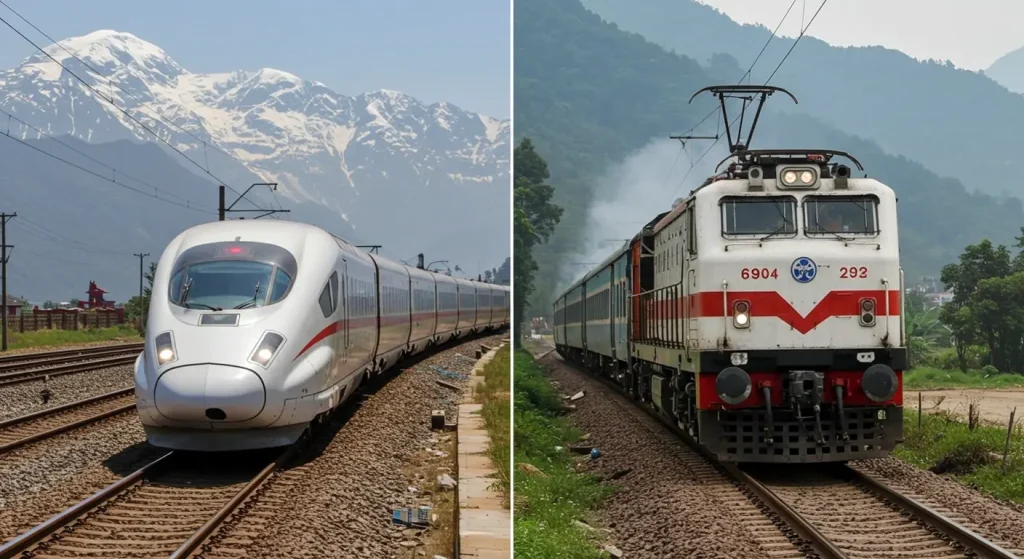
Nepal’s geographical location between India and China has turned its infrastructure development into an arena for their rivalry.18This is most clearly evident in competing railway projects, which are not so much transport arteries as lines of geopolitical influence.
On the one side, China-Nepal railway – This is a technically complex and expensive project ($5.5 billion) to extend the Tibetan railway to Kathmandu.20It is a key part of China’s Belt and Road Initiative (BRI) and the Trans-Himalayan Multidimensional Transport Network. The project aims to reduce Nepal’s dependence on India and integrate it into China’s economic sphere.22The project faces enormous technical challenges: more than 98% of its 72-kilometre section in Nepal will run through tunnels and bridges across the Himalayas.20
On the other side, India-Nepal railway – is a proposed $3 billion-plus line from Raxaul, India, to Kathmandu.21The project is seen as a direct response to China’s growing influence.21It is noteworthy that the Chinese line is designed with a standard gauge, while the Indian one is designed with a broad gauge. This is not a technical accident, but a deliberate barrier that prevents the creation of a through transit corridor and reinforces the division into spheres of influence.21
These projects are the physical manifestation of a geopolitical barometer. For China, this is a way to gain a foothold in South Asia and create a potential non-maritime trade route.21For India, it is an attempt to preserve its historical sphere of influence and prevent what it perceives as strategic encirclement.22 Nepal’s official foreign policy is based on the principles of non-alignment26, is put to the ultimate test. The choice of priority project, the method of financing it (grant or loan), and the terms of the agreement become diplomatic acts of the highest order that demonstrate Nepal’s true geopolitical preferences at the moment. Infrastructure here is not just roads and rails, but foreign policy cast in steel and concrete.
Financing the Future: Pokhara Airport and the Debt Trap Debate
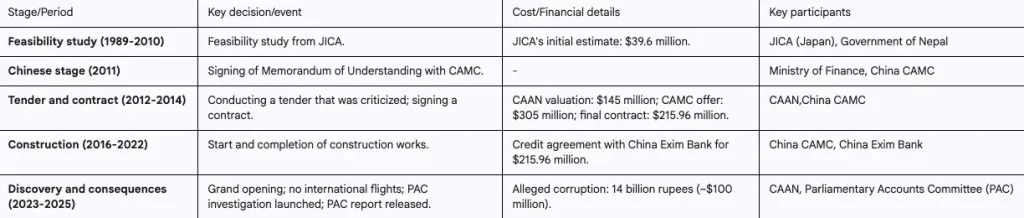
The Pokhara International Airport has become a shining example of how ambitious projects can turn into serious problems. Built with a $215.96 million soft loan from China’s Exim Bank by China’s state-owned CAMC, it was surrounded by controversy from the start.27
The project has been at the centre of a high-profile corruption scandal. An investigation by the Parliamentary Public Accounts Committee (PAC) found widespread irregularities and alleged corruption amounting to around 14 billion Nepalese rupees (over $100 million).29Key findings of the investigation include:
- Overpricing: The project cost has inexplicably risen from the Civil Aviation Authority of Nepal’s (CAAN) initial estimate of $145 million to the final contract price of $215 million.30
- Violation of procedures: The contract was awarded without a competitive tender following the signing of a memorandum of understanding that favoured CAMC from the outset.27
- Questionable expenses: According to the investigation, payments were made for work that was never completed, such as delivering soil to raise the level of the runway.29
To top it all off, the airport has proven to be economically unviable. It struggles to attract regular international flights, making it financially unsustainable. To cover operating costs alone, the airport needs to generate revenue of at least 1.5 billion Nepali rupees a year, not to mention servicing the annual interest on the $3.2 million Chinese loan.33This has raised serious concerns that the airport could become a “debt trap” for Nepal.35
However, an analysis of the situation shows that the problem is not only the final amount of debt. The trap is the opaque financing and procurement process itself. The loan was “tied”, meaning it could only be used to hire a specific Chinese contractor, thereby bypassing competitive bidding.28It was this lack of competition that created the conditions for the alleged price gouging and corruption that became the subject of the PAC investigation.31Thus, the debt is not the cause but the consequence of an inherently flawed process. This shifts the focus from simplistic blame on the creditor to a systemic critique of the structure of such transactions and the failure of Nepalese institutions like CAAN to ensure proper oversight.28
Table 2: Pokhara International Airport Case – From Dream to Scandal
The Price of Progress: Social and Ecological Balance
An analysis of megaprojects would be incomplete without an assessment of their impact on the ground. Decisions made in capital offices have very real and often painful consequences for people and nature. This section shifts the focus from geopolitics and finance to the human and environmental costs that are not always reflected in official reports.
Displacement and Discontent: The Human Cost of Development
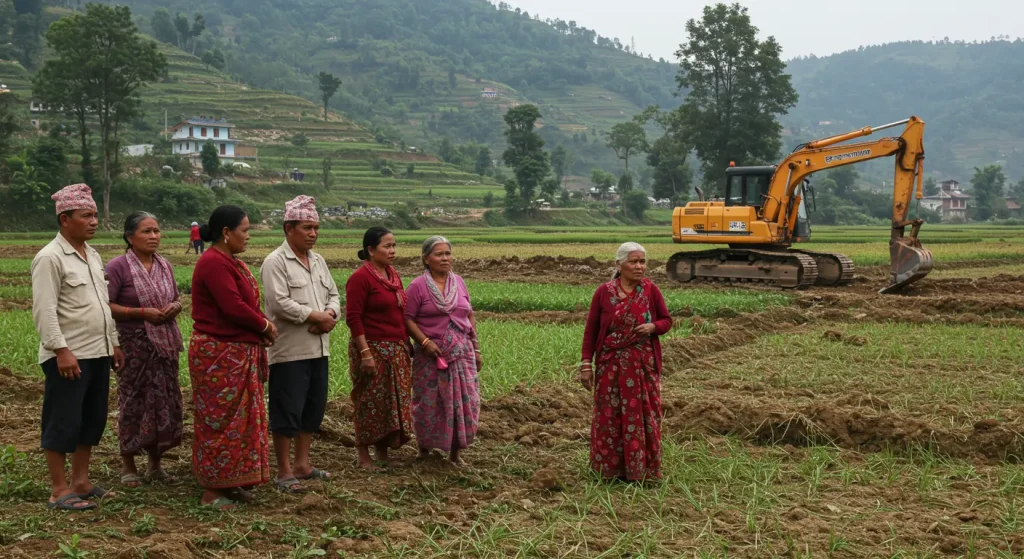
Forced land acquisition is one of the main sources of conflict and delays in project implementation. Construction Kathmandu-Terai Expressway for years it was stuck at its starting point, in the area Hokana, where local communities actively resist the seizure of their lands of important cultural and agricultural significance.13
Hydropower projects become epicenters of social upheaval. Project HPP Arun-III was accompanied by repeated protests and disputes over compensation for land taken for the construction of the dam, access roads and power lines.40Research shows that although compensation is paid, it often fails to ensure long-term sustainability of livelihoods and leaves farming families dispossessed of their land in a vulnerable economic position.43
The process of land acquisition itself is often flawed, with local residents complaining of a lack of genuine consultation and a fair valuation of their property.42In some cases, developers are accused of forging signatures and falsifying reports to obtain the necessary permits.46
These repeated conflicts demonstrate that social problems are not just a side effect of development, but a serious financial and time risk factor for the projects themselves. The delay at Håkan increases the cost of the highway.39The controversy surrounding Arun III required government intervention at the highest level.41Failure to obtain a “social license to operate” is therefore as dangerous to a project as underfunding or technical failures. This reframes “social cost” from a purely moral category to a core project management issue that decision makers systematically underestimate.
Environmental Costs: Fragile Ecosystem Under Threat
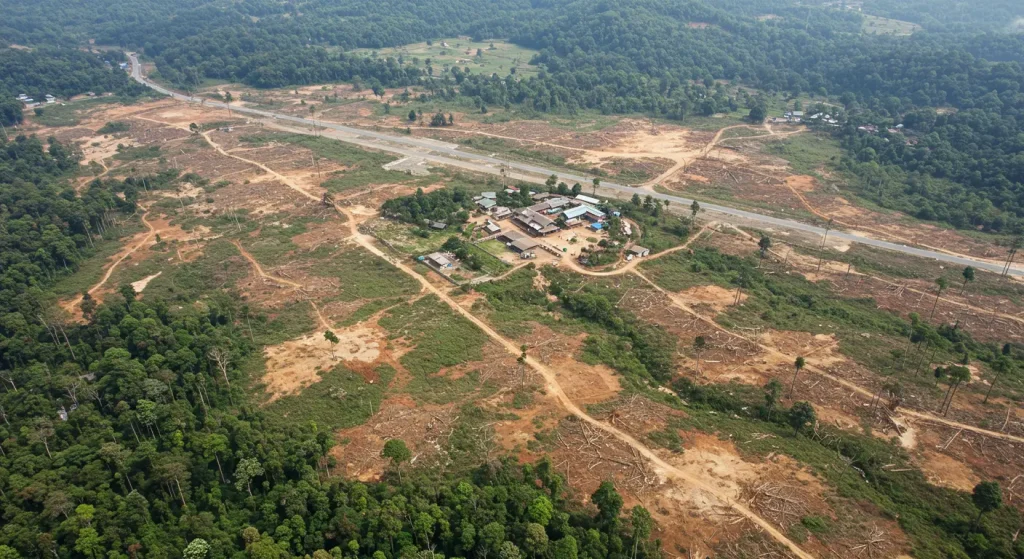
The implementation of megaprojects in the Himalayas is associated with huge environmental risks. Construction project Nijgadh International Airport is highly controversial because it would require clearing a huge tract of primeval broadleaf forest that is home to endangered wildlife and is located in close proximity to the national park.47
Construction of Kathmandu-Terai highways has already led to the felling of tens of thousands of trees.13Although compensatory planting is required by law, its effectiveness is often questioned.
Projects China-Nepal Railway and other hydroelectric power plants involve large-scale construction of tunnels and other structures in geologically unstable, seismically active zones, raising concerns about landslides and the long-term stability of the structures.24Project location
Upper Arun Downstream of expanding glacial lakes pose a significant risk of glacial lake outburst floods (GLOFs), a threat that has become particularly acute following recent dam disasters in the region.49
There is a fundamental tension here between the nationalist drive to build grandiose projects (‘National Pride Projects’) and the responsibility to preserve one of Nepal’s key assets – its unique and fragile Himalayan ecosystem. The Nijgadh Airport Debate47are a perfect illustration of this conflict. Supporters see it as a vital economic hub, while opponents see it as an ecological disaster.
Lack of rigorous, independent environmental impact assessments (EIAs)47suggests that the construction-oriented development narrative is currently winning. However, this victory may come at the cost of irreversible losses. The decisions made on these projects are not only about the economy; they determine the long-term values of the nation and its relationship with its natural heritage.
Conclusion: Nation Building or House of Cards?
The analysis shows that decision-making on megaprojects in Nepal is not a rational, technocratic exercise, but a complex and often chaotic interplay of competing forces. Decisions that will shape the country for decades are born at the intersection of a fragmented and politicized domestic governance system, the geopolitical ambitions of external players, and opaque financial deals where speed and expediency often prevail over transparency and cost-effectiveness.
The key findings are stark. Domestic governance is fragmented and subject to political whims, undermining long-term planning. The geopolitical landscape turns infrastructure into an instrument of foreign policy, where Nepal’s interests may take a back seat. Financial arrangements, as the Pokhara airport example showed, can create conditions for corruption and lead to the creation of unviable assets that place a heavy burden on the country’s budget. Finally, profound social and environmental costs are often treated as necessary evils rather than critical risks that require careful management.
The ultimate success of these projects and the realization of the vision of a “Prosperous Nepal” depend less on the ability to pour concrete and dig tunnels than on the political will to reform the decision-making process itself. Without transparent governance, evidence-based economic analysis, and a genuine commitment to social and environmental justice, Nepal’s ambitious megaprojects risk becoming not gateways to prosperity, but costly monuments to unresolved systemic problems.
Sources used
- National Planning Commission
- The Fifteenth Plan – National Planning Commission
- National Pride Projects – Wikipedia
- The Rise of Infrastructure Development in Nepal: A Construction Perspective
- (PDF) Challenges and Obstacles in the Implementation of National Pride Projects in Nepal
- Planning Guideline for Three Tires Government of Nepal – Scientific Research Publishing
- NPC recommends formulation of Act to define nat’l pride projects – The Kathmandu Post
- Welcome | Investment Board Nepal
- Investment Board Nepal: Welcome
- Legal barriers to infrastructure development in Nepal – NEUPANE LAW ASSOCIATES
- Challenges and Obstacles in the Implementation of National Pride Projects in Nepal
- Kathmandu–Terai Expressway – Wikipedia
- Fast track construction makes 37% progress – The Rising Nepal
- Fast Track Project – Kathmandu – Terai Expressway – Jagdamba Enterprises – Faith of the Ages
- (PDF) Assessing the Rationale for the Nepali Army’s Involvement in Catalyzing National Development and Infrastructures Construction – ResearchGate
- FAST TRACK: Moving In The Right Direction | New Spotlight Magazine
- Kathmandu-Terai/Madhesh Fast Track (Expressway) Road Project – GCE Group
- Dynamics and Geopolitical Interests in China-Nepal Relations – SpecialEurasia
- OF DIPLOMACY & DEVELOPMENT – Policy Entrepreneurs Inc.
- China–Nepal railway – Wikipedia
- India-China rail race | Nepali Times
- China Breaks India’s Blockade: $8 Billion Railway to Nepal Changes Everything – YouTube
- The Belt and Road Initiative: Assessing Its Implications for Nepal’s Development
- China-Nepal Railway – World’s Highest Railway Tunnels in the Himalayas
- Geopolitical Implications of BRI in South Asia – Nepal Journals Online
- Everything You Need to Know About Nepal’s Foreign Policy
- Pokhara airport: China’s soft power, Nepal’s hard landing – The Kathmandu Post
- Pokhara International Airport Scandal: Uncovering … – Nepal News
- The Unfolding Sorry Saga of Nepal’s China-built Airport at Pokhara – The Diplomat
- Nepal probe panel reveals Rs 14 billion graft in airport built by Chinese firm – India Today
- Nepal Panel Uncovers Billions in Corruption in China-Built Pokhara Airport – Deccan Herald
- 10 billion corruption in Pokhara Airport, immunity to the leadership making policy decisions
- Pokhara Airport fails to take off | The Annapurna Express
- Corruption in Pokhara International Airport: Chinese firm dismisses parliamentary report
- How expensive Pokhara airport could become another China-funded debt trap for Nepal
- House committee asks CIAA to look into Pokhara airport scam – The Kathmandu Post
- Corruption in Pokhara airport: PAC directs CIAA to investigate the case
- Kathmandu-Terai Expressway Is Unliely To Complete By 2083: Nepal Army
- Sluggish Fast Track – The Rising Nepal
- Power vs rights of indigenous people – Nepal Live Today
- Nepal government to address the problem facing Arun III hydropower project
- Growing dispute affecting construction of Arun III transmission line – The Rising Nepal
- USE OF CASH SURVEY – (ARUN-3 HYDROPOWER PROJECT) – Investment Board Nepal
- Environmental Justice in Hydropower Development: Voices of the Marginalized in Nepal
- (PDF) Changes in the Livelihood Capitals and Strategies of Hydropower Displaced Community of Arun-III in Nepal – ResearchGate
- Reporting confirms alleged Indigenous rights violations in Nepal hydropower project
- Nijgadh International Airport – Wikipedia
- Kathmandu-Tarai Expressway achieves 39% physical progress – The Rising Nepal
- World Bank flip-flop on Upper Arun | Nepali Times
- Nepal train project struggles to stay on track | Nepali Times
- The Fifteenth Plan – ADB’s Law and Policy Reform Program
- Nepal-China connectivity gains traction with BRI Framework – The Rising Nepal
- China, Nepal jointly advance ground surveying for Himalayan railway, targets June 2025 completion amid technical challenges – Global Times
- Nepal Compact – Millennium Challenge Corporation
- Nepal: Projects and Results | Asian Development Bank
- Nepal Strategic Road Connectivity and Trade Improvement Project | Bank Information Center