Key Takeaways
- Non-Tariff Barriers are not bureaucratic errors; they are often sophisticated, undeclared protectionist tools India deploys to manage its domestic agricultural prices and supply, particularly during its own harvest seasons.
- The core problem is not a lack of labs in Nepal; it is the absence of a politically negotiated Mutual Recognition Agreement (MRA), which renders Nepalese certifications powerless at Indian checkpoints and forces costly, time-consuming re-testing.
- Over-reliance on the Indian market is a critical strategic vulnerability. The ultimate risk mitigation strategy is not better compliance with India’s unpredictable standards, but aggressive market diversification to regions with more transparent and stable trade regimes, like the Middle East and Southeast Asia.
Introduction
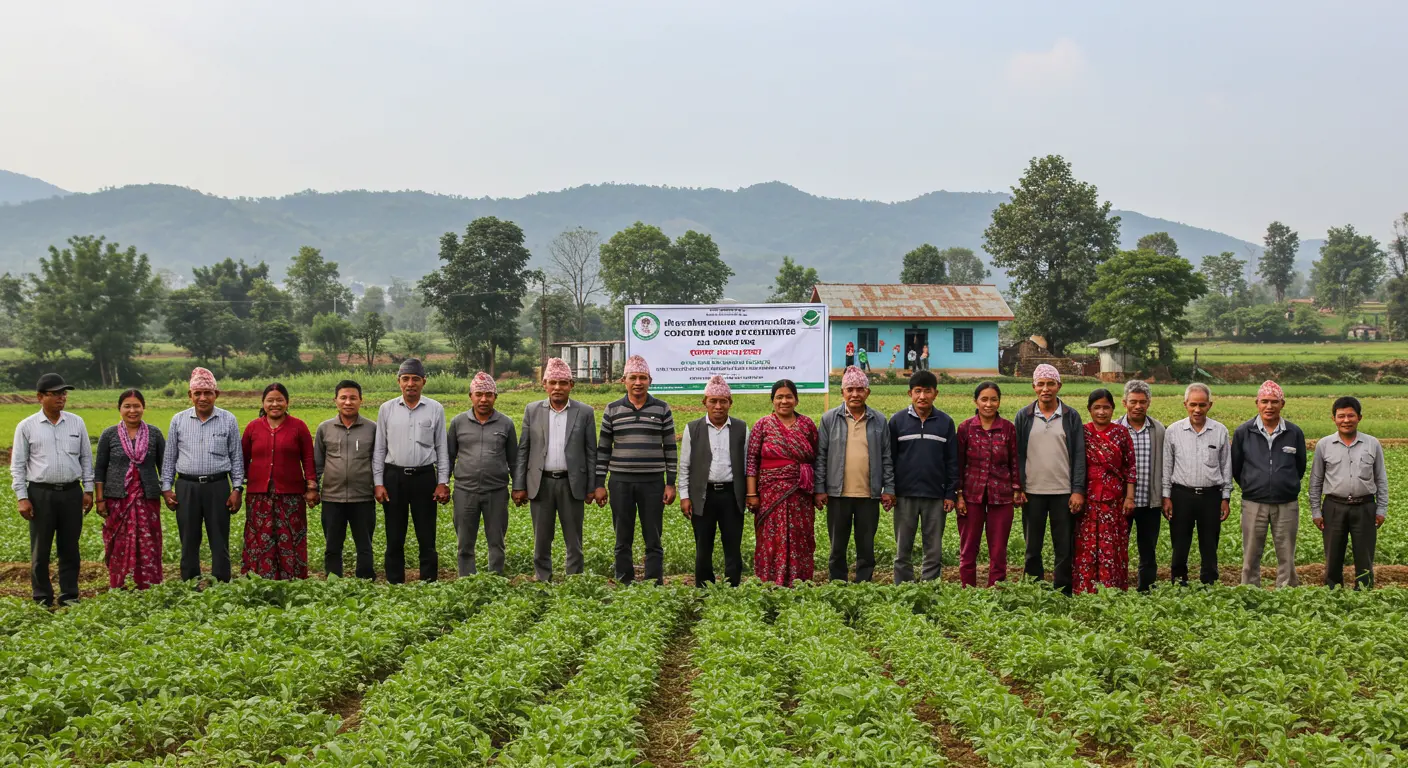
For a Nepali ginger farmer in Ilam, the journey to market should be a story of agricultural toil culminating in commercial success. Instead, it often becomes a lesson in geopolitical economics. The farmer’s meticulously grown produce, loaded onto a truck, begins a perilous journey not just over mountains, but through a labyrinth of invisible walls erected at the Indian border. The truck, and the farmer’s entire year of income, can be stopped not by a formal tax or tariff, but by a sudden demand for a new pesticide residue test, a quarantine notice citing a pest unheard of yesterday, or a subjective “quality” assessment by a single official.
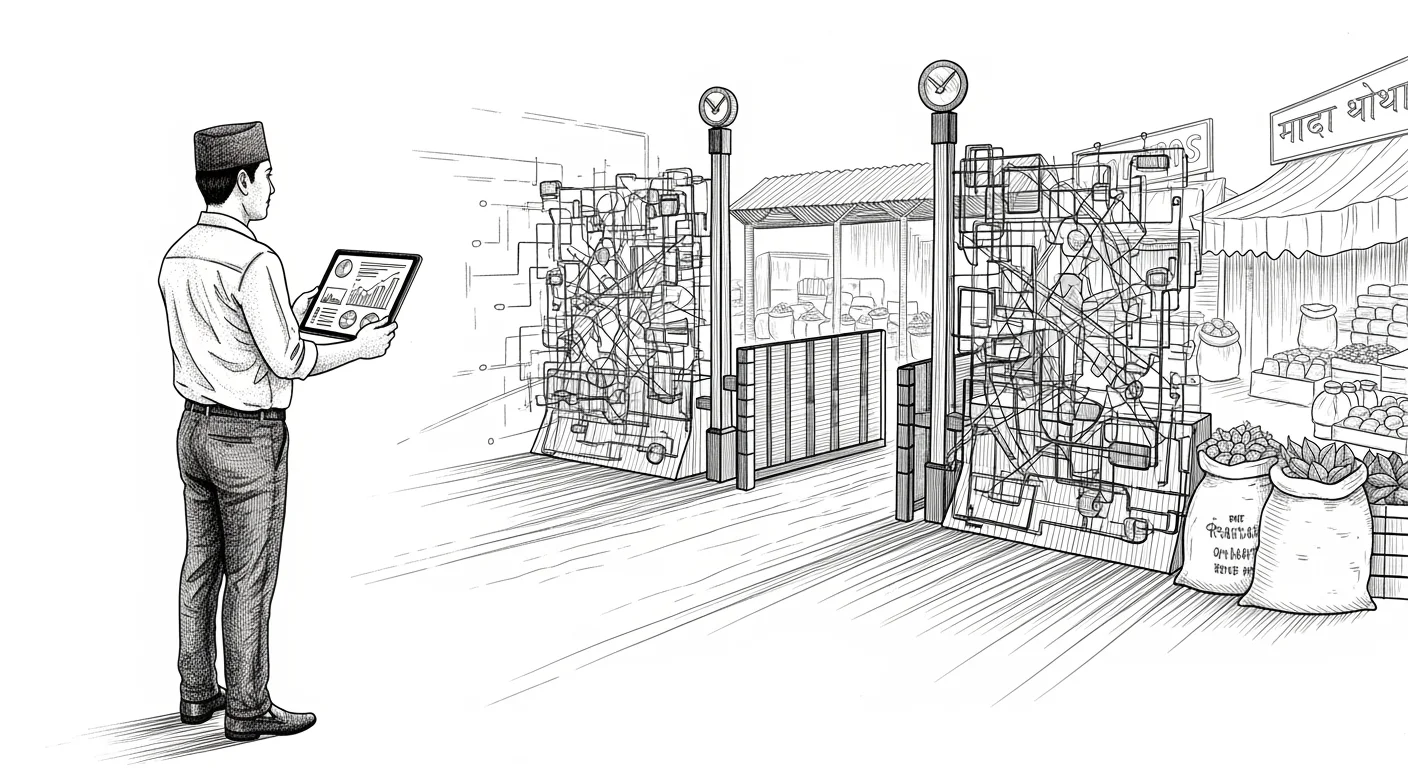
This is the harsh reality of Nepal’s agricultural trade with its largest partner. While headlines and trade agreements trumpet the virtues of free trade under SAFTA, the lived experience of exporters tells a different story—one defined by Non-Tariff Barriers (NTBs). These are the subtle, often technically-justified hurdles that function as a de-facto quota system, far more damaging than a straightforward customs duty because of their sheer unpredictability. They transform the Indo-Nepal border from a commercial gateway into a strategic chokepoint.
This article moves beyond the daily news reports of stalled trucks at Kakarbhitta or Raxaul. It provides a hard-hitting look at the trade reality, dissecting the mechanisms of quarantine, phytosanitary, and lab testing barriers that cripple Nepal’s key agricultural exports. More critically, it proposes a strategic framework for Nepali businesses and policymakers to navigate this treacherous landscape, arguing that survival and prosperity depend not just on meeting standards, but on fundamentally rethinking our strategic dependence on a single, overwhelmingly dominant market.
The Mechanics of De-Facto Protectionism
In classical economics, trade barriers are tariffs—a transparent tax on imported goods. But in the modern world of free trade agreements, tariffs have been supplemented by a more insidious tool: the Non-Tariff Barrier. For Nepal’s agricultural sector, the most potent NTBs are Sanitary and Phytosanitary (SPS) measures. In theory, these are legitimate rules designed to protect India’s consumers and agriculture from pests and diseases. In practice, they are frequently wielded with devastating precision to protect Indian producers from Nepali competition.
The mechanism is deceptively simple and functions on the principle of weaponized ambiguity. Consider the case of Nepali ginger. For years, exports flowed with standard paperwork. Suddenly, Indian authorities may begin demanding a “Pesticide Residue Analysis,” specifying test results for a list of chemicals. The problem is not the test itself, but its arbitrary application. The requirement might materialize without prior warning, leaving trucks stranded as exporters scramble to find a lab that can even perform the specified test. By the time the certification is obtained—days or weeks later—the ginger has lost quality and market value, or India’s domestic ginger harvest has reached the market, conveniently depressing prices. The barrier has done its job; the financial damage is inflicted without a single rupee of tariff being levied.
Similarly, Nepal’s prized large cardamom (Alaichi) faces challenges related to quality standards. Indian buyers or customs officials might suddenly reject a consignment, citing high moisture content, “foreign matter,” or levels of essential oils that don’t meet an unspecified benchmark. Because these parameters can be subjective and testing methods can vary, the Nepali exporter has little recourse. For perishable vegetables like tomatoes or beans, the preferred tool is the quarantine. A sudden alert for a fruit fly or a leaf blight—often timed perfectly with the peak supply season in neighboring Indian states—can halt all imports for “phytosanitary inspection.” The delay is the penalty. A truckload of tomatoes can lose its entire value in 48 hours of tropical heat at a border crossing. The economic outcome is the same as a 100% tariff, but it is executed under the legally defensible guise of public health and safety under WTO rules.
It is a profound mistake to view these incidents as isolated bureaucratic failures. They are a system. The inconsistency is the point. It creates maximum uncertainty for the Nepali exporter, raising their risk profile and making it impossible to sign reliable, long-term supply contracts. This strategic uncertainty is a far more effective barrier than a predictable 10% tariff, as it systematically dismantles the competitiveness of Nepal’s agricultural export sector from the inside out.
The Asymmetry of Infrastructure: A Battle of Laboratories
The immediate response to these technical barriers is often a chorus of calls for Nepal to “improve its quality” and “build more labs.” This advice, while well-intentioned, fundamentally misunderstands the core of the problem. Nepal’s challenge is not simply a deficit of laboratory equipment; it is a critical deficit of diplomatic and institutional recognition. The trade battle is being fought, and lost, over a concept known as a Mutual Recognition Agreement (MRA).
An MRA is a formal agreement between two countries to accept each other’s conformity assessments—in this case, lab tests and certifications. A functional MRA would mean that a certificate issued by an accredited Nepali lab for a consignment of cardamom would be legally accepted by Indian customs, no questions asked. Nepal and India do not have a functional, comprehensive MRA for agricultural products. This single fact is the root cause of much of the chaos at the border.
Herein lies the asymmetry. A Nepali exporter presents a certificate from Nepal’s Food Technology and Quality Control Department (DFTQC). The Indian customs officer at the border, under no obligation to recognize that piece of paper, can legally demand a re-test at an Indian lab accredited by the National Accreditation Board for Testing and Calibration Laboratories (NABL). This creates a workflow designed for failure. The sample must be physically sent to an approved lab, which could be hours or even days away. The process introduces crippling delays, added costs, and a second point of potential failure, all while the primary goods—often highly perishable—are deteriorating at the border post. The Nepali certification is rendered practically worthless at the point where it matters most.
Nepal’s strategy of building small labs in every province exacerbates this problem. Spreading limited resources thin results in a collection of under-funded, under-staffed labs, none of which can achieve the high level of international accreditation (like ISO/IEC 17025) that could form the basis of a credible MRA negotiation. India, in contrast, has a vast, interconnected network of NABL-accredited labs. When a Nepali exporter is forced to use this system, they are competing on India’s home turf, by India’s rules, using India’s infrastructure. It is a game Nepal cannot win. Until the diplomatic focus shifts from firefighting individual border incidents to the painstaking work of negotiating binding, commodity-specific MRAs for key exports, any investment in domestic labs will be like building a world-class factory with no road to the market.
Beyond Bureaucracy: The Political Economy of Perishables
To fully grasp why these non-tariff barriers persist, we must look beyond border logistics and lab reports. We must analyze the powerful political and economic forces at play, particularly within India. The frequent and strategic application of SPS measures against Nepali agriculture is not random; it is a direct consequence of the immense political sensitivity of agricultural prices in Indian domestic politics.
Think of it as the “Onion Principle.” In India, the price of onions can famously make or break governments. The same sensitivity applies, to varying degrees, to tomatoes, potatoes, ginger, and other staples. When a flood of cheaper Nepali produce—even if it’s a relatively small volume—threatens to depress market prices for farmers in a politically important state like Uttar Pradesh or West Bengal during their peak harvest, the political pressure on local and central authorities becomes immense. In this context, activating a non-tariff barrier is the perfect political tool. It is fast, effective, and crucially, deniable. Instead of imposing a politically unpopular tariff, which would violate SAFTA commitments and be highly visible, a ministry can simply “tighten” enforcement of an existing food safety or quarantine rule. The official narrative is one of protecting consumer health, but the economic effect is pure protectionism. The Nepali exporter is caught in the crossfire of India’s internal political calculations.
This is permissible due to a massive loophole in the global trade framework. The World Trade Organization’s SPS Agreement allows countries to set their own standards for food safety and animal/plant health. However, it stipulates that these measures must be based on scientific principles and not be used as a disguised restriction on trade. The fatal ambiguity lies in the interpretation of “scientific principles.” India can always produce a scientific justification—a newly discovered pest risk, a concern about a specific pesticide—for its actions. For a smaller country like Nepal, challenging this justification through the WTO’s dispute settlement mechanism is a prohibitively expensive, complex, and time-consuming process that can take years. By the time a ruling is reached, entire export industries could be wiped out.
This dynamic creates a deeply uneven playing field. Nepal’s access to the Indian market is treated as a privilege that can be revoked at any moment for domestic political reasons, while India’s access to Nepal’s market for its industrial goods and services is largely unconditional. This isn’t a conspiracy; it’s the natural outcome of a bilateral relationship with a massive power imbalance. India is simply exercising its regulatory sovereignty to serve its domestic interests. For Nepali policymakers and businesses, acknowledging this uncomfortable reality is the first step toward building a realistic and resilient trade strategy.
The Strategic Outlook
Predicting the future of Nepal-India trade requires we abandon wishful thinking and adopt a clear-eyed, scenario-based approach. The pattern of disruptions is not a temporary anomaly; it is the new normal. How Nepali businesses and the state respond will determine the fate of the nation’s entire agricultural export economy.
Scenario 1: The Inertial Path. If Nepal continues its current strategy—relying on ad-hoc diplomatic interventions to clear stranded trucks and making scattered, unfocused investments in small, unaccredited labs—the situation will deteriorate. As India’s own agricultural productivity increases and its internal politics remain volatile, these NTBs will become more frequent and sophisticated. Nepali exporters will face perpetually squeezed margins, unable to commit to large-scale production or long-term contracts due to systemic uncertainty. The “death by a thousand cuts” will continue, leading to a slow erosion of our agricultural base and increased dependence on remittance income.
Scenario 2: The Resilience and Compliance Path. A more proactive approach involves accepting the Indian system and mastering it. On a micro level, this means Nepali export houses must evolve. They must form consortia to build and operate their own accredited labs and cold storage chains near border points. They must hire legal and technical experts specializing in Indian food safety law (FSSAI) to ensure pre-emptive compliance. They become players in the Indian system, minimizing friction through over-compliance. On a macro level, the Government of Nepal must pivot its investment strategy. Instead of a dozen provincial labs, it must channel all resources into establishing a single National Reference Laboratory for Agro-Exports, armed with top-tier international accreditation. The singular diplomatic goal then becomes negotiating a binding MRA for this one institution, starting with high-value, low-volume products like orthodox tea and large cardamom.
The Hard Truth: Even the most robust compliance strategy is a defensive measure. It cedes control of our economic destiny to the shifting priorities of another nation’s regulators and politicians. The fundamental hard truth for every Nepali CEO and policymaker to internalize is this: an export strategy that relies on a single market which accounts for over 65% of your trade, and which can unilaterally shut down that trade using opaque regulatory measures, is not a strategy—it is a chronic liability. India will always, and rightly, prioritize the interests of its farmers and consumers. Expecting otherwise is strategic negligence.
This leads to the only logical conclusion: The ultimate risk mitigation strategy is aggressive market diversification. This is not an anti-India stance, but a pro-Nepal imperative. The immense effort required to meet the unpredictable standards of the Indian market could be redirected. The cost of compliance for a shipment to Dubai or Kuala Lumpur, while high, is at least stable and transparent. The standards required by the EU or US are stringent but predictable. For products like ginger and turmeric, Bangladesh and the Middle East represent massive, accessible markets. For specialty products like orthodox tea and medicinal herbs, Europe offers high-margin potential. The initial investment in logistics, marketing, and meeting new international standards will be formidable. But it is a strategic investment in sovereignty and stability, freeing our most productive sectors from the political whims of a single trading partner. The question for Nepal’s business leaders is no longer whether we can afford to diversify, but whether we can afford not to.