Key Takeaways
- The ‘Bhutan Model’ is a fiscal illusion for Nepal; our economic scale and market structure demand a strategy of sophisticated segmentation, not simplistic exclusion. Blindly copy-pasting Bhutan’s high-fee policy risks sacrificing a resilient volume market for an elusive luxury segment we aren’t yet equipped to serve.
- Mandatory guide policies create a ‘cartelization risk’. While ostensibly for safety, the rule disproportionately benefits large, established trekking agencies, stifling the entrepreneurial ecosystem of independent guides and small lodges that form the backbone of rural tourism economies and represent a critical talent pipeline.
- The highest ROI is in ‘yield per region,’ not ‘yield per tourist.’ The government’s strategic focus should shift from maximizing revenue from every individual to designing a tiered system that optimizes value extraction from different geographical zones—Everest for luxury, emerging trails for adventure, and cultural circuits for immersion.
Introduction
In the corridors of Nepal’s Ministry of Tourism, a new mantra is taking hold, one that carries the faint scent of Bhutan’s pristine, high-altitude air: “High Value, Low Volume.” It’s a seductive idea, a strategic pivot whispered as the panacea for an industry long defined by the vibrant, chaotic hum of the Thamel backpacker scene. This shift, colloquially termed the “Bhutanization” of our ecotourism sector, represents the most significant reimagining of Nepal’s global tourism proposition in a generation. The government is making a high-stakes wager, betting that by trading volume for value—swapping the budget-conscious free-independent-traveler (FIT) for the affluent, all-inclusive trekker—it can unlock greater revenue, mitigate environmental impact, and elevate the country’s brand. The primary levers for this transformation are policies that until recently would have been unthinkable: a blanket mandate requiring a licensed guide for all foreign trekkers and a sharp increase in various permit fees.
This is not merely a pricing adjustment; it is a fundamental restructuring of an economic ecosystem. For decades, Nepal’s tourism ‘operating system’ was built on accessibility. It thrived on the very notion that anyone with a sturdy pair of boots and a spirit of adventure could experience the Himalayas. This volume-driven model created a sprawling, decentralized economy of teahouse owners, independent guides, porters, and small-scale outfitters across the nation’s vast middle hills and high-mountain regions. The new value-focused strategy, however, threatens this established order. It creates a stark tension between the legacy market that built Brand Nepal and the aspirational market the government now wishes to court.
The core question for Nepali business leaders and policymakers is not whether “high value” is a desirable goal—it unequivocally is. The question is whether these specific policies are the correct mechanism to achieve it. Are we strategically ascending to a new market peak, or are we inadvertently triggering an economic avalanche in our own tourism heartland? This article deconstructs the economic architecture of this policy shift, analyzes the allure and the fallacy of the Bhutan model for Nepal, and provides a strategic outlook on where the true return on investment lies. It is an argument for nuance in an arena increasingly dominated by binary thinking: a strategy that doesn’t just choose value over volume, but intelligently extracts value from volume.
Deconstructing the New Policy: The Unintended Economics of Exclusion
The government’s dual policy of mandatory guides and increased permit fees functions as a powerful market filter. On paper, the logic is sound. The mandatory guide rule, officially implemented by the Nepal Tourism Board (NTB) on April 1, 2023, is framed as a safety measure, designed to reduce incidents of solo trekkers getting lost or injured. The inflation of Trekkers’ Information Management System (TIMS) cards and other regional permits is presented as a necessary step to fund infrastructure and conservation. Together, however, their primary economic function is to raise the floor price of trekking in Nepal, effectively engineering the FIT—the independent backpacker who micro-manages their budget—out of the market.
The immediate consequence is a forced consolidation of the market. Previously, a trekker’s budget would be distributed across a wide, atomized network: a few dollars for a dal bhat here, a room there, a flexible daily wage for a porter hired in a trailside village. This model, while less “efficient” in terms of centralized tax collection, was deeply embedded in the rural economy. The new “guide-mandatory” rule channels a significant portion of this spending away from the periphery and toward the center. Trekkers are now compelled to go through registered trekking agencies, largely based in Kathmandu or Pokhara, to hire a guide. These agencies, logically, bundle services. The result is that a trek that might have cost an FIT $30-$40 per day now starts at $60-$80 per day, with much of that margin captured by the urban agency rather than being spent directly in the trekking region. This is not “creative destruction,” the Schumpeterian concept where a new, more innovative model replaces an old one. This is simply destruction of a decentralized network in favor of a centralized one, with questionable gains in overall efficiency or quality.
p>This policy creates a significant ‘cartelization risk.’ By making guides a non-negotiable component, the policy grants immense market power to a finite number of registered agencies and a licensed guide pool. This structure is ripe for price-fixing and a reduction in service-level competition. The independent guide, the quintessential tourism entrepreneur who built a reputation through word-of-mouth and competed on skill and personality, is now structurally disadvantaged. They are forced to become a wage-earning employee of an agency, their entrepreneurial dynamism stifled. For investors and business leaders, this signals a less dynamic and more rigid market, one where a few large players control access, and innovation at the grassroots level is suffocated. The small teahouse in a remote village in the Manaslu region, which once competed for the business of passing FITs, now finds its customer flow mediated and pre-determined by package deals struck in Kathmandu.
The Bhutan Allure: Chasing Revenue or Preserving Paradise?
To understand the ‘why’ behind this seismic shift, one must appreciate the magnetic pull of the Bhutanese paradigm. Bhutan’s “High Value, Low Volume” strategy, centered on a mandatory Sustainable Development Fee (SDF) of $200 per person per day (recently halved to $100 to boost post-pandemic numbers), is the gold standard for state-controlled, high-yield tourism. For a Nepali policymaker grappling with issues of overcrowding on Everest, waste management problems on popular trails, and a desire to increase foreign currency reserves, the Bhutan model appears as a perfect, elegant solution. It promises more money from fewer tourists, thus solving both economic and environmental challenges simultaneously. This is the official narrative, and it contains elements of truth. Unregulated tourism has undeniably placed strains on fragile ecosystems.
However, this narrative overlooks a critical economic principle: the price elasticity of demand. This concept measures how much the quantity demanded of a good (in this case, a Nepal trek) changes in response to a change in its price. The client profile for Bhutan is fundamentally different from Nepal’s traditional base. Bhutan attracts an older, wealthier demographic for whom the high SDF is a mark of exclusivity. Their demand is highly inelastic; a price increase does not significantly deter them. Nepal’s core ‘volume’ market, the 20-to-35-year-old backpacker, has extremely elastic demand. For them, a $500 increase in the total trip cost (due to mandatory guides and higher fees) is not an inconvenience; it is a deal-breaker. They will not simply upgrade their budget; they will choose an alternative destination, be it the Indian Himalayas, Southeast Asia, or South America.
Therefore, the government’s pursuit of higher per-capita tourist revenue is based on a dangerous assumption: that the ‘value’ market will materialize at a scale sufficient to offset the loss of the ‘volume’ market. This is far from guaranteed. Building a luxury brand requires more than just high prices. It requires a corresponding investment in ‘high-value’ infrastructure: upgraded lodges with reliable heating and sanitation, improved trail safety standards, streamlined domestic air travel, and world-class service quality. By putting the pricing cart before the infrastructure horse, we risk alienating our existing market without successfully capturing the new one, leading to a net decrease in total tourism revenue and widespread unemployment in the sector’s lower rungs. The Bhutanese allure is powerful, but applying its lessons requires understanding that Bhutan is selling curated exclusivity, while Nepal’s core product has always been raw, accessible adventure.
Nepal’s Market Paradox: Too Big for Bhutan, Too Wild for Switzerland
The strategic error at the heart of the “Bhutanization” policy is a failure to appreciate Nepal’s unique market position. We are not a small, boutique destination like Bhutan, nor are we a hyper-developed, infrastructure-rich destination like Switzerland. Our strength lies in our magnificent paradox: we offer Everest-sized scale and complexity at a price point that makes it accessible. Trying to mimic another country’s model is a fundamental misreading of our own competitive advantage.
Let’s contrast the operational realities. Bhutan’s entire tourism industry is channeled through a single international airport. The government has total control over entry points and tourist numbers, making a high-fee, low-volume policy feasible to enforce. Nepal, by contrast, is a wonderfully porous and sprawling tourism landscape. We have multiple international and regional airports, countless land border crossings with India, and a trekking trail network of unparalleled length and diversity. Our private sector is a vast, competitive, and sometimes chaotic ecosystem of thousands of businesses. Imposing a single, monolithic policy across such a diverse geography is like trying to fit a square peg in a round hole. The needs of the Everest region, which naturally attracts higher spending, are entirely different from those of the emerging Tamang Heritage Trail or the wilderness of Dolpo, which could be decimated by the loss of the FIT market that is essential for exploring and popularizing new routes.
Consider the Swiss model as an alternative high-value benchmark. The Alpine nations command high prices through impeccable infrastructure. Their trails are perfectly manicured, their hut systems offer hotel-like comfort, and their transport (trains, cable cars) is a marvel of precision engineering. A trekker in Switzerland pays a premium for safety, comfort, and predictability. Nepal’s brand promise is the exact opposite. Our value proposition is the thrill of the unknown, the authenticity of a remote teahouse, the challenge of a rugged trail. To invest billions in ‘Swiss-ifying’ our mountains would not only be economically impossible but would dilute our core brand identity. We sell adventure, not convenience. Aspiring to be a ‘cheap Switzerland’ is as strategically flawed as aspiring to be a ‘big Bhutan’.
The Strategic Outlook
Continuing on the current path of uniform, exclusionary policies presents a predictable and bleak future. Scenario one, the full-throttle “Bhutanization,” will likely see a continued decline in overall arrival numbers. While per-tourist spending from the smaller pool of visitors may increase, it is unlikely to compensate for the total revenue lost from the evaporated volume market. This will create a ‘hollowed-out’ industry: a few large agencies in Kathmandu will prosper by serving the luxury segment, while thousands of small businesses in rural Nepal face insolvency. The very regions the government claims to want to develop through tourism will be the hardest hit. This will also damage our global brand, changing our image from the world’s most accessible adventure hub to a second-rate luxury destination that can’t compete with the polish of an Alpine nation or the true exclusivity of Bhutan.
The ‘Hard Truth’ is that Nepal’s greatest strategic asset is its diversity, and our policies must reflect this. The obsession with a single ‘yield per tourist’ metric is analytically lazy. The highest and most sustainable return on investment lies in a far more sophisticated approach: optimizing ‘yield per region’ through market segmentation. This is not a call to abandon the pursuit of high-value tourism. It is a call to pursue it intelligently, in parallel with nurturing the market segments that are our bedrock.
The forward-looking strategy is a hybrid model built on geographical and product-based tiering. We must have the courage to design a system with differentiated rules for different zones. For instance:
- The Premier Zone (e.g., Everest, Annapurna Sanctuary): Here, we explicitly target the high-value market. Implement higher permit fees, make experienced guides mandatory, enforce stricter environmental standards, and incentivize investment in luxury lodges. These are our ‘premium’ products and should be priced and managed accordingly.
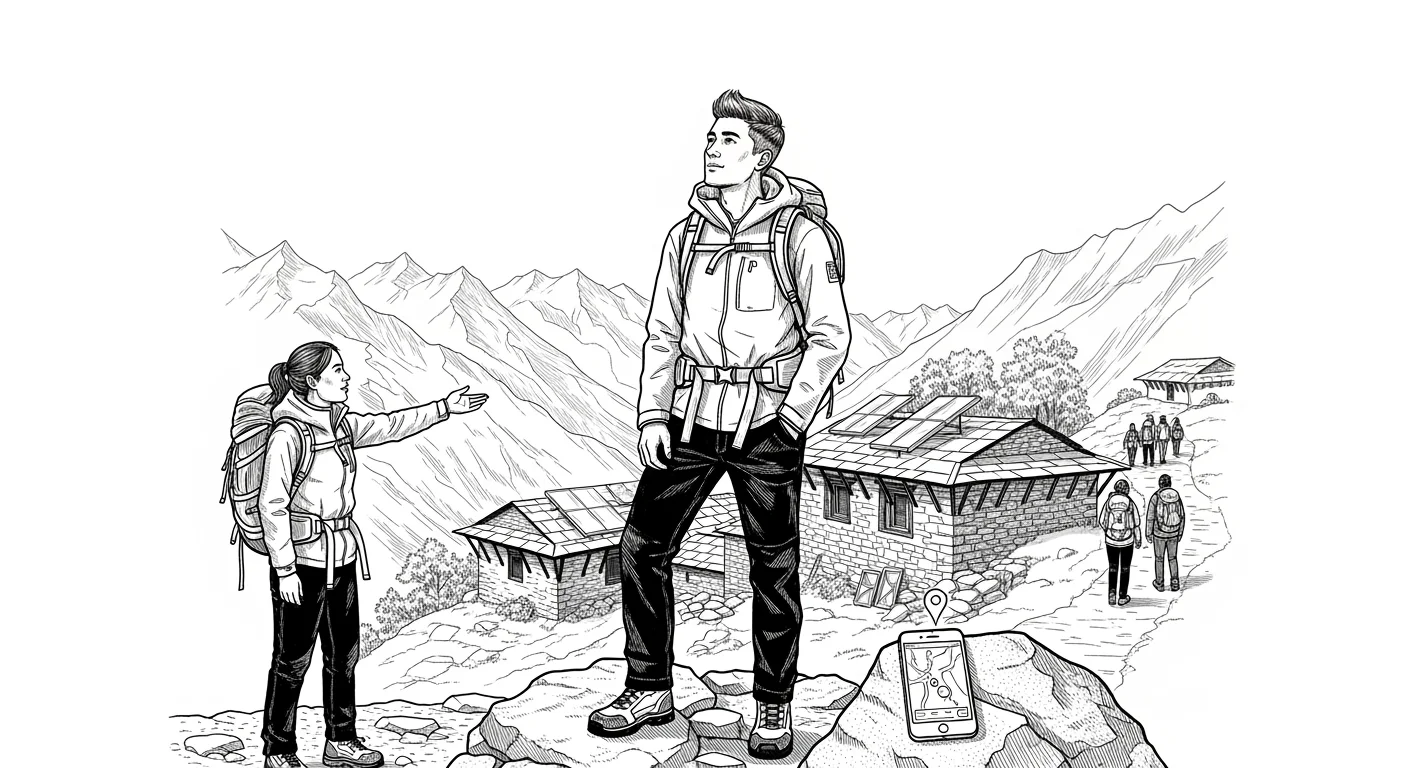
- The Adventure Zone (e.g., Manaslu, Kanchenjunga, emerging trails): This is where we preserve the spirit of independent trekking. Keep permit fees moderate and make guides optional. However, we can use technology to mitigate safety concerns, mandating that all FITs in these zones carry a GPS tracker and hold a specified level of rescue insurance, with the rental and purchase of these services creating a new, modern business ecosystem. This allows us to keep the adventurous, brand-building FIT market alive and use them as pioneers for trail diversification.
- The Cultural/Community Zone (e.g., village homestay networks, non-trekking areas): Here, the focus should be on maximizing dispersal and community benefit. Minimal fees, with a model that encourages longer stays and direct spending on local food, crafts, and experiences.
This tiered approach allows us to be everything to everyone, but in different places and at different price points. It allows us to be ‘Bhutan’ in the Khumbu and ‘classic Nepal’ in Langtang. It requires a more complex and nuanced level of governance, moving beyond blunt, one-size-fits-all regulations. The ultimate challenge is not choosing between backpackers and billionaires. It is building a system that recognizes the value of both, and strategically channels each segment to the geography and experience where they generate the highest total benefit for Nepal. That is the path from volume and value to true, sustainable prosperity.