Key Takeaways
- GMV is a vanity metric when fueled by Cash-on-Delivery (COD). High top-line growth figures in Nepali e-commerce hide a catastrophic failure in unit economics, where a significant portion of reported revenue is phantom income that never materializes.
- The true cost of a failed COD order is not just the two-way shipping fee. It includes the capital cost of locked inventory, reprocessing labor, customer service overhead, and the marketing cost of acquiring a non-committal customer—collectively turning a single failed transaction into a loss equivalent to the profit of three to five successful ones.
- Forcing a prepayment shift is not a technology problem but a strategic courage test. The first major platform to accept a temporary GVM dip by penalizing COD and aggressively rewarding digital payments will achieve profitability and force the entire market to follow, fundamentally reshaping Nepal’s e-commerce landscape.
Introduction
In the boardrooms of Kathmandu’s burgeoning e-commerce startups, one metric reigns supreme: Gross Merchandise Value (GMV). It is the headline number celebrated in press releases, flashed to investors, and cited as evidence of Nepal’s digital leapfrog. The narrative is compelling—a nation rapidly moving online, with transaction volumes soaring year-on-year. Yet, beneath this veneer of hyper-growth lies a toxic secret, a structural flaw so profound that it renders almost every major player unprofitable. This is the Cash-on-Delivery (COD) trap, a crisis not of market size or consumer demand, but of broken unit economics.
For years, COD has been positioned as a necessary evil, the bridge of trust required to coax a skeptical Nepali populace into online shopping. It powered the initial adoption phase, allowing platforms to report exponential GMV growth. But this growth is a mirage. The very payment method designed to build trust has cultivated a consumer behavior of zero commitment, leading to return and cancellation rates that can approach 30-40% in some categories. While GMV measures the value of all orders placed, it fails to account for the value that is systematically destroyed before a transaction is truly complete. The tension is stark: COD maximizes the potential for sales but simultaneously decimates the probability of profit.
This article deconstructs the unit economics of payment methods in Nepal’s e-commerce sector. It will argue that the industry’s addiction to COD is the single greatest impediment to sustainable profitability. The strategic conclusion is uncompromising: a profitable future for e-commerce in Nepal will remain elusive until platforms summon the strategic courage to force a behavioral shift towards digital prepayment, even if it means sacrificing the seductive, but ultimately hollow, allure of short-term GMV growth.
The Anatomy of a Failed Delivery: Deconstructing Unit Costs
To understand the depth of the COD crisis, one must first grasp the concept of unit economics. In its simplest form, it is the direct revenue and cost associated with a single unit—in this case, one customer order. A healthy business model ensures that the lifetime value of a customer is greater than the cost of acquiring and serving them, and at an even more granular level, that each transaction is fundamentally profitable. In Nepal’s e-commerce ecosystem, COD shatters this equation with surgical precision.
Consider a typical prepaid order for a Rs. 3,000 product. The platform receives the cash upfront. The unit economics are straightforward: Revenue (Rs. 3,000) minus Cost of Goods Sold (e.g., Rs. 2,100), minus payment gateway fees (approx. 1-2%), minus packaging and last-mile delivery (e.g., Rs. 150). The margin is clear and the cash flow is positive. The operational risk is limited to product returns for legitimate defects, a manageable business cost.
Now, let’s analyze the same order via COD. The initial workflow is identical, but the financial reality is inverted. The platform disburses capital—for the product, the packaging, and the delivery—based on a customer’s non-binding promise. Here, the transaction splits into two catastrophic paths if it fails. The first is a cancellation mid-transit. The second, and more costly, is a refusal at the doorstep. In both scenarios, the Rs. 3,000 in GMV evaporates instantly. It becomes a ghost figure in a spreadsheet. What remains is a cascade of real, hard costs.
The cost of a failed COD delivery is not merely the forward logistics fee of Rs. 150. It’s a multi-layered financial wound. First, there is the reverse logistics cost—the expense of bringing the package back to the warehouse, which is often as high as the initial delivery fee. So we are already at Rs. 300 in direct cash burn with zero revenue. Second is the reprocessing cost: an employee must receive the returned item, inspect it for damage (as refused packages are often handled poorly), update the inventory system, and restock it. This is a real labor cost. Third, there is the inventory lock-up cost. For the entire duration of the transit and return journey—which can be anywhere from three to ten days depending on the location—that Rs. 2,100 of capital is tied up in a non-productive asset. It cannot be sold to a committed buyer. For a business operating on thin margins and tight working capital, this is a silent killer. Finally, the customer acquisition cost (CAC) for that order—the marketing spend used to attract that click—is completely wasted.
When you sum up these costs—two-way logistics (Rs. 300), reprocessing labor (let’s estimate Rs. 50), and the opportunity cost of locked capital—a single failed delivery can easily represent a direct loss of over Rs. 350-400. This single failure can wipe out the net profit from three to five successfully delivered orders. With return rates hovering at a conservative industry average of 25% for COD, the mathematical conclusion is brutal: a quarter of a company’s operations are dedicated to actively losing money. This isn’t a growth challenge; it’s a business model on a treadmill to insolvency.
The Psychology of Zero Commitment: Why COD Fails
The high failure rate of COD is not a logistical problem; it is a behavioral one that platforms have inadvertently nurtured. COD removes all friction and consequence from the purchasing decision, transforming the online checkout process from a binding contract into a casual expression of interest. A customer placing a COD order has zero “skin in the game.” This psychological detachment is the root cause of the crippling return rates.
In behavioral economics, this is a classic example of eliminating commitment devices. When a customer enters their card details or logs into a digital wallet, they perform a deliberate act of financial commitment. The payment confirmation screen is a point of finality. Buyer’s remorse may still occur, but the default action is to accept the product; returning it requires a conscious, separate effort. COD completely inverts this dynamic. The purchase decision is deferred to the moment the delivery rider stands at the door. The default option is refusal, which requires no effort, no phone calls, and no consequences. The path of least resistance is to simply say, “I don’t want it anymore,” or worse, not even answer the phone.
This zero-commitment framework enables several destructive consumer patterns unique to COD-dominant markets. First is “competitive ordering,” where a customer orders the same or similar product from multiple platforms and accepts whichever arrives first, refusing the rest. This pits e-commerce companies against each other in a race that only one can win, while all bear the logistics costs. Second is the “mobile fitting room” phenomenon, especially in fashion. Customers order multiple sizes or colors with the full intention of keeping only one, effectively using the e-commerce platform’s cash and logistics network as a free personal shopping service. Third is a pure impulse purchase, where the initial excitement wanes by the time the product arrives two days later. With no money spent, the impulse to cancel is unchecked.
The industry’s long-standing defense of COD is that it addresses a “trust deficit” in the Nepali market. This argument, while valid a decade ago, is now becoming a convenient excuse to avoid a difficult strategic pivot. The rapid and widespread adoption of digital wallets like eSewa, Khalti, and the Fonepay network for everything from utility bills to QR payments at local tea shops demonstrates that a majority of the urban and semi-urban target audience is now comfortable with digital transactions. The “trust deficit” is less about the fear of online payment and more about the consumer’s rational preference for a system that offers them maximum flexibility at the expense of the seller. Nepali consumers are not unwilling to prepay; they are simply not incentivized to. The industry has trained them to expect the risk-free convenience of COD.
The Regional Paradox: Lessons from India’s Painful Pivot
Nepal’s struggle with COD is not unique; it is a replay of a chapter that our immediate neighbor, India, has already lived through and is actively exiting. The Indian e-commerce market, a decade ahead in scale and maturity, faced the exact same paradox: explosive GMV growth fueled by a COD habit that made profitability a fantasy. The strategies employed by Indian e-commerce giants like Flipkart and Myntra offer a clear, albeit painful, roadmap for their Nepali counterparts.
Initially, Indian platforms also treated COD as an indispensable tool for customer acquisition. However, as they scaled and the absolute cost of returns ballooned into hundreds of millions of dollars, they recognized it as an existential threat. The pivot was not subtle; it was a deliberate, multi-pronged assault on the viability of COD. First, they began to introduce “COD fees”—a surcharge of INR 50-100 (NPR 80-160) on all orders paid at the doorstep. This move was revolutionary. It directly monetized the additional risk and operational complexity of COD, reframing it from a standard service to a premium, paid-for convenience.
Second, and more importantly, they created a powerful positive incentive loop for prepayment. This went far beyond a simple 5% discount. They engineered their entire value proposition to favor the prepaid customer. Orders paid for digitally were prioritized in fulfillment queues, leading to faster dispatch and delivery times. Exclusive “prepaid-only” deals and early access to sales were introduced. Return policies for prepaid orders were made seamless—instant refunds to the source account—while COD refunds were issued as slower, less flexible store credits, trapping the customer’s capital within the platform’s ecosystem.
The advent of India’s Unified Payments Interface (UPI) was the critical catalyst that accelerated this shift. UPI made bank-to-bank transfers instantaneous and free, eliminating the friction of entering card details or wallet logins. E-commerce platforms integrated UPI as their primary call-to-action at checkout. The lesson for Nepal is profound: the solution lies in a “push and pull” strategy. You must simultaneously “push” customers away from COD by introducing friction and cost, while “pulling” them towards prepayment with tangible, compelling benefits that go beyond marginal discounts. Nepal’s robust, interoperable Fonepay network and established digital wallets are its equivalent of UPI; the infrastructure is already in place. The industry’s failure is not in technology, but in its strategic application.
The Strategic Outlook
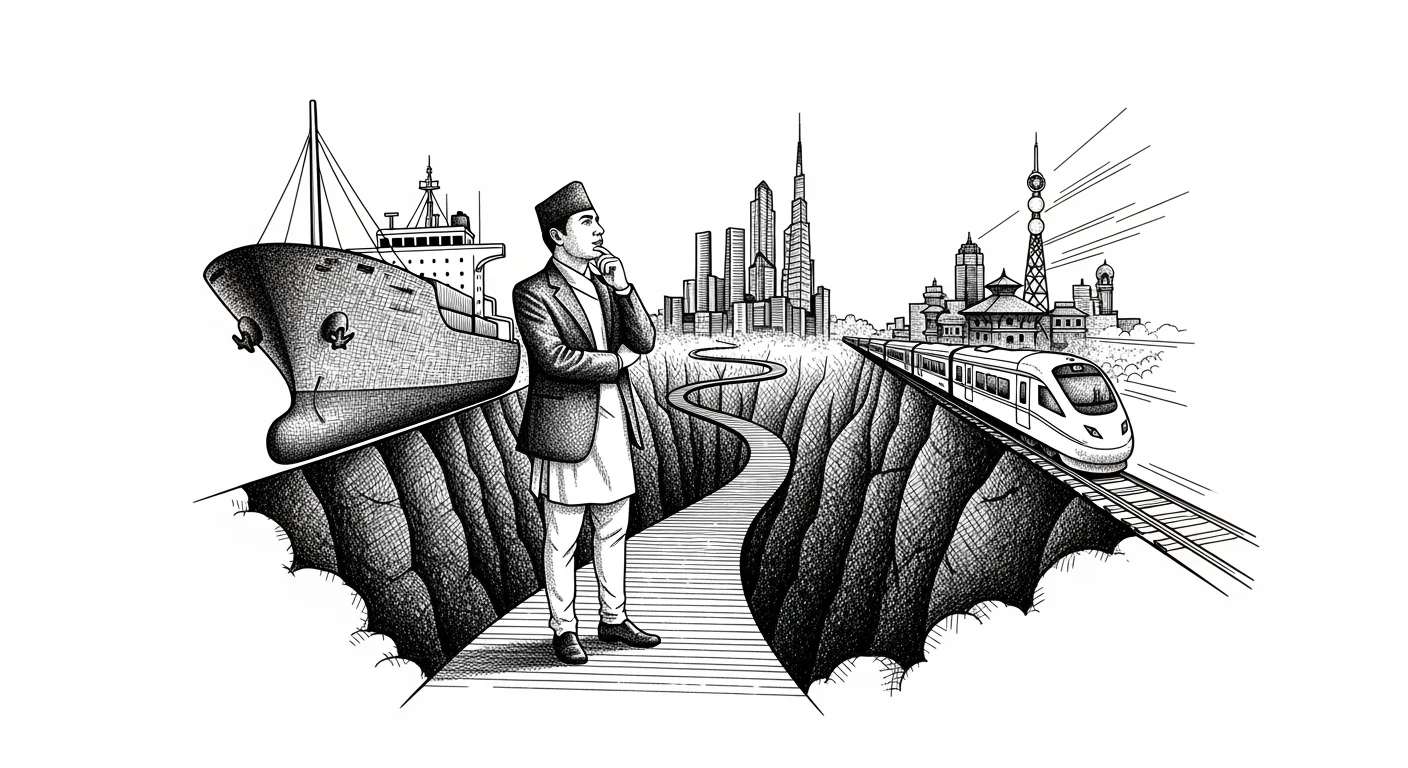
The trajectory for Nepali e-commerce is approaching a critical fork in the road. The current path, driven by the pursuit of COD-fueled GMV, leads to a predictable outcome: a prolonged period of cash burn, consolidation driven by access to foreign capital rather than operational excellence, and the eventual extinction of smaller, local players who cannot sustain the losses. In this scenario, profitability remains a distant horizon, and the industry’s health is perpetually dependent on the whims of venture capitalists. The market will look big, but it will be hollow.
The alternative path is a painful but necessary strategic pivot. This future belongs to the first major player with the audacity to break the COD dependency. This will involve implementing a structured program to shift consumer behavior. It begins with the introduction of a non-waivable COD handling fee on all orders, immediately segregating casual browsers from serious buyers. It must be paired with an aggressive rewards system for digital payments—not just discounts, but priority shipping, exclusive access, and a superior, hassle-free returns process. The marketing message must shift from “Shop Now!” to “Pay Now & Get More.”
This pivot will come at a short-term cost. In the quarter a company implements this strategy, its GMV will almost certainly decline. Customers accustomed to the zero-commitment model will balk, and some will migrate to competitors who still offer free COD. The board will be nervous, and investors may question the strategy. This is the moment of truth. However, the drop in GMV will be accompanied by a dramatic improvement in the net revenue retention and, most critically, the unit economics. The cancellation and return rate will plummet. The average cost per transaction will decrease, and cash flow will improve. While the top-line number shrinks, the bottom-line will, for the first time, have a credible path to turning black.
The Hard Truth: Profitability in Nepali e-commerce is not a logistics problem, a technology problem, or a market-size problem. It is a courage problem. It is the C-suite’s addiction to vanity metrics and the fear of being the first to move. Policy can help, but not by subsidizing. Nepal Rastra Bank’s role should be to ensure the digital payment infrastructure—ConnectIPS and the Fonepay network—remains cheap, interoperable, and robust, removing any final excuse for not prepaying. But the onus is on the businesses. The first e-commerce leader to sacrifice short-term GMV for long-term unit economic sanity will not just build a sustainable business; they will trigger an industry-wide cascade, forcing competitors to follow suit and finally pulling Nepali e-commerce out of its self-inflicted cash-on-delivery trap. They won’t just win the market; they will define it.