Key Takeaways
- Fragmentation Is Now the Enemy of Inclusion: Contrary to popular belief, the explosion of digital wallets has created a fragmented landscape that actively hinders deep financial inclusion. The battle for low-margin utility payments prevents the data aggregation necessary for high-value services like micro-credit and insurance.
- The Inevitable Commodity Trap: The core business of most Nepali fintechs—payments and QR transactions—has become a commoditized, low-margin utility. Without a non-payment “anchor” service like e-commerce or social networking, these platforms have no sustainable moat and are defensively vulnerable.
- The Great Consolidation Is Imminent: The era of launching new payment service providers (PSPs) is over. The next 24 months will be defined by a “fintech hunger games” of aggressive mergers, acquisitions, and shutdowns. Investor fatigue and a tightening regulatory environment will force consolidation, leaving only 2-3 dominant super-apps.
Introduction
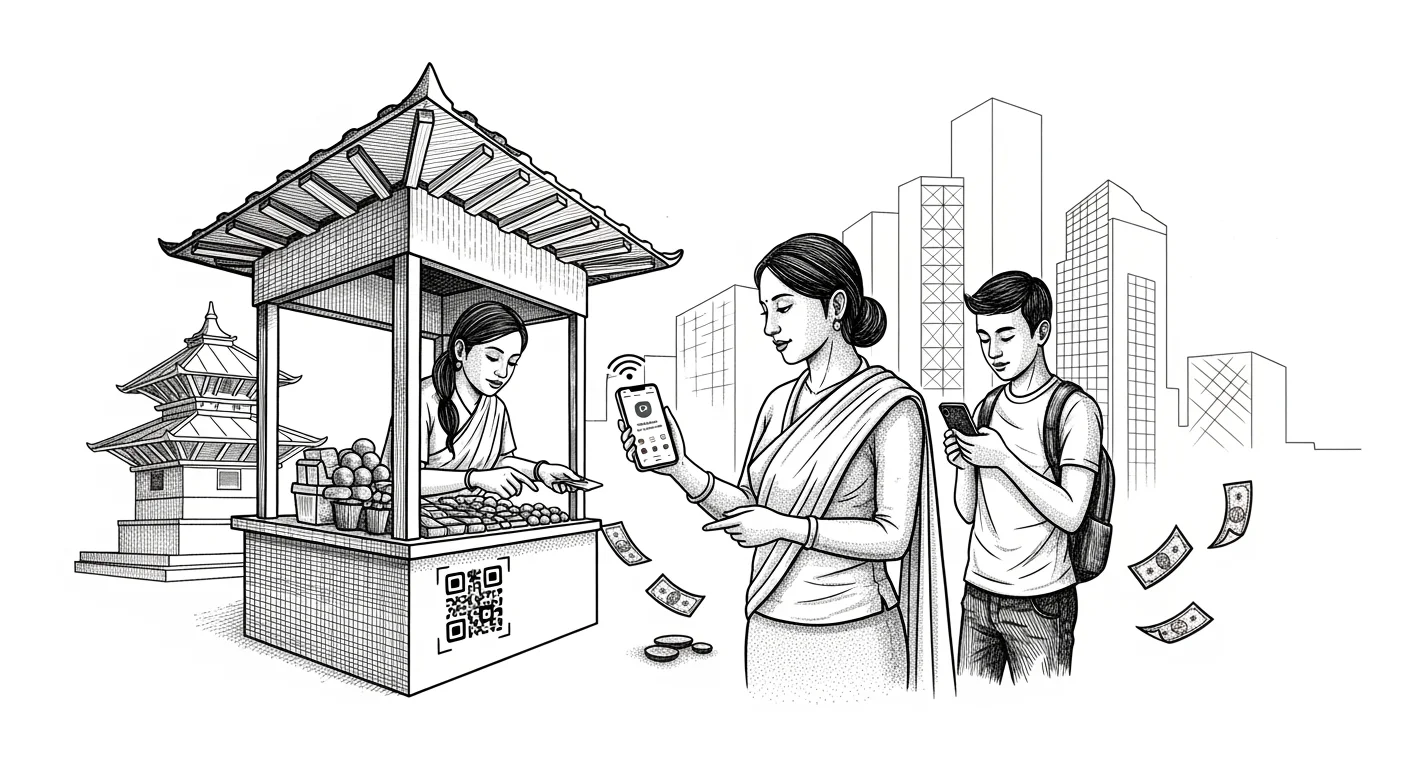
Walk into any bustling Kirana in Kathmandu, from Asan to Baneshwor, and you are greeted by a peculiar mosaic of modernity: a collage of QR codes plastered near the cash counter. One for eSewa, another for Khalti, a third for Fonepay, and perhaps a fourth for IME Pay or a specific bank’s app. This visual cacophony is the single most telling symptom of the Nepali fintech ecosystem’s greatest paradox. In our laudable sprint towards financial inclusion, we have inadvertently created a saturated, fragmented, and ultimately unsustainable digital payments landscape.
The headline numbers paint a picture of resounding success. Nepal boasts over two dozen licensed Payment Service Providers (PSPs) and ten Payment System Operators (PSOs). The volume of QR-based transactions has skyrocketed, growing over 1,000% in a single year post-pandemic. From an outside perspective, it appears Nepal is acing the digital transition. But for the discerning strategist, investor, or CEO, this surface-level success masks a deep structural crisis. The proliferation of choice has bred complexity, not efficiency. Fierce competition over razor-thin margins on utility bill payments has starved the market of the capital needed for genuine innovation.
This article argues that the current state of Nepal’s fintech sector is not a sign of a healthy, competitive market, but rather the chaotic precursor to a brutal consolidation. We will dissect the anatomy of this saturation, explore the “Fragmentation Paradox” where more players lead to less meaningful financial access, and draw critical lessons from the super-app playbooks of China and India. Ultimately, we will present a strategic outlook: the next 24 months will not be about growth, but survival. A wave of mergers and acquisitions is not just likely; it is inevitable, leaving a landscape fundamentally reshaped around two or three dominant, vertically integrated “super-apps.”
The Anatomy of Saturation: A Perfect Storm of Policy and Opportunity
The current over-saturation was not an accident, but the result of a powerful convergence of three distinct forces: a clear market gap, a permissive regulatory environment, and the powerful allure of a replicable business model. Understanding this trifecta is crucial to grasping why “fintech” in Nepal became synonymous with “digital wallet.”
First, the market opportunity was undeniable and low-hanging. In the mid-2010s, the friction in the Nepali economy was palpable. Paying an electricity bill, topping up a mobile phone, or transferring small sums of money involved queues, cash, and significant time costs. Early movers like eSewa demonstrated the immense latent demand for a digital solution. They didn’t need to invent a new user behavior; they simply digitized an existing, painful one. This focus on utility payments and telco top-ups provided a clear, immediate, and easily understandable revenue stream. It was the path of least resistance to user acquisition and the most visible problem to solve.
Second, Nepal Rastra Bank (NRB) played the role of a deliberate catalyst. Recognizing the need to jolt the nation towards a digital economy, the central bank’s initial licensing policy for PSPs was strategically permissive. The initial capital requirements were not prohibitively high, and the compliance framework was designed to encourage new entrants rather than stifle them. This was a necessary and correct policy for its time, designed to break the inertia of the cash-based economy. However, this policy had a powerful, unintended consequence: it lowered the barriers to entry so significantly that it signaled a gold rush. The creation of standardized QR networks like Fonepay further reduced entry barriers. A new wallet no longer needed to build its own two-sided network of users and merchants from scratch; it could simply plug into the existing QR infrastructure, instantly gaining access to thousands of merchants. This commoditized the core function of merchant acceptance.
Third, the “copycat” dynamic, fueled by both local and foreign venture capital, took hold. The success of India’s Paytm and the legend of China’s Alipay and WeChat Pay created a powerful narrative for investors. A digital wallet was seen as a proven, scalable model. For aspiring entrepreneurs and investors alike, launching a wallet seemed far less risky than venturing into unproven sectors like agritech, healthtech, or deep-tech SaaS. It was easier to pitch “the Paytm of Nepal” than to explain a complex B2B software solution. This mimicry led to a flood of capital into dozens of functionally identical startups, all chasing the same pool of users and the same narrow set of utility payment use cases. The result is the market we see today: a fleet of competitors armed with similar technology, fighting a war of attrition over customer acquisition costs and branding, with little to no fundamental product differentiation.
The Fragmentation Paradox: More Wallets, Less Financial Value
The central tension in Nepal’s fintech narrative is what we term the “Fragmentation Paradox.” The proliferation of wallets, ostensibly a sign of a vibrant market that promotes financial inclusion, has become a primary barrier to the *deepening* of that very inclusion. We have achieved breadth—getting millions of users to perform a digital transaction—but have failed to achieve depth, which involves moving users up the value chain to credit, insurance, and investments. The saturation itself is the problem.
Consider the user and merchant experience. For a typical user, the landscape is a confusing mess of walled gardens. A balance in one wallet is not fungible with another. A user might have NPR 500 in Khalti but needs to pay a merchant who only prominently features a Fonepay QR code, forcing a cumbersome bank transfer or maintaining balances across multiple apps. This introduces cognitive load and friction, the very things fintech was meant to eliminate. For merchants, especially small businesses, the situation is an operational headache. They must manage relationships with multiple PSPs, track settlements from different sources with varying timelines, and navigate different Merchant Discount Rates (MDRs). This is not simplification; it is the digitization of complexity.
More critically, this fragmentation prevents any single player from achieving the scale of data necessary for true financial innovation. The holy grail of financial inclusion is not payments; it is access to credit for the unbanked and underbanked. A robust micro-lending model requires a rich, longitudinal dataset of a user’s complete financial behavior—cash inflows, spending patterns, bill payment history, and commercial transactions. When a user’s digital financial life is splintered across three different wallets, a few bank apps, and a credit card, no single entity has a holistic view. Each wallet holds only a small, incomplete piece of the puzzle. This data poverty makes it nearly impossible to build the sophisticated credit scoring models that have powered the lending businesses of super-apps abroad. Consequently, most Nepali wallets remain stuck in the low-margin “transactional” phase, unable to graduate to the far more profitable and impactful “lending and advisory” phase.
This stands in stark contrast to India’s Unified Payments Interface (UPI). UPI is a public utility, a set of rails upon which any licensed entity can build. It ensures full interoperability at the base layer. This commoditized the payment itself and forced companies like Google Pay, PhonePe, and Paytm to compete on user experience and, more importantly, on the value-added services they could build *on top* of the payment layer. In Nepal, we have competing private rails and non-interoperable wallets. This structure encourages competition *within* the payment layer, a low-value game, rather than fostering innovation *above* it.
Learning from the Super-App Playbook: Anchor, Ecosystem, and Data
The inevitable endgame for a saturated payments market is the “super-app”—a single application that integrates a wide range of services, from payments and social messaging to e-commerce and ride-hailing. The strategic pathway to this endgame, however, is where Nepali fintechs have critically diverged from their more successful international counterparts. The lesson from China and India is clear: payments are a feature, not the product. They are the gateway to an ecosystem, not the destination itself.
Consider the genesis of China’s dominant players. Alipay was born out of Alibaba’s e-commerce behemoth, Taobao. Its primary purpose was to solve the trust and payment friction in online shopping. It was an “anchor” service—e-commerce—that drove the adoption of the payment feature. Similarly, WeChat Pay was layered onto WeChat, an already-dominant social messaging app with over a billion users. The payment function was introduced to a massive, highly engaged, captive audience. In both cases, the payment tool was a means to enhance a core, high-frequency use case. Once the user was locked into the ecosystem by the anchor service, it became trivial to cross-sell other financial products like wealth management (Yu’e Bao) or micro-loans (Ant Credit Pay).
Now, contrast this with Nepal. The vast majority of our digital wallets were born as “payment-first” companies. They lack a powerful, non-financial anchor service. Their primary use case is the infrequent, low-engagement task of paying a utility bill once a month. This makes them fundamentally vulnerable. There is very little “stickiness” to the platform. A user can easily switch from eSewa to Khalti to IME Pay for their next electricity bill payment based on a minor cashback offer. There is no deep ecosystem to lock them in. This is the strategic Achilles’ heel of the Nepali wallet ecosystem. They built the payment gateway without first building the city it was meant to serve.
The players who understand this are already making moves. The acquisition of the e-commerce platform Sastodeal by the group behind eSewa was a clear strategic move to create this anchor. Pathao and inDriver, while primarily ride-hailing platforms, have an enormous opportunity to leverage their high-frequency, daily use case to build a powerful integrated payments and financial services arm. Banks, with their enormous captive customer base and access to low-cost capital, are also formidable potential players if they can overcome their traditionally slower pace of innovation. The lesson for any existing wallet is stark: find an anchor or become a feature within someone else’s ecosystem.
The Strategic Outlook
The freewheeling, growth-at-all-costs era of Nepali fintech is definitively over. The market has entered a new, far more brutal phase governed by the laws of economic gravity. The strategic outlook for the next 24 months is not one of greenfield opportunity but of intense consolidation. CEOs, boards, and investors must shift their mindset from market entry to market dominance or strategic exit.
Three primary triggers will accelerate this consolidation. First, investor fatigue will set in. The venture capital that fueled the initial boom will demand a clear path to profitability. With dozens of players burning cash on marketing to acquire users for low-margin transactions, the unit economics are simply unsustainable. Investors will stop funding “another wallet” and will instead push their portfolio companies towards M&A. They will finance acquisitions that create scale, not more of the same competition. We will see a shift from funding startups to funding roll-ups.
Second, a regulatory push for stability from Nepal Rastra Bank is on the horizon. Having successfully catalyzed the market, NRB’s next logical step is to ensure its long-term health and security. This will likely manifest as increased paid-up capital requirements, stricter compliance and governance standards (especially around data security and AML/CFT), and potentially a push towards forced interoperability. Higher capital requirements will immediately render many smaller, under-capitalized players inviable, forcing them to sell or shut down. Stricter compliance increases operational costs, squeezing margins and favoring larger players who can afford dedicated legal and compliance teams. A regulatory moat, once easy to cross, is now being built higher and wider.
Third, the leading players will initiate a proactive M&A blitz to build their super-app empires. The race is on to acquire not just users, but niche capabilities. A large wallet might acquire a smaller competitor with a strong foothold in a specific province. Another might buy a startup that has built a robust bus-ticketing platform or a popular food delivery service. These will be strategic, “acqui-hire” or “acqui-feature” transactions designed to accelerate the acquirer’s roadmap to becoming an indispensable, all-in-one platform. The goal is no longer to just be a wallet, but to be the operating system for a user’s digital life.
The Hard Truth: When the dust settles in 24 to 36 months, Nepal’s crowded field of 25+ digital wallets will have been whittled down to two or three dominant forces. These winners will likely be a combination of a bank-backed powerhouse, a legacy fintech that successfully acquires or builds a non-payment anchor, and potentially a dark horse like a ride-hailing app that masters the financial services pivot. For the vast majority of today’s PSPs, the strategic imperative is no longer to become the next eSewa, but to position themselves to be acquired by them. The “fintech hunger games” have begun. Survival will demand a level of strategic ruthlessness and financial discipline that the market has not yet had to demonstrate.