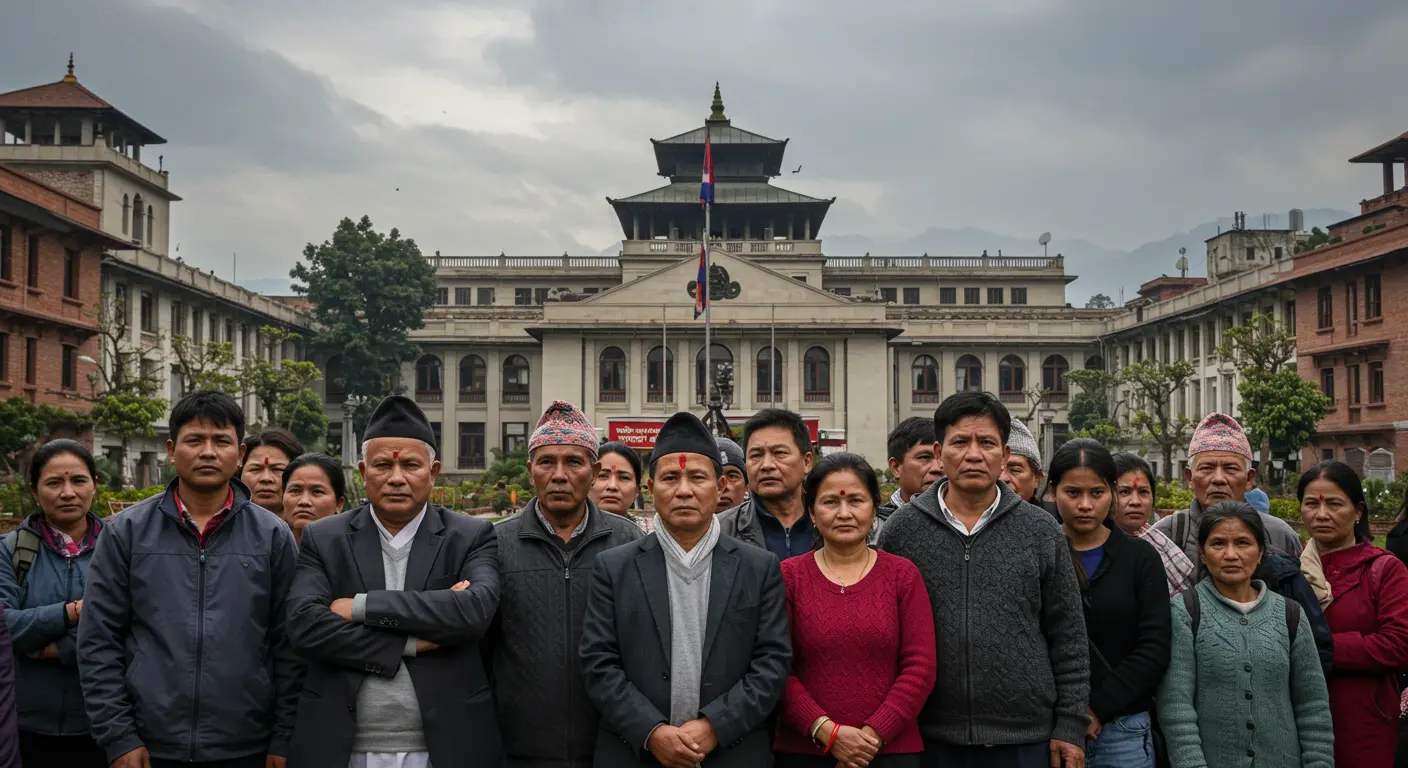
Political Kaleidoscope in Kathmandu
Nepal, a young federal democratic republic proclaimed in 2008 after centuries of monarchical rule, is going through a protracted crisis of formation.1More than a decade and a half after the historic transition to democracy, the country’s political system remains in a state of permanent turbulence. Instead of becoming the basis for stable development, state institutions have found themselves at the center of a deep crisis of confidence, the most striking manifestation of which has become chronic political instability.

Politics in Kathmandu is a kaleidoscope, with the same people and parties constantly replacing each other in power, offering neither a long-term strategy nor a coherent policy to the public. Nepal’s Westminster model of parliamentary democracy has effectively become hostage to behind-the-scenes power-sharing deals that determine the stability (or rather instability) of governments far more than election results or the will of the people.3
Recent years have provided a graphic illustration of this chaos. In March 2024, then Prime Minister Pushpa Kamal Dahal, known as “Prachanda,” replaced his main coalition partner. However, in July of that year, another reshuffle took place, resulting in Khadga Prasad Sharma Oli returning to the post of head of government.4This “revolving door policy” has become the norm, leading to a situation where the country changes on average two prime ministers a year, completely eliminating the possibility of any continuity in governance.2
This relentless cycle of power shifts exposes a fundamental problem: Nepal’s political system is structured not for effective governance, but for a permanent struggle over access to state resources. The constant reshuffling of coalitions made up of the same key players – the Communist Party of Nepal (Unified Marxist-Leninist) (CPN-UML), the Nepali Congress, and the Maoist Centre – is almost always driven by “disagreements over power sharing.”3This indicates that the main goal of political activity is not the implementation of programmatic goals for the benefit of the country, but the provision and redistribution of powers and control over financial flows for a narrow group of elites.
It is only natural that this situation is creating deep disillusionment in society. The feeling that the country is heading in the wrong direction, which, according to polls, is shared by up to 68% of Nepalis, is not just pessimism, but a rational reaction to the obvious failure of the political class.6Former King Gyanendra’s call for the restoration of the monarchy, though not widely supported, is a worrying symptom of this disillusionment. It shows that part of the population is losing faith in the democratic system itself, which is unable to provide basic stability and predictability.6
Parliament and Government: Struggle for Power Instead of Governance
The performance of the legislative and executive branches of government in Nepal clearly demonstrates how power struggles have supplanted the function of governance. Instead of being arenas for making laws and implementing public policies, parliament and the government have become battlegrounds for personal ambitions and fragile coalition intrigues. This has paralyzed the state’s ability to respond effectively to the country’s pressing problems.

Even when so-called “grand coalitions” form that enjoy comfortable majorities in parliament, such as the CPN-UML-Nepali Congress alliance, they prove dysfunctional. Their work is poisoned from the start by internal squabbles and power struggles among leaders.4As a result, such governments are unable to agree even on key issues, such as constitutional amendments, and are unable to present a unified programme of action to society.6
This internal weakness is eroding democratic procedures. Governments, even with formal majorities, increasingly resort to issuing executive orders rather than passing laws through the standard parliamentary procedure. They cite the urgency of reforms, but in practice bypass debate and oversight by legislators. A striking example was the controversial decree on amendments to the Land Law, which provoked sharp criticism from the opposition and suspicions of attempts to bribe parliamentarians.6Such practices demonstrate disregard for the role of parliament and undermine the foundations of the separation of powers.4
At the root of this instability are not so much ideological differences as structural problems in Nepalese politics, exacerbated by personality conflicts. The clash of leadership styles and ambitions of leaders such as Oli and Prachanda means that decisions are often taken unilaterally, without consulting coalition partners. This creates a fear of marginalization among junior partners and inevitably leads to the collapse of yet another alliance.4
The result is a paradoxical situation that can be described as the “tyranny of an unstable majority.” Unlike a classic “hung parliament,” where inaction is explained by the lack of a majority, in Nepal the government often has one on paper. However, this majority is so internally divided and based on short-term agreements that it is absolutely useless for implementing long-term, consistent policies. This fragility forces the executive to seek roundabout, anti-democratic ways, such as decrees. Passing a law through parliament requires consensus and debate, which can expose cracks in the coalition and provoke its disintegration. A decree avoids this risk, but at the cost of weakening parliament and further deterioration of institutions.
Political chaos in the capital is directly reflected in the regions. Changes in the composition of the national coalition immediately trigger votes of no confidence and changes of government in provinces such as Koshi and Madhesh.3This shows that the federal system, designed to decentralize power and develop local self-government, remains in practice a captive of the central political elite. It does not allow effective regional leaders to emerge and proves that federalism in Nepal has not yet become a mature and independent system of governance.
Corrosion of Trust: Corruption as a System
If political instability is a symptom of the disease, its root cause is systemic corruption, which corrodes state institutions from within and is the main factor in the decline of public trust. These are not isolated cases of bribery, but a deeply entrenched system that has become an integral part of the country’s political and economic life, protected by a culture of impunity.

International rankings only confirm the scale of the problem. According to Transparency International’s 2023 Corruption Perceptions Index (CPI), Nepal ranks a dismal 108th out of 180 countries, with a score of just 35 out of 100. Any score below 50 indicates serious levels of corruption.7Compared to previous years, the country has not shown significant progress, indicating stagnation in the fight against this evil.9
| Side | CPI 2023 rank (out of 180) | CPI 2023 Score (out of 100) |
| Butane | 26 | 68 |
| India | 93 | 39 |
| Maldives | 93 | 39 |
| Nepal | 108 | 35 |
| Sri Lanka | 115 | 34 |
| Pakistan | 133 | 29 |
| Bangladesh | 149 | 24 |
| Afghanistan | 162 | 20 |
Source: Transparency International, 20237
Public trust has been undermined by a series of high-profile corruption scandals involving high-ranking officials and politicians. These include the Bhutanese refugee scam, in which citizens were duped into emigrating to the United States for large sums; a scam involving government land in Kathmandu’s upscale Lalita Niwas district; and cases of industrial-scale gold smuggling.4These are not isolated incidents, but well-organized criminal schemes that indicate the fusion of power and crime.
The system doesn’t just tolerate corruption; it actively protects the corrupt. When police took decisive action to arrest senior politicians in the refugee case, the lead investigators were suddenly transferred to other positions, reportedly due to political pressure.11Moreover, the government has proposed a bill that would allow criminal cases against politicians to be dropped if they are deemed to be “political in nature.” This effectively creates a legal loophole for avoiding accountability for corruption crimes.11
Political instability and corruption are not two separate problems; they are in a symbiotic, mutually reinforcing relationship. Fragile coalitions need constant compromises and deals to survive. Part of these deals is protecting coalition partners and their entourage from criminal prosecution, as was the case with the charges against one party leader.3This protection breeds impunity and encourages further corruption. The proceeds of corruption are in turn used to finance political activities, bribes, and ensure loyalty, which further entrenches an unstable political system. Thus, political instability creates a demand for impunity, and corruption provides the resources to maintain political actors in power. Breaking this vicious circle without addressing both problems simultaneously is virtually impossible.
Justice in Question: Weakness of the Judicial System
Nepal’s judicial system presents a critical paradox. At first glance, the country appears to be a leader in South Asia on formal measures of rule of law. However, a deeper analysis reveals that the justice system suffers from fundamental flaws such as corruption, inefficiency, and political interference, and its failure to provide justice for past crimes undermines trust in the entire legal framework of the state.

According to the World Justice Project (WJP) Rule of Law Index 2024, Nepal ranks 1st out of 6 countries in South Asia and 69th in the world.12But this regional success is deceptive. It reflects more on the very poor performance of Nepal’s neighbors, such as Pakistan, Bangladesh, and Afghanistan, than on its own achievements.12A more detailed analysis of individual factors paints a grim picture: Nepal ranks 91st in the world for “Absence of Corruption” and 102nd for “Civil Justice.”12This suggests that although formal institutions may exist, in practice they are unable to ensure fair and incorruptible justice.
A key failure that plagues the entire system is the lack of justice for the massive human rights violations committed during the 1996-2006 armed conflict. Nearly two decades after it ended, a proposed transitional justice bill still contains provisions that could lead to amnesty for serious crimes, including murder and sexual violence, in direct contravention of international law.11This failure sends a clear message to society: even the most heinous crimes can go unpunished if they are committed by those in power.
This “fundamental impunity” for past crimes has become the basis for the normalization of corruption and abuse in the present. Many of today’s leading politicians were active participants or key figures in that conflict, and they have a vested interest in securing amnesty for their past actions.11Having failed to create a justice system that can hold them accountable for the past, they have, consciously or not, built a system that cannot hold them accountable for present corruption. If a system cannot prosecute a war crime, its ability to effectively combat complex financial fraud is seriously compromised.
The culture of impunity extends to ongoing abuses by security forces. The National Human Rights Commission has named 286 officials suspected of serious crimes, but none of these cases are known to have been prosecuted.11Moreover, in a glaring example, an officer involved in a torture case was appointed to head the national police. Instead of being punished for his alleged abuses, he was given the highest position in the law enforcement system.11For ordinary citizens, the justice system remains slow, expensive and inaccessible, especially for marginalized groups such as Dalits (“untouchables”), who continue to face discrimination.14
The Price of Inefficiency: Economic Stagnation and the Youth Exodus
Abstract failures of governance have a very concrete and high price that the people of Nepal pay every day. Political paralysis, systemic corruption and a dysfunctional justice system are not victimless crimes. Their direct consequences are a stagnant economy, a lack of prospects and a mass exodus of the most active and able-bodied part of the population – the youth.
Despite some recovery from the pandemic, Nepal’s economic growth lags significantly behind its potential and that of its neighbors.16The economy suffers from chronic problems: a huge trade deficit, low productivity, poor infrastructure, and the government’s inability to effectively implement capital projects that could stimulate growth.2
The lack of employment opportunities within the country has led to a severe youth unemployment crisis. In 2024, the unemployment rate for people aged 15 to 24 reached an alarming 20.8%.18This figure is the main factor pushing young Nepalis abroad in search of a better life. According to various estimates, there are between 2.1 and 7 million Nepalese citizens living abroad.19In the last financial year alone, more than 750,000 people officially went abroad to work.19Every day, between 1,500 and 2,000 young people leave the country.
This mass exodus has made Nepal’s economy dangerously dependent on migrant remittances, which account for between 24% and 30% of the country’s GDP.4On the one hand, this money helps millions of families survive and reduces extreme poverty. On the other hand, it creates the illusion of macroeconomic stability and reduces pressure on the government, which no longer needs to carry out difficult and painful reforms to create jobs at home.17
This creates a vicious circle that can be called the “human capital curse.” Unlike resource-cursed countries, where dependence on oil or mineral exports stifles other sectors, Nepal’s main export commodity has become its own citizens. The state’s failure to create a functioning economy pushes people out of the country. The remittances they send home stabilize the financial system and serve as a social safety net. This, in turn, allows the political elite to avoid the reforms needed to stop this exodus. In effect, the government has shifted its responsibility for job creation and social security to foreign labor markets.
In this context, mass migration becomes more than just an economic phenomenon. It is a continuous, daily referendum on the quality of governance. Every young person who buys a one-way ticket is voting with their feet, expressing a vote of no confidence in their country’s institutions and their ability to provide for their future. This is perhaps the most powerful and honest indicator of a crisis of confidence, surpassing any opinion poll. And it clearly shows the gap between the priorities of the people, who, according to polls, are most concerned about inflation, unemployment, and lack of development, and the priorities of a political elite absorbed in an endless struggle for power.21
Conclusion: The Path to Restoring Trust
Nepal’s crisis of trust in public institutions is not a problem of perception or a temporary phenomenon. It is the natural and deep-rooted result of systemic dysfunction, rooted in three interrelated elements: chronic political instability, pervasive corruption, and a compromised judiciary. These factors have created a vicious cycle that leads to economic stagnation, social despair, and a generational loss of faith in the country’s future.
The analysis shows that the state, instead of being the engine of progress, has become the main obstacle to a decent life for many citizens. The political elite, locked in an endless struggle for power, has become disconnected from the urgent needs of society. Parliament and government are paralyzed by internal strife, and the justice system is unable to ensure justice and protect the rights of citizens, which feeds a culture of impunity.
The cost of this inefficiency is enormous: a stagnant economy that cannot create jobs, and a mass exodus of young people whose labor and talents build other countries’ economies. Reliance on remittances only masks the depth of the problem, creating a dangerous illusion of stability and postponing needed reforms indefinitely.
Restoring trust requires not cosmetic measures, but a fundamental change in the very logic of the political process. It requires a decisive rejection of the short-term, personal ambition-based struggle for power in favor of transparent, accountable and effective governance focused on solving the real problems of citizens. The key task is to break the vicious circle between political instability and impunity. Only by creating conditions for stable functioning of institutions and ensuring the inevitability of punishment for corruption will Nepal be able to lay the foundation for sustainable economic growth and restore hope for the future of its citizens in their native land.
Sources used
- Nepal
- Nepal’s political and economic uncertainty
- Nepal in 2024: Political Instability, Geopolitical Contest, and Economic Growth
- Unrest and Uncertainty: The Deepening Crisis in Nepal’s Democracy
- World Report 2025: Nepal | Human Rights Watch
- Corruption and crisis define Nepal’s 2024
- Nepal ranks 108th in Corruption Perceptions Index – The Kathmandu Post
- 2023 Corruption Perceptions Index: Explore the… – Transparency.org
- Nepal Corruption Index – Trading Economics
- Nepal ranks 107th in Corruption Perceptions Index
- World Report 2024: Nepal | Human Rights Watch
- Nepal Ranks 69 out of 142 in the World Justice Project Rule of Law …
- Nepal Ranks 71st out of 142 in Rule of Law Index – World Justice Project
- Opening the Path to Equality: Access to Justice for Dalits in Nepal | OHCHR
- Progress of the World’s Women: Pursuing Justice – UN Women
- Nepal: Country File, Economic Risk Analysis | Coface
- Nepal: World Bank Report Outlines Key Reforms to Boost Growth, Create Jobs
- Nepal Youth Unemployment Rate (1991-2024) – Macrotrends
- Severe unemployment crisis: Pressing need for reforms – The Himalayan Times
- Nepal Development Update – World Bank Documents and Reports
- NATIONAL SURVEY OF NEPAL – International Republican Institute (IRI)