Key Takeaways
- The Land Use Act of 2019 is the silent enabler. More than contract law, its rigid classification of land is creating a stable, non-speculative asset base for agriculture, forcing landowners to either farm productively or lease to those who will—a critical precondition for corporate investment.
- Contract farming is not about lowering costs, but about de-risking balance sheets. For Nepal’s agro-processors, paying a predictable premium for raw materials via contract is infinitely preferable to the capital-destroying volatility of the open market, transforming agricultural supply from a variable risk into a manageable, fixed operational cost.
- The model’s success hinges on a missing middle-layer. The gap between large corporations and thousands of fragmented smallholders is too wide. The key to unlocking scale is the rise of professional third-party aggregators who manage contracts, enforce quality, and absorb counterparty risk, a role currently unfulfilled in the Nepali market.
Introduction
In the bustling industrial corridors of Birgunj and Biratnagar, a persistent, expensive silence haunts the factory floors of Nepal’s largest agro-processors. This is the sound of production lines running at partial capacity. It is the sound of a noodle manufacturer whose multi-billion rupee machinery is idle, waiting for a consistent supply of high-gluten wheat. It is the sound of a juice company paying a 40% spot-price premium for mangoes one quarter, only to see a market glut erode margins the next. This raw material volatility is not a temporary market anomaly; it is the fundamental structural weakness of Nepal’s industrial ambitions, a direct consequence of an agricultural sector defined by fragmented land holdings and unpredictable output.
For decades, the narrative has been one of market failure. But a quieter, more profound shift is underway, one rooted not in markets, but in regulations. We are on the cusp of a systemic change driven by a new legal architecture. The conversation among Nepal’s most forward-thinking business leaders is no longer about lamenting supply chain gaps, but about actively engineering solutions through legal instruments. The nascent regulatory environment surrounding land pooling (चकलाबन्दी – *Chaklabandi*) and the forthcoming Contract Farming Act is creating a pathway for corporate entities to forge direct, legally-enforceable partnerships with smallholder farmers. This is not just another government initiative; it is the blueprint for industrializing Nepal’s agriculture from the ground up.
This article moves beyond the headlines to dissect the mechanics of this transformation. We will explore how this evolving legal framework is designed to guarantee supply consistency for agro-processing giants, effectively reducing the raw material volatility that has long crippled the sector. For CEOs, investors, and policymakers, understanding this mechanism is no longer optional. It is the key to unlocking the next phase of economic growth, turning Nepal’s agrarian base from a source of liability into the nation’s most formidable competitive advantage.
From Fragmentation to Federation: The Legal Architecture of Modern Nepali Agribusiness
The story of Nepal’s agricultural underperformance is, at its core, a story of land. With an average holding of 0.7 hectares, often split across multiple non-contiguous parcels, the individual Nepali farmer lacks the scale to mechanize, invest, or produce for industrial demand. The traditional solution—land consolidation—is a political non-starter, deeply entangled with issues of ownership, identity, and ancestral heritage. The genius of Nepal’s emerging legal framework lies in its ability to circumvent this impasse. It achieves commercial consolidation without demanding ownership consolidation, a critical distinction that is paving the way for corporate engagement.
The foundational pillar of this new architecture is the Land Use Act, 2019. On the surface, its mandate to classify all land into specific categories (agricultural, residential, industrial, etc.) seems like a bureaucratic exercise. Its strategic impact, however, is profound. By designating prime agricultural land and severely restricting its conversion for non-agricultural purposes, the Act serves two vital functions. First, it halts the speculative real estate creep that was continuously shrinking Nepal’s arable land base. This provides a stable, long-term asset class for agricultural investment. Second, and more importantly, it creates a powerful incentive for unproductive landowners. A plot designated as “agricultural” that lies fallow becomes a dormant, non-appreciating asset. This ‘use it or lease it’ pressure is subtly nudging landowners towards commercial leasing and pooling arrangements with entities that can guarantee productivity.
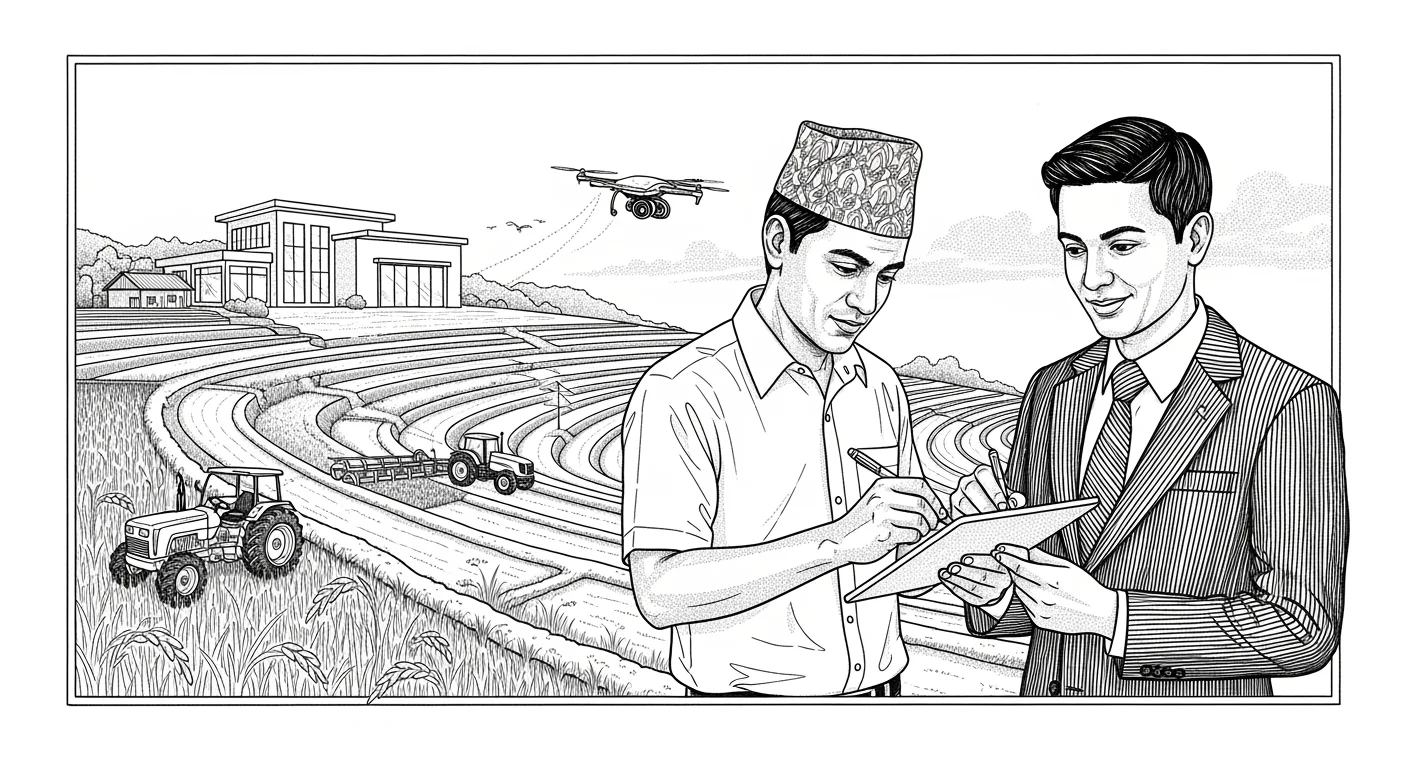
This is where the concept of *Chaklabandi* (land pooling) becomes operative. Legally recognized under the Land Use Regulations, it allows multiple landowners to pool their contiguous parcels into a single, commercially viable unit. Crucially, they retain individual ownership titles but agree to collective management, cultivation, and profit-sharing under a formal agreement. For a corporation like Dabur Nepal, which requires thousands of tons of a specific herb, this is a game-changer. Instead of negotiating with 200 individual farmers, it can now negotiate with a single legal entity representing a 100-hectare pooled block. This legal vehicle dramatically reduces transaction costs and creates a single point of accountability for quality and delivery, making large-scale farming viable for the first time.
The final layer is the impending Contract Farming Act. While contracts can be signed under the existing Contract Act, 2000, it is a blunt instrument ill-suited for the unique risks of agriculture. It offers little specific guidance on crop failure due to pests or weather, quality disputes, or price adjustments. The proposed specialized Act aims to remedy this by creating clear, enforceable guidelines for agricultural agreements. It is expected to mandate clauses on pre-agreed pricing formulas (e.g., floor price plus market-linked bonus), define quality standards, specify the inputs and technical support the corporation must provide, and establish specialized, fast-track dispute resolution tribunals. This legal certainty is the final piece of the puzzle, providing both the farmer and the corporation the confidence to enter into multi-year commitments.
The Economics of Predictability: De-Risking the Agro-Processing Balance Sheet
To understand the corporate appetite for contract farming, one must look beyond the procurement department and into the Chief Financial Officer’s office. The primary driver is not simply securing supply, but mastering predictability. For a publicly-listed food company or a large private enterprise, raw material price and supply volatility is a cancer on the balance sheet and a drag on shareholder value. It wreaks havoc on financial forecasting, complicates inventory management, and inflates the cost of capital.
The core issue is the working capital cycle. An agro-processor reliant on the open market is forced into a reactive, inefficient mode of operation. When a key commodity like tomatoes or wheat is cheap and abundant, the company must buy in massive quantities and invest heavily in storage infrastructure to buffer against future shortages. This ties up immense amounts of cash—working capital—that could otherwise be deployed for brand building, R&D, or market expansion. Conversely, during a shortage, the company must either pay exorbitant spot prices, destroying its gross margins, or scale back production, hurting revenue and ceding market share to competitors, particularly importers from India or China who benefit from more stable and subsidized agricultural systems.
Contract farming fundamentally alters this equation. Consider a large Nepali juice manufacturer. By entering into a contract with a farmers’ cooperative managing a pooled 50-hectare orchard in the Terai, the company can lock in a supply of 1,000 metric tons of oranges per year. The contract might stipulate a price that is, on average, 10-15% higher than the historical spot market price. A purely cost-focused analysis would deem this a bad deal. But a strategic financial analysis sees it as a masterstroke. That 15% premium is not an extra cost; it is an insurance premium paid to eliminate risk. It transforms a volatile, unpredictable variable cost into a stable, predictable fixed cost.
This predictability has cascading benefits. Financial models become more accurate, allowing for confident five-year strategic planning. Banks and financial institutions, seeing a de-risked business model with guaranteed supply, are more willing to extend credit at favorable rates for capacity expansion. The need for massive buffer-stock inventory is reduced, freeing up millions of rupees in working capital. The company can now run its factory at a consistent 90% capacity, maximizing return on its fixed assets. In essence, the corporation is outsourcing agricultural risk to a network of farmers and, in return, is gaining a level of operational and financial stability that is impossible to achieve in Nepal’s open agricultural market. It is a strategic trade-off: sacrificing potential for ultra-low-cost sourcing in good years for the certainty of avoiding catastrophic costs in bad years.
Beyond the Farm Gate: Contract Farming as a Gateway to the Value Chain
The corporate calculus is clear, but the model’s sustainability rests entirely on its value proposition to the smallholder farmer. For the farmer, the decision to cede autonomy over their planting decisions to a corporate partner is a significant one. The motivation to do so extends far beyond the promise of a guaranteed income; it represents a crucial entry point into the formal, modern agricultural value chain, from which they have been historically excluded.
The most immediate benefit is the transfer of technology and knowledge. The standard contract farming agreement is not merely a purchase order. It is a partnership where the corporation has a vested interest in maximizing the farmer’s yield and quality. This typically involves the provision of superior inputs—high-yield, disease-resistant seeds or saplings, specific fertilizer blends, and prescribed bio-pesticides. More importantly, it brings corporate-funded agronomists directly to the farm. For a farmer in a remote district of Karnali growing herbs, access to a professional who can diagnose soil deficiencies or implement efficient irrigation techniques is a form of capital far more valuable than a simple loan. This elevates the farmer from a subsistence-level producer to a skilled cultivator meeting industrial standards.
The second, and perhaps most powerful, benefit is the mitigation of market risk. The greatest fear that haunts a Nepali farmer is not crop failure, but a bumper crop. In a localized market, a surplus harvest can cause prices to collapse overnight, often to levels below the cost of production. This perverse incentive discourages investment and innovation. A contract with a pre-agreed price floor completely removes this existential threat. It provides a safety net, assuring the farmer that no matter how much the local market price falls, their income is secure. This security fundamentally changes the farmer’s economic behavior, encouraging them to invest in improving their land and techniques for long-term gains rather than focusing solely on short-term survival.
Finally, the signed contract itself becomes a powerful financial instrument. A farmer holding a multi-year supply agreement with a reputable entity like Chaudhary Group or a multinational operating in Nepal possesses a bankable asset. They can present this contract to a commercial bank or a microfinance institution as proof of guaranteed future cash flow. This dramatically improves their access to formal credit for purchasing machinery, expanding their operations, or meeting personal financial needs. It allows them to break free from the clutches of informal lenders who charge exorbitant interest rates, a cycle of debt that traps millions. By providing a bridge to formal finance and insulating them from market volatility, contract farming offers smallholders a tangible path out of poverty and into a more prosperous, stable future as key players in a modern agricultural economy.
The Strategic Outlook
The legal and economic gears are beginning to turn, but the trajectory of contract farming in Nepal is not pre-ordained. The next three to five years are a critical window that will determine whether this becomes a transformative national movement or a series of isolated, boutique projects. The outcome will be shaped by the interplay of legislative action, corporate courage, and the emergence of new market structures.
Two primary scenarios lie ahead. In the **Accelerated Path**, the government passes a robust and unambiguous Contract Farming Act by mid-2025. This Act must feature clear, non-negotiable clauses for timely payment and a low-cost, rapid dispute resolution mechanism at the municipal level. Simultaneously, a few pioneering corporations—perhaps in the dairy, horticulture, or spice sectors—execute highly visible, successful large-scale projects involving over 500 farmers each. The demonstrated success of these pilots, amplified by media, would create a domino effect. It would validate the model, trigger a surge in domestic and foreign direct investment into agro-processing, and establish Nepal as a credible sourcing hub. By 2028, we would see contract farming becoming a standard operating model for any serious agro-industrial player, deeply integrated into the national supply chain.
Conversely, the **Muddled Middle** scenario sees the Contract Farming Act stalled in parliamentary committees or passed as a diluted, toothless law. Ambiguity around enforcement and dispute resolution would deter large corporations from making significant, long-term commitments. They would revert to informal, season-to-season agreements with trusted suppliers, failing to achieve true scale. Growth would be slow and fragmented, leaving the majority of the agricultural sector disconnected from industrial demand. In this scenario, Nepal’s supermarkets will continue to be flooded with processed goods and fresh produce from India, and the nation’s immense agricultural potential will remain a recurring theme in seminars rather than a reality on the ground.
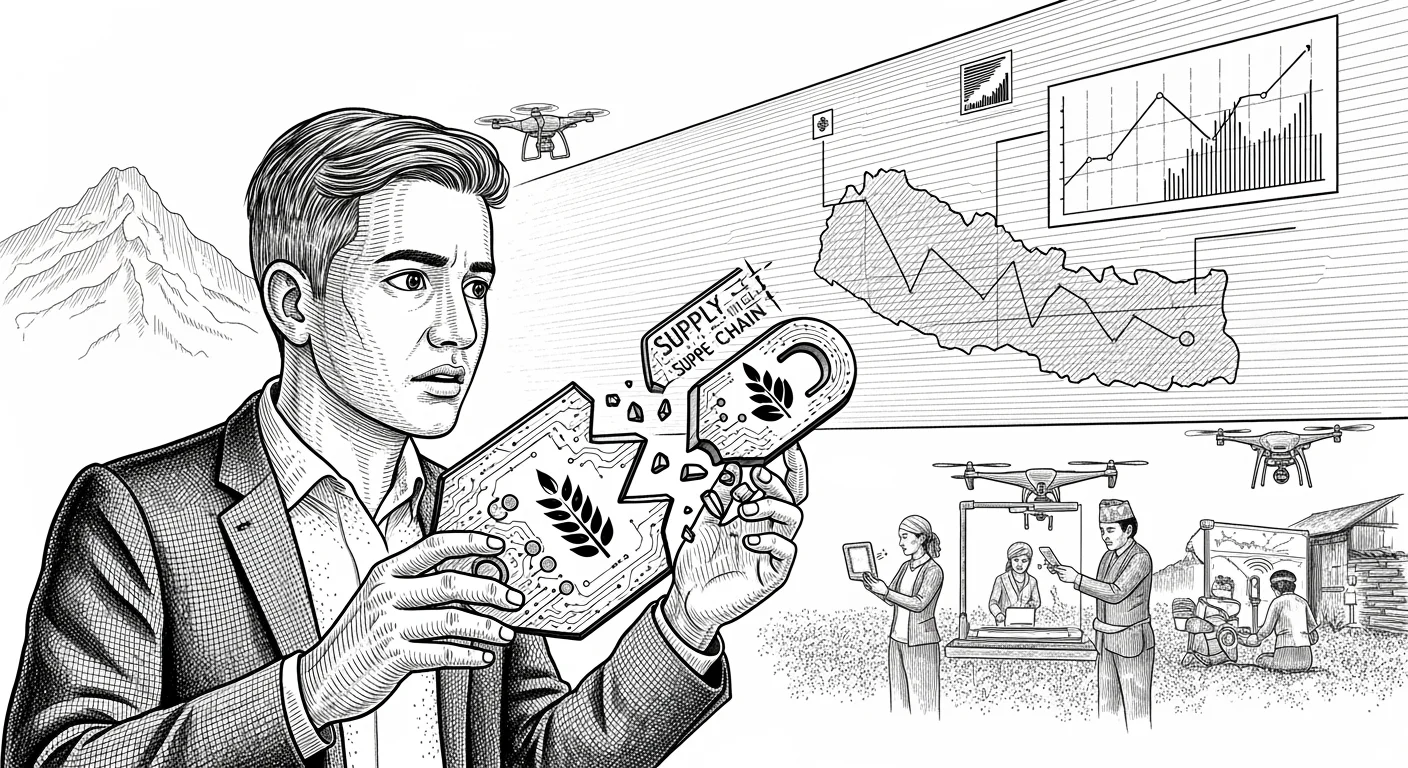
The wildcard in this forecast is the role of Agri-Tech. The fundamental challenge of the model is the high transaction cost for a single corporation to manage thousands of individual farmer contracts. This is where digital platforms can intervene. We can expect the rise of Nepali Agri-Tech startups that act as “digital aggregators.” These platforms could onboard farmers, use satellite data to monitor crop health and compliance, facilitate a transparent flow of information, and automate payments through digital wallets. Such a platform would solve the “missing middle” problem, acting as a trusted, efficient intermediary that connects corporate demand with fragmented supply at scale. The first company to successfully build and deploy this digital infrastructure will not just be a successful startup; it will be a piece of critical national infrastructure.
The Hard Truth: Ultimately, the legal frameworks and digital platforms are just enablers. The success or failure of contract farming will be determined by an old-fashioned, analog virtue: trust. The historical relationship between Nepali farmers and large commercial entities is fraught with suspicion. If the first wave of corporate contracts is perceived as exploitative, with companies using their legal power to short-change farmers on quality clauses or delay payments, the entire model will collapse. Farmers will retreat, and no law will be able to force a partnership. The long-term viability of this entire enterprise rests not on legal enforcement, but on the willingness of Nepal’s corporate leaders to build genuine, symbiotic relationships based on fairness, transparency, and a shared vision of prosperity. Without that cultural shift, even the most perfect legal architecture will be nothing more than a hollow promise.