Key Takeaways
- The core investment is in logistics and data, not just hardware. The highest returns will not come from manufacturing or selling cold storage units, but from operating a tech-enabled “cold-chain-as-a-service” (CCaaS) platform that optimizes asset utilization and provides market linkage.
- The business model pivots from large CAPEX burdens to flexible OPEX payments. This shift is the single most critical factor for adoption, as it aligns with the cash-flow realities of Nepal’s smallholder farmers and cooperatives, who cannot afford large, upfront investments but can pay for services that generate immediate returns.
- Success hinges on mastering “first-mile” aggregation, which is a human problem, not a technical one. The ultimate bottleneck is not the temperature of the cold unit but the operational complexity of consolidating produce from hundreds of fragmented, small-scale producers into economically viable volumes.
Introduction
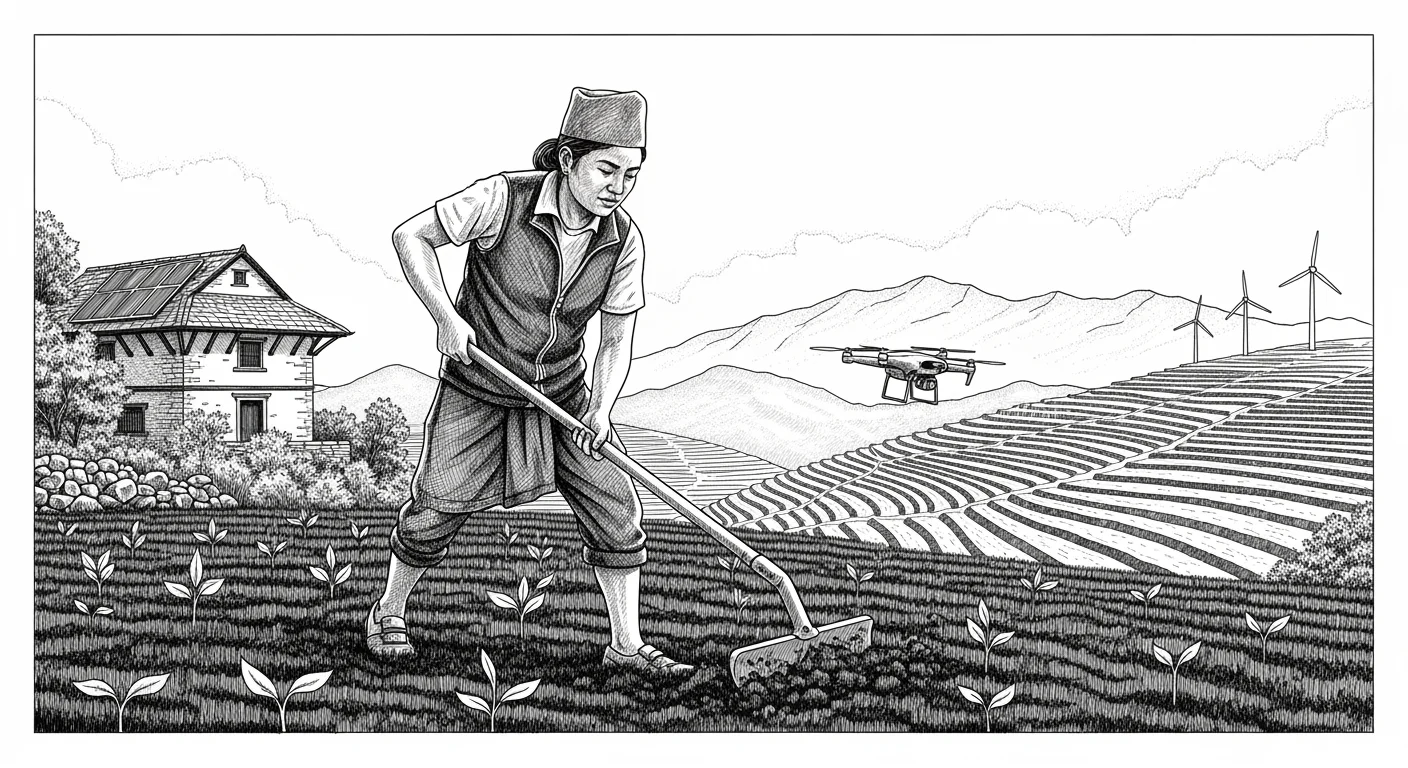
Picture a farmer in Dhading, standing over crates of ripe, red tomatoes. Three days ago, they were perfect. Today, under the unrelenting sun, a faint, sweet smell of decay signals a harsh reality. The market in Kathmandu is paying a premium, but the truck isn’t here yet. By the time it arrives, a third of his harvest—and his profit—will have been lost to the simple physics of decomposition. This scene, repeated daily across Nepal’s agricultural heartlands, represents a staggering economic hemorrhage: an estimated 30-40% of our high-value horticultural produce is lost post-harvest. This is not a farming failure; it is a catastrophic failure of logistics.
For decades, the proposed solution has been a monotonous chant of “more cold storage.” This led to a focus on large, centralized, multi-crore facilities, often located near urban centers. The model has largely failed to serve its intended user: the smallholder farmer. Why? Because it demanded that the farmer, already cash-strapped, transport his goods to a distant facility, pay significant upfront fees, and navigate a complex system. It was a solution built for large exporters, not the producer in rural Palpa or Jumla. It solved a problem, but for the wrong audience, at the wrong price, and in the wrong location.
This article argues that the real high-yield opportunity lies not in repeating this flawed, asset-heavy model, but in dismantling it. The focus of intelligent capital should be on a radically different approach: the “Micro-Cold Chain” delivered as a service. Specifically, this analysis will deconstruct the powerful economics of the “cold-chain-as-a-service” (CCaaS) model, a system where farmers pay for cooling on a flexible, per-crate, per-day basis, shifting the financial burden from crippling capital expenditure (CAPEX) to manageable operational expenditure (OPEX). This is not about selling refrigeration units; it is about selling time, market access, and financial empowerment.
From CAPEX to OPEX: The Economic Revolution of Cold-Chain-as-a-Service
To understand the revolutionary potential of CCaaS, one must grasp the fundamental economic distinction between CAPEX and OPEX from the perspective of a Nepali agricultural cooperative. A capital expenditure, or CAPEX, is a large, one-time investment in a physical asset—for instance, purchasing a 10-metric-ton cold room for NPR 2.5 million. An operational expenditure, or OPEX, is a recurring, pay-as-you-go cost to run the business—for example, paying NPR 70 per crate to store produce for two days.
The traditional model forced the CAPEX burden onto the farmer or cooperative. This is a structural mismatch with the financial reality of Nepali agriculture. A cooperative’s income is seasonal and volatile, dependent on weather, pests, and wildly fluctuating market prices. Committing to a multi-lakh loan for a cold room that may only be used intensively for 3-4 months of the year is a ruinous proposition. The asset becomes a liability, demanding electricity, maintenance, and loan repayments even when it sits empty. This is why many government-subsidized cold stores across the country are either defunct or chronically underutilized. They are fixed assets in a fluid industry.
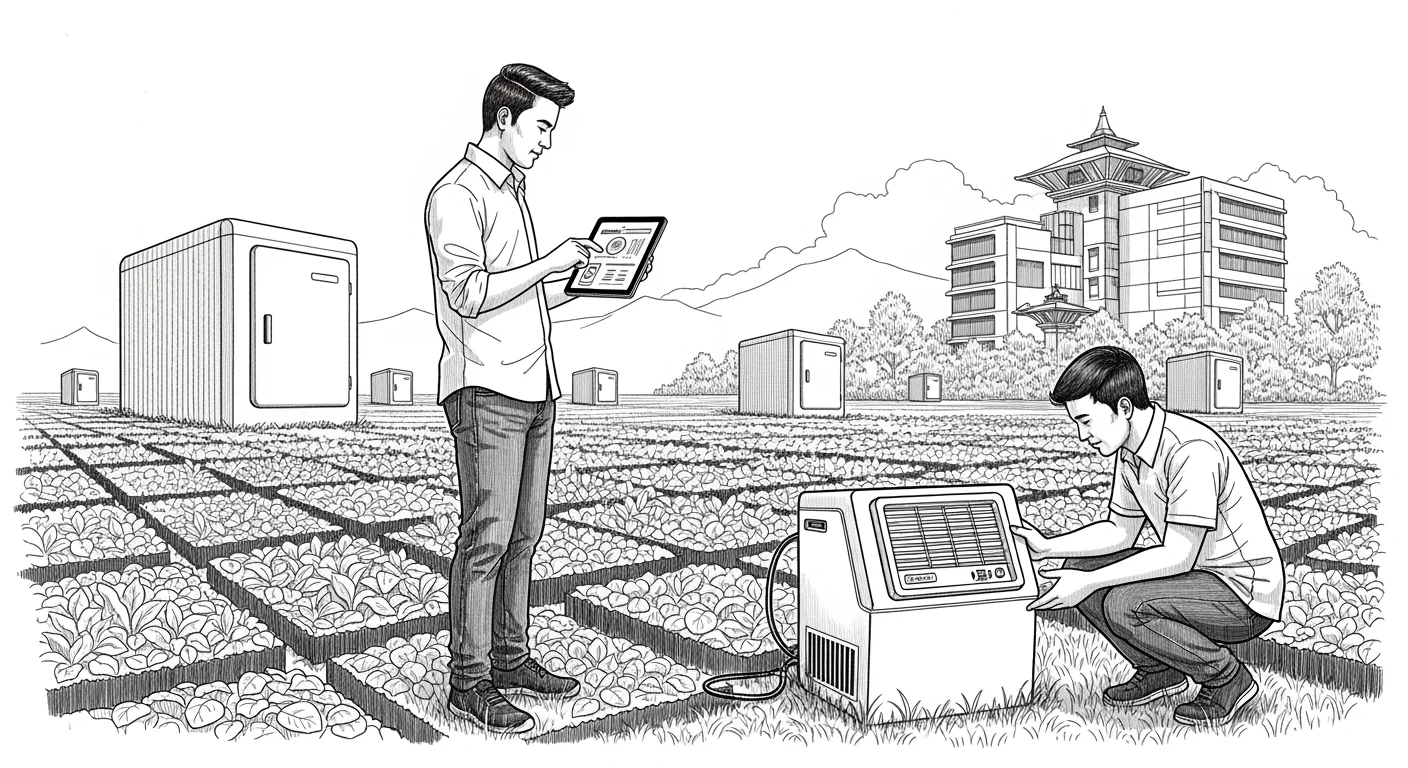
The CCaaS model flips this dynamic entirely. Here, an independent company—the CCaaS operator—makes the initial CAPEX investment in a network of modular, portable, and often solar-powered micro-cold units. These units, with capacities of 2-5 metric tons, are strategically placed at key aggregation points: a ginger cooperative in Salyan, a fish collection center in Dhanusha, or a flower market on the outskirts of Pokhara. The operator, not the farmer, bears the asset risk.
The farmer or the cooperative then interacts with the cold chain purely on an OPEX basis. They pay a small, predictable fee for a specific service: chilling a certain volume of produce for a certain number of days. This transforms the cold chain from a daunting capital investment into a simple, on-demand utility, much like topping up a mobile phone. The financial barrier to entry is obliterated. A farmer who could never contemplate a loan for a cold room can easily justify paying NPR 1,000 to preserve a harvest worth NPR 50,000, especially if that preservation allows him to avoid distress selling and capture a 20-30% higher price a few days later. This alignment of cost with immediate, demonstrable value is the engine of the CCaaS model. It solves the farmer’s most pressing problem: not the long-term need for infrastructure, but the immediate need for cash flow and market leverage.
The Unit Economics: Why a Crate of Apples is a Financial Instrument
The investment case for CCaaS becomes compelling when we dissect the unit economics at the crate level. A crate of apples from Jumla is not merely fruit; it is a time-sensitive financial instrument whose value is dictated by logistics. The CCaaS model is an arbitrage play on the time value of that produce.
Consider a hypothetical apple farmer in Jumla with 500 kilograms (approximately 25 crates) of high-grade apples.
Scenario A: No Cold Chain. The farmer must sell immediately at the farm-gate or the nearest collection point. With multiple farmers offloading their harvest simultaneously, a buyer’s market is created. The price plummets to, let’s say, NPR 80 per kilogram. The farmer’s total revenue is NPR 40,000. He sells out of necessity, not opportunity.
Scenario B: With CCaaS. A CCaaS operator has placed a 3-metric-ton solar-powered cold unit at the local cooperative. The farmer decides to store his 25 crates. The operator charges a fee of, for instance, NPR 50 per crate per day. The farmer decides to wait for 5 days for the market price in Surkhet or Nepalgunj to stabilize post-harvest-glut.
Total Storage Cost: 25 crates * NPR 50/day * 5 days = NPR 6,250.
During this 5-day window, the farmer, through the CCaaS operator’s platform or his own contacts, finds a buyer in a city market willing to pay NPR 120 per kilogram, a realistic premium for well-preserved, high-quality produce.
New Total Revenue: 500 kg * NPR 120/kg = NPR 60,000.
Net Gain: NPR 60,000 (Revenue) – NPR 40,000 (Old Revenue) – NPR 6,250 (Storage Cost) = NPR 13,750.
For the farmer, this is a phenomenal 34% increase in net income, achieved simply by controlling the timing of his sale. The NPR 6,250 was not a cost; it was an investment that yielded a direct, measurable return. For the CCaaS operator, the revenue from just this one farmer is NPR 6,250. If their 3-ton unit (which can hold roughly 150 crates) operates at 70% capacity over a 120-day apple season, their seasonal revenue from a single, movable unit can be substantial, rapidly paying down the initial asset cost. The key for the operator is utilization. An empty crate space is lost revenue, which is why the service model, which aggregates demand from dozens of farmers, is vastly superior to a single farmer owning a unit they cannot fully utilize.
Furthermore, the use of solar power is a critical variable in Nepal. It decouples the operational cost from the erratic and often expensive national grid, stabilizing the operator’s OPEX and making the service viable in remote, off-grid locations where high-value agriculture thrives. The economics are not just about preventing spoilage; they are about using temperature control as a tool to create pricing power where none existed before.
Beyond Hardware: The Unseen Layers of Data and Aggregation
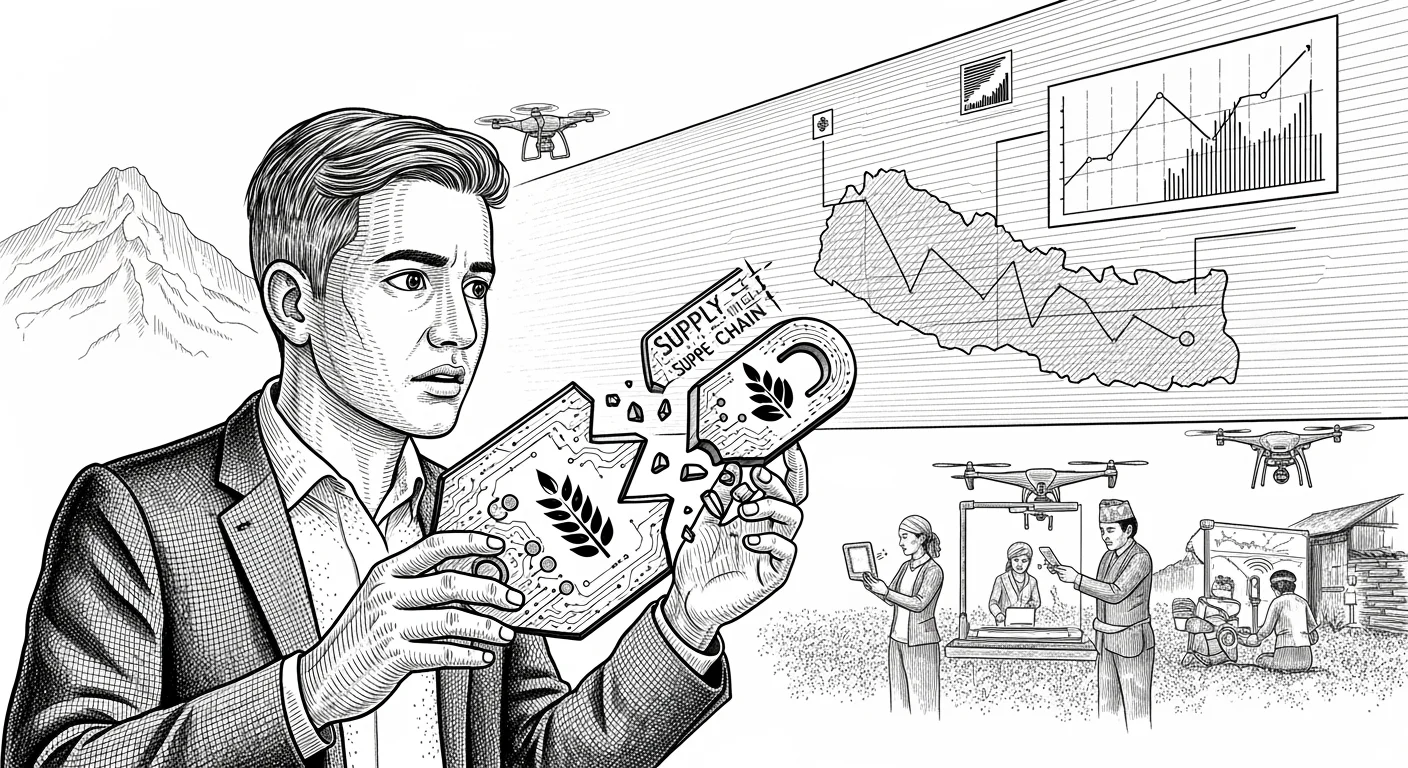
To view the micro-cold chain opportunity as merely a hardware play—selling refrigerated boxes—is to miss the multi-billion-dollar point. The box is a commodity. The true, defensible, and scalable business is built on the invisible software, data, and logistics layers that sit on top of the physical infrastructure. The cold unit solves the spoilage problem; the data platform solves the market access and trust problem.
The most successful CCaaS ventures will not be hardware manufacturers. They will be tech companies that treat cold units as nodes in a distributed logistics network. This digital layer performs several critical functions that create a powerful moat around the business.
1. Aggregation and Booking Platform: The core of the service is a simple, mobile-based platform (potentially a simple app or even a Viber-based system) where farmers can see space availability in their nearest unit and book it. This system aggregates demand, ensuring high utilization rates for the CCaaS operator. It solves the jigsaw puzzle of matching fragmented supply with available cooling capacity.
2. Market Linkage: This is the most crucial value-add. The platform doesn’t just store produce; it markets it. By aggregating data on the type, quality, and volume of produce stored across its network, the CCaaS operator can create a virtual marketplace. They can approach large buyers—supermarket chains like Bhat-Bhateni, hotel groups, or food processors—with a guaranteed, consolidated supply of quality-controlled produce. They can tell a buyer in Kathmandu, “We have 15 tons of grade-A cauliflower, chilled within two hours of harvest, available for delivery in 48 hours.” This transforms the operator from a storage provider into a high-value supply chain partner.
3. Traceability and Quality Assurance: By using simple QR codes on crates at the point of entry into the cold unit, a traceable history is created. This data—farm location, entry time into the cold chain, temperature log—is invaluable. It allows for differentiation in the market. A restaurant can confidently market “Traceable greens from Panchkhal, maintained in a perfect cold chain.” This is a direct lesson from global supply chains. In China, platforms like Pinduoduo have built empires by connecting farmers directly to consumers, with data and logistics as the foundation. A Nepali CCaaS can do the same, starting with B2B buyers.
4. Fintech Integration: The data generated by a farmer’s consistent use of the CCaaS becomes a powerful financial asset. A farmer who reliably produces and stores 10 tons of potatoes every season has a verifiable track record. This data can be used to create a credit score, allowing fintech lenders or even commercial banks to provide pre-harvest loans or inventory-backed financing. The stored produce in the CCaaS unit can act as digital collateral. This bridges the gap between agrotech and fintech, solving the farmer’s chronic lack of access to formal credit.
The Strategic Outlook
Predicting the trajectory of this nascent sector requires looking beyond the technology and focusing on the ecosystem. The path forward is not guaranteed; it is contingent on a few strategic choices made by investors and policymakers.
The Bull Scenario: In the next 3-5 years, two or three well-capitalized CCaaS operators emerge, each initially focusing on a specific high-value agricultural corridor—for example, the Dhading-Kathmandu vegetable route, the Ilam-Jhapa corridor for large cardamom and tea, or the Terai belt for fisheries and bananas. They resist the temptation to build their own hardware, instead sourcing quality units (perhaps from India, where this market is more mature) and focusing obsessively on operational excellence and the tech platform. They partner with agricultural cooperatives as their channel partners for hyper-local aggregation. Critically, the Nepal Rastra Bank, seeing the potential for secure lending, issues clear guidelines for “digital warehouse receipts,” allowing the stored produce to be legally recognized as collateral by banks. This unlocks credit, fueling a virtuous cycle of investment and production, and creating a new, high-return asset class for Nepali investors.
The Bear Scenario: The market falls into the “hardware trap.” Lured by government subsidies focused on asset purchase, the market is flooded with cheap, low-quality, inefficient cold storage units sold directly to individual farmers or dysfunctional cooperatives. Without a sophisticated service layer to manage aggregation, market linkage, and utilization, these units are used sporadically and inefficiently. High electricity costs and maintenance issues make them uneconomical. Within a few years, they are abandoned, becoming expensive, derelict sheds—a monument to a misunderstood opportunity. Investors who backed hardware manufacturers see their returns evaporate, and the entire sector gains a reputation for failure.
The Hard Truth: The hard truth is that agrotech is not about tech; it is about agriculture. The success of the micro-cold chain will not be determined in a lab in Kathmandu but in the dusty, chaotic collection centers of rural Nepal. It is a business of immense operational complexity. The winner will not be the company with the most efficient compressor or the slickest app, but the one whose team can consistently convince hundreds of skeptical farmers to trust them with their livelihoods, manage a fleet of trucks on unreliable roads, and build robust human relationships at every node of the supply chain. The opportunity for high-yield investment is immense, but it is an investment in a meticulously executed logistics and human services company that just happens to use refrigeration, not the other way around. Technology is a powerful tool, but in Nepal’s first-mile agriculture, trust is the ultimate platform.