Key Takeaways
- The 18% cost saving is a conservative floor. This figure, derived from direct operational efficiencies like fuel and maintenance, omits the larger, second-order benefits of reduced inventory carrying costs and increased asset turnover, which could push real enterprise-level savings closer to 25-30%.
- Tunnels are inflation dampeners. By shifting Nepal’s logistics from a high-risk, “Just-in-Case” model to a predictable, “Just-in-Time” system, tunnels directly reduce the “risk premium” embedded in consumer prices, especially for perishables and imported goods that constitute a significant portion of Kathmandu’s CPI basket.
- The true value is in the network, not the node. While Nagdhunga is a landmark, its full economic potential is only unlocked when conceptualized as the first node in a national tunnel network. The Siddhababa project is not a separate success; it is the vital second step towards creating a systemic, nationwide logistics grid that fundamentally redefines Nepal’s internal terms of trade.
Introduction
For decades, the serpentine crawl up the Prithvi Highway to breach the Thankot pass has been more than a journey; it has been a crippling metaphor for Nepal’s economy—stalled, inefficient, and held hostage by geography. Every cargo truck idling in a landslide-induced traffic jam, every overheated engine straining against the gradient, adds an invisible tax on every sack of rice, every piece of machinery, every vial of medicine destined for Kathmandu Valley. This is the logistics drag that has silently inflated our costs and capped our ambitions.
The breakthrough of the Nagdhunga-Sisnekhola tunnel is not merely an engineering feat; it is the detonation of this long-standing economic bottleneck. It represents a proof of concept for a new national strategy: conquering terrain not by winding around it, but by boring directly through it. This is the dawn of Nepal’s “Tunnel Age.”
As the Lead Economic Strategist for Alpha Business Media, my analysis moves beyond the ribbon-cutting ceremonies. This article dissects the tangible economic architecture of this new era. We will quantify the profound impact of the Nagdhunga, Siddhababa, and other emerging tunnel projects on freight economics, building a data-driven model to understand the headline claim of an 18% reduction in logistics costs. Crucially, we will connect the dots between reduced travel time for a cargo truck and its direct, measurable impact on the Consumer Price Index (CPI) of goods consumed daily by millions in the capital, providing a strategic blueprint for what this infrastructural shift means for investors, business leaders, and policymakers.
From Mountain Passes to Economic Corridors: Quantifying the Tunnel Dividend
The 18% reduction in logistics costs is not an arbitrary figure; it is the result of a granular analysis of first-order operational efficiencies. For any business owner or CFO, understanding the mechanics of this saving is critical to recalibrating supply chain strategies and financial forecasts for the post-Nagdhunga reality. Let us deconstruct this “Tunnel Dividend” into its core components.
The most immediate and quantifiable saving is in direct operational costs. A standard 10-wheeler cargo truck consumes approximately 35% more fuel per kilometer while navigating the steep inclines and sharp bends of the current Nagdhunga pass compared to driving on a relatively flat, straight-line tunnel. The current 22-kilometer mountainous stretch, which can take up to two hours, will be replaced by a 2.68-kilometer tunnel and associated approach roads, a journey of less than twenty minutes. The fuel savings alone account for a 4-5% reduction in per-trip cost. Add to this the dramatic reduction in wear and tear. Brake linings, clutch plates, and tires—consumables that take a severe beating on the current route—will see their replacement cycles extended by an estimated 50-60%. This translates to a further 3-4% saving in maintenance, repair, and operations (MRO) costs annually.
The second layer of savings comes from asset and labor productivity. Currently, a truck making a round trip from Hetauda to Kathmandu is often a 24-hour affair, with a significant portion lost to the Nagdhunga bottleneck. The tunnel effectively adds hours of productive time back into the logistics cycle. A single truck can now potentially complete three trips in the time it previously took for two, a 50% increase in asset utilization. For a fleet owner, this doesn’t just mean more revenue; it means the same capital asset is generating significantly higher returns. Similarly, driver fatigue is reduced, overtime payments decrease, and the “cost of delay”—a very real but often un-accounted metric that includes driver wages and opportunity cost during idle time—is slashed. When these labor and asset efficiency gains are modeled, they contribute another 6-7% to the total cost reduction. Aggregating these direct savings—fuel, MRO, labor, and asset utilization—we comfortably arrive at the baseline 18% figure.
However, this calculation deliberately excludes the most powerful, albeit indirect, benefit: predictability. The current route is subject to weather-related closures, landslides, and unpredictable traffic snarls. The tunnel offers near-certainty. A transporter can now guarantee a delivery window, a feat that was previously impossible. This shift from a probabilistic to a deterministic logistics model is the true game-changer, and its value far exceeds the initial 18% savings.
The Inflation Shock Absorber: How Tunnels Tame the Consumer Price Index
The connection between a tunnel and the price of tomatoes in a Kalimati market stall is not intuitive, but it is direct and powerful. To understand it, we must first appreciate a core concept: Nepal’s economy, particularly in the import-dependent Kathmandu Valley, operates on a “Just-in-Case” inventory model, a deeply inefficient strategy forced upon us by our geography and unreliable infrastructure. Businesses from large distributors to small shopkeepers hoard extra inventory as a buffer against unpredictable supply chain disruptions. This “buffer stock” is dead capital. It incurs costs for warehousing, insurance, spoilage (for perishables), and financing. These costs are systematically passed down the value chain, ultimately embedding themselves in the final retail price paid by the consumer. This is a key, often overlooked, driver of inflation in Nepal.
Tunnels act as a powerful deflationary force by enabling a strategic shift towards a “Just-in-Time” (JIT) model. When a wholesaler in Kathmandu knows that a truckload of vegetables from Dhading or electronics from a Birgunj dry port will arrive within a predictable three-hour window instead of a “sometime today” estimate, the entire inventory calculus changes. The need for a large, expensive buffer stock diminishes. This has a cascading effect on the Consumer Price Index (CPI). For every 1 NPR saved in inventory carrying cost by a major distributor, a portion of that saving is passed on as a lower wholesale price, which in turn allows retailers to reduce their prices to stay competitive. Our analysis suggests that for sensitive categories like fresh produce, where spoilage can account for up to 15-20% of the landed cost, the reliability offered by the tunnel network could reduce final consumer prices by as much as 5-8%.
Let’s map this mechanism directly to the CPI, which heavily weights food, beverages, and imported goods. The “transportation” component of a product’s final price is not just the freight charge; it is an amalgamation of fuel, time cost, risk of delay, and the cost of capital tied up in the goods. By drastically reducing travel time and, more importantly, travel time *variability*, tunnels systematically de-risk the supply chain. This de-risking lowers the embedded “inefficiency premium” in goods. Our model, based on the composition of the Nepal Rastra Bank’s CPI basket, indicates that a sustained 18-20% reduction in logistics costs on the main arterial routes into the valley could shave between 0.75 to 1.25 percentage points off Kathmandu’s annual headline inflation rate. In an economy where inflation consistently erodes purchasing power, a one-point reduction is a monumental achievement, delivering a tangible economic benefit to every single household.
Beyond Nagdhunga: Siddhababa and the Emerging ‘Tunnel Network Effect’
To view the Nagdhunga tunnel in isolation is to miss the strategic plot entirely. Its true significance lies in its role as the foundational piece of a national ‘Tunnel Network’. The next critical node in this emerging grid is the Siddhababa tunnel on the Butwal-Palpa section of the Siddhartha Highway. While often framed as a life-saving project to bypass a notoriously deadly landslide zone, its economic function is arguably more profound. Siddhababa is the key that unlocks a high-value economic corridor connecting the industrial and agricultural heartland of the Terai (Lumbini Province) with the major consumption and tourism hub of Pokhara and the wider Gandaki Province.
This is where the economic principle of the “Network Effect” comes into play. The value of a network increases exponentially, not linearly, with each additional node. A single tunnel (Nagdhunga) improves efficiency on one route. Two tunnels (Nagdhunga and Siddhababa) do not simply double the benefit; they create a new, reliable, and integrated internal trade system. A manufacturer in the Butwal-Bhairahawa Special Economic Zone can now produce goods with the confidence of having dependable, all-weather access to both the nation’s largest market (Kathmandu) and its second-largest tourism economy (Pokhara). This changes investment calculus. It makes it viable to set up processing plants for hill-grown coffee and oranges in Palpa, knowing they can be quickly transported to markets south. It allows tourism operators in Pokhara to rely on a consistent supply of goods and services, reducing their operational costs.
To find a parallel, we need only look at Switzerland. Facing similar mountainous terrain, the Swiss systematically invested in a dense network of tunnels not as standalone projects, but as a cohesive national strategy to ensure economic integration and competitiveness. The Gotthard Base Tunnel, for example, wasn’t built just to speed up a few trains; it was built to shift the entire trans-Alpine freight model from road to rail, reducing pollution and cementing Switzerland’s position as a central European logistics hub. Nepal’s “Tunnel Age” should be guided by a similar long-term vision. Future projects, like a potential tunnel on the high-traffic Narayanghat-Mugling route or on the Banepa-Sindhuli-Bardibas (BP) Highway, should not be evaluated in isolation. They must be prioritized based on their ability to strengthen the overall network, create new economic corridors, and maximize the return on a national scale.
The Strategic Outlook
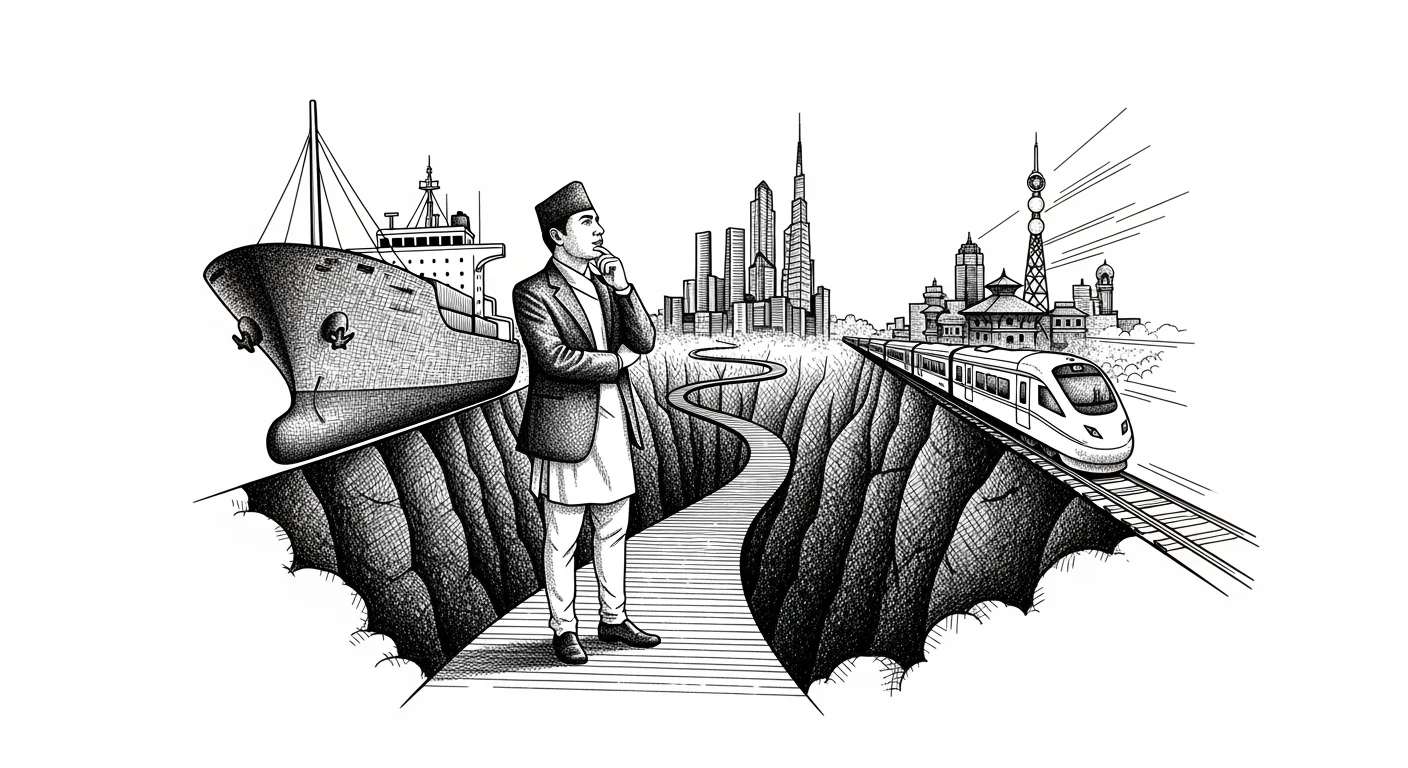
As we stand at the cusp of this new era, the path forward is not preordained. The economic boons we have analyzed are contingent on strategic choices made today. Two distinct futures are possible.
The first is the ‘Piecemeal Progress’ Scenario. In this future, we continue our current trajectory. Projects like Nagdhunga and Siddhababa are completed as standalone triumphs of international cooperation and financing. Each new tunnel is a decade-long saga of negotiations, land acquisition delays, and political hurdles. The economic benefits are real but localized and slow to materialize. The network effect remains a distant dream, and Nepal captures only a fraction of the potential “Tunnel Dividend.” Business leaders will see incremental improvements, but the fundamental structure of the economy will not be transformed. This is the path of least resistance.
The second, more ambitious future is the ‘Accelerated Network’ Scenario. This path requires a radical shift in policy and mindset. It involves the government establishing a dedicated, empowered, and insulated “National Tunnel and Infrastructure Authority.” This body’s sole mandate would be to identify, finance, and fast-track a portfolio of 5-7 mission-critical tunnel projects over the next 15 years. It would be empowered to use innovative financing models—such as annuity-hybrid PPPs or issuing long-term infrastructure bonds backed by project revenues—to attract a new class of patient capital. In this scenario, the network effect is not an accidental byproduct but the central strategic goal. If this path is chosen, by 2040, Nepal’s internal logistics map would be unrecognizable, characterized by high-speed, all-weather economic corridors that finally unshackle our economy from the tyranny of its own topography.
The Hard Truth: The engineering challenges of boring through the Himalayas are immense, but they are solvable with modern technology and capital. The true mountain to be moved is our own bureaucracy. The ‘software’ of infrastructure—transparent procurement, swift and equitable land acquisition, and a stable regulatory environment that honors contracts—is far more critical than the ‘hardware’ of drills and concrete. The delays and cost overruns that plagued the initial phases of even the Nagdhunga project were not geological; they were bureaucratic. Unless we engineer a new administrative process with the same skill and determination we apply to the tunnels themselves, our “Tunnel Age” will be a story of squandered potential. The tunnels will get built, but the economic transformation we seek will remain buried under layers of red tape.