Himalayan rope
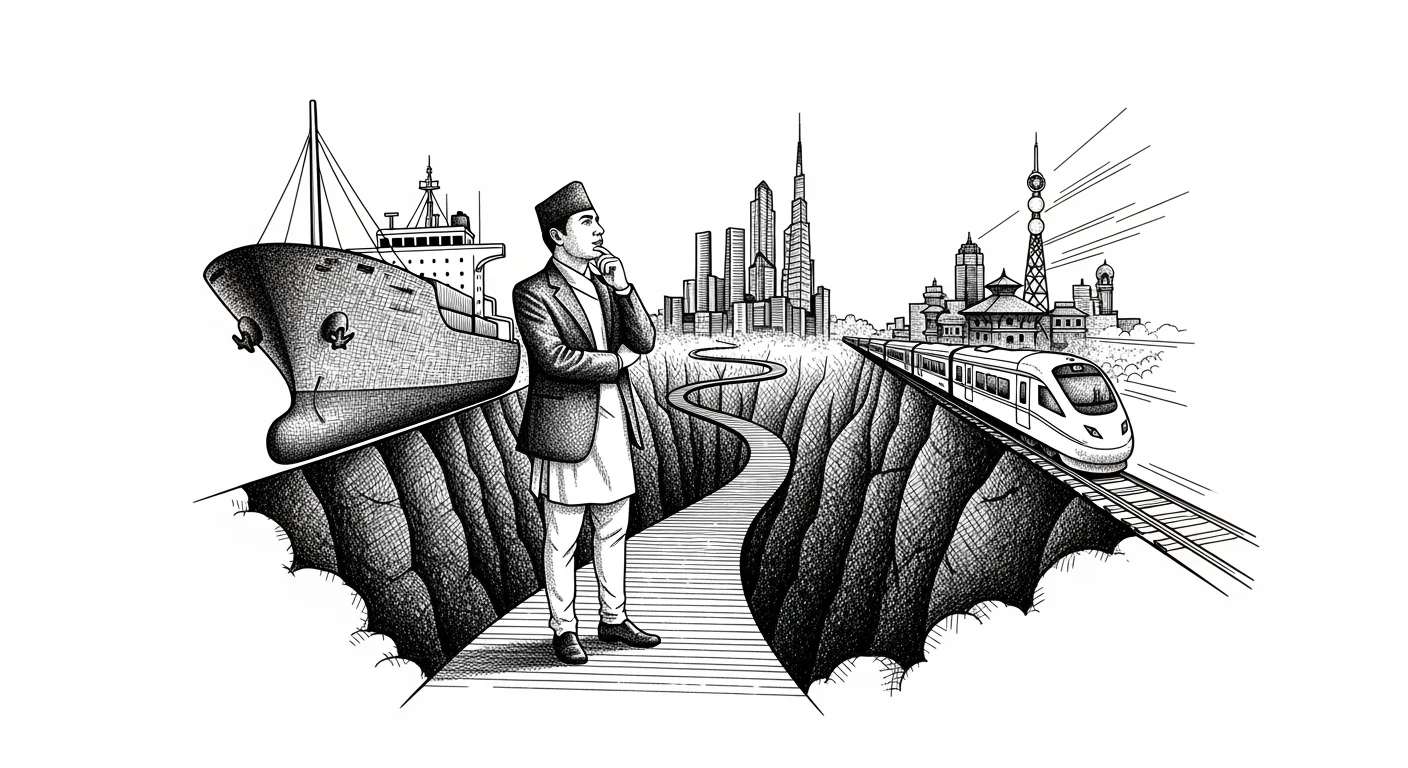
Situated at the top of the world, Nepal has historically been sandwiched between two civilizational giants – India and China.1But in 2025, its position is best described not as passively caught between a rock and a hard place, but as an active and precarious geopolitical tightrope walker. It is not just a buffer state, but a strategic actor, albeit one with limited capabilities, that is trying to exploit the rivalry of its powerful neighbors to achieve its own goals: national development, economic diversification, and, ultimately, the strengthening of sovereignty.1
For decades, Nepal has skillfully navigated between Delhi and Beijing, maintaining a fragile balance.2But the stakes are higher than ever. China, pushing its global Belt and Road Initiative (BRI), is seeking to transform Nepal from a landlocked country into a land-linked one, with ambitious infrastructure projects that could permanently change the region’s economic geography.3India, for its part, is stepping up its “Neighbourhood First” policy, seeking to strengthen historic ties and counter Beijing’s growing influence through its own investments, particularly in the strategically important energy sector.
This fact-based, neutral report examines how this rivalry is reflected in every aspect of Nepal in 2025. We look at how foreign policy vectors affect the fragile domestic politics of Kathmandu, where coalitions are made and broken based on the alignment with the southern or northern neighbor. We examine the “great game” of infrastructure, from the Trans-Himalayan Railway to hydroelectric dams, assessing real progress and hidden risks. And finally, we examine economic indicators – trade, investment, and debt – to answer the central question: can Nepal walk this Himalayan tightrope without losing its balance or sacrificing its sovereignty?
The Legacy of Balancing: From the ‘Special Relationship’ to Strategic Diversification
To understand the complex dynamics of 2025, it is necessary to look back at the history that has shaped Nepal’s contemporary position. For much of its history, Nepal was within India’s exclusive sphere of influence. This relationship was not simply political or economic; it was deeply rooted in shared religion, culture, and close people-to-people ties.5Some three million Nepalis live and work in India, and Delhi has granted Kathmandu vital duty-free transit rights to trade through its territory, an existential necessity for the landlocked country.5
However, this closeness had its downside. Nepal often saw India not as an equal partner, but as an “older brother” prone to micromanagement and interference in domestic affairs.6The 1950 Treaty of Peace and Friendship, which formalised this “special relationship”, was controversial in Kathmandu from the outset, as some of its provisions were seen as limiting Nepal’s sovereignty and placing it under India’s security umbrella.6This long-standing sense of resentment and desire to assert independence created fertile ground for the search for alternatives.
China became such an alternative. Formal relations between Kathmandu and Beijing began in the mid-20th century. In 1960, a peace and friendship treaty was signed, and in 1961, an agreement was reached to build a road connecting Kathmandu with Tibet, which became the first strategic step to break the geographical isolation from its northern neighbor.8During the Sino-Indian border war of 1962, Nepal adopted a position of neutrality, laying the foundation for its future balancing policy.8
The turning point that turned gradual diversification into a national imperative was the fuel crisis of 2015. Following the adoption of Nepal’s new constitution, a de facto blockade was created on the Indo-Nepal border, leading to severe shortages of fuel and essential goods. In Kathmandu, this was perceived as deliberate pressure from India.1The episode came as a national shock to Nepal, highlighting the vulnerability of being completely dependent on one neighbor. As a direct consequence, Nepal signed a landmark transit agreement with China in March 2016, formally ending India’s monopoly on Nepal’s access to seaports and global markets.6
This shift has been reinforced by domestic political developments. The rise of Maoist and other leftist parties in Nepalese politics in the 2010s has led to an ideological rapprochement with Beijing and a gradual distancing from traditional ties with New Delhi.10Thus, by 2025, Nepal’s policy was no longer simply a response to geography; it was the result of a conscious strategic choice born out of historical experience and a desire for greater autonomy on the global stage.
Political Arena 2025: How Foreign Policy Shapes Domestic Power
In 2025, Nepal’s domestic politics are inextricably linked to its foreign policy balancing act. The geopolitical rivalry between India and China is not just a backdrop but an active factor that directly influences the formation and dissolution of government coalitions, shapes the careers of political leaders, and sets the tone for public debate. The country’s political landscape is highly unstable, with frequent changes of government even within a single election cycle.12
A clear example of this dynamic was the coalition change in March 2024. Prime Minister Pushpa Kamal Dahal, known as Prachanda, suddenly broke his alliance with the Nepali Congress, traditionally seen as closer to India, and formed a new government with the Communist Party of Nepal (Unified Marxist-Leninist), led by KP Sharma Oli. Oli is known for his strong pro-China stance, and the move was seen as a clear tilt in Kathmandu toward Beijing.13Such sharp reversals make Nepal’s foreign policy difficult to predict and complicate long-term planning for its partners.
This instability is fueled by the fact that for Nepalese political elites, foreign policy has become a key tool in the domestic struggle for power. The ability to secure support and, more importantly, funding from Delhi or Beijing directly affects the political weight and legitimacy of a leader.14Visits to the capitals of neighboring countries become a kind of political theater for the domestic consumer. The signing of a memorandum of understanding or the launch of yet another “feasibility study” on a project is presented as a major diplomatic victory, even if the actual implementation of the project is delayed for years or does not begin at all. This explains why many much-heralded initiatives, especially those under China’s Belt and Road Initiative, have shown “glacial progress.”15: political gain is gained at the moment of signing, and the burden of complex and costly implementation is shifted onto the shoulders of future governments.
Despite these partisan maneuvers, there is a broad “national consensus” in Nepal on the need to maintain good relations with both giants. Maintaining long-term ties with China as an indispensable development partner is a common position among all major parties, regardless of who is in power, Nepali politicians, including former senior officials, say.16Nepal’s official foreign policy is based on the principles of non-alignment and a commitment to a balanced approach.6Nepalese leaders are aware of the risks of becoming overly dependent on either side and are keen to avoid becoming a pawn in someone else’s game.16
The situation is further complicated by the “third player” – the United States. The US Millennium Challenge Corporation (MCC), which has provided Nepal with a $500 million grant to develop energy and road infrastructure, has become the subject of fierce political controversy. The ratification of the MCC agreement in parliament in 2022 has sparked widespread protests and accusations that the initiative is part of the US Indo-Pacific strategy aimed at containing China and undermines Nepal’s sovereignty.16In 2025, the program’s future is in question due to a review and potential cut of the MCC’s global budget in Washington, adding another element of uncertainty to Kathmandu’s already complex geopolitical solitaire.18Nepal is thus forced to balance not between two, but between three centers of power, each of which offers its own opportunities and carries its own risks.
The Great Infrastructure Game: Roads, Rails, and Rivers of Influence
Infrastructure has become a key arena for the rivalry between India and China for influence in Nepal. Each side uses large-scale projects – from railways and airports to hydroelectric power plants and pipelines – as a key tool for soft power and strategic penetration. For Nepal, this represents a unique opportunity to modernize its aging infrastructure, but also a huge risk of financial and political dependence.

China’s Belt and Road Initiative (BRI) and the Trans-Himalayan Dream
China’s Belt and Road Initiative (BRI) offers Nepal a truly transformative opportunity: to transform itself from an isolated mountain country into a vital transit hub linking China with South Asia.3Nepal joined the BRI in May 2017, and the initiative has since dominated the discourse on China-Nepal relations.1
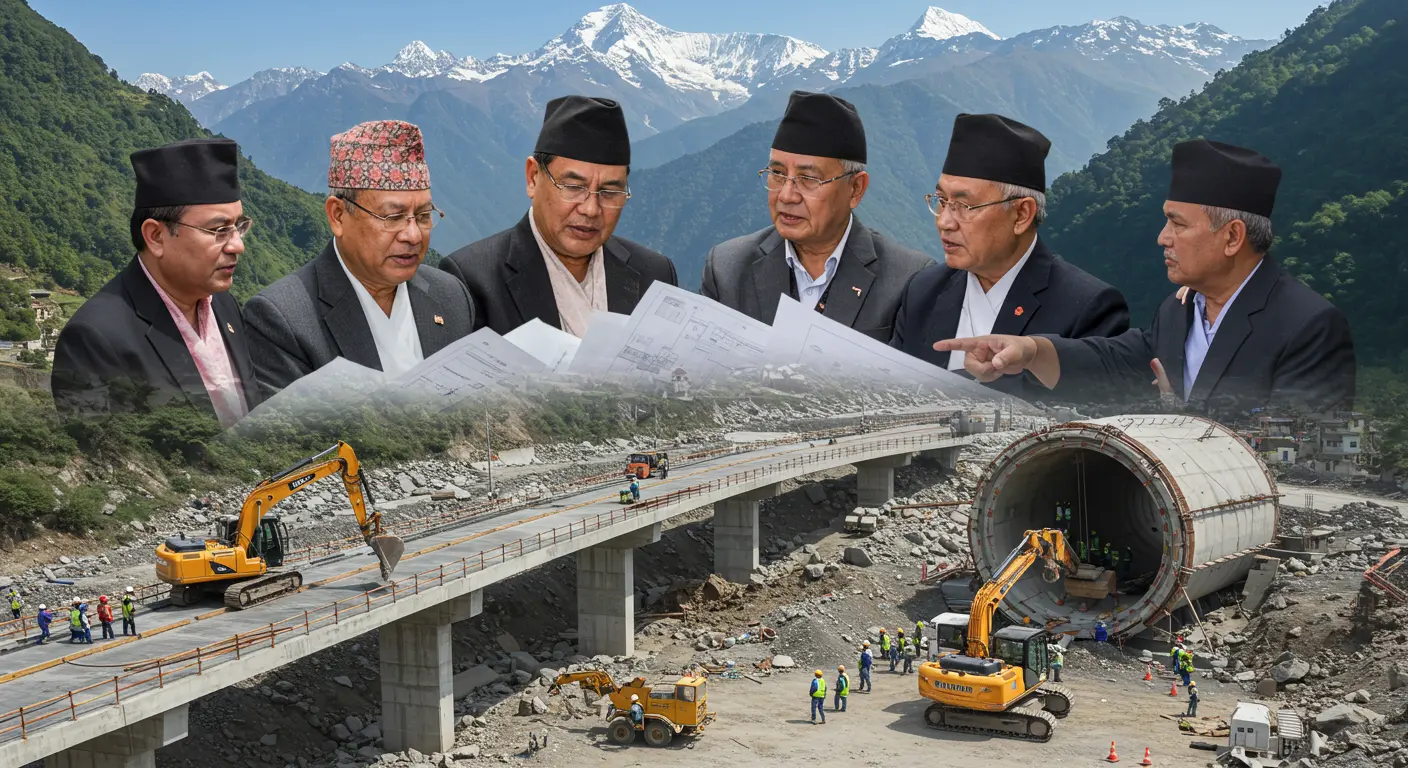
The centerpiece of the Chinese proposal is an ambitious Trans-Himalayan Railway project that would connect the Tibetan town of Kherung with the Nepalese capital, Kathmandu.15The project is seen in Kathmandu as a strategic breakthrough that could diversify trade routes and reduce dependence on India. But its implementation is fraught with enormous challenges. Preliminary studies show that more than 98% of the 72-km Nepalese section of the road will have to be built in tunnels and over bridges to overcome the extreme terrain of the Himalayas.22As of April 2025, the Chinese side is conducting a comprehensive feasibility study on the project, which is expected to be completed by mid-2026.23
Apart from the railway, other projects under discussion within the BRI include the construction of the Tokha-Chhahare tunnel, upgrading of roads connecting Nepal with the Chinese border, and development of hydropower.25One of the signature projects that China often refers to as BRI is the Pokhara International Airport, built with Chinese loans and due to open in 2023. However, this claim is in dispute, as Nepal insists the airport agreement was made before the country joined the BRI, and Kathmandu does not officially recognize it as part of the initiative.27
The main and almost insurmountable obstacle to the implementation of BRI in Nepal remains the issue of financing. From the very beginning, Nepal has clearly stated that it is not in a position to take on commercial loans for the implementation of expensive projects and insists on receiving grants.30China’s BRI model, by contrast, is primarily focused on loans rather than grants.28This fundamental conflict of interest has meant that, seven years after the signing of the BRI memorandum of understanding, not a single major project has been launched.4
Nepal’s concerns are fueled by the negative experiences of other countries, such as Sri Lanka, which was forced to hand over the long-term lease of the Hambantota port to China due to its inability to service its debt. The risk of falling into a “debt trap” is one of the main constraints for Kathmandu.9

To break this deadlock, a new “Belt and Road Cooperation Framework Agreement” was signed during Prime Minister Oli’s visit to China in December 2024.32In this document, the parties moved away from the rigid wording of “grants” or “loans” and used the compromise and deliberately vague term “aid assistance financing”.26This allows both sides to save face and claim progress, but in reality it only postpones the solution to the key issue. It is assumed that the financing terms will be negotiated individually for each of the 10 selected projects, which opens up space for long and difficult negotiations. Thus, China’s “trans-Himalayan dream” in 2025 remains more of a strategic promise and a tool of influence than a reality under construction.
India’s Neighbourhood First Policy: A Countermove Through Energy and Connectivity
India, alarmed by China’s growing activity in its traditional backyard, is responding with its own strategy, known as the Neighbourhood First policy.35Unlike the single mega-brand BRI, India’s approach is more diversified, aimed at strengthening existing ties and creating new dependencies in sectors where Delhi has compelling advantages.
A key area of Indian influence is energy. Nepal has enormous hydroelectric potential, and India has positioned itself as a major investor and the only major market for Nepalese electricity. The flagship project here is the 900-MW Arun-3 hydropower plant, which is being built by a subsidiary of India’s state-owned SJVN. As of June 2024, the project was more than 74% complete, and power generation is expected to begin in 2025.37India is actively using its market position to exert strategic pressure on China: Delhi adheres to a policy of refusing to purchase electricity from hydroelectric power plants built with the participation of Chinese companies or with Chinese loans.7This makes Chinese investment in Nepalese hydropower extremely risky and financially unviable, as Nepal has no other market for such volumes of energy.
Beyond hydropower, India is strengthening its ties in hydrocarbon supplies. In October 2024, the Indian and Nepalese oil corporations signed a major agreement to upgrade infrastructure for transporting petroleum products. The project, with a total investment of about Rs 15 billion, includes new pipelines and storage facilities, tying Nepal’s energy security even more closely to India.38

In the area of transport connectivity, India is also proposing its counter-project to the Chinese railway – the construction of a railway line from the Indian city of Raxaul to Kathmandu.23The Indian side has already completed and handed over to Nepal a study report on the final location of the route. However, as with the Chinese project, actual construction has not yet begun and the timing remains uncertain.23It is important to note that the Indian project is broad-gauge, while the Chinese one is standard-gauge. This technical difference is not accidental: it creates a de facto barrier to the creation of a single transit corridor from China to India via Nepal, allowing India to retain control over access to its rail network.23
Beyond hard infrastructure, India has been actively using soft power tools, drawing on historical proximity. This includes providing humanitarian and medical aid, such as $2 million in vaccines and medicines in 2025, which reinforces India’s image as a reliable partner that comes first in times of need.40
Thus, India’s strategy is not to out-invest China, but to use its unique geographic and market advantages to achieve “strategic denial” – creating conditions in which Chinese projects in Nepal become economically unviable or isolated.
Key Infrastructure Projects in Nepal: Arena of Competition (2025 Status)

The Price of Partnership: Economic Sovereignty at Stake
The intense courtship of India and China, accompanied by promises of multi-billion dollar investments, presents Nepal with both opportunities and serious challenges to its economic sovereignty. An analysis of key economic indicators – foreign direct investment (FDI), trade balance, and public debt structure – allows us to assess the real extent of Kathmandu’s dependence on its neighbors and understand how justified are fears of a “debt trap.”

In the realm of FDI, despite the narrative of rapid Chinese penetration, India still maintains its leading position. According to the Central Bank of Nepal’s report for the fiscal year 2022/23 (with data up to mid-2024), India accounts for 35% of the country’s total FDI stock, amounting to INR 103.45 billion. China is a distant second with 12% or INR 35.46 billion.43This demonstrates the deep and historical integration of Indian capital into the Nepalese economy, especially in the industry and services sector.
The picture is very different in the area of trade. Nepal has a huge trade deficit with both its neighbours, but the imbalance with China is particularly significant and a matter of grave concern. An analysis of trade flows for the first eleven months of the 2023/2024 financial year showed that trade between Nepal and China more than doubled. However, this growth was almost entirely due to Chinese imports worth about US$696 million, while Nepal’s exports to China were only worth US$12.3 million.9This asymmetric trade structure increases Nepal’s dependence on China as a supplier of industrial and consumer goods and limits its own export opportunities.46
The most sensitive issue directly related to sovereignty is public debt. The popular narrative in media and policy circles about the Chinese “debt trap” paints a picture in which Nepal risks repeating the fate of Sri Lanka. However, the actual data as of early 2025 shows a different reality. According to the report of the Public Debt Management Office of Nepal, as of January 2025, the country’s total external debt was NPR 1,301.41 billion. The key point is that the vast majority of this debt – 89.29% – is owed to multilateral creditors such as the World Bank (through the International Development Association, IDA) and the Asian Development Bank (ADB).47These organizations provide loans on extremely favorable terms with low interest rates and long repayment periods.
Bilateral creditors account for only 10.21% of external debt. In this small category, the largest creditors are Japan and the Eximbanks of India and China.47So, Nepal is not currently in a Chinese “debt trap.” However, this does not mean that there is no risk. The danger lies in the future. If major infrastructure projects under the BRI, such as the multi-billion dollar Trans-Himalayan Railway, are financed with Chinese commercial loans, this could dramatically change Nepal’s debt structure, dramatically increasing its dependence on a single creditor and posing a real threat to its financial stability and sovereignty.9
This is why the “debt trap” debate in Nepal is not so much a reflection of the current economic situation as it is a powerful political tool. For opposition factions and civil society, it is a powerful argument for demanding grant funding from China. For India and the US, it is a way to warn Kathmandu against getting too close to Beijing. The fear of a “debt trap” has thus become an important factor shaping Nepal’s negotiating position and holding back the implementation of the riskiest BRI projects.
Nepal’s Economic Interdependence: Key Indicators (2023-2025)

Conclusion: Navigating in the Shadow of Giants
By 2025, Nepal finds itself at the epicenter of a complex geopolitical game, dancing a precarious tightrope between the ambitions of India and China. Analysis shows that Kathmandu is not a passive victim of circumstance; it is actively trying to use this rivalry to solve its own pressing problems – overcoming its infrastructure backwardness and diversifying its economy. This strategy has borne some fruit: Nepal has become the target of unprecedented infrastructure proposals from both neighbors.

But the price of this attention is high. External rivalries directly spill over into domestic politics, causing chronic instability and turning foreign policy orientations into bargaining chips in the struggle for power. Grand projects, whether China’s Trans-Himalayan Railway or India’s Raxaul-Kathmandu line, are bogged down in endless negotiations and studies, confronted with fundamental disagreements over funding and geopolitical concerns.
Public opinion in Nepal, polls show, reflects this desire for a pragmatic balance. Nepalis value deep cultural and human ties with India, but also see China as a source of much-needed investment and an opportunity for economic growth. They expect their government to act in the national interest without being completely biased toward either side.50
The presence of a third influential player, the United States, with its MCC program, further complicates this balance, forcing Nepal to maneuver in a trilateral format and take into account not only regional but also global fault lines.52
Ultimately, the greatest challenge for Nepal in 2025 lies not externally but internally. The issue is not choosing between India and China, but building strong, stable, and competent domestic institutions capable of managing this complex process. Without building a national consensus on key foreign policy issues and improving the effectiveness of the state apparatus, Nepal risks allowing external pressures and temptations to lead not to development but to further fragmentation and loss of sovereignty. The success or failure of its Himalayan tightrope walk will depend less on Beijing’s largesse or Delhi’s goodwill than on the political maturity and unity of Kathmandu itself.
Sources used
- Articles – Journal “Bulletin of the Institute of Oriental Studies of the Russian Academy of Sciences”
- Map sets India at odds with Nepal – Nezavisimaya Gazeta
- China-Nepal railway to be a game changer, transform Nepal from landlocked to landlinked: former envoy – Global Times
- The Belt and Road Initiative: Assessing Its Implications for Nepal’s Development
- Conflict of Interests between India and China in Nepal – Topic of Scientific …
- Transformation of Nepal’s Role in the India-Nepal-China Triangle
- The Great Himalayan Chessboard: China, India, and the Geopolitical Gambit in Nepal
- China-Nepal relations – Wikipedia
- Dynamics and Geopolitical Interests in China-Nepal Relations – SpecialEurasia
- India-Nepal relations – Wikipedia
- India’s Search for Optimal Foreign Policy – New Eastern Outlook
- Nepal in 2024: Has Political Instability Finally Come to an End …
- Nepal’s Political Landscape: 2024 Update – SRIRAMs IAS
- On a path to embrace Chinese models – The Kathmandu Post
- Glacial progress on 10 BRI projects – The Kathmandu Post
- Exclusive: Maintaining long-term relations with China a ‘national …
- The MCC Debate and U.S.-Nepal Ties in Flux – OBSERVER RESEARCH FOUNDATION
- MCC faces major global budget cut, Nepal projects in doubt – The Kathmandu Post
- Partnership Tested: Shuttering MCC Would Send the Wrong Signal to Nepal and Hand a Win to China | Center For Global Development
- BRI in Nepal: An Appraisal – Observer Research Foundation
- How Nepal Balances Between China and India – EDNews.net
- China–Nepal railway – Wikipedia
- India-China rail race | Nepali Times
- Geological study for Kerung-Kathmandu railway enters final phase
- Decoding China’s BRI Agreement with Nepal – Vivekananda International Foundation
- What do we know about the new BRI deal? – The Annapurna Express
- China’s National Security White Paper and South Asia’s Absence
- China, Nepal and the BRI dilemma – The Kathmandu Post
- Nepal’s Approach to China’s BRI | Vivekananda International Foundation
- Nepal rules out loans for BRI projects; emphasises grants, consensus – The Economic Times
- Challenges of implementing BRI framework | The Annapurna Express
- NEPAL: BRI Cooperation Deal Signed with China – HKTDC Research
- Challenges In Executing BRI Projects – The Rising Nepal
- Nepal-China BRI Framework: What ‘Aid Assistance Financing’ Entails – ETV Bharat
- India’s Neighbourhood First Policy | Current Affairs – Vision IAS
- A Decade of ‘Neighbourhood First’: Perspectives from South Asia
- India-Nepal Energy Partnership …
- India, Nepal strengthen energy partnership with B2B petroleum infrastructure deal – India News Network
- Prospects for opening a railway to Everest – 4sport.ua
- India-Africa Partnership: A Shared Desire to Grow Together as Equals
- India sends USD 2 million in medical aid to Nepal under Neighbourhood First Policy
- MCC Nepal Compact exempted from US aid pause, implementation to continue
- Nepal receives FDI from 58 countries with industrial sector having largest share
- Nepal’s FDI stock rose 11.8 percent to Rs295.50 billion – The Kathmandu Post
- Nepal Foreign Direct Investment: % of GDP, 2001 – 2024 | CEIC Data
- Quarterly Debt Report
- Nepal: Fourth Review Under the Extended Credit Facility Arrangement—Debt Sustainability Analysis in – IMF eLibrary
- Nepal-Joint World Bank-IMF Debt Sustainability Analysis
- BALANCING THE HIMALAYAN NEIGHBOURS: UNPACKING NEPAL’S PUBLIC PERCEPTION OF INDIA AND CHINA
- A SURVEY OF PUBLIC OPINION IN NEPAL: India and China in Competition
- Nepal’s Geopolitical Crossroads: Balancing China, India, and the United States
- Geoeconomics: The new geopolitics in Nepal – The Kathmandu Post
- China fails to push BRI implementation plan in Nepal