Key Takeaways
- The Paradox of Penetration: Despite near-ubiquitous mobile phone ownership in Nepal, the adoption of mobile payments for daily transactions remains strikingly low, creating a vast, untapped market driven by a deeply entrenched cash-based culture and a significant trust deficit in digital systems.
- Beyond Payments to Platforms: The most significant investment opportunity lies not in basic payment processing, but in building integrated “super-apps” that leverage payment data to offer adjacent services like micro-credit, insurance, and investment products, thereby creating a compelling value proposition that cash cannot match.
- Regulatory Evolution is Key: While Nepal Rastra Bank has laid a foundational regulatory framework, future growth hinges on a more agile and enabling policy environment, including the implementation of a true regulatory sandbox, streamlined licensing, and strategic incentives for small and medium-sized enterprise (SME) adoption.
Introduction
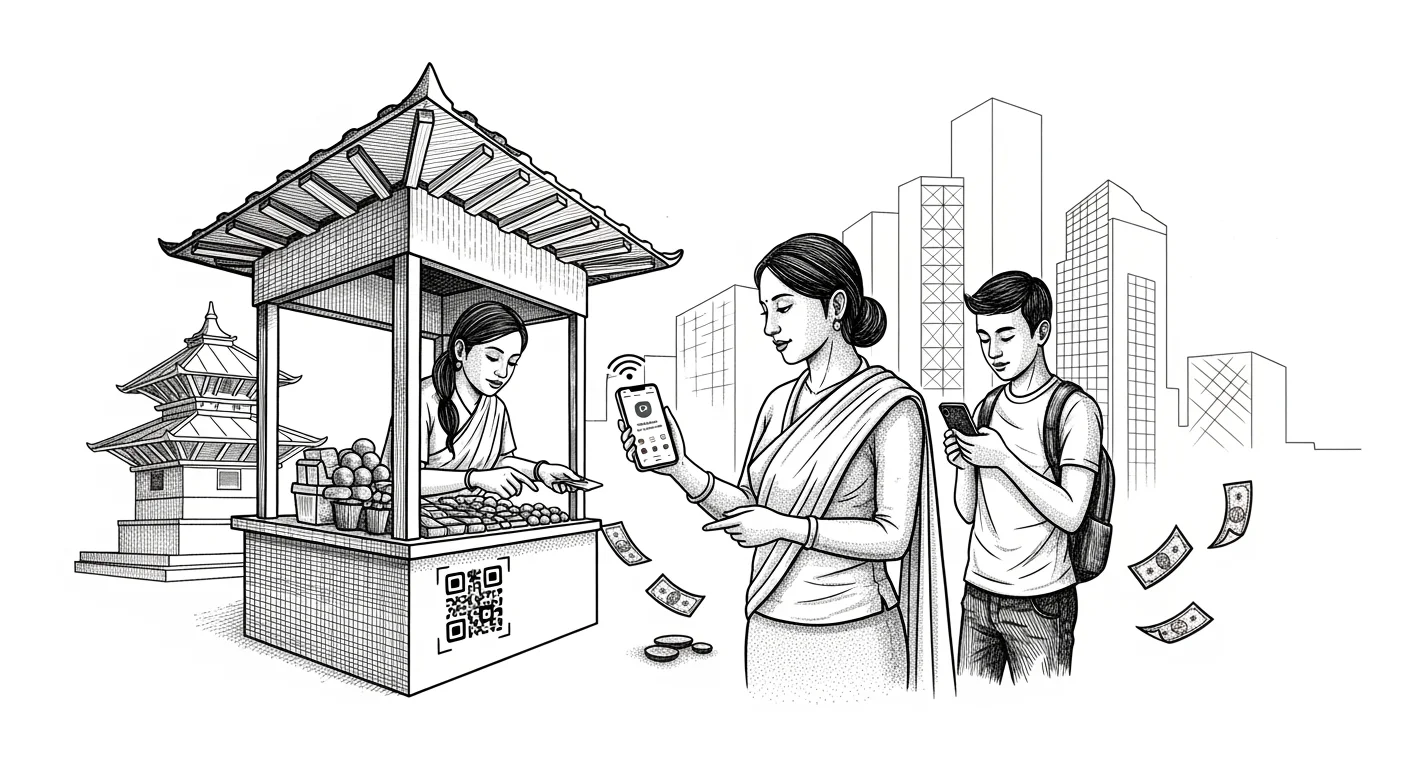
In the bustling markets of Kathmandu and the remote villages nestled in the Himalayas, a stark economic paradox is playing out. Nepal boasts a mobile phone penetration rate exceeding 130%, a figure that suggests a society primed for a digital revolution. Yet, the vast majority of economic activity, from daily grocery purchases to large-scale supply chain transactions, remains stubbornly anchored in physical cash. This chasm between digital connectivity and financial digitalization represents what is arguably the single largest untapped investment opportunity in Nepal today: the mobile payment ecosystem.
While early pioneers have laid the groundwork, the market is far from saturated. The current landscape is merely the prologue to a much larger story of financial transformation. For investors, entrepreneurs, and policymakers with the foresight to look beyond surface-level adoption metrics, the challenge is clear. It is not about simply replacing cash with a digital equivalent; it is about building a comprehensive digital financial infrastructure that is more efficient, inclusive, and valuable than the legacy system it seeks to displace. This analysis will deconstruct the barriers holding back mass adoption, identify the most lucrative investment theses, and outline a strategic roadmap for unlocking the immense potential of a truly digital Nepal.
The Anatomy of Latent Demand: Why Cash Still Reigns
To understand the opportunity, one must first diagnose the inertia. The persistence of cash is not merely a habit; it is a system with its own deeply ingrained logic and perceived benefits. The primary barrier is a profound trust deficit. For a large segment of the population, particularly outside major urban centers, digital transactions evoke fears of fraud, technical failures, and a lack of recourse when things go wrong. A crumpled banknote is tangible, immediate, and final; a digital confirmation on a screen feels abstract and vulnerable.
Secondly, the perceived value proposition is often weak. For a small, everyday transaction, using cash is fast, anonymous, and requires no digital literacy or reliable internet connection. Many existing mobile payment solutions have failed to offer a compelling reason to switch, often amounting to little more than a digital facsimile of a bank transfer. Without added benefits—such as loyalty points, instant credit, or seamless integration with other services—the incentive to change long-standing behavior is minimal. This is especially true for the small merchants who form the backbone of Nepal’s retail economy, for whom adopting digital payments can mean new costs (Merchant Discount Rate), technical complexities, and formal inclusion into the tax system, which many prefer to avoid.
Infrastructure: More Than Just Internet Connectivity
While mobile data and Wi-Fi have become more accessible, the definition of “infrastructure” for a robust mobile payment ecosystem extends far beyond internet signals. A critical missing piece is the infrastructure of digital literacy. A significant portion of the population, including many small business owners, lacks the confidence and skills to navigate digital interfaces, manage online accounts, and troubleshoot basic technical issues. National-level, sustained campaigns to build digital confidence are essential but have been fragmented at best.
Another crucial infrastructure layer is the agent network for Cash-In/Cash-Out (CICO) services. In a cash-dominant economy, the ability to easily convert digital money to physical cash and vice-versa is paramount for building user trust and utility. While remittance companies have established extensive networks, their integration with the broader mobile payment ecosystem is incomplete. For mobile payments to become truly ubiquitous, a dense, interoperable, and reliable CICO network that reaches every corner of the country is not a luxury but a prerequisite. This represents a significant, yet often overlooked, investment area in itself—the “picks and shovels” of the digital gold rush.
The Regulatory Maze: Enabler or Inhibitor?
Nepal Rastra Bank (NRB), the central bank, has been proactive in establishing a regulatory framework for Payment Service Providers (PSPs) and Payment System Operators (PSOs). It has issued licenses, set transaction limits, and mandated certain security protocols, creating a structured environment that has prevented a chaotic free-for-all. However, this same framework can, at times, act as an inhibitor to the very innovation it seeks to govern.
The licensing process can be arduous and capital-intensive, creating high barriers to entry for lean startups. Transaction limits, while intended to mitigate risk, can stifle use cases in B2B payments or high-value consumer goods. Most importantly, the regulatory environment has been more prescriptive than adaptive. The absence of a genuine “regulatory sandbox”—a controlled environment where startups can test innovative products without needing a full license from day one—means that disruptive ideas often die before they have a chance to prove their viability. For Nepal to leapfrog, its regulatory philosophy must evolve from one of strict control to one of agile enablement, fostering innovation within clear, risk-managed boundaries.
Investment Thesis #1: The “Payments-Plus” Super-App
The most compelling investment opportunity is not in creating another simple payment wallet. The future belongs to integrated platforms—or “super-apps”—that use payments as the gateway to a wider ecosystem of financial services. The transaction data generated by a user’s payment history is immensely valuable. It is a precise, real-time ledger of their economic life, and it can be used to build a highly accurate, alternative credit score.
Imagine a small shopkeeper who uses a single app to accept payments from customers. Based on her consistent cash flow, the app can offer her an instant, pre-approved micro-loan to purchase new inventory—a loan she could never secure from a traditional bank due to a lack of formal collateral. The same app could offer her micro-insurance for her shop or a simple savings product that automatically sweeps a small percentage of her daily earnings. This “Payments-Plus” model transforms a payment app from a simple utility into an indispensable financial partner. For investors, funding companies that demonstrate a clear roadmap from payment processing to these higher-margin, data-driven services is the primary path to exponential returns.
Investment Thesis #2: Vertical-Specific B2B Solutions
While consumer payments grab headlines, the larger, more immediate opportunity may lie in the Business-to-Business (B2B) space. Nepal’s economy is powered by complex supply chains in agriculture, construction, FMCG, and manufacturing, which are still overwhelmingly managed with cash, paper invoices, and manual reconciliation. This creates massive inefficiencies, limits access to credit, and obstructs transparency.
Fintech startups that focus on solving the specific payment and financing problems of a single industry vertical can gain significant traction. For example, a platform designed for the agricultural sector could facilitate digital payments from wholesalers to farmers, while simultaneously providing farmers with access to credit for seeds and fertilizer based on their delivery history. A solution for the construction industry could digitize payments to laborers and suppliers, improving project management and reducing payment delays. These vertical-specific solutions are “stickier” than generic payment apps because they solve deep, operational pain points, embedding themselves into the core workflow of the businesses they serve.
Bridging the Merchant Adoption Gap
No mobile payment ecosystem can succeed without widespread acceptance by merchants, especially the Small and Medium-sized Enterprises (SMEs) that constitute over 90% of businesses in Nepal. To date, their adoption has been lackluster for three main reasons: cost, complexity, and formality. The solution requires a multi-pronged strategy from fintech providers.
To combat cost, providers can innovate on the business model. This could mean offering a zero-MDR (Merchant Discount Rate) for transactions below a certain threshold, a model that encourages adoption for small-ticket items and builds a user base. The revenue can then be generated from value-added services offered to the merchant, such as inventory management software, payroll services, or access to credit. To reduce complexity, the onboarding process must be radical in its simplicity—as easy as signing up for a social media account, with intuitive interfaces that require minimal training. Finally, to address the fear of formalization, the value proposition must outweigh the perceived cost of tax compliance. By offering tangible benefits like business analytics, customer loyalty tools, and access to otherwise unavailable credit, fintechs can frame digital payments not as a compliance burden, but as a powerful tool for business growth.
The Path Forward: A Call for Strategic Action
Realizing the full potential of mobile payments in Nepal requires a concerted and collaborative effort. The opportunity is immense, but it will not be unlocked by market forces alone. A strategic, targeted approach is necessary for all key stakeholders.
For policymakers, particularly the NRB, the priority must be to evolve from a regulator to an enabler. This means launching a fully-functional regulatory sandbox, streamlining the licensing process for innovators, and working with the Ministry of Finance to create compelling tax incentives for SMEs that digitize their payments. Furthermore, a national, government-backed campaign to promote digital and financial literacy is non-negotiable for building the foundation of trust the ecosystem needs.
For investors, the directive is to look deeper. Resist the allure of funding yet another “me-too” payment wallet. Instead, seek out companies with a clear vision for a “Payments-Plus” platform, a defensible strategy for a specific B2B vertical, or the infrastructure play that will support the entire ecosystem. The real value lies in the data and the services that can be built upon the payment rails, not the rails themselves.
Finally, for entrepreneurs, the challenge is to solve real-world problems. The winning platforms will be those built on a deep understanding of the end-user, whether it is a farmer in the Terai or a shopkeeper in Pokhara. They will be platforms that prioritize simplicity, build trust through flawless execution and customer service, and deliver a value proposition so compelling that reverting to cash becomes unthinkable. The race to build Nepal’s digital financial future is on, and for those with the vision and tenacity to address these core challenges, the rewards will be transformative.