Nepal on the brink of change: economic reforms gain momentum
Nepal is at a critical juncture in its economic development. The government has launched an ambitious program of legislative reforms that many analysts have dubbed a “second wave” of liberalization. This process is not happening in a vacuum, but under pressure from powerful internal and external factors that are forcing the political leadership to act decisively and quickly. Understanding these drivers is key to assessing both the potential opportunities and the significant risks that the new laws pose.
The main catalyst for the reforms was Nepal’s upcoming graduation from the list of least developed countries (LDCs), scheduled for November 2026.1While this transition is a symbol of national progress, it also means the loss of preferential trade tariffs and other benefits that have long supported the country’s economy. As a result, Nepal is being forced to urgently shift from a model dependent on international aid to one that is self-sufficient, driven by trade and private investment.2Added to this is the need to recover from the economic shocks caused by the COVID-19 pandemic and address systemic issues such as the growing trade deficit.3
In response to these challenges, the government, led by Finance Minister Bishnu Prasad Paudel, has declared economic reforms its top priority.4Officially stated goals include stimulating the private sector, creating jobs and strengthening the national economy.4To achieve these goals, a real “legislative blitz” was launched: the authorities are actively using decrees (ordinances) to quickly amend dozens of existing laws, which indicates extreme urgency.6The key instruments of this transformation have been the comprehensive “Amendment of Certain Laws of Nepal Relating to Improvement of Economic and Business Environment and Investment Promotion Act, 2025” (IEBEEI Act)8and the “Action Plan for the Implementation of Economic Reforms – 2082”, which provides for the abolition of outdated regulations and the restructuring of state-owned enterprises.9
However, the speed and methods of reform raise serious questions. The use of ordinances that allow changes to more than 25 laws at once7, bypasses the standard procedures of parliamentary debate and stakeholder consultation. This creates the risk of ill-conceived laws being passed, as was clearly demonstrated by the controversial land ordinance, which gave rise to accusations of lobbying by narrow interests and was subsequently submitted to parliament as a bill with almost no changes.11This is the central contradiction of the current moment: the colossal ambitions of reformers collide with the limited capacity of the state to ensure their effective, fair and transparent implementation. This gap between intentions and capabilities defines the main vector of risks and opportunities for all who follow Nepal’s development.
Opening the Doors for Capital: Reforming Investment Laws
The centerpiece of Nepal’s economic program has been an aggressive campaign to attract foreign direct investment (FDI). The government has taken bold steps to dismantle decades-old bureaucratic barriers in an effort to make the country more predictable, accessible, and profitable for foreign capital. The focus is on creating a favorable environment for all investors, but there is a particular emphasis on supporting the fast-growing information technology sector.

The legal basis for these changes is the Foreign Investment and Transfer of Technology Act (FITTA) Amendments 2019 and the IEBEEI Comprehensive Act 2025.8These documents introduce a number of fundamental innovations aimed at simplifying procedures and increasing the attractiveness of the Nepalese jurisdiction.
Key changes in the investment climate
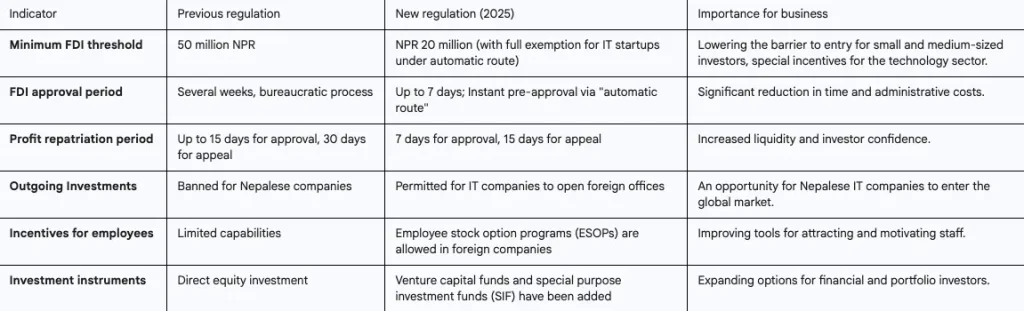
The most significant innovation is the introduction of the so-called “automatic route” for FDI approval. This new online system allows investors in key sectors such as energy, infrastructure, tourism and information technology to receive fast-track approval for projects up to NPR 500 million (approximately US$3.7 million).12This innovation radically reduces bureaucratic red tape that could previously drag out the process for weeks.13
At the same time, the government has lowered the minimum threshold for foreign investment to 20 million Nepalese rupees (around US$150,000), opening the door for small and medium foreign enterprises.12In a strategic move for the development of the digital economy, IT startups using the “automatic route” have been completely exempted from this minimum threshold, removing one of the main obstacles for technology entrepreneurs.13
The procedure for repatriation of profits has been significantly simplified. The period for approval of withdrawal of funds has been reduced from 15 to 7 days, and the consideration of appeals has been reduced from 30 to 15 days.15This increases investors’ confidence that they will be able to freely manage their income.
There has also been a significant shift in outbound investment policy. For the first time, Nepali IT companies have been allowed to invest abroad and set up overseas offices, giving them the opportunity to compete in the global market.15
The reforms also affected financial instruments. Foreign investors can now enter into the capital of Nepalese companies through special investment funds (SIFs) and venture capital funds.8In addition, companies with foreign participation are allowed to implement employee stock option programs (ESOP), which is an effective tool for attracting and retaining qualified personnel.8Finally, the concept of “technology transfer” has been expanded to include services such as marketing, financial consulting and outsourcing, creating new opportunities for international cooperation.8
The table below presents key changes in Nepal’s investment climate.
The gap between commitments and reality
Despite the impressive reform package, data analysis reveals a worrying gap. While the volumedeclaredFDI has grown sharply, with growth at one point reaching 92.6%17, and in the other – 33%18, — real tributary capital remains at a depressingly low level, amounting to less than 0.1% of GDP.17This demonstrates a critical discrepancy between legislative changes and actual investment activity.
The reasons for this gap go deeper than just the text of the laws. Although the government has successfully simplified the procedure filing an application investment, the final decision to transfer capital to a country depends on more fundamental factors. International reports and business climate analysis point to persistent systemic problems that discourage investors: high levels of corruption, chronic political instability, ineffective government, and a tax regime that often does not comply with international standards.12
Thus, the reforms that have been implemented are a necessary but not sufficient condition for attracting real investment. Without a decisive fight against systemic governance problems, Nepal risks remaining a country of “eternal potential,” where loud political declarations and new laws do not lead to tangible economic results. For any potential investor, this means that despite the “open doors,” the path to successful work in Nepal is still associated with significant non-commercial risks that require careful assessment.
The Land Issue: Balancing Development and Social Justice
Land reform in Nepal has become perhaps the most complex and controversial element of the current legislative agenda. At the centre of the debate is the “Nepal Land-Related Certain Laws Amendment Bill, 2025.”11This document is a tangled web of contradictions, as it simultaneously attempts to solve two diametrically opposed problems: on the one hand, to give impetus to the development of the real estate market, and on the other, to restore historical justice in relation to landless citizens. The central question that arises when analyzing this bill is whether these two goals can coexist or whether one of them will inevitably be realized at the expense of the other.

Two pillars of reform
The first and most discussed aspect of the bill is the relaxation of restrictions on land holding limits for real estate companies.20Amendments to the Land Act 1964 will allow developers to sell housing and land plots created in areas exceeding previously established legal limits, provided that the projects receive prior approval.11Officially, this is being presented as a measure to unblock “frozen” construction projects, support developers and inject liquidity into the stagnating sector.20The goal is to eliminate the legal uncertainty that has hindered the sale of already constructed properties.20
The second, socially oriented pillar of the reforms is aimed at solving the long-standing problem of landlessness. The same legislative package contains provisions that allow land ownership to be granted to landless Dalits (lower caste people) and squatters who have lived for many years on unregistered or government lands, including forest lands and coastal areas.11This step is the fulfilment of a direct constitutional obligation (Article 40(5))22and an attempt to address a deep social problem, as it is estimated that up to 25% of Nepal’s population is landless, which is a key cause of poverty and social unrest.23
Controversy and hidden risks
The bill has drawn intense criticism because it is almost an exact copy of an earlier and highly controversial decree.11Opposition parties and independent experts claim it is a case of “corruption at the political level” designed to benefit the “land mafia and brokers”.11The land minister publicly denied the allegations, saying the bill was intended to streamline settlement and facilitate real estate activities.25
However, a deeper analysis reveals serious risks and potential unintended consequences. The bill embodies a classic development conflict, where policies designed to stimulate economic growth can exacerbate social and environmental problems. Research shows that rapid and unregulated real estate development in Nepal is converting productive agricultural land to non-agricultural use.26This directly threatens the food security of the country, which is already struggling with the problem of fragmentation of agricultural land.27
Moreover, such a policy stimulates the growth of land prices and speculation.28, which can ultimately make housing even better – less accessible to ordinary Nepalis and exacerbate wealth inequality. At the same time, provisions to allocate land to the landless, despite their noble purpose, face enormous implementation challenges, from verifying genuine applicants to preventing further encroachment of state lands.22
There is a significant risk that the commercial aspects of the Bill, which benefit a small and influential group of developers, will be implemented quickly and efficiently, while the socially difficult provisions for the landless will remain on paper or will be misused. This could ultimately lead to a purely negative outcome for the majority of citizens: decreased food security, rising housing costs and environmental degradation, all under the guise of addressing social justice issues. The dual nature of the Bill may be a political tactic, disguising a pro-business programme as a populist measure.
The Labor Market: Between Flexibility and Protection
An analysis of Nepal’s labour market situation reveals a stark contradiction between official government policy and the worsening reality for most workers. While paper proclaims goals of job creation and strengthening social protection, actual trends point to rising precarious employment, weak law enforcement, and the erosion of stable jobs.
Official agenda and the real state of affairs
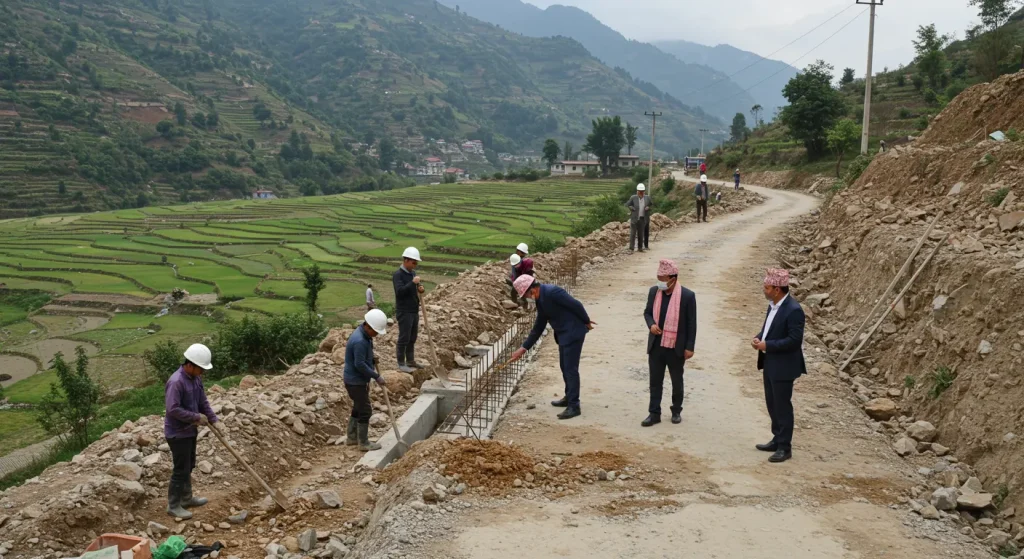
The Nepalese government has shown its commitment to improving working conditions. The period from 2025 to 2035 has been declared as the “Decade of Domestic Employment Promotion.”30, and digital portals such as Shram Sansar are being launched to connect workers with employers.31The 2017 Labor Law requires the minimum wage to be reviewed every two years.32, and the government has already announced plans to review it again next financial year, possibly with a 10% increase.32Currently, the minimum wage is 17,300 Nepalese rupees per month.32
However, data presented in the General Federation of Nepal Trade Unions (GEFONT) Labour Audit Report 2024 paints a very different picture – one of a systemic crisis in the labour market.35

The GEFONT report shows alarming trends. The number of permanent, permanent jobs has fallen by more than 10% in just one year.35There has been a sharp increase in the use of outsourced workers: their share in audited companies has grown from 9.9% to 14.9%.36Violations of labor laws have become widespread: 29% of companies do not comply with the minimum wage (an increase from 21.7%)36, and among outsourcing companies, 77% do not provide their employees with basic conditions.37Only 60% of employers enter into formal employment contracts with employees.36
Problems with the social security system
The cornerstone of the social protection system is the Social Security Fund (SSF), which operates on a contributory basis. However, its effectiveness is extremely low, with coverage at just 17% of the population.38, and the system itself suffers from administrative inefficiencies, a lack of qualified personnel and a design that is predominantly oriented towards the formal sector.39This leaves a huge and growing informal sector, including contract and outsourced workers, with virtually no social protection.
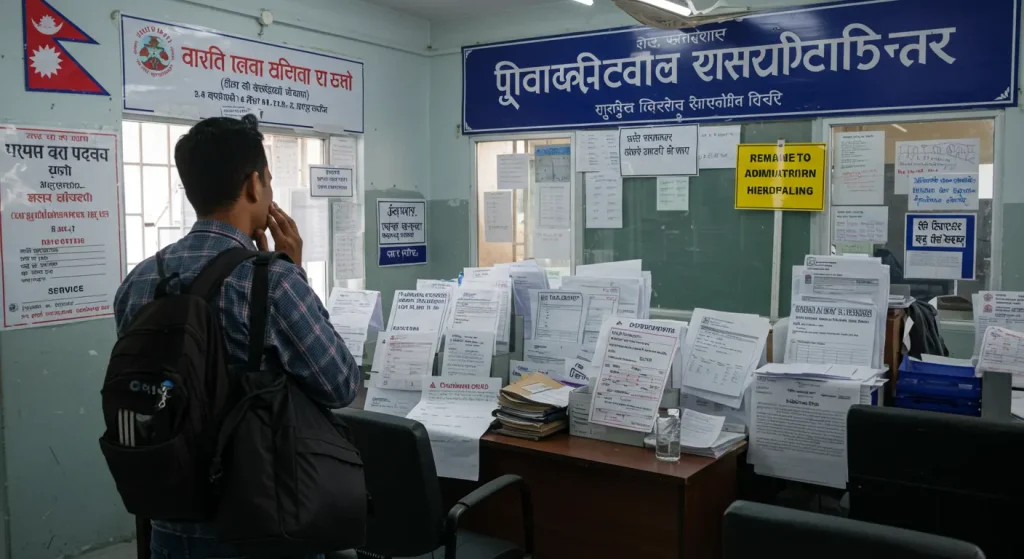
These labor market trends create a fundamental structural contradiction that undermines broader national development goals. On the one hand, investment reforms are designed to attract capital and create quality jobs, which in theory should lead to the formation of a strong middle class and growth in domestic demand.42On the other hand, the labor market is moving in the opposite direction – towards precarization, that is, towards low-paid, unstable, contractual work without social guarantees.35
A vulnerable workforce lacks purchasing power, cannot undertake long-term financial commitments (such as mortgages for housing built under the same land reform) and is unable to provide the stable consumer demand necessary for sustainable economic growth. This leads to the formation of a two-tier economy: a small, protected formal sector (civil servants, highly skilled specialists) and a huge, vulnerable informal sector.
The government’s economic policy thus appears to be self-contradictory. The desire to attract investment and business flexibility appears to be fueling a model of labor relations that is counter to the very prosperity for which investment is being sought. This is a fundamental flaw in the current reform program, which, if not addressed, could lead to increased social inequality and instability, even in the face of formally positive macroeconomic indicators.
Conclusion: An Uncertain Future and the Way Forward
An analysis of Nepal’s current wave of legislative reforms reveals that the country is at a critical, yet highly volatile, point in its development. The ambitious agenda has certainly opened up new business opportunities and laid the groundwork for a potential economic boost. However, its ultimate success and impact on the lives of ordinary citizens are far from guaranteed. Our analysis identifies three key contradictions that will shape Nepal’s development trajectory in the coming years.

First of all, it is a gap in the implementation of investment policy. The laws are attractive on paper, but their ability to translate into real capital inflows remains questionable until deep systemic governance problems such as corruption and bureaucratic inefficiency are addressed.12
Secondly, it is the paradox of land reform. The bill attempts to simultaneously serve the interests of big capital and solve the problem of landlessness. There is a serious risk that in practice this will lead to the enrichment of a narrow elite of developers at the expense of food security and housing availability for the population.11
Thirdly, it is a structural contradiction in the labor market. It is impossible to build a modern, prosperous economy on a foundation of growing precarity and insecurity of the workforce. Policies that promote flexibility for employers undermine the purchasing power and stability needed for sustainable domestic growth.35
Taken together, these factors paint a picture of a future filled with both significant opportunities and profound uncertainty. The success of this era of reform will depend less on the laws themselves than on the government’s ability and political will to ensure that they are transparent, fair, and rigorous implementation and enforcement. For international businesses, this means that investing in Nepal requires careful assessment of not only legal but also political and social risks. For Nepali citizens, this means that the promised prosperity may prove illusory if economic growth is not inclusive. The coming years will tell whether this legislative blitz will become the foundation for sustainable development or a catalyst for greater inequality.ic growth and restore hope for the future of its citizens in their native land.
Sources used
- Nepal: World Bank Report Outlines Key Reforms to Boost Growth, Create Jobs
- Trade and Investment Facilitation: Way Forward for Nepal
- Anga Raj Timilsina: Economic Governance Reform Blueprint of Nepal
- Economic reform is our top priority: DPM Paudel
- Budget Speech of Fiscal Year 2024/25
- Six new bills registered, 18 still pending
- Ordinances and Their Enactment in Nepal
- Publication of Act to Amend Some Nepal Acts Relating to Improving …
- Govt issues Economic Reform Implementation Action Plan-2082
- Economic Reform Implementation Action Plan-2082 issued
- Bill lands in House but no different from controversial land ordinance
- 2024 Investment Climate Statements: Nepal
- Company Registration in Nepal: What’s New in 2025?
- Future Outlook: Is Nepal the Next Hotspot for Foreign Business Incorporation?
- Nepal Investment Law Amendment: Key Changes (2025)
- Amendments made to Foreign Investment and Technology Transfer Act 2019 by Ordinance to Amend Some Nepal Acts Relating to Improving Economic and Business Environment and Investment Promotion 2025
- On automatic route, FDI commitments nearly double
- Nepal’s FDI commitments surge 33 percent amid policy reforms
- Land-Related Amendment Bill, 2025 presented in parliament
- Government moves to ease land ceiling restrictions for real estate firms
- Nepal eases land ceiling laws, offering relief to real estate developers
- Land ordinance aims to resolve practical problems
- Barriers to Women’s Land and Property Access and Ownership in Nepal
- “Land is Life, Land is Power”: Landlessness, Exclusion, and Deprivation in Nepal
- Local levels urged to complete classification of land by the end of current fiscal year
- New Challenges in Land Use in Nepal: Reflections on the Booming Real-estate Sector in Chitwan and Kathmandu Valley
- AGRICULTURE LAND USE IN NEPAL: PROSPECTS AND IMPACTS ON FOOD SECURITY RH Timilsina1
- Economic Impacts of Real Estate in Nepal
- Identifying the Impact Factors on the Land Market in Nepal from Land Use Regulation
- Govt declares 2025-35 as Internal Employment Promotion Decade
- Nepal News Evening Economic Brief – May 1, 2025
- Govt to revise minimum wage of private sector workers next FY
- Govt to increase workers’ minimum wage by 10% within a year
- Best of minimum wage in Nepal of NPR 17,300
- Nepal: Decline in regular jobs highlights worsening labour law compliance and growing challenges in enforcement
- Regular jobs decline sharply in Nepal as labour law compliance worsens
- 29% of firms in Nepal violate minimum wage rule of Rs 17300 a month: GEFONT
- Nepal’s Social Protection System Reinforces Inequality
- Challenges of Contribution-based Social Security in Nepal
- Nepal’s Contribution-based Social Security Scheme: Challenges and Opportunities
- (PDF) Social Security/ Social Protection in Nepal : Situational Analysis
- Doing Business in Nepal – 2025