Key Takeaways
- The “social proof” paradox: Nepali consumers often place more trust in the superficial “likes” and comments on an unregulated Instagram page than in the legally-binding, system-based trust of a formal e-commerce platform. This preference for personal, albeit fragile, validation over institutional security is the single biggest psychological barrier holding back platforms like Daraz and Sastodeal.
- The invisible tax of distrust: Every “photo ma jasto dekhiyena” (it didn’t look like the photo) incident on social media isn’t an isolated event. It contributes to a collective trust deficit that acts as an invisible tax on the entire digital economy, forcing legitimate businesses to overspend on marketing to overcome a cynicism they did not create.
- Regulation as a market catalyst: The impending formalization of social commerce—through mandatory registration and tax compliance—will not kill the sector. Instead, it will act as a market-sorting mechanism, forcing a flight to quality. This will inadvertently become the most significant growth driver for established, compliant platforms, as serious sellers and buyers migrate towards accountability.
Introduction
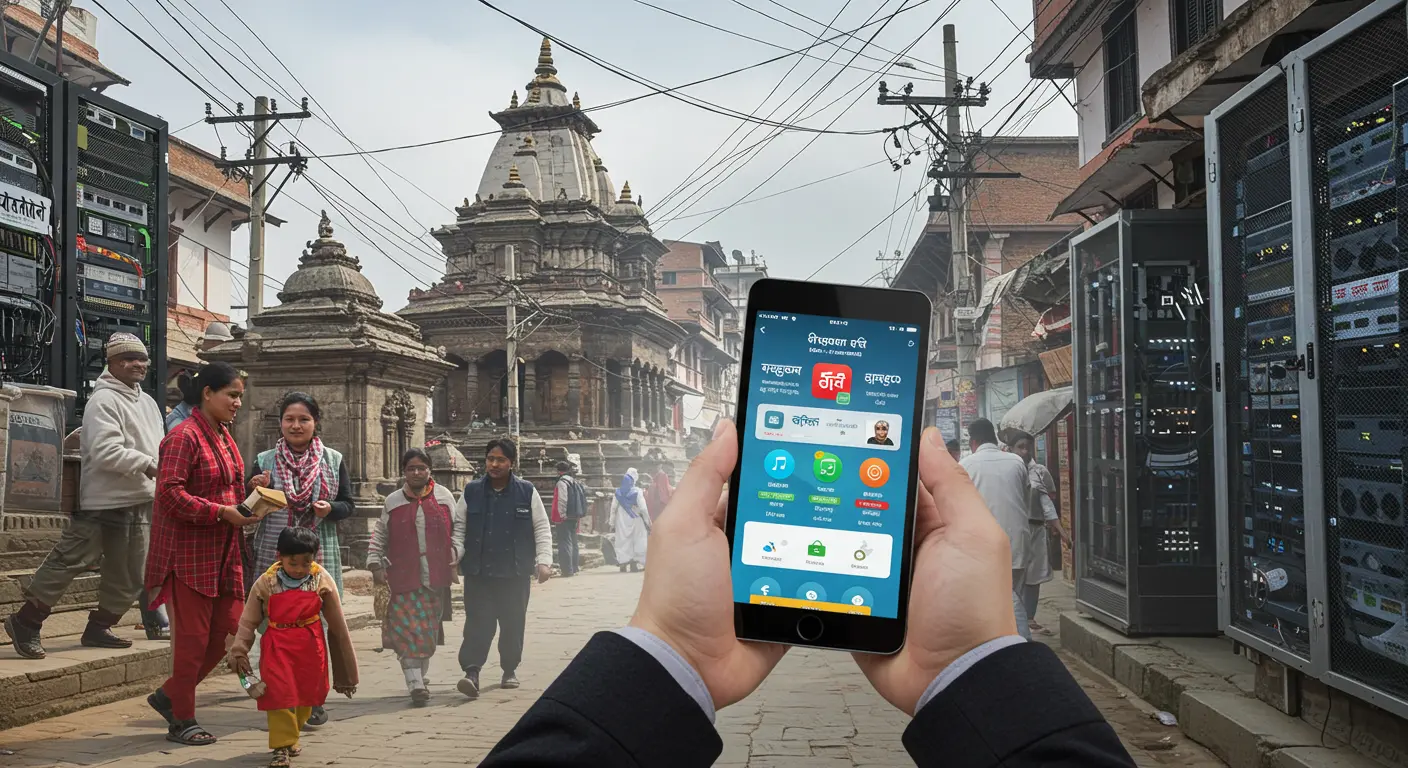
In the bustling digital marketplaces of Kathmandu, a curious paradox is unfolding. Nepal’s e-commerce transaction volume is surging, a testament to burgeoning internet penetration and a youthful, digitally-native demographic. Yet, beneath this veneer of growth lies a deep, persistent chasm of distrust. The average Nepali consumer, phone in hand, is more likely to be a digital window-shopper than a confident buyer. The “add to cart” button is clicked with hesitation, and the final payment is often made with a prayer. This hesitation isn’t a technological issue; it is a profound problem of consumer psychology, a trust deficit sculpted by years of inconsistent experiences, primarily in the unregulated wilderness of social commerce.
The core tension in Nepal’s e-commerce landscape is not between brick-and-mortar and online, but between two distinct digital philosophies. On one side are the formal platforms like Daraz and Sastodeal, which invest heavily in logistics, payment gateways, and buyer protection policies—systems designed to build institutional trust. On the other side is the sprawling, anarchic bazaar of Facebook and Instagram, where millions of transactions occur based on little more than a DM, a Viber message, and a leap of faith. This latter ecosystem, while a powerful engine of micro-entrepreneurship, has become the primary breeding ground for the “scam” perception. Its low barrier to entry and near-zero accountability have conditioned consumers to expect the worst: products that don’t match photos, dubious quality, and ghost sellers who vanish after payment.
This article will dissect the anatomy of this trust deficit, moving beyond surface-level complaints to explore the economic principles and psychological biases at play. We will analyze why the informal, relationship-based trust of social media often eclipses the system-based trust of formal platforms. More critically, we will argue that this fragile equilibrium is about to be shattered. A wave of formal regulation targeting “social sellers” is not a distant possibility, but an imminent economic necessity. For established platforms, this regulatory shift represents the single greatest strategic opportunity to finally level the playing field and capture the latent value in a market held hostage by fear.
The Anatomy of Distrust: Asymmetric Information in the Digital Bazaar
To understand why a Nepali consumer fears buying a Rs. 5,000 watch online, we must look to a 1970 Nobel Prize-winning concept: “The Market for Lemons.” Economist George Akerlof argued that in markets with severe asymmetric information—where the seller knows vastly more about a product’s quality than the buyer—a destructive cycle begins. Buyers, unable to distinguish good products (“peaches”) from bad ones (“lemons”), become unwilling to pay a premium for quality they can’t verify. They offer a price reflecting the average quality of all goods in the market, including the lemons. This discourages sellers of high-quality goods, as they cannot get a fair price, causing them to exit the market. Over time, the market becomes dominated by low-quality lemons, confirming the buyers’ initial suspicions and leading to market collapse.
Nepal’s social commerce scene on Facebook and Instagram is a textbook, real-world manifestation of this theory. It is a market of extreme information asymmetry. A seller operating from a generic Instagram page, posting glossy, often stock, photos of a handbag or a pair of sneakers, holds all the cards. They know the true cost, the material’s origin (often a Chinese “first copy” or “master copy”), and the actual product’s flaws. The buyer, on the other hand, sees only a curated digital representation, a price, and a set of follower counts and comments that can be easily manipulated. The ubiquitous Nepali complaint—”photo ma jasto ramro thiyo, bahira ta khattam raicha” (it looked great in the photo, but the real thing is terrible)—is the cry of a buyer victimized by information asymmetry.
This environment creates a negative feedback loop. After being burned once or twice by a “lemon,” the consumer’s risk appetite plummets. They begin to view every online seller with suspicion, assuming all products are of low quality. They become unwilling to pay more than a bargain-basement price, even for items that might be genuinely good. This forces even honest social sellers to compete on price, often by sourcing cheaper, lower-quality goods to maintain a margin. The market spirals downwards. Consequently, the very concept of “online shopping” becomes mentally anchored to the expectation of poor quality and potential deception, poisoning the well for the entire digital economy. Formal platforms, which try to solve this problem with seller verification, brand malls, and transparent user reviews, are fighting an uphill battle against a market-wide perception shaped by the failures of its most unregulated segment.
Social Proof vs. System Trust: The Psychology of the Nepali Consumer
If the risks are so high in social commerce, why does it thrive? The answer lies in the powerful, and often irrational, psychological shortcuts our brains use to make decisions. The primary force at play is social proof, the tendency to assume the actions of others reflect the correct behavior in a given situation. An Instagram page with 50,000 followers and a stream of comments saying “price please” or “looks amazing” acts as powerful, albeit superficial, social proof. The consumer’s brain subconsciously concludes, “If so many people are interested, it must be legitimate.” This is amplified in Nepal’s high-context, collectivist society, where peer and community validation carry immense weight.
Furthermore, the direct messaging (DM) or Viber/WhatsApp interaction with a social seller creates a perception of a personal relationship. This one-on-one communication, however transactional, taps into a preference for relationship-based trust over anonymous, institutional trust. It feels more like buying from a person you “know” than from a faceless corporation. The seller might be friendly and responsive, building a thin layer of rapport that temporarily masks the underlying lack of accountability. A consumer may feel more comfortable negotiating or asking questions in this informal setting, creating an illusion of control.
This stands in stark contrast to the system trust required to confidently use a platform like Sastodeal or Daraz. System trust is the belief in the integrity of a platform’s rules, processes, and a recourse mechanism. It requires faith that the star-rating system is accurate, the “Daraz Mall” badge signifies genuine quality, and the 14-day return policy will be honored without a fight. This form of trust is more abstract and cerebral. For a consumer base repeatedly exposed to broken systems and unfulfilled promises in other areas of life, placing faith in an impersonal digital system can feel like a bigger leap than trusting a friendly voice on Viber. The fear of a cumbersome, bureaucratic return process on a formal platform can loom larger than the fear of being scammed by a social seller, where the loss, while total, feels simpler and less emotionally draining than fighting a corporate entity. This cognitive bias, known as loss aversion—where the psychological pain of a loss is twice as powerful as the pleasure of an equivalent gain—is a critical factor. The perceived hassle of a formal return process is framed as a potential loss of time and energy, often outweighing the clear gain of buyer protection.
The Unregulated Engine: How Social Commerce Redefined the Playing Field
The explosive growth of social commerce in Nepal is a direct result of its frictionless nature. For a new entrepreneur, particularly a woman or a young person operating from home, the barriers to entry are virtually non-existent. There is no need for company registration, a PAN/VAT number, office rent, or a software developer. An internet connection and a smartphone are sufficient to launch a business, source products from wholesalers or via personal import channels, and reach thousands of potential customers. Platform commissions do not exist; all revenue, minus the cost of goods and delivery, is pure profit. This model has undeniably democratized entrepreneurship and created a vibrant, parallel digital economy.
However, this same frictionless environment is precisely the source of the market’s core dysfunction. The lack of formal identity and registration creates a climate of impunity. If a customer receives a defective product and complains, the seller can simply block them. If a page accumulates too many negative comments, the owner can deactivate it and launch a new one under a different name within hours. There is no reputational history to preserve and no legal entity to hold accountable. This “ephemeral” nature of social sellers means that accountability is a choice, not a requirement. It’s a Wild West environment where the sheriff is absent, and sellers set their own rules.
This stands in stark contrast to our neighbors. In India, for instance, while social commerce is massive, the government is actively trying to create interoperable standards through the Open Network for Digital Commerce (ONDC), aiming to bring small, disparate sellers into a standardized, more accountable framework. In China, social commerce operates within the walled gardens of super-apps like WeChat. While the selling is social, the transaction is almost always processed through integrated, highly regulated payment systems like WeChat Pay or Alipay, which are linked to the user’s real-name national ID. This creates a crucial layer of trust and traceability that is completely absent in Nepal’s DM-to-cash-on-delivery model. Nepal’s system combines the social front-end of China with a payment and accountability model that is far less mature, creating a unique and perilous market structure for the consumer.
The Strategic Outlook
The current equilibrium in Nepal’s e-commerce market is inherently unstable and unsustainable. A large, untaxed, and unaccountable gray market is operating in plain sight, eroding consumer trust and creating an unlevel playing field for formal businesses that comply with regulations, pay taxes, and invest in customer-centric infrastructure. The pressure for change is mounting from three directions: the Ministry of Finance seeking to expand the tax base, formal businesses lobbying for fair competition, and a growing chorus of public complaints about online fraud. This convergence makes the formalization of social commerce not a matter of ‘if,’ but ‘when’ and ‘how.’
The regulatory future will likely unfold in a predictable sequence. The first and most critical step will be the enforcement of mandatory business registration for any entity conducting regular online sales. This will likely involve linking a business PAN to social media pages and e-commerce accounts. Second, we will see a push from the Nepal Rastra Bank and payment service providers (PSPs) like Fonepay and eSewa to channel these transactions through formal digital channels, moving away from the opaque Cash-on-Delivery model. This could involve promoting escrow services, where a PSP holds the buyer’s payment until the product is confirmed delivered and satisfactory. Finally, the Department of Commerce, Supplies and Consumer Protection will likely issue and, more importantly, begin enforcing specific directives for online sellers regarding returns, refunds, and product descriptions, with tangible penalties for non-compliance.
The Hard Truth: This transition will be painful for the thousands of micro-entrepreneurs who have thrived in the unregulated space. It will increase their cost of doing business and introduce bureaucratic hurdles. However, this regulatory tightening is the necessary medication for a sick market. For strategic players like Daraz, Sastodeal, and other aspiring formal platforms, this is a watershed moment. As the cost and compliance burden on social sellers rises, their primary competitive advantages—price and lack of oversight—will diminish. This levels the playing field. Suddenly, the value proposition of a formal platform—its logistics network, integrated payments, buyer protection, and system trust—becomes exponentially more compelling for both buyers and sellers. Serious social sellers, seeking legitimacy and scale, will begin migrating to formal platforms to reach a wider, more confident customer base. Consumers, burned by the ‘lemons’ and now seeing a clearer distinction between registered and unregistered sellers, will gravitate towards the safety of accountable systems. The impending regulation, therefore, should not be viewed as a threat to e-commerce, but as the catalyst that will finally unlock its true potential, sorting the professionals from the hobbyists and rewarding the businesses that chose to build on a foundation of trust from the very beginning.