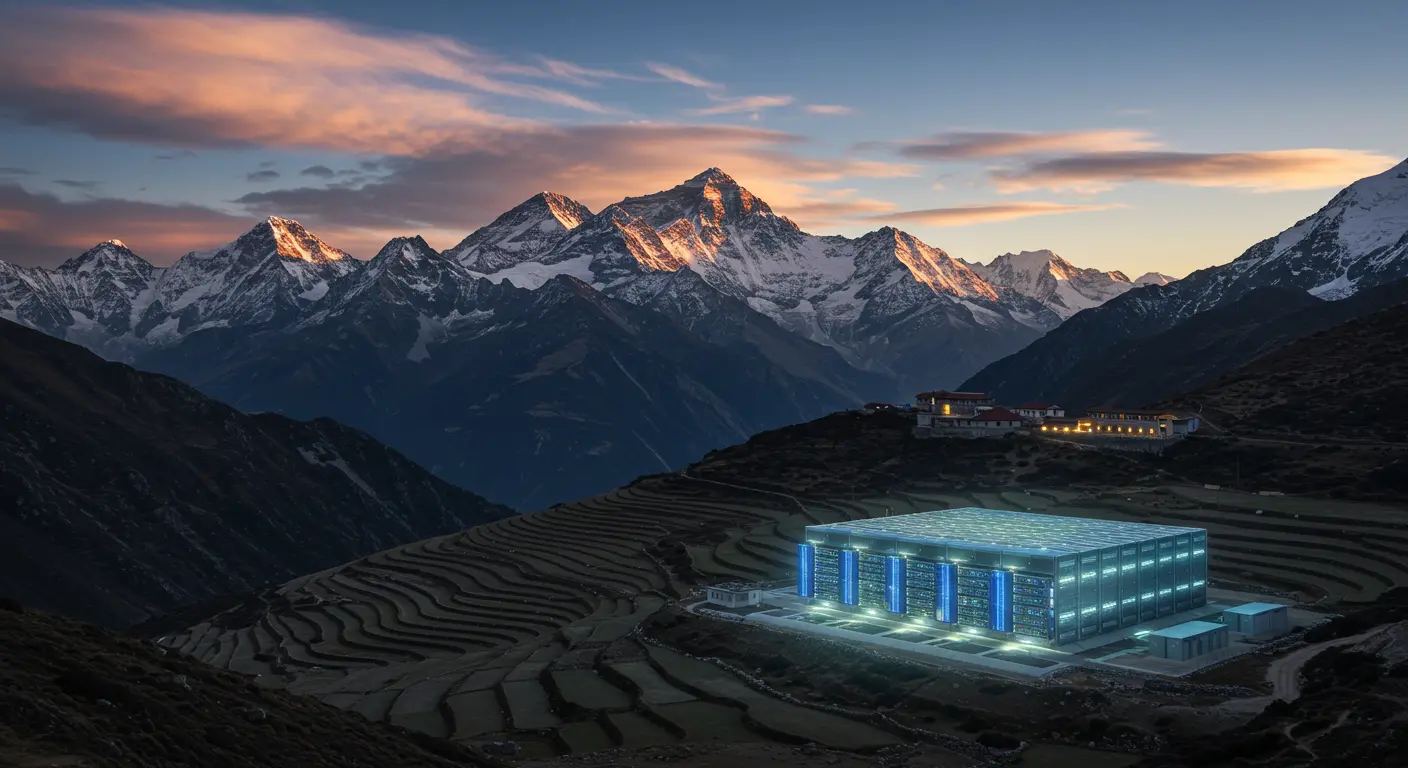
Digital Dawn Over the Roof of the World
Nepal, a country whose image is inextricably linked with the majestic peaks of the Himalayas, is today on the threshold of a new era – the digital era. Clouds of technology are gathering over the “roof of the world”, bringing with them not only stormy challenges but also unprecedented opportunities. This metaphor accurately reflects the current state of affairs: on the one hand, unique geographical and economic barriers, on the other – no less unique natural advantages that can turn the country into a regional digital hub.
Situated between two of the world’s fastest growing economies, India and China, Nepal has historically viewed its geography as a source of challenges.1But in the era of digital transformation, this is being rethought. The question is no longer about physical trade routes, but about data flows. Can Nepal, having overcome its internal challenges, ride this new wave and turn its mountains into data fortresses and its rivers into a source of energy for the global digital economy?
This report is intended for business leaders, investors, and IT professionals. It aims to provide a comprehensive assessment of the current state and prospects for data center and cloud infrastructure in Nepal. We will review the government’s ambitious strategy, assess the current state of the infrastructure, uncover key challenges holding back cloud adoption, and most importantly, highlight the “green card” that could give Nepal a decisive competitive advantage in the global arena.
Government Policy: Digital Nepal as a Roadmap
Nepal’s aspiration for a digital future is enshrined at the national level in a comprehensive strategy – the Digital Nepal Framework (DNF). This document serves as the official roadmap defining the country’s development vector in the high-tech sector. Its evolution from the first version to the updated concept demonstrates both the ambitiousness of the plans and a sober assessment of the difficulties encountered along the way.

The Vision: The Digital Nepal Framework (DNF)
The first version of the strategy, Digital Nepal Framework 1.0, was adopted by the government in October 2019 and was a bold statement of digital transformation.2The document identified 80 key initiatives in eight priority sectors: digital foundation, agriculture, health, education, energy, tourism, finance and urban infrastructure.1The aim was to use disruptive technologies to accelerate socio-economic growth. Among the initiatives announced were such fundamental steps as recognizing the Internet as an essential service and striving for leadership in the deployment of 5G networks.1
However, as often happens with large-scale programs, implementation collided with reality. During the implementation of DNF 1.0, systemic problems emerged: insufficient coordination between departments, lack of funding, a shortage of qualified personnel, and a lack of data compatibility between different government systems.2
Recognizing these lessons, the government initiated the development of Digital Nepal Framework 2.0, the project of which was presented in 2025.5This updated version marks a major strategic shift. Instead of a broad list of 80 initiatives, DNF 2.0 focuses on creating fundamental enablers, grouped together in the acronym
FAST:
- Future-Ready Digital Foundations
- Access to digital services
- Skills and digital literacy
- Transformation of the Digital Economy
This shift from a list of desired outcomes to a plan to create the necessary conditions demonstrates the maturity of the government’s strategy. The government has recognized that a grand vision cannot be realized without a solid foundation. For businesses, this is a signal that, while the government’s intentions are serious, improvements in the digital ecosystem will come gradually as these basic pillars are strengthened.
The Cornerstone: Government Integrated Data Center (GIDC)
The central element of the state digital infrastructure isGovernment Integrated Data Center (GIDC), or Government Integrated Data Centre. Managed by the National Information Technology Centre (NITC), the GIDC aims to be a single, secure and reliable digital heart for all government agencies.6Its main objective is to centralize government IT resources to minimize investment and operating costs, increase efficiency and ensure stable operation of electronic services for citizens, businesses and the government itself (G2C, G2B, G2G).8GIDC hosts government websites, email services and key e-government applications.7
The data center in Kathmandu is equipped to modern standards: it has multi-level backup power supply systems (including diesel generators and UPS), climate control systems (HVAC), fire protection and physical security with biometric access control.7
A key aspect that demonstrates forward-looking planning is the consideration of high seismic risk. The Government of Nepal, with the assistance of the Republic of Korea, initiated the establishment of Disaster Recovery Center in the city of Hetauda.10This decision is dictated by the understanding that the concentration of all critical data in one place, especially in a seismically active zone, creates unacceptable risks. The presence of a geographically remote backup site is a prerequisite for ensuring the continuity of government services in the event of an earthquake or other natural disaster.
Current Reality: Infrastructure on the Ground
There is a gap between the government’s ambitious plans and the daily reality that businesses face. An analysis of the actual state of internet connectivity and the data center landscape reveals a complex picture full of paradoxes.

Connectivity: A Tale of Two Metrics
A quick glance at the Nepal Telecommunication Authority (NTA) statistics reveals a striking internet access situation. While the penetration rate was 61-63% in 2017-18,11, then by April 2024 this figure reached an astonishing 144.56%.13This high percentage is explained by the fact that many users have several SIM cards with Internet access. The dominant connection method is mobile broadband access – it is used by more than 96% of subscribers.13
But for businesses, these numbers hide a harsh truth. Connectivity is poor. More than 30% of Nepalese firms suffer from frequent internet outages, resulting in an average of 3.5 hours of downtime and a loss of 2.1% in annual sales.15As a landlocked country, Nepal is entirely dependent on India and China for international internet traffic. This makes data transit expensive, and the cost is subject to taxes and currency fluctuations.15There is a significant “usage gap” where formal availability of network coverage does not translate into effective and sustainable use due to poor quality of service compared to other countries in the region.15
The Data Center Landscape: Local Champions and Global Giants
Against the backdrop of communication problems, Nepal is developing its own data center market, represented by both strong local players and the indirect presence of global giants.
Local providers have become a response to the business need for a reliable and local infrastructure. Among them, two key players stand out:
- DataHub: Positions itself as an operator-neutral data center, certified according to the ISO 27001:2013 standard. The company offers a full range of services: from equipment placement (colocation) to public and private clouds (including the “Yeti Cloud” brand), data replication, backup as a service (BaaS) and firewall as a service (FWaaS).16Their key benefits for local businesses include 24/7 local support and the ability to pay in Nepalese Rupees (NPR), eliminating currency risks.17DataHub has a primary site in Kathmandu and a disaster recovery center in Butwal, providing geographic redundancy.16
- Cloud Himalaya: Claims to be the only Tier-4 data center in Nepal that guarantees 99.995% availability and is also ISO 27001:2013 certified.19According to the Uptime Institute, Tier 4 means complete fault tolerance, where a single failure of any component or distribution path does not affect the operation of the systems.20Although this statement comes from the company itself, it demonstrates a commitment to meeting the highest global standards of reliability.
In addition to these leaders, the country has an ecosystem of smaller hosting providers such as Babal.Host, eHostingServer and Gurkha.Host, indicating a growing and competitive local market.21
Global Cloud Providers, such as Amazon Web Services (AWS), Microsoft Azure, and Google Cloud Platform (GCP), do not have a physical presence in Nepal. They do not have their own data centers here. However, their services are widely used. Access to them is provided by local partners and consultants, such as Cloudlaya, which offers consulting, migration, and managed services for GCP.22Global clouds are used in latency-insensitive tasks where their scale and advanced tools are indispensable, such as big data analytics, machine learning, and artificial intelligence.23A prime example was the use of cloud computing to coordinate rescue efforts after the devastating 2015 earthquake.23
The combination of deceptively high internet penetration rates with low reliability, high latency when accessing global cloud regions (for example, to AWS in Singapore or Mumbai, the latency can be 60-100 ms or more25) and the emergence of competent local data centers creates a unique situation. For any serious Nepali business, a hybrid cloud strategy is becoming not just an option, but a necessity. The logic here is simple: companies require low latency and compliance with data sovereignty laws, which forces them to host mission-critical, client-side applications and databases with local providers such as DataHub or Cloud Himalaya.16At the same time, they want to use powerful and scalable analytics or AI/ML tools that only global giants offer.22The only rational solution is a hybrid architecture, where the core of the business operates locally, and auxiliary, resource-intensive tasks are performed in the global cloud.
Benchmarking: Cloud Infrastructure in Nepal

Business Challenges: Obstacles to the Cloud
Despite the strategic vision and growing market, Nepali businesses’ journey to the cloud is littered with significant obstacles. These challenges are systemic and span infrastructural, economic, and regulatory aspects.

Infrastructural and Geographical Hurdles
- Communications and electricity: As already noted, low quality and high cost of Internet access are a fundamental barrier, especially for small and medium-sized businesses (SMEs).15Similarly, despite the huge hydroelectric potential, the existing power grid needs to be upgraded to provide stable and uninterrupted power, which is critical for data centers.29
- Seismic risk: This is perhaps the most serious and insurmountable challenge. Nepal is located in one of the most seismically active zones in the world.30A history of devastating earthquakes, including the 2015 tragedy, serves as a constant reminder of this threat. Most buildings in the country were not built to modern seismic standards.33For a data center, which is a critical infrastructure facility, this means the need for colossal investments in the design and construction of seismically resistant buildings, which significantly increases capital expenditures and operational risks.
Economic and Human Resource Challenges
- Financial restrictions: For many Nepalese SMEs, adopting cloud computing remains an unaffordable luxury. Limited budgets and high interest rates on loans make it difficult to invest in IT infrastructure.27
- Talent shortage and digital literacy: This is one of the most acute and frequently mentioned problems. There is an acute shortage of qualified IT specialists in the country. Only 0.16% of the population has an education in the ICT field and only 2% in STEM (science, technology, engineering, mathematics).15An astonishing 91% of adults are unable to perform basic digital tasks such as copying and pasting text.15This skills gap prevents companies from using cloud technologies effectively, even if they can afford them.28
- Low awareness: Many SME owners are simply not aware of the benefits that cloud infrastructure can bring to their business, which leads to hesitation and failure to implement.27
Regulatory and Security Hurdles
- Data Security and Privacy: Security concerns are one of the main reasons slowing down the transition to the cloud.38Companies are concerned about potential data leaks, privacy breaches and information integrity breaches, especially in multi-tenant cloud environments where data from different clients may be stored on the same physical servers.28
- Data sovereignty and legal uncertainty: Nepal has laws regulating data handling such as the Data Act 202226, and even directives requiring some industries (such as OTT services) to store customer data on servers within the country.39However, in general, the regulatory environment is perceived by businesses as not being clear enough.28This legal uncertainty makes companies, especially foreign ones, cautious in building their data management strategies.40
These problems do not exist in a vacuum; they are closely interrelated and form a vicious circle. Unreliable infrastructure discourages investors. Lack of investment limits the creation of quality jobs for IT specialists. As a result, about 7,500 IT graduates annually42either leave the country or work as freelancers for foreign companies37, which exacerbates the talent shortage. And the shortage of skilled workers, in turn, prevents companies from implementing technologies that could help them overcome other challenges. To break this cycle, a coordinated effort is needed on all fronts at once.
Opportunities on the Horizon: Nepal’s Green Trump
In the midst of serious challenges, Nepal has a unique opportunity to not just compensate for its shortcomings, but to turn them into a strategic advantage. That trump card is its vast reserves of clean, renewable, and potentially cheap energy.
The Power of Water: Hydropower as a Game-Changer
- Abundance of clean energy: Nepal’s economically viable hydropower potential is estimated at more than 42,000 megawatts.29It is a virtually inexhaustible source of 100% renewable energy.44As global energy consumption by data centers and AI systems grows exponentially, Nepal’s surplus of clean energy is becoming an incredibly valuable asset.46
- Green data center niche: This resource allows Nepal to position itself as an ideal location for building sustainable, green data centers.45For global tech giants committed to net-zero carbon neutrality, this is a powerful argument in favour of choosing Nepal as a location for their facilities.46Local providers are already starting to tap into this trend, advertising “solar-powered server rooms” and “green hosting.”47
- Price advantage: Combining abundant hydropower with natural cooling at high altitudes can significantly reduce the operating expenses (OPEX) of data centers. Cooling costs are one of the largest expenses in any data center, and the ability to reduce them by 40% or more is a significant economic incentive.45

Strategic Location and Human Capital
- Bridge between giants: Nepal’s geographical location between India and China can be seen not as a constraint but as an opportunity to become a neutral and trusted data hub for the vast South Asian market of 2.8 billion people.1
- Growing IT sector: Despite the talent shortage, Nepal has already developed an IT services export industry worth over US$515 million, driven by low labor costs and a young, entrepreneurial population.37This creates the talent foundation to support the future data center ecosystem.
Learning from a Neighbor: The Bhutan Model
Neighboring Bhutan is a case in point. The country is already pursuing a strategy to attract investment in data centers and AI, while betting on its green energy. Projects like Gelephu Mindfulness City, built in partnership with international companies, show a working model that Nepal can adapt and surpass.46
The key strategic choice for Nepal is whether it can continue to follow the traditional model of exporting surplus electricity to neighboring countries such as India.43This is the export of raw materials, goods with relatively low added value and volatile prices. But there is another, much more promising path. Instead of sending energy to data, you can attract data to energy. By building modern “green” data centers on its territory, Nepal will be able to use its own hydropower to power servers. In this case, the product for export will no longer be kilowatts, but high-tech and high-margin services: computing power, data storage, training artificial intelligence models. This path allows you to move up the economic value chain, creating highly skilled jobs in the country46, develop our own technological ecosystem37and occupy a unique niche in the global digital economy.
Solutions and the Way Forward: How Businesses and Providers Can Reach Digital Heights
The path to digital prosperity requires coordinated action from all participants in the process: business, IT providers and the state. Specific recommendations can be formulated for each of them.
For business (especially SMEs)
- Adopt a hybrid cloud strategy: Don’t bet on one model. Use local providers for latency-sensitive applications and sovereign data. Turn to global clouds for scalable, non-mission-critical workloads and access to advanced analytics. This will help you balance cost, performance, and compliance.
- Invest in people: Partner with universities and training centers to upskill existing staff. Focus on hands-on certifications in leading cloud platforms (AWS, GCP) and cybersecurity.53
- Start small and scale up: Use pay-as-you-go models offered by cloud providers. This allows you to digitize business processes gradually, one by one, avoiding large initial capital investments.28
For local IT and data center providers
- Promote the “green” advantage: Aggressively position your services as “100% Green” and “Powered by Himalayan Hydropower”. This is a world-class unique selling proposition.45
- Specialize and collaborate: Don’t try to compete with AWS in everything. Focus on niche, high-margin services: ultra-low-latency hosting, disaster recovery solutions, building secure private clouds for regulated industries (finance, healthcare). Become official partners of global clouds, helping Nepalese companies integrate hybrid solutions.
- Prove your reliability: Invest in seismic resistance and get certified. This is not just an optional extra, but a requirement for operating in Nepal. Promote this aspect actively to gain the trust of both local and international clients.
For government and regulators

- Optimize public-private partnerships (PPP): Actively promote the PPP model for the construction of critical infrastructure, including national fiber optic backbones and data centers.48Create a clear, transparent and expedited approval process for investors.
- Invest in the “middle mile”: Use public funds to build redundant, high-capacity national fiber networks that connect key cities and lower the cost of Internet traffic for all providers. This will address a fundamental market failure that individual companies cannot solve on their own.15
- Balancing regulation and innovation: Clarify and make data sovereignty laws more pragmatic. The goal should be to protect citizens’ privacy39, rather than stifling the digital economy. Consider creating “digital free zones” or regulatory “sandboxes” to attract foreign investment into the data center sector.
- Launch national digital literacy programs: Tackling the skills shortage at its root by integrating digital skills into the national school curriculum and launching mass public reskilling initiatives.2
Conclusion: From the Himalayas to Global Data
Nepal faces a steep climb to a digital future. The infrastructure, human resources, and regulatory challenges are real and require systemic solutions. But the path to the top is illuminated by the bright light of a unique opportunity: the vast potential of green hydropower.
The country faces a strategic choice: continue to export raw electricity or start exporting high-tech digital services produced with this energy. The second path, although more difficult, promises incomparably greater economic benefits, the creation of high-quality jobs, and the formation of a sustainable competitive advantage for decades to come.
The “clouds” over the Himalayas are no longer just a pretty metaphor. For Nepal, they represent a tangible economic frontier. By strategically addressing challenges and boldly leveraging its unique “green” advantage, the country can transform its geography from a constraint into its greatest digital asset and take its rightful place in the global data economy.renaissance.ost valuable resource for the 21st-century global economy. have every chance of conquering it.
Source used
- 2019 DIGITAL NEPAL FRAMEWORK
- DRAFT
- 2018 Digital Nepal Framework | PDF | Nepal | Economic Growth – Scribd
- Digital Nepal Framework – Digital Development Site
- Digital Nepal Framework 2.0: A Step Digitally Empowered Nepal – ICT Frame
- NITC – National Information Technology Center — Government Body from Nepal
- Government Integrated Data Center (GIDC) is the key foundation for e-Government implementation in Nepal
- Government Integrated Data Center in Kathmandu
- Introduction to GIDC – (Government Integrated Data Center) – Department of Computer and Electronics & Communication Engineering
- National Information Technology Center : An Introduction – NASC Document Management System
- Internet penetration at 61pc of population – Nepal In Data
- According to NTA, the internet penetration in Nepal has reached 63%
- Nepal’s persistent digital divide: From high penetration to inclusion – The Himalayan Times
- Mobile data users in Nepal higher than Wi-Fi – SAMENA Daily News
- Nepal’s potential in digital sector faces regulatory, skill and cost issues
- Public Cloud Service in Nepal | Scalable & Cost-Effective – DataHub Nepal
- DataHub Nepal: Nepal’s Own Cloud Service Provider
- Data Hub-Marketing / Advertising / Customer Service-2nd Floor, Shikhar Biz Center, Thapathali, Kathmandu, Nepal – Froxjob
- Data Center in Nepal | Discover Cloud Himalaya – Sole Tier-4
- Data Center Tier Certification – Uptime Institute
- Nepal Data Center Rating – Servers.Expert
- Google Cloud Platform – Cloudlaya
- Cloud Computing in Rescue Operations
- Big Data Analytics in Telecom Market Size | Forecast 2025-2034 – Global Market Insights
- AWS Latency Monitoring
- Nepal | Jurisdictions – DataGuidance
- Exploring Sustainability in Cloud Computing Adoption among SMEs in Nepal: A Conceptual Model – ResearchGate
- Exploring Sustainability in Cloud Computing Adoption among SMEs in Nepal: A Conceptual Model – Human Resource Management Academic Research Society
- AI Powering Progress, Straining Grids: Can Nepal Be a Green Data Hub?
- (PDF) Comparative study on the seismic performance of a typical low-rise building in Nepal using different seismic codes – ResearchGate
- Seismic Retrofitting Guidelines of Buildings in Nepal – United Nations Development Programme
- New Probabilistic Seismic Hazard Model for Nepal Himalayas by Integrating Distributed Seismicity and Major Thrust Faults – MDPI
- SEISMIC SAFETY IN OWNER-BUILT BUILDINGS
- The 14th World Conference on Earthquake Engineering
- (PDF) Cloud Computing and Data Security Challenges: A Nepal Case – ResearchGate
- Cloud Computing and Data Security Challenges: A Nepal Case
- Unleashing it: advancing Nepal’s digital economy – Institute for Integrated Development Studies
- Adoption of Cloud Computing in Nepal – Publishing India Group
- Data protection laws in Nepal
- The Battle for Data Sovereignty in the Digital Era – Nepal Economic Forum
- Data Sovereignty and AI: Why You Need Distributed Infrastructure – The Equinix Blog
- Information Technology Outsourcing in Nepal: Strengths, Challenges, and Priorities
- Nepal Hydropower Development Program | Fact Sheet
- Green Mountain Data Centers
- Why Choose Nepal for Your Green Data Center? – IMRenewable
- Nepal: Harnessing the Future as an AI Power Hub | NepalEnergyForum
- The Future of Hosting in Nepal: NVMe, AI & Green Data Centers
- Data Center | Public–Private Partnership – Scribd
- Blog & Insights – IMRenewable – Green Data Center Consultancy in Nepal
- Easy Guide to AI Server and Data Center Establishment in Nepal – – Company Registration
- Impact of DeepSeek on Bhutan’s AI data center plans – The Bhutanese
- LS to build power grid for Bhutan smart city project – The Korea Herald
- Find answers to your questions about AWS training courses
- Cloud Computing and Data Security Challenges: A Nepal Case
- Opportunities and Challenges of Public-Private Partnerships in Nepal
- BENCHMARKING INFRASTRUCTURE 2023 IN NEPAL
- Nepal’s Data Act 2079 Explained: What Businesses and Residents Need to Know