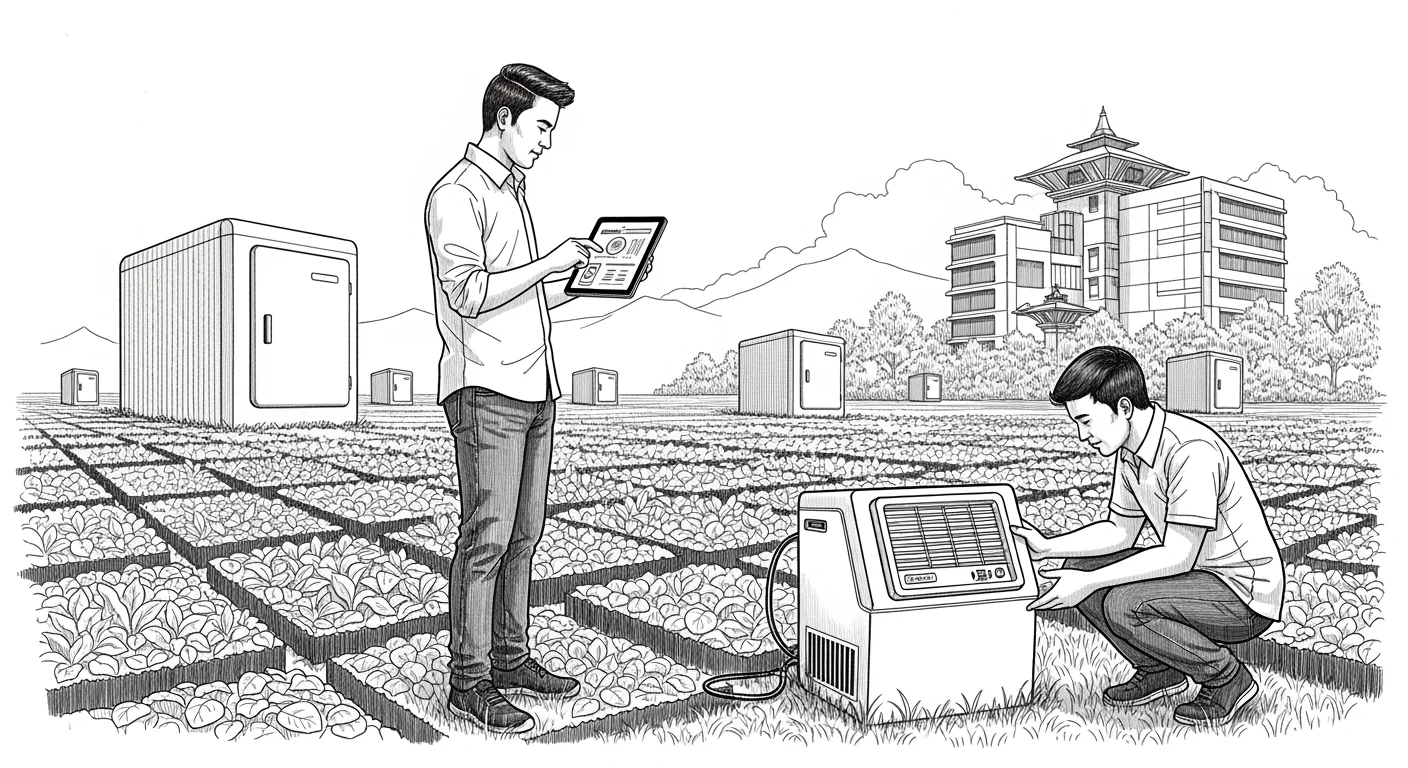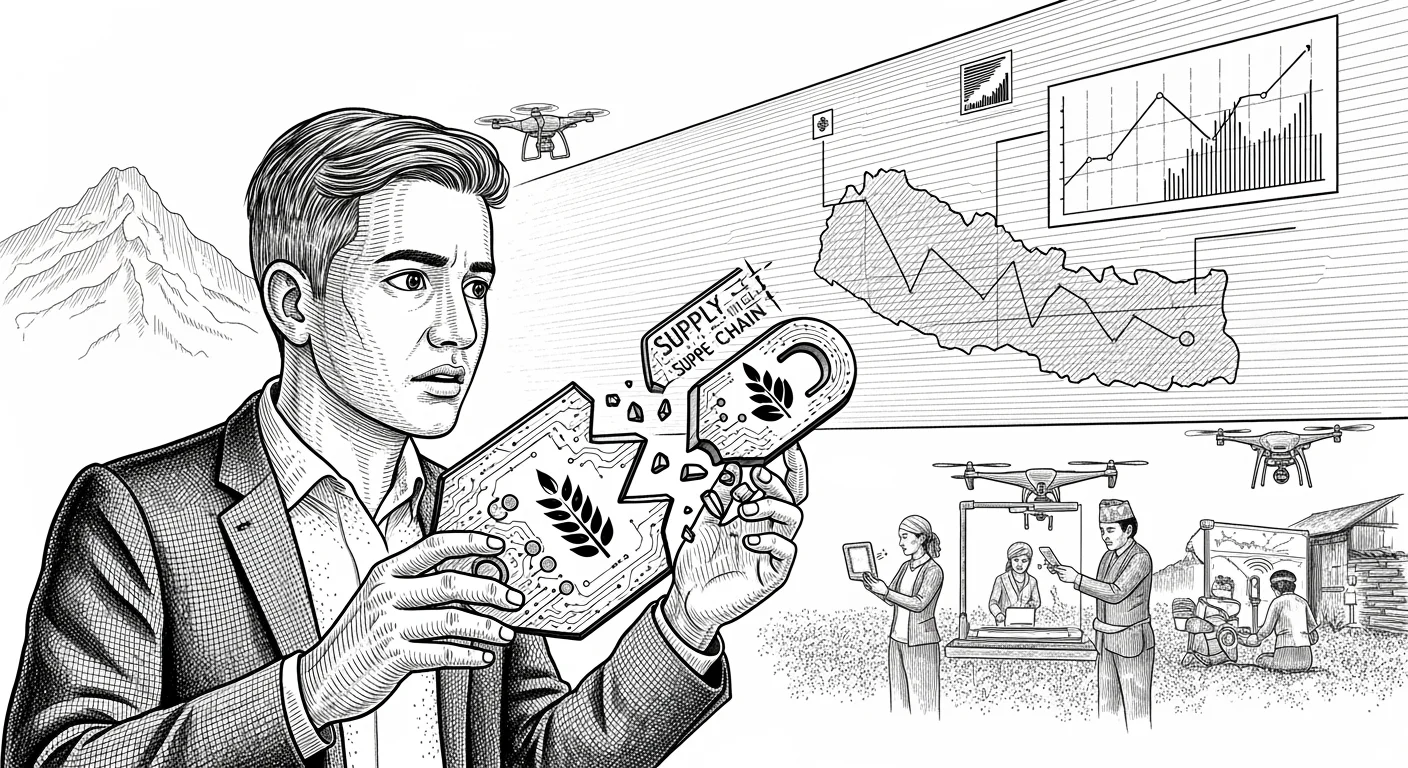
Key Takeaways
- The most valuable ‘product-market fit’ in Nepali agrotech is not a consumer-facing app. It is a B2B logistics platform that systematically resolves the information asymmetry between agricultural producers and large-scale commercial buyers.
- Post-harvest loss is a market, not a tragedy. The 30-40% of produce that perishes between farm and market represents a quantifiable, multi-billion rupee inefficiency. For a logistics-focused venture, this loss is the addressable market and a source of massive potential IRR (Internal Rate of Return).
- Fintech’s moat is digital; agrotech’s is physical. While fintech startups compete for user screen time, B2B agrotech builds a more defensible competitive advantage by embedding itself into the physical economy, creating high switching costs through integrated logistics, finance, and quality control that purely digital platforms cannot replicate.
Introduction
In the rarefied air of Kathmandu’s investor circles, the conversation is dominated by a familiar triad: fintech, edtech, and e-commerce. Pitch decks glow with promises of disrupting digital payments, democratizing education, and capturing the urban consumer. This mimicry of global trends is understandable, but it betrays a profound strategic blind spot. While our brightest minds chase scalability in the digital realm, they are overlooking the sector with the highest actual economic ceiling in the nation: agriculture. The real alpha, the excess return on investment that defines market-beating success, is not hidden in an algorithm for a new digital wallet. It is buried in the soil, and more pointedly, lost on the broken hundred-kilometer journey from that soil to the market.
Accounting for nearly a quarter of Nepal’s GDP and over 60% of its employment, agriculture is not just an industry; it is the bedrock of the national economy. Yet, the word “agrotech” in Nepal is too often conflated with consumer-facing “farm-to-table” delivery apps that service a niche urban clientele. This is a fatal misreading of the core problem. The fundamental weakness in our agricultural value chain is not the last mile of consumer delivery; it is the first hundred miles of post-harvest logistics. The central tension of our time is the collision between a resilient, traditional farming base and an archaic, pre-digital supply chain. This is a system plagued not by a lack of production, but by a catastrophic failure of connection.
This analysis will argue that for patient capital with a long-term horizon, the most strategic and lucrative opportunity in the Nepali startup ecosystem lies in B2B agrotech. Specifically, ventures that focus relentlessly on solving supply chain logistics and information gaps for large-scale buyers will unlock far greater, more sustainable, and more defensible value than any consumer-facing application. The question is not whether agrotech can succeed, but who understands where the real value is waiting to be unlocked.
The Value Ceiling: Why Agriculture Dwarfs Other Sectors
To understand the scale of the opportunity, one must first appreciate the fundamental difference in the Total Addressable Market (TAM) between agriculture and its more fashionable tech counterparts. The TAM for a Nepali fintech company is ultimately constrained by the number of banked individuals, their transaction volumes, and the regulatory ceiling on fees. For edtech, the market is limited by the disposable income households are willing to spend on supplemental education. These are significant markets, but they are fundamentally domestic and consumption-driven.
The TAM for agriculture operates on an entirely different economic plane. It is tethered to three of the most powerful macroeconomic levers a country can pull: national food security, import substitution, and export growth. Nepal currently imports over NPR 300 billion worth of agricultural products annually, much of which could theoretically be produced domestically. This import figure is not a sign of weakness; it is a direct measure of the domestic market demand that a more efficient internal supply chain could capture. Every kilogram of Indian rice or Chinese apples sold in a Kathmandu market represents a market-validated price point that a Nepali producer could, with the right logistical support, compete for.
The true ceiling, however, extends beyond our borders. High-value crops like cardamom, ginger, tea, and specialty coffee are where the concept of a “value ceiling” becomes most apparent. Consider the journey of Ilam’s orthodox tea. A Nepali farmer sells green leaf at a low price to a local factory. The factory processes it and sells it, often in bulk, to a wholesaler who then exports it to buyers in Germany or the United States. There, it is expertly blended, branded with an exotic story, and sold to a final consumer at 50 or 100 times the price the farmer received. In economic terms, the majority of the “value addition”—the process of turning a raw commodity into a high-margin consumer good—occurs outside of Nepal. The wealth is not captured at the source.
An efficient B2B agrotech platform attacks this problem at its root. By creating a transparent and reliable link between producer cooperatives and international markets, it creates the foundation for capturing more of this value domestically. It enables traceability, which is a non-negotiable requirement for premium export markets. It allows for the enforcement of quality standards. It provides the data needed to secure financing for better processing equipment. While a fintech app fights for a 2% transaction fee, a B2B agrotech platform is fighting for a 200% increase in the captured value of a national export. The latter is a battle for economic sovereignty, and its potential returns are an order of magnitude greater.
Anatomy of a Broken Chain: Information, Not Infrastructure, is the Weakest Link
A common narrative blames Nepal’s mountainous terrain and poor roads for its agricultural supply chain woes. While infrastructure is undeniably a constraint, it is a convenient scapegoat that masks a deeper, more solvable problem: a complete and systemic failure of information. The most significant bottlenecks in our supply chain are not potholes; they are the information vacuums where value is siphoned away and produce is left to rot.
To grasp this, let’s trace the perilous journey of a crate of tomatoes from a farm in Dhading to a kitchen in Kathmandu, a distance of less than 100 kilometers. The first failure is **price discovery**. The farmer, isolated from real-time market data, has little to no knowledge of the prevailing price at the Kalimati Fruit and Vegetable Market. His decision to sell is based not on market dynamics, but on the offer made by the first local collector (the *byapari*) who arrives at his farm gate. This acute information asymmetry creates a classic principal-agent problem, where the agent (the collector) acts in his own interest, not the principal’s (the farmer), securing the tomatoes at a price that guarantees him a significant margin.
This crate then enters a multi-layered labyrinth of intermediaries. The local collector sells to a district-level aggregator. That aggregator negotiates with a transport syndicate to secure a spot on a truck. The truck delivers to a wholesaler at Kalimati, who then sells to a retail vendor, who finally sells to the end consumer. Each of these five to seven layers exists primarily to perform one function: arbitrage. They exploit the price differential between two geographic points or two moments in time, a differential that exists only because of opaque pricing and a lack of coordination. They add immense cost but create little tangible value. They are not logistics providers; they are arbitrageurs enabled by inefficiency.
This information failure has devastating physical consequences, manifesting as post-harvest loss. The widely cited figure of 30-40% loss in fruits and vegetables is the direct financial cost of this broken system. A truck fails to arrive on schedule because the aggregator couldn’t confirm a full load. A farmer harvests early or late, guessing at demand. The lack of predictable volume and timing makes investment in a cold storage facility in Dhading an unjustifiable risk. The produce perishes not because of heat, but because of uncertainty. A B2B agrotech platform’s primary function is to replace this uncertainty with data. By aggregating demand from large buyers and providing farmers with a fixed schedule and a transparent, pre-agreed price, the platform transforms the entire risk equation. It turns a gamble into a predictable manufacturing process, making investments in quality control, proper packing, and cold chain logistics not just possible, but profitable.
The B2B Imperative: Why Patience Pays More Than Virality
The allure of a consumer-facing, “farm-to-table” app is powerful. It promises a clean, direct connection between the idyllic farm and the urban consumer, wrapped in a beautiful user interface. This B2C model, however, is a strategic trap in Nepal’s current market context. These apps target a sliver of the population—high-income, tech-savvy urbanites—and compete in a red ocean against a deeply entrenched network of local vegetable vendors and a growing number of generalist e-commerce platforms. The unit economics are punishing: high customer acquisition costs, the logistical nightmare of last-mile delivery for low-value, perishable goods, and the constant pressure to offer discounts to retain customers. Crucially, they attempt to solve the final and easiest mile of the supply chain while ignoring the first hundred, most broken miles.
A B2B platform operates on a fundamentally sounder premise. Instead of chasing thousands of individual consumers, it focuses on securing contracts with a few dozen large, predictable buyers: hotel chains, restaurant franchises, industrial caterers, modern supermarkets, and food processors. This approach immediately solves the demand-side uncertainty that plagues the entire value chain. A hotel group doesn’t order one kilogram of tomatoes; it requires 500 kilograms every week, 52 weeks a year. This predictable, aggregated demand is the key that unlocks the entire system.
This B2B model creates a powerful flywheel effect that builds a deep, defensible moat.
First, with guaranteed offtake from large buyers, the platform can offer farmers what they value most: a guaranteed market and a fair, transparent price. This breaks their dependency on the extractive local middleman and builds immense loyalty.
Second, this predictable volume allows for radical logistics optimization. Instead of a chaotic fleet of small trucks making speculative trips, the platform can schedule full-truck loads on optimized routes, drastically reducing transportation costs per unit.
Third, with established collection centers and routes, the platform can introduce and enforce quality control—grading produce, rejecting substandard items, and ensuring proper handling. This allows them to service higher-margin clients who demand consistency.
Finally, and most powerfully, the platform accumulates a priceless asset: data. With a digital record of every farmer’s production volume, quality, and delivery history, the platform can partner with financial institutions to underwrite working capital loans. This solves one of the biggest constraints to agricultural growth—access to credit—and embeds the platform as an indispensable partner, creating switching costs that are virtually insurmountable.
Look to the regional giants for this model. India’s Ninjacart and Bangladesh’s iFarmer did not become unicorns by selling vegetables to households. They became industrial powerhouses by building the underlying, tech-enabled infrastructure that serves businesses. Their moat is not a downloadable app; it is a network of collection centers, a fleet of temperature-controlled trucks, and a proprietary dataset on agricultural output. This is the blueprint for Nepal.
The Strategic Outlook
The next five years in Nepal’s startup landscape will be defined by a great bifurcation of capital in the agrotech sector. The “fast money,” driven by a desire for viral growth and quick exits, will continue to pour into B2C delivery models. These ventures will provide a valuable service to a few but will likely contend with high cash burn rates, brutal competition, and a wave of inevitable consolidation. The real, transformative wealth will be built by “patient capital”—venture funds, private equity, and development finance institutions with a ten-year investment horizon. This capital will gravitate towards the unglamorous but vital B2B logistics platforms that are tackling the foundational problems of the agricultural economy.
Two primary scenarios will likely unfold. The most probable short-term outcome is the rise of **Fragmented Specialists**. We will see several B2B players emerge, each focusing on a specific high-value vertical or geographic corridor. One might master the dairy supply chain in Chitwan, another the apple logistics from Jumla, and a third the export of specialty coffee from the mid-hills. This fragmented approach allows for focused execution but limits the potential for broad, systemic network effects.
The more lucrative, long-term scenario is the emergence of a **Winner-Takes-Most** platform. A single, exceptionally well-run and well-capitalized B2B venture could successfully crack the code for a major vegetable corridor, such as Dhading-Kathmandu or the Terai plains to major cities. By achieving critical mass, it would trigger powerful network effects on both the supply and demand sides, making it prohibitively difficult for competitors to enter. This company would not be just another startup; it would become the invisible, essential infrastructure layer for a significant portion of the nation’s food supply—the “Stripe” or “Maersk” of Nepali agriculture. The returns for its early investors would be generational.
The Hard Truth, however, is that building this kind of company is antithetical to the popular “move fast and break things” ethos of Silicon Valley. This is a “move deliberately and build trust” enterprise. Success requires far more than elegant code. It demands navigating the complex socio-politics of transport syndicates, spending years building relationships with farmer cooperatives in remote villages, and deploying significant capital into hard assets like warehouses and refrigerated trucks long before the balance sheet turns positive. It is a grueling, operations-heavy business that marries data science with the grit of on-the-ground execution. The founders who win in this space will have as much operational tenacity as technological vision. And the investors who back them will be those who understand that in agriculture, the most profound returns are measured not in quarters, but in harvests.