Discontent of the nation
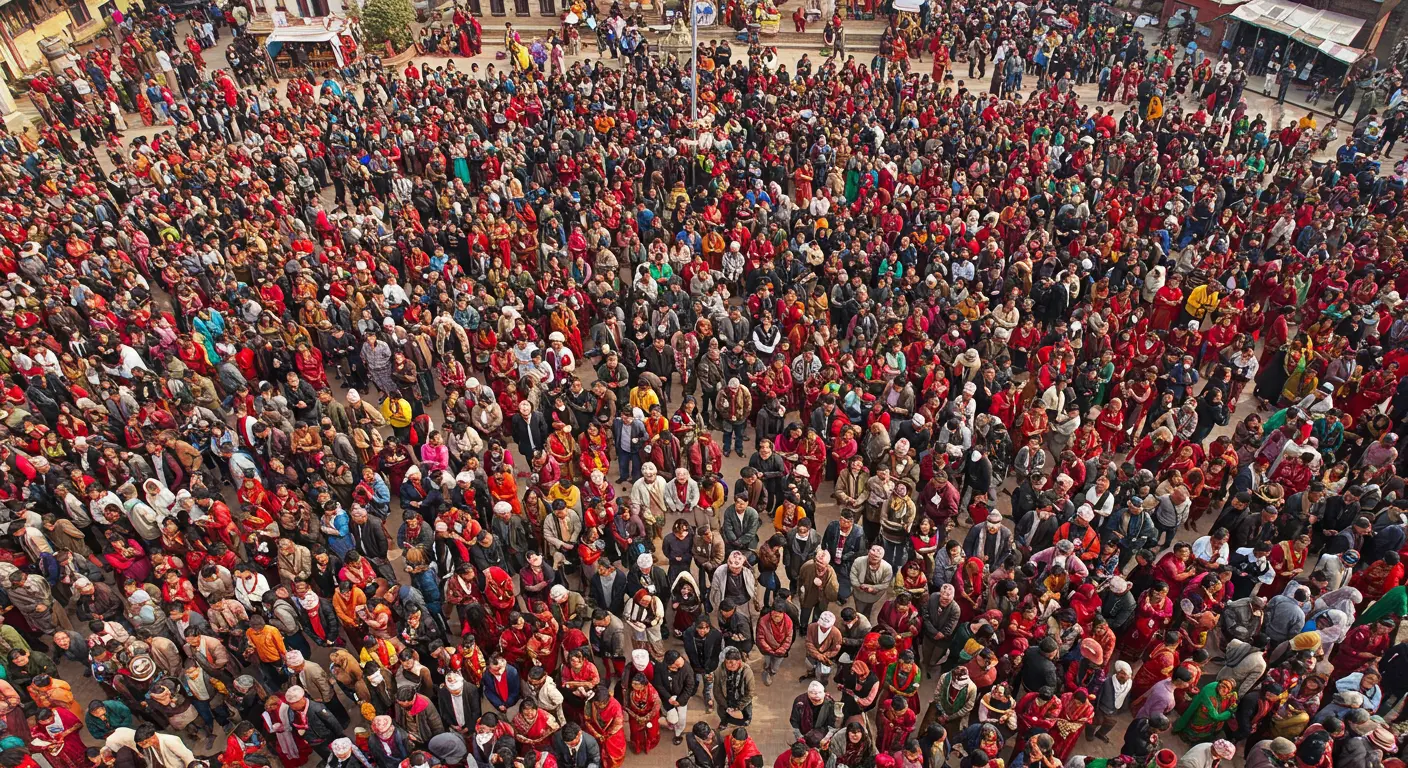
Nepal is a country of striking contrasts, caught between enormous potential and deep social frustration. It is a place where tourism has made a spectacular economic recovery1 coexists with mass migration of youth, and democratic processes2 are undermined by a pervasive mistrust of the political class.3The numbers speak for themselves: a staggering 68% of Nepalis believe the country is heading in the wrong direction, citing corruption and bad governance as the main reason.3
At the heart of this general discontent lies what might be called a “triple crisis” – three fundamental social problems that shape the political agenda today jobs crisis, which is pushing an entire generation abroad; cost of living crisis, which is not reflected in official statistics; and crisis of justice, fueled by endemic corruption and lack of government accountability.
Amid this discontent, a key question arises: Are Nepal’s political parties’ reactions a genuine response to the “voice of the people”? Or are we witnessing the use of sophisticated political technologies – methods used to influence public preferences and actions, often while maintaining the illusion of free choice?6This article examines how the fundamental demands of Nepalese society are becoming a major battleground for political forces ahead of the new electoral cycle.
Anatomy of the Triple Crisis
To understand the current political situation in Nepal, it is necessary to take a closer look at three key issues that are angering society and shaping the political landscape.
The Jobless Generation: The Youth Exodus from Nepal
The scale of Nepal’s unemployment crisis is staggering. The country’s overall unemployment rate has reached 12.6% in 2022-23.9, but the situation is much worse for young people. The unemployment rate among people aged 15 to 24 has soared to 22.7%9, and according to other data, in 2024 it amounted to 20.82%.10This is forcing about 1,700 young Nepalese to leave the country. Daily in search of work abroad. Over the past three decades, nearly 6.8 million people have received permits to work abroad.9

The problem is not just a lack of jobs, but a deep mismatch between education and market demands. A 2021 report by the International Labour Organization found that more than 60% of Nepalese youth are either underemployed or working in jobs that do not match their skills.9Every year, even highly qualified specialists – doctors and engineers – leave the country.9This reflects a systemic failure of economic policy, with the economy still dependent on low-productivity agriculture and struggling to diversify.11
This unemployment is directly linked to deep-rooted economic inequality. Wealth is concentrated in the hands of a small elite who dominate high-income industries such as banking and real estate, limiting the economic space for young entrepreneurs.9Government policies are said to favour large corporations over ordinary citizens, while underfunding of public education and training leaves underprivileged youth with limited opportunities to succeed.9In such a system, migration becomes the only real path to financial stability for the majority.
The Price of Survival: Inflation and Economic Difficulty
There is a stark gap between official inflation figures and the reality of Nepali citizens. While the central bank reports low inflation, which fell to 2.77% in mid-May 2025, citizens are facing a steady increase in the prices of basic commodities.13Specific examples illustrate the problem: the price of mutton has jumped from Rs 1,000 to Rs 1,400 per kilogram, eggs have gone up from Rs 15 to Rs 25 per piece, and a kilogram of apples costs almost Rs 400.13
Experts attribute this paradox to a “collapse of aggregate demand” caused by mass youth migration and falling investment, rather than to goods becoming more affordable.13A distinction must be made between low inflation rate and high price level. The methodology for calculating the consumer price index (CPI) itself has also been criticized because it averages costs and may not reflect the real consumer basket of the most vulnerable low-income households.13

This has real human consequences. With stagnant incomes, families are forced to borrow, forgo foods like fruit, and make impossible choices between eating and paying for their children’s education.13The high cost of living is a major source of public concern and a key point of political pressure.14In addition, Nepal is vulnerable to “imported inflation” from India and global price shocks, making the situation even more volatile.15
Trust Deficit: Corruption and the Long Wait for Justice
Pervasive corruption is one of the main reasons why the public feels that the country is moving in the wrong direction.3In the 2024 Corruption Perceptions Index, Nepal ranks 107th with a low score of 34, placing it among the most corrupt countries.17A staggering 84% of Nepalis consider government corruption a major problem.19Of particular concern are bribery in the areas of public services, taxation, contracting and import-export operations.18
The problem is exacerbated by a culture of impunity. The transitional justice process, which was meant to address abuses from the civil war, has stalled. The Truth and Reconciliation Commission (TRC) and the Commission of Investigation on Enforced Disappearances (CIEDP) have been criticized for their lack of transparency and for legislative amendments that could lead to amnesty for serious human rights violations, denying victims justice.2Failure to hold those responsible accountable undermines faith in fundamental state institutions.
The concept of “justice” goes beyond corruption to include caste discrimination (especially against Dalits), violence against women, child marriage, and forced evictions of marginalized communities. All of these problems persist despite legal prohibitions.2This creates a multi-layered social justice crisis that is fueling widespread public anger.

These three crises do not exist in isolation; they form a vicious circle in which one exacerbates the other. Constant political instability, characterized by frequent coalition changes and intra-party strife12, prevents the sustained economic reforms needed to create jobs. The lack of stable governance and employment opportunities directly fuels the youth exodus.9Mass migration of the economically active population reduces the domestic market, which leads to a “collapse of aggregate demand”.13This collapse artificially suppresses the official inflation rate, but does not reduce the high structural level of prices for essential goods, creating the “low inflation, high cost of living” paradox.13At the same time, the unstable political environment allows corruption and impunity to flourish.2, as accountability mechanisms are weakened and political energy is directed toward power struggles rather than governance.24This widespread corruption and lack of fairness further undermines public trust, leading to voter apathy and disillusionment.4, which in turn makes the political system more vulnerable to populist manipulation and perpetuates the cycle of instability.
Political Market – Selling Decisions to the People
This section analyses how Nepal’s political parties package and sell ‘solutions’ to the triple crisis, contrasting the approaches of the established old guard with disruptive new forces.
The Old Guard Strategy: Big Promises and Familiar Faces
Established parties have resorted to ambitious, almost fantastical, promises of job creation. The Communist Party of Nepal (Unified Marxist-Leninist), or CPN(UML), has pledged to create 500,000 jobs annually, the Nepali Congress 250,000, and the CPN-Maoist Centre 200,000.26These promises should be seen in the context of a weak economy.1and a history of unfulfilled commitments, making them classic examples of populist economic rhetoric.27
These parties also use broad brushstrokes in their rhetoric about social justice. The CPN (Maoist Centre) defines its mission as a campaign for “social justice, good governance and prosperity” to improve the lot of the poor.29Nepali Congress vows to expand social security ‘from cradle to grave’32These broad, attractive statements stand in stark contrast to the public perception that these same parties are mired in corruption and responsible for the country’s poor governance.3
The key problem for the old guard is the “trust gap.” Decades of political strife, frequent changes of government12and the failure to deliver on past promises has left voters deeply disappointed.4Their grandiose promises are often met with public skepticism and seen as self-serving calculations to retain power.4
Rise of the New Guard: The Rastriya Swatantra Party’s Anti-Corruption Crusade
Against this backdrop, the Rastriya Swatantra Party (RSP) has emerged and stormed onto the political scene in the 2022 elections, becoming the fourth largest party with an anti-corruption and good governance agenda.33The party’s success is a direct consequence of public dissatisfaction with the established political order.
The ideology of the RSP is based on constitutional socialism, participatory democracy and economic liberalism.35But its central message is a relentless fight against corruption. It is not just a programmatic item but its central identity, expressed in leader Rabi Lamichhane’s vow to “cleanse dirty politics from corruption.”36
Unlike the vague promises of the old guard, the RSP offers concrete, tangible anti-corruption mechanisms. These include Whistleblower Protection Act, creation of a special Anti-corruption police at the Commission for the Investigation of Abuse of Authority (CIAA)35and, most importantly, a firm position against any statute of limitations for corruption cases.37This specificity gives their platform a degree of credibility that the older parties lack. They also propose structural reforms, such as the abolition of the Constitutional Council, to which appointments are political.35
Battle of Narratives: “People vs. Elite”
Populism is a political strategy that pits the virtuous “people” against the corrupt “elite.”27This narrative is particularly effective in contexts of high inequality and low trust in institutions41– a perfect description of the situation in Nepal.
The RSP’s success is a textbook example of this narrative. Their anti-corruption crusade is not just politics, it is a moral battle against an entrenched, self-serving political establishment.34This narrative resonates deeply with a population that feels betrayed by traditional parties.4The conflict is presented not as a simple political debate, but as an existential struggle between the ordinary citizen and the kleptocratic ruling class.44
In turn, the established parties are trying to counter this by presenting the RSP as inexperienced and its behavior as “childish.”47, while simultaneously trying to borrow populist language while making their own grand economic promises26, a tactic that often proves ineffective due to their track record.
The strategic shift made by the RSP is that they have moved the political battlefield. Instead of trying to “out-promise” the old parties in the complex and difficult to fulfill economic sphere, where their promises are easily tested and refuted,26, they focused their brand on one powerful and emotionally charged topic: corruption.33This is a strategic choice. The promise to “fight corruption” is a moral position, not an economic forecast. It activates a powerful populist narrative of “the people versus the elite.”40, which is harder to refute with economic data, and reframes elections as a choice between “clean” and “dirty” politics. To make this abstract moral position seem concrete, the RSP proposes concrete legislative instruments, such as the Whistleblower Protection Act.35These proposals serve as “proof of sincerity,” making their anti-corruption rhetoric more persuasive than their rivals’ vague platitudes about “good governance.” The RSP thus uses the concept of justice as its primary political technology, eschewing the direct and likely losing battle on the field of economic promises and waging a more effective war on the plane of political morality.
Modern Toolkit – Political Technologies in Nepal
This section examines the specific tools and methods used to understand and influence the Nepalese electorate, moving from the ‘what’ (the content of the message) to the ‘how’ (its delivery).

Listening to the Echo: Measuring Public Sentiment
Modern election campaigns rely heavily on electoral research. Tools such as mass surveys and focus groups help identify issues that concern voters, test messages, and develop campaign strategies.52Detailed public opinion polling data in Nepal, such as from the Sharecast Initiative Nepal3, show a deep understanding of public discontent. The fact that 68% of the population believes the country is moving in the wrong direction, and that this discontent is higher among the educated and wealthy3, is precisely the information that political strategists use to tailor their messages. RSP’s focus on corruption is probably not accidental, but a decision based on data that identifies corruption as a major public problem.
Digital Battlefield: Social Media as a New Political Arena
Social media has become central to Nepali politics. With 13.5 million users (49.6% of the population), platforms like Facebook, TikTok, and YouTube are not just an additional tool for campaigns, but a primary one.56Parties and candidates use them to disseminate information, advertise and mobilize voters.59
This has led to new and significant spending. In the 2022 election, more than $165,000 was spent on political advertising on Facebook alone.57The average cost per candidate’s ad post ($164) exceeded the average monthly income per capita, highlighting how a seemingly democratic digital campaign can be an expensive and monetized enterprise.57
But digitalization has a dark side. Social media creates echo chambers that amplify bias and deepen divisions.56They are fertile ground for the weaponization of information, including distorted propaganda and fake news, which can influence voters’ beliefs and undermine the integrity of democracy.56Using emotional appeals that target anger and fear is a key tactic.59The Electoral Commission’s efforts to regulate this space and combat disinformation are noted, but the task remains enormous.61
The rise of social media in Nepal creates a fundamental paradox: it simultaneously empowers grassroots movements and provides elites with more sophisticated tools to control the population. On the one hand, social media allows new, less-funded political forces like the RSP to bypass the control of traditional party apparatuses and mainstream media.34This facilitates direct communication with voters and rapid mobilization of support around an anti-establishment message, which is a democratizing force. On the other hand, an effective social media campaign requires significant financial investment in advertising and data analysis.57This creates a new “digital elite” and makes financial power a key factor once again. Moreover, the very nature of social media algorithms that favor emotionally charged and divisive content56, makes these platforms ideal tools for manipulative political technologies. This leads to a paradox: the same tool that gives “the voice of the people” is also the most effective means for shaping this voice using technological methods.
Conclusion: “Voice of the people” or technological echo?
Nepal’s political turbulence is rooted in a real and acute “triple crisis” – lack of jobs, high prices and lack of justice. The voice of public discontent is real, loud and undeniable.

The political response to this voice is hybrid. The emergence of new parties such as the RSP is a direct and genuine consequence of the failure of the old guard, a clear signal that the electorate demands change. However,All Political players, both new and old, increasingly rely on the sophisticated tools of modern political technology to navigate this landscape.
“People’s voice” and “political technology” are no longer mutually exclusive concepts; they are inextricably linked. Key public issues serve as the raw material—the emotional fuel—for political campaigns. Political technology provides the engine and steering mechanism to transform that fuel into votes. The future of Nepal’s democracy will be shaped by this dynamic. The challenge for voters is to distinguish genuine responses from technologically engineered echoes, and the challenge for political leaders is to prove that their promises are more than just sophisticated strategies for winning power. Otherwise, the country risks falling into a perpetual cycle of populist hopes followed by inevitable disappointment, further undermining trust in democratic institutions41 for sustainable economic growth and restore hope for the future of its citizens in their native land.
Sources used
- Nepal’s Political and Economic Uncertainty Likely to Continue
- Nepal: Freedom in the World 2024 Country Report
- Politics of discontent – The Kathmandu Post
- Disillusioned voters – The Kathmandu Post
- Corruption and crisis define Nepal’s 2024 – East Asia Forum
- the use of political technologies in election campaigns
- Political technologies – Wikipedia
- Political technologies – politsecrets
- How economic inequality is driving youths abroad
- Nepal Youth Unemployment Rate (1991-2024) – Macrotrends
- Severe unemployment crisis: Pressing need for reforms – The Himalayan Times
- Nepal’s Unending Political Instability – The Diplomat
- Nepal market prices mock central bank’s inflation claims – Asia News …
- Ogonyok – Request for Justice – Romir
- (PDF) Analysis of Inflation of Nepal – ResearchGate
- Food prices are on the rise again. Here’s a look at the reasons
- Nepal ranks 107th in Corruption Perceptions Index
- TI Report: Corruption rises in Nepal, CPI ranking drops to 107th with a score of 34
- Nepal – Transparency.org
- World Report 2025: Nepal | Human Rights Watch
- Human rights in Nepal – Amnesty International
- www.state.gov
- Nepal’s political and economic uncertainty – GIS Reports
- What Explains Nepal’s Perennial Instability? – The Diplomat
- Boosting Voter Turnout in Nepal: Strategies for a More Engaged Electorate
- Election Manifestos – The HRM Nepal
- Populism – Wikipedia
- Kremlin experts predict the rise of populism in Russia according to the Western model – EISI
- Socialist revolution in a new phase: Maoist Centre Chair Dahal – Nepal Samaj
- Maoist Centre’s goal is to uplift living standards of poor people, says Prachanda – Nepal News
- ‘Campaign for social justice, economic prosperity successful’ – The Rising Nepal
- Mainstreaming of Social Protection Agenda in the Political Parties’ Election Manifesto in Nepal
- Higher corruption in high places | Nepali Times
- New contours in Nepali politics
- Rastriya Swatantra Party – Wikipedia
- Rabi Lamichhane’s RSP and Its Future – myRepublica
- Rabi Lamichhane opposes statute of limitation on corruption cases | Ratopati
- Five-Year statute of limitations in corruption cases is not acceptable: Rabi Lamichhane
- No time limit for investigation of corruption: Rabi Lamichhane – The Rising Nepal
- Political and economic theory of populism // Issues of theoretical economics Text of the scientific article on the specialty – CyberLeninka
- The Decline of Populism? Crisis of Trust and Alternative Political Parties in Contemporary Italy
- Populism: What is it and how does it affect society – Ideological examination
- THE PROBLEM OF TRUST IN INSTITUTIONS AS A FACTOR OF POLITICAL PROCESSES IN THE POST-SOVIET SPACE The text of the scientific article on the specialty “Sociological Sciences – CyberLeninka
- “GROWTH OF FREEDOM” IN THE “ORTHODOX KHANSTA”: Russian Political Elite and the Tsar in the 17th Century – Photos
- Tatyana Vorozheykina. “The Risks Facing Modern Democracy and the Chances of Preserving It” – Gorbachev Foundation
- Democratic Institutions in the Age of Donald Trump – New Literary Review
- House protest helping Rastriya Swatantra Party’s agenda? – The Kathmandu Post
- Pledges to create 1.2 million jobs within 5 years – The Rising Nepal
- UML unveils election manifesto, vows to resolve citizenship issue within six months
- NC, left alliance putting final touches on poll manifestos – The Kathmandu Post
- Digital Rights Weekly/Year 1/Issue 22
- Electoral Research – Social Information Agency St. Petersburg
- Sociological methods for studying electoral behavior …
- Electoral sociological research
- Public Pulse | The Kathmandu Post
- Weaponizing Information: The Rise of Social Media Manipulation in Nepal
- Online platforms, Polling, and Misinformation: Electioneering strategies in Nepal
- The Use of Social Media for Political Socialization in Nepal: An Effectiveness Analysis of Platforms – The Outlook: Journal of English Studies – Prithvi Narayan Campus
- Social Media and Information Integrity in Elections in Nepal – ResearchGate
- Voter Education through Digital and Social Media in Nepal – VoICE.NET
- Elections in the age of social media – The Record Nepal
- Populism as a Political Phenomenon: A Challenge to Contemporary Democracy
- Information and analytical support for election campaigns