Digital Dawn Over the Himalayas
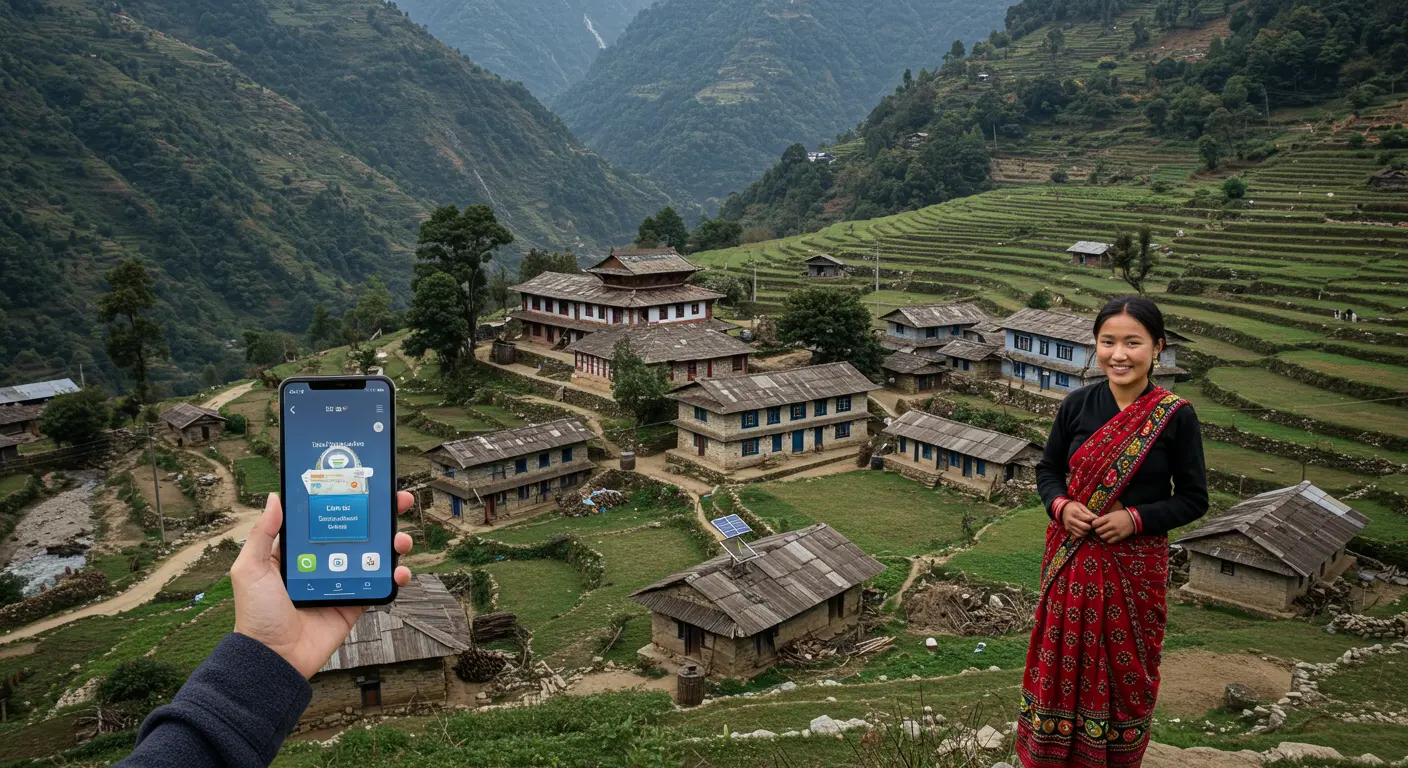
For 33-year-old Jyoti Baniya, a poultry farmer in Syangja district, her day begins not with a bank statement but with a simple tap on her smartphone. After undergoing digital literacy training, she moved all her farm’s financial transactions online. “I feel much more at ease because I no longer have to handle cash, it has taken a huge burden off my shoulders,” she says.1Her story is not just an isolated incident, but a vivid illustration of the quiet but powerful revolution that is unfolding across Nepal.
Despite its rugged mountainous terrain, deep-rooted socio-economic problems and status as one of the poorest countries in South Asia, Nepal is undergoing a profound technological transformation.2Financial technology, or fintech, is not just a convenience for the urban elite here, but a critical tool for national development. The innovation promises to connect every citizen to the formal economy, from the farmer on the Terai plains to the entrepreneur in a remote mountain village.4

In this article, we explore how Nepal is making the digital leap. We begin by examining the underlying problem—pervasive financial exclusion—and then dive into how digital payments and microcredit are changing the game. Through success stories, we see the real impact of these technologies on people’s lives, analyze the remaining obstacles along the way, and look into the future of finance in the Himalayan kingdom.
The Unbanked Kingdom: Nepal’s Financial Landscape
To understand the scale of Nepal’s fintech revolution, one must first understand the depth of the problem it is solving. For decades, the country has struggled with systemic financial exclusion, driven by geography, economics, and social structure.
Geographical and economic barriers
Nepal is a predominantly rural country, where more than 20% of the population lives below the poverty line, and in rural areas this figure exceeds 25%. 2 The rugged mountainous terrain has always made building and maintaining physical bank branches extremely expensive and impractical, especially in remote areas.3This created a natural barrier that cut off millions of people from basic financial services.

The result is a stark urban-rural divide. While metropolitan areas like Kathmandu have high banking penetration (3,296 accounts per 1,000 people), rural municipalities have abysmally low penetration of just 251 accounts per 1,000 people.7This gap is also evident in the data on the number of people served by a bank branch: in Madhesh and Karnali provinces, the figure is significantly higher than in the densely populated Bagmati province, indicating a lack of banking infrastructure density.4
Deep gender gap
The problem is compounded by persistent gender inequality. Women in Nepal have historically been excluded from the financial system. There are only 687 bank accounts for every 1,000 women, compared to almost twice as many men, at 1,314.2The situation is even more dire for rural women, where there are only 201 accounts per 1,000 people.
The problem has deep socio-cultural roots. Women own only a small share of assets, such as land and houses (only 17% of rural households have assets registered in women’s names), which are traditionally required as collateral for loans.2The lack of collateral and a formal financial history forces 90% of women-owned businesses to turn to informal lenders who charge exorbitant interest rates.2This not only limits their economic opportunities, but also hinders the development of entire communities, since women’s economic participation directly impacts the health, education and well-being of their families.2
The paradox of “sleeping” accounts
In recent years, the Nepalese government has made significant efforts to address the problem of physical access to banks. It has implemented a policy requiring commercial banks to open branches in almost all of the country’s 753 local government areas.7This move did indeed lead to an increase in the number of accounts opened and formally improved the statistics of financial accessibility. However, behind these figures there was an important nuance: about a third of all deposit accounts (33.6%) were “dormant,” that is, inactive.8
This phenomenon revealed a critical difference between access And active usePeople opened accounts because they could, but they didn’t see any real use for their everyday lives. Low levels of financial literacy (on average, only 57.9% across the country), the time and money it took to visit a bank branch, and the lack of services that focused on everyday microtransactions made a bank account more of an inconvenient storage facility than a working tool.9
It was this vacuum—the existence of basic infrastructure but the lack of practical application—that created the perfect conditions for the explosive growth of fintech. Digital wallets and payment systems didn’t have to convince people to open a bank account—the government had already done that. They just had to make the account.useful, adding a missing “convenience layer” on top of the existing but underutilized infrastructure. They turned a passive deposit into an active financial instrument, accessible right from your pocket.
Table 1: Nepal’s Digital Leap: Key Indicators of Financial Inclusion

These figures clearly demonstrate the dramatic progress made in less than a decade and set the stage for a story aboutHowit became possible.
A Wallet in Every Pocket: The Digital Payment Revolution
The most visible manifestation of Nepal’s fintech boom has been the revolution in digital payments. Technologies that once seemed like a distant future have quickly become part of the daily lives of millions of Nepalis, revolutionizing the way they interact with money.

Pioneers of Change: eSewa and Khalti
At the origins of this transformation are two companies: in Sewa And Khalti. eSewa, launched in 2009, was Nepal’s first digital wallet, while Khalti, which came later, quickly gained popularity due to its user-friendly interface and wide range of services.12These platforms offered a simple solution to a variety of everyday tasks: paying electricity, water and internet bills, topping up a mobile phone balance, buying movie and plane tickets, and making payments in online stores.15
The road to success was not easy. In a cash-dominated society, building trust was a major challenge. Companies invested heavily in educational campaigns, used marketing tools like cashback and bonuses, and worked hard to overcome initial skepticism from retailers and businesses.17eSewa’s journey from manually processing scratch cards for mobile top-ups to fully integrated with telecom operators is a shining example of this evolution.17
Explosive growth of QR payments
The real catalyst for the mass adoption of cashless payments has been the widespread adoption of QR codes. The volume of transactions using QR codes has increased by almost 200% in just one year, which has become a key factor in the move towards a “less cash society” actively promoted by the Nepal Rastra Bank (NRB).4
The secret of such success lies in interoperability — the ability of different systems to work together. Instead of a fragmented market, where each wallet would have its own, incompatible QR code, Nepal has created unified networks. The key role here was played by the payment system operator Fonepay and national standard NEPALPAY QR, developed under the auspices of the NRB.19 Thanks to them, a seller only needs to place one QR code to accept payments from dozens of different banking applications and digital wallets. This has dramatically lowered the barrier to entry for small businesses into the digital economy.22
The results are visible everywhere: from a tea stall on a busy street in Kathmandu to a souvenir shop in Pokhara, they can now easily accept cashless payments from locals and tourists, expanding their customer base and improving security.5An important step was the integration with the Indian payment system UPI through Fonepay, which significantly simplified payments for numerous Indian tourists and strengthened cross-border trade.20
Agent Networks: The Human Bridge to Technology
Agent networks have been key to fintech’s success in Nepal, especially in rural areas. Initiatives like eSewa’s Cash Points and Khalti’s Pasals have created physical infrastructure where digital services meet the reality of the cash world.6
These agents are more than just places to top up your wallet or withdraw cash. They perform a vital “last mile” function, being trusted guides into the world of digital finance. In villages and small towns, they are the ones teaching people how to use the apps, answering questions, dispelling fears, and helping to build trust in the new technology.6
The success of QR payments in Nepal is a model example of how public-private partnerships can trigger a positive feedback loop. First, NRB as the regulator set a level playing field by implementing the NepalQR standard and initiating the National Payment Switch.4Then private companies like Fonepay built on this foundation to create an interoperable network that connected banks and wallets.12This has led to a dramatic reduction in barriers for merchants, causing an avalanche-like growth in the number of QR codes accepted: from 282 thousand in 2021 to 2.34 million in early 2024.26The more merchants accepted QR, the more useful it became for buyers. And the more buyers used it, the more useful it became for merchants. The COVID-19 pandemic only accelerated this already-in-progress process.27
But the most important consequence of this revolution is that every QR transaction leaves a digital trace. This data — the history of payments, purchases, transfers — becomes the foundation for the next, even more important wave of fintech innovation: digital lending.
Unsecured Loan: A New Era of Microfinance
If digital payments were the first step towards financial inclusion, the next frontier was lending. For millions of Nepalis who lacked access to traditional bank loans, fintech has opened up new opportunities to raise funds for business development, education, and better quality of life.

Foundation: Traditional Microfinance
Nepal has a rich history of microfinance. Over the decades, the country has had various models aimed at supporting the poorest segments of the population. These include microfinance institutions (MFIs) operating under the model Grameen Bank (group lending without collateral), savings and loans Cooperatives (SCCs) and Self-help groups (SHGs).28
These organizations pioneered the provision of small loans to rural people, especially women, who were completely excluded from the formal banking system. They not only provided loans, but also built a community culture of financial discipline, savings, and mutual trust, thus laying a vital foundation for further development.30
Digital Breakthrough: Instant Loans in the App
A real revolution in the lending sector occurred with the emergence of digital platforms. A striking example is the service in the telephone. This platform is integrated directly into banks’ mobile apps and allows eligible customers (initially, people with official salaries) to receive small, short-term loans (“payday loans”) instantly, without collateral, paperwork or visiting a bank branch.32
This marks a fundamental shift from the traditional, face-to-face, group-based MFI model to a new one that is data-driven and focused on speed and convenience.
Success stories from the fields

The power of this new access to finance is best illustrated by the real stories of people whose lives have been changed by credit.
- Innovative Farmer: Chandra Kanta Ghimire, who returned to his homeland after several years of working in Saudi Arabia, took a loan from a leading MFI, Sana Kisan Bikas Laghubitta, to expand his buffalo farm. Today, his income is ten times what he earned abroad.33
- Women Entrepreneurs: Across the country, women’s cooperatives are giving their members loans of up to 1.5 million rupees (about $11,200). The money is used to open beauty salons, agricultural supply stores, and even an entire rice mill that is entirely owned and operated by women.34
- Modern agribusiness: Bhoj Bahadur Tamang used borrowed funds to lease land for integrated organic farming. He specializes in growing vegetables during the off-season when prices are highest, providing him with a stable and high income.33
These examples show how access to capital, whether through traditional or digital channels, is fueling entrepreneurship, innovation and rural development.
Digital lending in Nepal is not yet replacing traditional microfinance, but rather creating a parallel, complementary system. Traditional MFIs have deep local understanding and high levels of trust in communities, but their transaction costs are high and processes are slow.28Digital lenders like Foneloan, on the other hand, offer speed and low costs, but their services are currently only available to a narrow segment of customers with a formal credit history.32
The real revolution will happen at the intersection of these two models. MFIs can implement digital tools to optimize their work, for example, to accept applications and repay loans through mobile apps. And digital lenders, in turn, can use artificial intelligence (AI) and machine learning to analyze alternative data – such as transaction history in a digital wallet, the timeliness of utility bill payments, or data on the receipt of money transfers.20This will allow credit ratings to be created for people without formal banking history.
This convergence of models could finally solve the problem of lending to the “unbanked but economically active” segment of the population—the very people for whom MFIs were created. A farmer’s digital transaction history or a rural woman’s remittance data could become a new kind of “digital collateral,” opening up access to formal credit without the need to own land or other physical assets.35This is the path to true, scalable financial inclusion.
Table 2: Fintech Toolkit: Key Players and Their Role

The Road Ahead: Overcoming Obstacles on the Digital Path
Despite impressive progress, Nepal’s journey to full financial digitalization is far from over. There are significant obstacles along the way that require a balanced and comprehensive approach from both the government and the private sector.

Double Divide: Digital and Financial Literacy
One of the main problems remains the low level of financial literacy of the population, which on average across the country is only 57.9%, with significant differences between provinces.10People simply don’t understand how complex financial products like loans, insurance or investments work and can’t make informed decisions.
This gap is exacerbated by a lack of digital literacy, especially in rural areas and among the older generation.3Lack of skills and confidence in using digital devices creates a fear of making mistakes, mistrust of technology and, as a result, a refusal to use it.
Infrastructure and trust
Although the situation is improving, access to stable internet and reliable electricity remains a challenge for many remote regions, creating a fundamental barrier to the use of digital services.3
But an even more important and fragile asset is trust. Concerns about data security, privacy, and fraud remain a major deterrent for many potential users.3High-profile hacks or data leaks, even if isolated, can damage the reputation of the entire ecosystem and discourage those just starting to take their first steps in the digital world.41
Regulator rope
The central bank, the NRB, plays a key role in overcoming these challenges. The regulator faces a difficult task: it must find a balance between stimulating innovation and ensuring financial stability and consumer protection.42
On the one hand, NRB is taking commendable steps to support the industry. The launch Digital Finance Innovation Hub and plans for creation regulatory sandbox — are key initiatives that allow fintech companies to test new products in a controlled environment. This reduces risk for consumers and uncertainty for businesses, while encouraging responsible innovation.4
On the other hand, overly strict regulations, such as low transaction limits, can hinder market development and force people to return to using cash, which does not have such restrictions.45
In the long term, the biggest threat to fintech growth in Nepal is not the technology or infrastructure, but the potential erosion of trust. The entire digital financial ecosystem is built on users’ confidence that their money is safe and their data is private.39As the system grows, it becomes an increasingly attractive target for cyberattacks.3At the same time, low digital literacy makes users vulnerable to phishing and other types of fraud.47One major, highly publicized failure – be it a data breach, a system failure or a massive fraud – can undo years of hard work to build trust, especially among new and hesitant users in rural areas. This means that investing in cybersecurity, developing robust data protection laws and ongoing public education campaigns are not just nice-to-have measures, but vital to the survival and sustainability of the entire industry. Vigilant oversight by the NRB and the commitment of companies themselves to security are crucial factors here.42
Conclusion: Nepal’s Fintech Future – An Opportunity to Leap Forward?
Nepal’s journey over the past decade has been impressive, moving steadily from deep financial exclusion to a more connected and inclusive economy where digital payments and innovative lending models are becoming the norm.

Experts interviewed, such as former DBS Bank chief innovation officer Neil Cross and global financial analyst Emmanuel Daniel, agree that Nepal has a unique opportunity to make the leapfrog.48Instead of following the slow, incremental path of development that Western countries have taken with their cumbersome legacy banking infrastructure, Nepal can skip several stages and move straight to more advanced, mobile-centric, and AI-powered financial services.49
The future of Nepalese fintech is likely to be built on three pillars:
- Technologies: Active implementation of artificial intelligence for credit scoring, personalization of services and risk management.35
- Culture: Formation of a culture of innovation within financial institutions and a culture of trust among the population.48
- Cooperation: Strengthening partnerships between regulators (NRB), private innovators (eSewa, Fonepay) and international organizations (IFC, World Bank) to create a sustainable and inclusive ecosystem.4
Ultimately, the true measure of the success of Nepal’s fintech revolution will not be the volume of transactions or the number of apps. Success will be measured by whether it has been able to truly empower people like Jyoti Baniya — rural farmers, women entrepreneurs, small shopkeepers — and help them build a more secure and prosperous future for themselves and their families. The goal is not just a digital Nepal, but a financially accessible Nepal for all.
Source used
- Using digital banking to empower rural women entrepreneurs
- Rural Women’s Financial Exclusion in Nepal: Impacts on Entrepreneurship and Development
- The Importance of FinTech in the Banking Industry of Nepal: Opportunities and Challenges
- Digital Financial Services in Nepal – International Finance Corporation
- Nepal’s Cashless Future: The Rise of Digital Payment Systems
- Case Study Analyzing e-Sewa’s Journey Towards Rural Fintech Penetration
- Status of Financial Inclusion in Nepal
- Two-thirds of Nepalis have a bank account
- Financial Access in Nepal
- Financial Literacy and Financial Inclusion in Nepal
- Financial Inclusion in Nepal
- Top IT Companies in Nepal: A Tech Landscape Overview 2025
- Top Payment Gateways in Nepal: Boosting Online Transactions for Companies
- Nepal’s Top 10 Startups That Tech Professionals Should Watch Out For in 2025
- Khalti: Digital Wallet & Online Payment Services in Nepal
- eSewa | Digital wallet in Nepal for Online payment services
- Jagdish Khadka: eSewa made digital payments a reality for all
- Can Nepal Continue Building Fintech Foundations to Support Economic Development and Growth?
- NEPALPAY QR – Nepal Clearing House Limited
- FinTech innovations: Transforming Nepal’s banking landscape
- Fonepay QR Payments: Reliable Payments over 1.4M Merchants | नगद छोडौ fonepay गरौ
- QR Code – NMB Bank
- Grow Your Business with Fonepay: Set Easy Business QR Payment
- Now Make & Receive Payments In A Jiffy With Khalti QR Code Merchant Payment
- How Fonepay is leading Nepal’s Digital Payment Revolution with UPI Technology
- QR code drives Nepal’s digital payment boom
- Decoding the Fintech Revolution in Nepal
- Models of Microfinance Institutions in Nepal
- Microfinance Against Poverty : The Nepalese Scenario
- Microfinance and ongoing movement in Nepal Looking for the right direction
- Evolution of Microfinance and Its Relevance in Nepal | International Research Journal of Parroha (IRJP)
- Homepage – Foneloan – Where there is desire and need there is Foneloan
- Success stories: Microcredit loans are transforming rural entrepreneurship
- Success stories from the field—and the farm
- A Study on Digital Lending and Its Impact on Access to Credit in Nepal: Opportunities, Challenges, and Pathways Forward
- The Use of Artificial Intelligence and Machine Learning in the Nepalese Financial Sector
- An overview of E-payment System(E-Sewa) – Quest Journals
- FINTECH IN NEPAL1 – IMF eLibrary
- Factors Affecting Adoption of Fintech in Nepal – ResearchGate
- Factors Affecting Adoption of Fintech in Nepal | IJSREM Journal
- Nepal Diaspora Digest – Émission – Apple Podcasts
- FY 2023/24 – Nepal Rastra Bank
- FY 2022/23 – Nepal Rastra Bank
- Nepal Rastra Bank launches digital finance innovation hub to boost fintech
- Payment Gateway and Security in Nepal – Insights
- SISA at The Nepal Fintech Festival 2025
- ‘Making payments digital while keeping other things manual is meaningless’
- ‘If I were a fintech entrepreneur in Nepal, I would start by mapping out the existing fintech landscape’
- ‘Nepal’s banking future depends on AI, decentralised payments, and digital finance’
- About – Fintech Alliance Nepal
- Nepal Rastra Bank, Financial Stability Report 2024
- Digital transactions surge at 210% annually