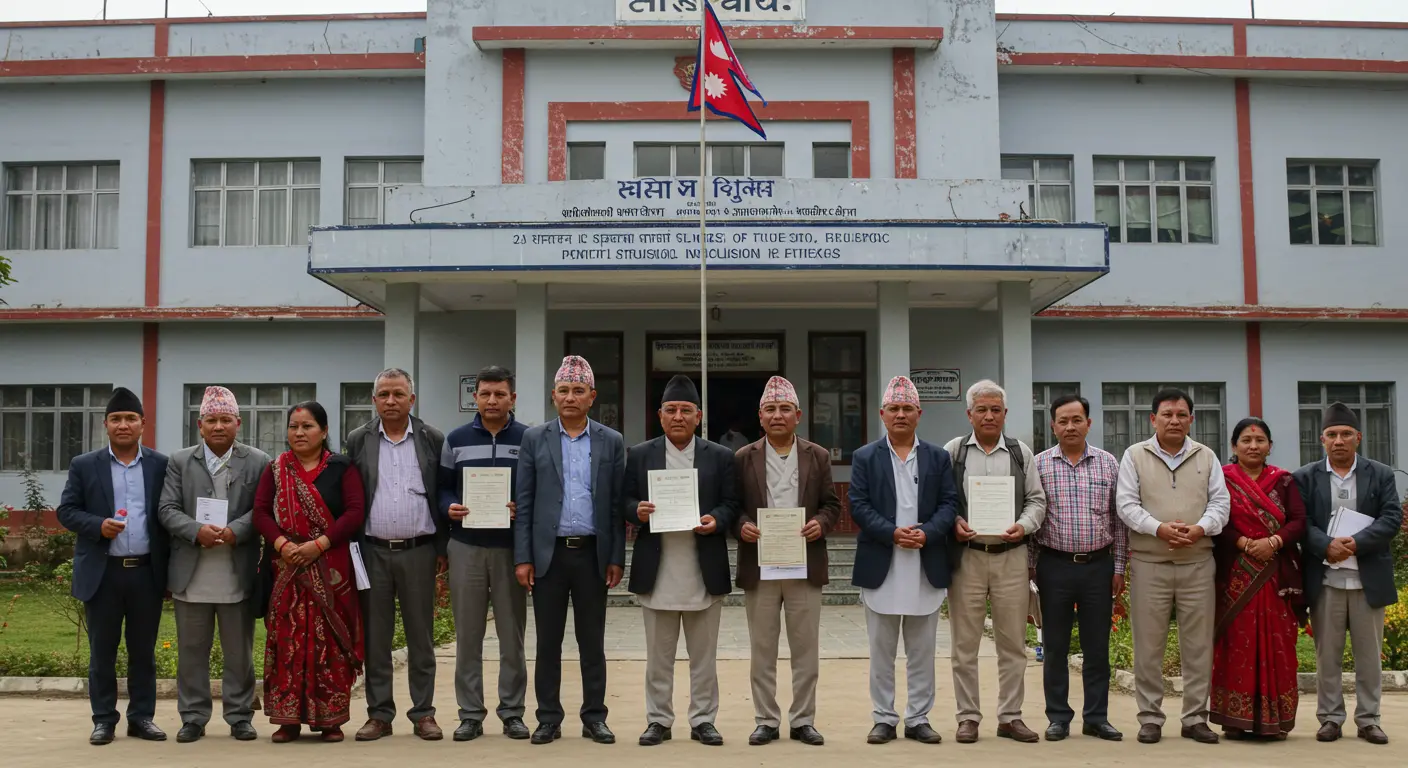
Nepal’s Experiment with Inclusion
After a decade of civil conflict, Nepal embarked on a path of profound transformation, culminating in the adoption of a new constitution in 2015. More than a set of laws, the document was a bold attempt to reimagine the very essence of the Nepalese state, which had suffered for centuries from deep-rooted social inequalities based on caste, ethnicity, and gender.1The Constitution proclaimed an ambitious goal: to build “an egalitarian society based on the principles of proportional inclusion and active participation.”3To achieve this goal, one of the most progressive legislative quota systems in Asia was created to ensure the representation of women, Dalits (untouchables), indigenous peoples (Janajatis), Madhesi and other marginalized groups in all organs of government.4
Years after the start of this massive social experiment, a key question remains: has this constitutional design led to a real redistribution of power and influence? Or is Nepal facing a phenomenon that might be called “symbolic politics,” in which representation figures are growing but real influence remains in the hands of traditional elites? This article offers an evidence-based analysis of how Nepal is trying to overcome its historical legacy of exclusivity. We look at how successful the quota system has been in politics, from the federal parliament to local committees, and at how inclusiveness is faring in the private sector, where the rules are very different. The goal is to understand whether Nepal’s new inclusiveness represents genuine empowerment or merely formal compliance.
Architecture of Equality: Legal Foundations for Inclusion
To appreciate the effectiveness of the Nepalese model, it is first necessary to understand its legal basis. It is not a set of disparate recommendations, but a complex, multi-layered, legally binding system designed to purposefully change the composition of government bodies.

Constitutional mandate
The foundation of this system is the 2015 Constitution, which enshrines inclusiveness as one of the fundamental principles of the state structure. Several articles are of key importance:
- Article 38(4) explicitly enshrines the right of women “to participate in all state bodies based on the principle of proportional inclusiveness.”6This provision became the legal basis for the introduction of gender quotas at all levels of government.
- Article 42 expands this principle by guaranteeing the right to participate in public structures for “socially backward women, Dalits, indigenous peoples (Adivasi Janajati), Madhesi, Tharus, minorities” and other vulnerable groups.6
- Article 70 requires that representation of each gender or community be ensured in the election of the President and Vice President.7
These norms were a direct response to the historical injustice in which political and economic power was concentrated in the hands of a small group, the so-called Caste Hill Hindu Elite (CHHE).8The 2015 Constitution was, in essence, an attempt to legislatively dismantle this monopoly. Although some analysts note that some progressive provisions of the 2007 Interim Constitution were weakened in the process of political compromise, the overall focus on inclusiveness remained.9
The Electoral System as a Tool for Inclusiveness
The constitutional principles have been implemented through the specific mechanisms of the electoral system. Nepal uses a mixed model, combining the First-Past-The-Post (FPTP) system, where voters vote for a specific candidate in their district, and the Proportional Representation (PR) system, where voters vote for party lists.10It was the PR component that was conceived as the main tool for ensuring representation of marginalized groups.10
Key legislative quotas include:
- 33% quota for women: The law requires that at least one third of seats in the federal parliament and provincial assemblies be held by women.9If, following the results of elections under the majoritarian system, this number is not reached, the parties are obliged to “fill in” the missing number of women from their proportional lists.11
- Local level quotas: The Local Elections Act 2017 introduced truly revolutionary provisions. In each of the country’s 6,742 wards, the five-member local committee must include two women, one of whom must be from the Dalit community.3
- Quotas for management positions: The same law obliged political parties to nominate a woman for one of two key positions in each municipality – either mayor/head or deputy mayor/deputy head.13
Nepal’s legal framework is thus not just a declaration of intent, but a clearly defined mechanism for forced inclusion. This creates a unique context for analysis: what happens when such sweeping laws collide with deeply entrenched social norms and power structures?
Revolution in numbers: the success of descriptive representation
If we judge the quota policy purely by quantitative indicators, it can be called an unqualified success. Legislative mandates have led to an unprecedented and dramatic increase in the number of representatives of previously excluded groups in government bodies. The numbers speak for themselves.

Dramatic increase in female representation
Before the introduction of quotas, women’s presence in Nepalese politics was minimal. For example, in the elections of the 1990s, their share in the House of Representatives did not exceed 6%.8The situation changed dramatically after the adoption of inclusion laws. Following the 2017 local elections, women occupied 40.9% (about 14,000) of all positions in local government bodies across the country.12This was a historic breakthrough.
At the federal level, the mandatory 33% quota was also largely met, making Nepal’s parliament one of the most gender-balanced in Asia and the world.11This jump was achieved mainly due to the proportional representation system, which compensated for the poor performance of women candidates in majoritarian districts.11
Unprecedented arrival of Dalit women
Perhaps the most significant achievement of the system has been the integration of women from the Dalit community, one of the most oppressed and marginalized groups in Nepali society, into politics. A mandatory quota of one Dalit woman seat in each local committee resulted in 6,567 Dalit women being elected in the 2017 elections, and 6,620 in 2022.15Before that, their presence in politics was virtually zero. This single norm literally opened the doors to politics for thousands of women who had historically been deprived of any voice.3As a result, Dalit women now constitute a significant share of all elected women representatives at the local level – 47.4%, a direct consequence of this targeted quota.13
Table 1: Impact of Quotas on Political Representation in Nepal

This table clearly shows the scale of the changes. The quota system became the main, if not the only, driver of this numerical revolution. It successfully solved the problemabsencemarginalized groups in politics. But behind these impressive figures lie more complex and disturbing trends about real influence and power.
Beyond Numbers: The Challenge of Substantive Representation
The analysis shows that the quantitative growth of representation has not automatically led to the acquisition of real power. This is the essence of the dilemma of “real representation or formal observance.” Despite the impressive figures, power has largely remained in the hands of traditional elites, and new representatives often find themselves in symbolic roles.

Glass ceiling in key positions
Data on the distribution of local positions reveals a worrying pattern. While women hold around 41% of all positions, their share in the most powerful, non-quota positions of mayor or head of municipality is only 2%. But in the positions of deputy mayor, which parties often give to women to meet the quota, their share reaches 91%.13This shows that political parties use women and minorities to formally enforce the law, but retain real power for themselves.
The dominance of the elite (Khas Arya) remains unshaken. Men from this group, although constituting only 16% of the population, hold 48% of mayoral posts and 44% of district committee heads.13This pattern clearly indicates that the quota system has created a two-tiered political system. At the first tier are powerful leadership positions that remain the preserve of elite men. At the second tier are less powerful, quota-based deputy and committee positions that are filled by women and minorities. This is a structural manifestation of tokenism, where inclusivity is demonstrated in secondary roles while the core of decision-making remains unchanged.12
‘Triple Discrimination’ Against Dalit Women
For Dalit women, the quota has become both a ticket into politics and a kind of “ghetto.” Their representation is almost entirely limited to a single, mandatory seat on the local committee.15Their presence in higher positions, such as deputy mayor, is “negligible.”13
Once mandated, they face enormous socio-cultural barriers. Deeply rooted patriarchal and caste prejudices mean that their voices are ignored in meetings, they are not respected by their male colleagues and the local community, and they are excluded from informal networks where real decisions are made.3They are often perceived not as full-fledged leaders, but merely as “representatives of Dalit women,” which reduces their role to symbolic.3So the quota solves the problem
absence, but it creates a new problemmarginalized presenceIt opens the door to the room, but does not guarantee a voice at the negotiating table.
Erosion of inclusion for other minorities
The proportional representation (PR) system, designed to benefit minorities, is also being eroded. Increasing the share of first-past-the-post (FPTP) constituencies to 60% in parliament reduces overall inclusiveness, as the first-past-the-post system historically favours dominant groups.10
Moreover, the list of groups eligible for quota reservations included the dominant elite Khas Arya group. The move has drawn sharp criticism as it erodes the very principle of positive discrimination and reduces the share available to historically oppressed communities such as the Madhesi and Janajati.9
Madhesi communities in the densely populated Terai plains are particularly disgruntled. They claim that their political influence is being deliberately undermined through so-called gerrymandering – the deliberate redrawing of constituency boundaries that merges their territories with sparsely populated hill areas.17Furthermore, redistricting based on geography rather than population puts them at a disadvantage.18The appointment of a Madhesi president is seen by many in the community as “pure tokenism” that does not address the systemic problem of their extremely low representation in the army, police and civil service.17
Inclusion in Business: A Whole Different World
While inclusiveness in politics is enforced by the state through strict laws, the private sector in Nepal has a very different atmosphere. Progress is much slower here and is subject to market logic rather than social mandates.

Lack of strict mandates
Unlike the political sphere, Nepal has no legally mandated quotas for the representation of women or ethnic minorities on boards of directors or in senior management positions in companies. An analysis of corporate governance legislation, particularly the Companies Act 2063 (2006), reveals that the discourse revolves around concepts such as transparency, accountability, shareholder rights, and directors’ fiduciary duties.19Gender diversity is mentioned as a “best practice” or aspirational goal, but not as a legal obligation.21
There is thus a fundamental gap between the two approaches to inclusion. The state views it as a right that must be enforced by law, while the corporate world sees it as a potential business advantage that should be encouraged. This gap in philosophy translates into a huge difference in results: while politics has undergone a numerical revolution, the corporate world is lagging far behind.
The State of Gender Diversity in the Corporate Sphere
Statistics on the subject are limited, but the available data paints a telling picture. According to a 2021 report, women make up 29.6% of managers in Nepal, a significant figure but still far from parity with the 70.3% of male managers.22In the cooperative sector, where women’s participation reaches 51%, they account for only 13.2% of management positions.23This situation is strikingly reminiscent of political dynamics: high representation at the grassroots level and a sharp decline at the decision-making level.
At the same time, international organizations such as the International Finance Corporation (IFC) and UN Women are actively promoting gender equality in the private sector. They point to direct economic benefits, arguing that achieving gender parity could increase Nepal’s GDP by 9.2%.22Research on Nepalese banks also shows a positive correlation between the presence of women on boards and improved ESG (environmental, social and corporate governance) performance, supporting the business case for diversity.24However, this progress is due to external pressures and slow market processes, rather than decisive government policies.
The economic gap as the main barrier
For communities like Dalits, talking about board seats seems almost surreal. The political inclusion provided by quotas does not address the fundamental problem of their economic exclusion, which makes participation in the corporate elite virtually impossible.
The statistics here are relentless. Dalits make up 13.8% of the country’s population.15, but 42% of them live below the poverty line.26Their average per capita income is about half that of Dalits.26Literacy rates are significantly low and access to higher education is minimal.27The economic activities of Dalits are mainly concentrated in daily labour and subsistence agriculture; only about 5% of them are engaged in any kind of business.26
Corporate leadership requires capital, education, and social connections – all of which have been systemically denied to these communities for centuries. So even if Nepalese companies wanted to diversify their boards, the pool of “qualified” Dalit candidates (by traditional corporate standards) would be extremely small. This shows that political quotas may create a path to one kind of power, but without parallel, equally radical economic and educational reforms, the doors to corporate governance and wealth creation will remain firmly closed to the most marginalized groups.
Conclusion: A half-fulfilled promise

Nepal’s experiment in promoting inclusion through a quota system has produced mixed but highly significant results. Analysis shows that the policy has been a powerful tool that has successfully achieved its primary objective of radically changing the face of Nepalese politics. IncreasedescriptiveThe representation of women and Dalits in government is undeniable and a historic achievement that has broken the centuries-old monopoly of elites on political participation.12
However, this promise remains only half-fulfilled. Quantitative success masks qualitative problems, since the increased presence has not yet been transformed into an equivalentsubstantiverepresentation and real influence.6The system has created a visible but often symbolic level of representation, where marginalized groups are concentrated in less influential, quota-based positions, while traditional elites retain control over key levers of power.13These problems are particularly acute for those who face intersecting discrimination, such as Dalit women, or for ethnic groups, such as the Madhesi, whose inclusion is undermined by political manipulation.15
In the corporate world, the journey toward inclusion has barely begun. It is a field governed by market principles rather than social mandates, where deep economic and educational barriers for marginalized groups remain virtually insurmountable.
Ultimately, quotas have proven effective as a necessary first step to cracking a closed system. They are indispensable for providing initial access. But they are not a panacea. True representation requires much deeper transformations: challenging the patriarchal and caste norms that breed tokenism; reforming the internal structures of political parties to promote genuine leaders from all walks of life; and, most important, undertaking fundamental economic and educational reforms. Only such comprehensive measures can create real pathways to power not only in politics but in all spheres of Nepali society.ble economic growth and restore hope for the future of its citizens in their native land.
Sources used
- Dalits Representation in National Politics of Nepal
- Reflections on Contemporary Nepal
- Dalit women: empowered or imperilled?
- Gender-Inclusive Constitution Key to Nepal’s Transition from Fragility to Development
- The fight for gender equality in Nepal from a Swiss perspective
- Exploring Dalit Representation in the Federal Government of Nepal: A Sociological Perspective on Decision-Making Dynamics
- Nepal – Global Gender Equality Constitutional Database
- Progress of Diversity and Inclusion in Nepal
- Comparing the 2007 and 2015 constitutions
- Electoral systems and political representation in post-war Nepal
- Dalits and women the most under-represented in Parliament
- Beyond “Capacity”: Gendered Election Processes, Networks, and Informality in Local Governments in Nepal
- Nepal’s house of cards: are women included or co-opted in politics …
- This is what leadership looks like: Laxmi Badi, a Dalit woman leader from Nepal, fights inequality every day
- Dalit women in local governance
- New House of Representatives to be less inclusive
- Why Madhesi Resentment against the Constitution?
- Why Madhesis Resentment against the Constitution?
- Corporate Governance in Nepal: A Comprehensive Analysis of the Company Act 2063 and Global Legal Perspectives
- Corporate Governance in Nepal
- Corporate Governance in Nepal | Imperial Law Associates
- Stock Exchanges and Global Partners Rally to Advance Gender Equality Kathmandu, Nepal, March 29, 2024—To mark International Wo
- Women Leadership and WASH, Nepal
- Composition and Activity of the Board of Directors: Impact on ESG Performance in Nepalese Banking System
- Composition and Activity of the Board of Directors: Impact on ESG Performance in Nepalese Banking System
- Dalit’s livelihoods in Nepal: income sources and determinants
- Report on Dalit Women and Critical Areas of Concern determined by the Beijing Platform for Action (BPFA) for Women
- COUNTRY GENDER EQUALITY PROFILE