Key Takeaways
- Systemic Vulnerability: Nepal’s combination of extremely high vehicle import taxes, procedural gaps in customs, and a historically paper-based vehicle registration system has inadvertently created a profitable destination market for sophisticated international car theft syndicates originating from countries like the UK.
- Widespread Economic Damage: The infiltration of stolen vehicles into Nepal inflicts multi-layered economic harm, including significant losses in state tax revenue, unfair competition that cripples legitimate auto dealerships, and severe risk exposure for financial institutions providing auto loans on illicit assets.
- Actionable Digital Solutions: A robust, multi-pronged strategy is required, centered on technological upgrades. This includes implementing a mandatory, centralized digital vehicle registry linked to international databases, enhancing customs with advanced screening, and compelling financial institutions to integrate comprehensive VIN verification into their loan-underwriting processes.
Introduction
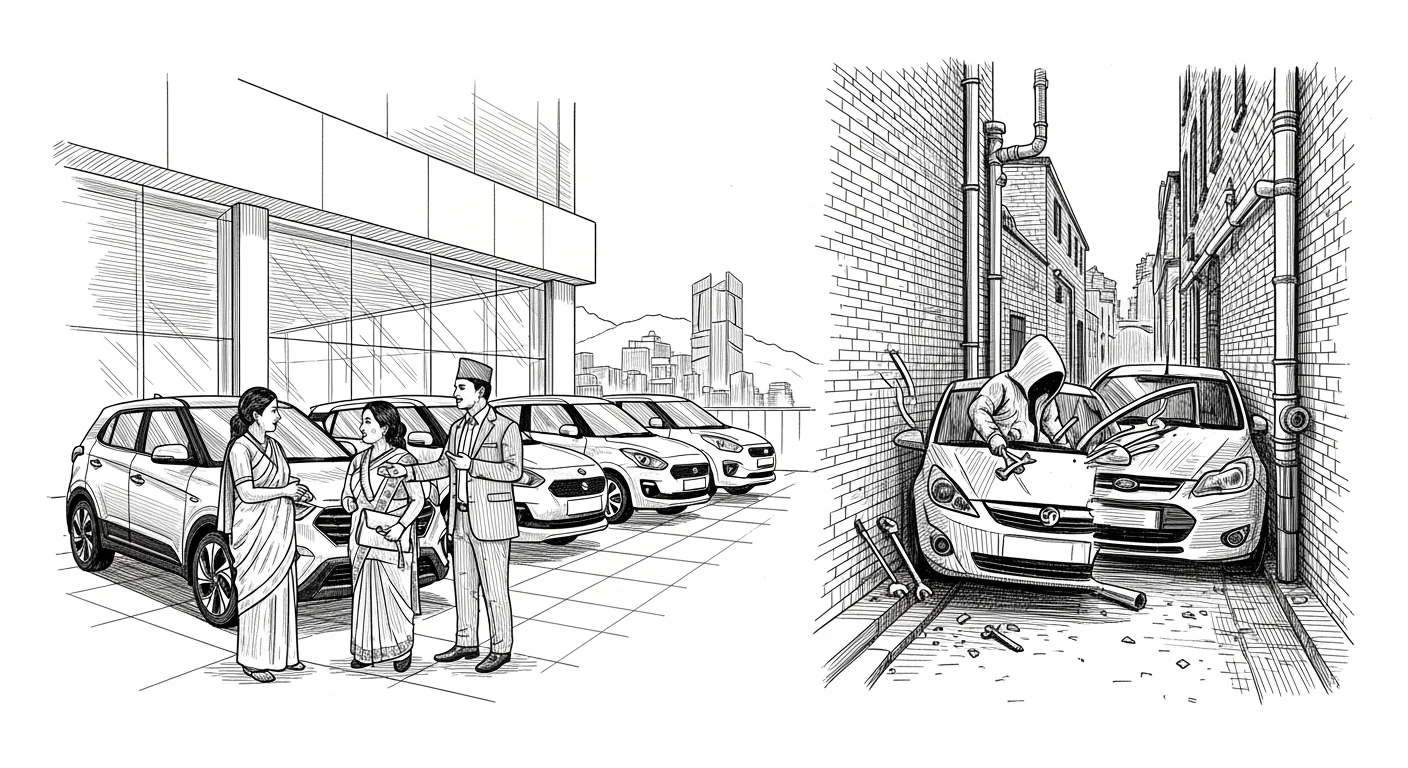
The sleek lines of a luxury SUV navigating the bustling streets of Kathmandu may seem a world away from a quiet suburban driveway in England. Yet, a startling headline connecting car crime in the UK to the Nepali automotive market reveals a dark and complex artery of transnational crime. This is not merely a story about stolen vehicles; it is a profound indictment of systemic vulnerabilities that lie at the intersection of global crime and Nepal’s domestic economy. The presence of these vehicles on Nepali roads is a symptom of a deeper issue, one that poses a direct threat to government revenue, the stability of the financial sector, the viability of legitimate businesses, and the trust of the average consumer.
As Alpha Analyst, we move beyond the sensationalism to dissect the intricate mechanics of this criminal enterprise and its tangible impact on Nepal’s economic landscape. This analysis will not only illuminate the scope of the problem but, more importantly, will outline a clear, solution-oriented framework for policymakers, business leaders, and financial institutions. The challenge is clear: to transform Nepal from a vulnerable destination into a fortified and resilient market. This requires a concerted effort to close regulatory loopholes, embrace digital transformation, and foster a new paradigm of vigilance across both the public and private sectors.
The Anatomy of a Global Criminal Pipeline
The journey of a stolen vehicle from a developed nation like England to a consumer in Nepal is a masterclass in exploiting systemic weaknesses across continents. The operation begins with high-tech theft methods, such as keyless relay attacks, where criminals capture the signal from a key fob inside a house to unlock and start a car. The targets are typically high-value, in-demand models from brands like Land Rover, BMW, and Mercedes-Benz. Within hours of being stolen, the vehicle’s identity is methodically erased. The physical Vehicle Identification Number (VIN) plates are swapped, and the engine and chassis numbers are often tampered with or professionally re-stamped. The vehicle’s electronic data, stored in its onboard computer, is reprogrammed to match the new, fraudulent identity.
The next phase involves creating a convincing, albeit entirely fake, paper trail. Forged ownership documents, sales invoices, and export certificates are generated to legitimize the vehicle for international shipping. Criminal syndicates exploit the sheer volume of global container shipping to conceal these vehicles. They are often declared as other goods, such as used machinery or household items, to evade cursory customs inspections at the port of origin. The final leg of the journey involves navigating the import process at the destination country. This is where Nepal’s specific vulnerabilities come into play. The criminals rely on gaps in verification, a reliance on physical paperwork that can be easily forged, and occasionally, corruption to clear the vehicle through customs and into the domestic market.
Why Nepal? A Confluence of Incentive and Opportunity
International criminal organizations do not choose their destination markets at random; they are meticulously selected based on a cost-benefit analysis. Nepal, unfortunately, presents an almost perfect storm of conditions that make it an attractive end-point for this illicit trade. The single greatest incentive is the country’s vehicle taxation policy. With customs duties, excise duties, and VAT combining to push the final cost of a legally imported vehicle to over 250% of its original price, the potential profit margin for a smuggled, stolen car is immense. A vehicle that costs $50,000 to import legally can be sold for a significant profit by criminals who have acquired it for a fraction of that cost, even after factoring in transportation and bribes.
This powerful financial incentive is coupled with significant procedural opportunities. Historically, Nepal’s Department of Transport Management (DoTM) has relied on a fragmented, paper-based registration system, often referred to as the “blue book.” This manual system is highly susceptible to forgery and manipulation. A skilled forger can create a blue book that is virtually indistinguishable from a legitimate one, making it difficult for buyers, and even banks, to verify a vehicle’s authenticity. Furthermore, there has been a lack of a centralized, real-time digital database that links customs data with registration data and is cross-referenced with international stolen vehicle databases like Interpol’s. This disconnect means that even if a vehicle’s VIN is flagged in a global database, there is no automated mechanism to stop it from being registered and sold within Nepal.
The Economic Fallout: A Cascade of Negative Impacts
The infiltration of stolen vehicles is not a victimless crime. Its economic consequences ripple through the entire Nepali economy. The most immediate and quantifiable impact is the massive loss of government revenue. Each stolen vehicle that enters the market represents a complete loss of customs duties, excise taxes, and Value Added Tax (VAT). In a country where vehicle import taxes are a significant source of state income, this black market constitutes a major fiscal leakage, diverting funds that could otherwise be used for public infrastructure, healthcare, and education.
Beyond the fiscal drain, the legitimate automotive sector is a primary casualty. Authorized dealers and importers who operate within the bounds of the law are placed at a severe competitive disadvantage. They bear the full burden of Nepal’s high tax regime, regulatory compliance costs, and after-sales service obligations. They simply cannot compete on price with a black market that has no acquisition cost and pays no taxes. This unfair competition erodes their market share, squeezes their profit margins, and can ultimately threaten their long-term viability. It discourages further investment in the formal auto sector, including in showrooms, service centers, and workforce training, thereby stunting the growth and professionalization of the industry.
Financial System at Risk: The Hidden Liability in Auto Loans
Perhaps the most insidious and overlooked risk is the one borne by Nepal’s banking and financial institutions. A significant portion of vehicle purchases in Nepal are financed through auto loans. When a bank approves a loan for a car, the vehicle itself serves as the primary collateral. In the current environment, lenders face the terrifying prospect of unknowingly financing stolen assets. Their due diligence processes, which traditionally focus on the borrower’s creditworthiness and a review of the paper-based registration documents (the blue book), are inadequate for detecting sophisticated fraud.
The consequences of this exposure are severe. If a financed vehicle is later identified by law enforcement as a stolen asset and seized, the collateral backing the loan evaporates instantly. The bank is left with a non-performing loan and little to no recourse for recovery. The borrower, who may have been an unwitting victim, is likely to default on the remaining payments, having lost their primary asset. A large-scale crackdown on stolen vehicles could trigger a wave of defaults across the banking sector, leading to significant write-offs and impacting the liquidity and stability of the lending institutions involved. This hidden liability represents a systemic risk that bank boards and risk management departments must urgently address.
Undermining Governance and International Credibility
The sustained presence of a market for vehicles stolen from allied nations like the UK deals a significant blow to Nepal’s international reputation. It signals to the global community that the country’s regulatory and enforcement mechanisms are weak, porous, and potentially compromised. This can lead to increased scrutiny on all of Nepal’s exports and imports, adding friction and cost to legitimate international trade. It raises questions about the government’s capacity and willingness to combat transnational organized crime, a key metric for international partnerships and foreign investment.
Domestically, it erodes public trust in key state institutions. When citizens see that the system designed to register vehicles and collect taxes can be so easily bypassed, it fosters a culture of cynicism and non-compliance. It suggests a level of either gross incompetence or deep-seated corruption within customs, transport management, and law enforcement agencies. This breakdown of trust is corrosive, undermining the social contract between the state and its citizens and making future governance reforms more difficult to implement. Addressing this issue is therefore not just an economic imperative but a matter of restoring faith in the country’s institutional integrity.
Fortifying the Gates: A Digital Overhaul for a Resilient System
The foundation of any credible solution lies in a comprehensive technological and procedural overhaul of the vehicle import and registration process. Nepal must move decisively away from its reliance on fallible paper-based systems. The foremost priority should be the development and mandatory implementation of a National Vehicle Registry—a centralized, blockchain-enabled digital database. This system would create a unique, tamper-proof digital identity for every vehicle in the country, from the moment it is cleared by customs to its final disposal.
Crucially, this registry must be integrated with international databases, primarily Interpol’s Stolen Motor Vehicle (SMV) database. Before a vehicle can be cleared at a Nepali border point, its VIN must be automatically cross-referenced against this global database. Any match should trigger an immediate red flag, seizure of the vehicle, and investigation. Furthermore, at the Department of Transport Management, the registration process must be modernized. This includes mandatory multi-point VIN verification, using digital scanners to check the chassis, engine, and other stamped parts against the import documentation and the digital registry. Introducing high-security registration certificates with embedded chips and biometric links to the owner would further harden the system against fraud.
The Role of the Private Sector: From Victims to Proactive Guardians
While the government must lead in regulatory reform, the private sector cannot afford to remain a passive victim. Legitimate businesses, particularly automotive dealers and financial institutions, have a vested interest in sanitizing the market and must play a proactive role. The NADA Automobiles Association of Nepal should take the lead in establishing an industry-wide Code of Conduct. This could include a “Certified Importer” program, where members must adhere to stringent due diligence protocols, including mandatory third-party verification of a vehicle’s entire supply chain history before import.
Banks and financial institutions must fundamentally re-engineer their auto loan underwriting process. Relying on the blue book is no longer sufficient. They must integrate a mandatory VIN check as a non-negotiable step in loan approval. Before disbursing funds, the lender should use commercially available international vehicle history services (analogous to CarFax or AutoCheck) to verify the vehicle’s provenance. They should also directly query the forthcoming National Vehicle Registry and international stolen vehicle databases. By making their financing contingent on a clean, digitally-verified history, banks can act as a powerful de-facto regulator, choking off the financial oxygen that allows the market for stolen vehicles to thrive.
Strategic Recommendations: A Multi-Pronged Approach for a Secure Market
The challenge posed by “car crime in England” manifesting as a problem “in the Nepalese market” is a complex, systemic issue that demands a coordinated and robust response. Merely reacting to individual cases is insufficient. Nepal requires a forward-looking strategy that addresses the root causes and builds a resilient ecosystem for the future. The path forward must be built on a partnership between the government, the private sector, and an informed public.
For policymakers, the agenda is clear: First, fast-track the creation of the integrated, digital National Vehicle Registry and mandate its use across customs and transport agencies. Second, forge formal data-sharing agreements with law enforcement in source countries and with Interpol. Third, launch a high-profile inter-agency task force to investigate and prosecute the networks facilitating this trade, sending a powerful signal of zero tolerance. For the private sector, led by NADA and the Nepal Bankers’ Association, the mission is to set new standards for due diligence. This means adopting rigorous supply chain verification protocols and making comprehensive VIN and history checks a mandatory component of every sale and every loan. By transforming their processes, they not only protect their own balance sheets but also safeguard the integrity of the entire market. Ultimately, by closing the loopholes that criminals exploit, Nepal can protect its revenue, stabilize its financial sector, and restore trust in one of the country’s most vital consumer industries.