Himalayan Chessboard
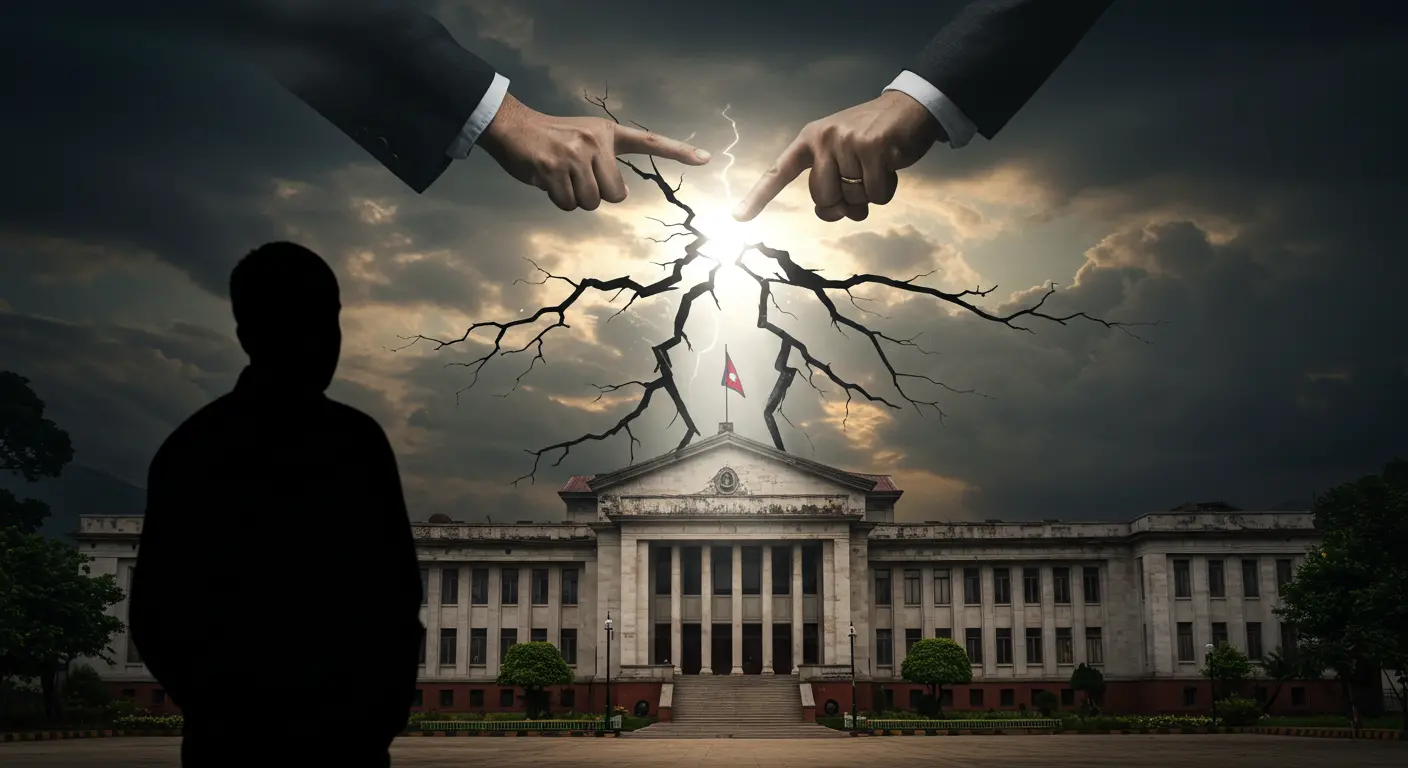
At the heart of Asia, sandwiched between the world’s highest peaks, lies Nepal, a country whose geography has shaped its destiny. It is more than just a small landlocked state; it is a key piece on the great Eurasian chessboard, a strategic crossroads where the interests of rising giants collide. For centuries, Nepal’s rulers have described their situation as “a yam between two boulders” – a fragile existence between India to the south and China to the north.1Today, these “boulders” have become tectonic plates of global politics, and a third powerful player, the United States, has been added to their rivalry, turning the region into an arena for a new “Great Game.”2
Nepal’s official foreign policy is based on the principles of non-alignment, enshrined in the country’s constitution and historically rooted in the Pancha Shila principles adopted at the Bandung Conference.7This position is not so much an ideological choice as a strategic necessity dictated by geography.1However, in the context of intensifying global competition, maintaining neutrality is becoming increasingly difficult. The shift from a unipolar to a multipolar world has only increased Nepal’s geostrategic importance, attracting the attention of not only its immediate neighbors but also the United States and the West in general.3
The central thesis of this analysis is that Nepal’s fate is determined not so much by its own foreign policy decisions, but by the complex interplay between the strategic ambitions of external powers and Nepal’s own deep domestic vulnerabilities. Chronic political instability, a fragile economy, and acute climate threats create cracks in the state’s foundations that external actors are adept at exploiting to advance their interests. The policy of “non-alignment” thus becomes a desperate balancing act in which every major international project – be it China’s Belt and Road Initiative (BRI) or the US’s Millennium Challenge Corporation (MCC) – becomes a bone of contention for domestic political factions, undermining the possibility of developing a unified national strategy.12
To understand the balance of power on this complex board, it is necessary to analyze the goals, tools and risks associated with each of the key players.
Table 1: Great Power Strategies in Nepal

Sources:2
The Indian Core – An Inseparable and Complex Connection
Nepal’s relationship with India is the bedrock of its foreign policy and economy, a complex and multifaceted bond that cannot be broken. On the one hand, it is a deep kinship, cemented by a thousand-year history, a common religion, culture and a unique open border that has given rise to the concept of “roti-beti” (the relationship of bread and daughters), symbolizing the close family ties between the peoples.18On the other hand, this proximity has historically resulted in Nepal being dominated by its “big brother,” subjected to political interference and economic pressure, which has inevitably fueled Nepalese nationalism and created opportunities for China.
Economic dominance and leverage
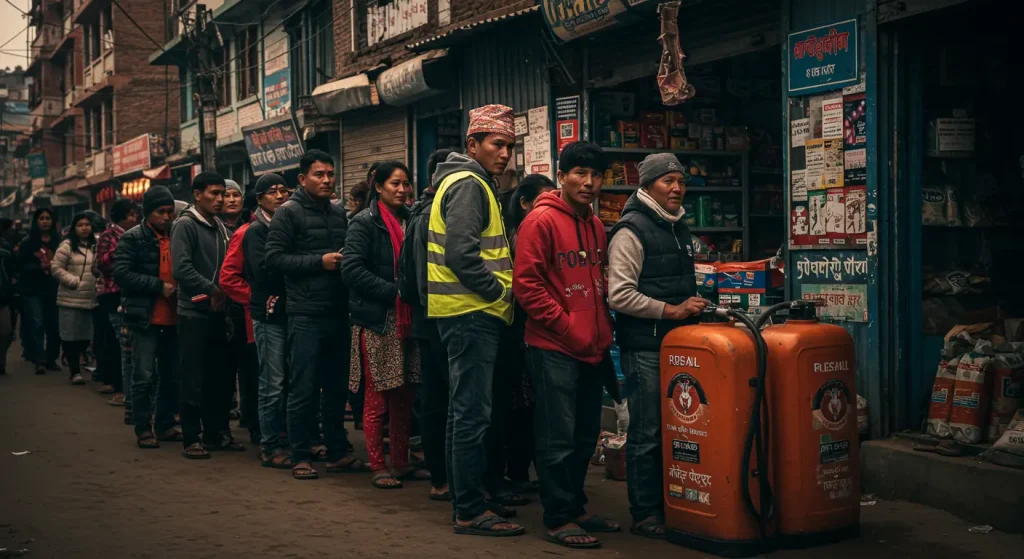
Nepal’s economic dependence on India is absolute. India accounts for more than two-thirds of Nepal’s merchandise trade, is the largest source of foreign direct investment (FDI), and is the supplier of 100% of Nepal’s petroleum products.23In the fiscal year 2024/25, exports to India grew by 82.5%, accounting for 79% of Nepal’s total exports.30This asymmetry gives New Delhi a powerful lever of economic influence.
The most striking example of this leverage was the unofficial economic blockade of 2015. Introduced after Nepal adopted a new constitution that India deemed unresponsive to the interests of the Madhesi (inhabitants of the southern plains with close ties to India), the blockade paralyzed the country’s economy, which was already barely recovering from a devastating earthquake.23The move was seen in Kathmandu as direct punishment and prompted Nepalese leaders to actively seek alternative trade routes and strengthen ties with China to reduce vulnerability to their southern neighbor.
Hydropower as a geopolitical instrument
In recent years, hydropower has become the main battleground for influence in Nepal. With a theoretical potential of 83,000 MW and an economically viable 42,000 MW, Nepal could become the energy hub of South Asia.4However, this potential has become a key instrument of geopolitics.
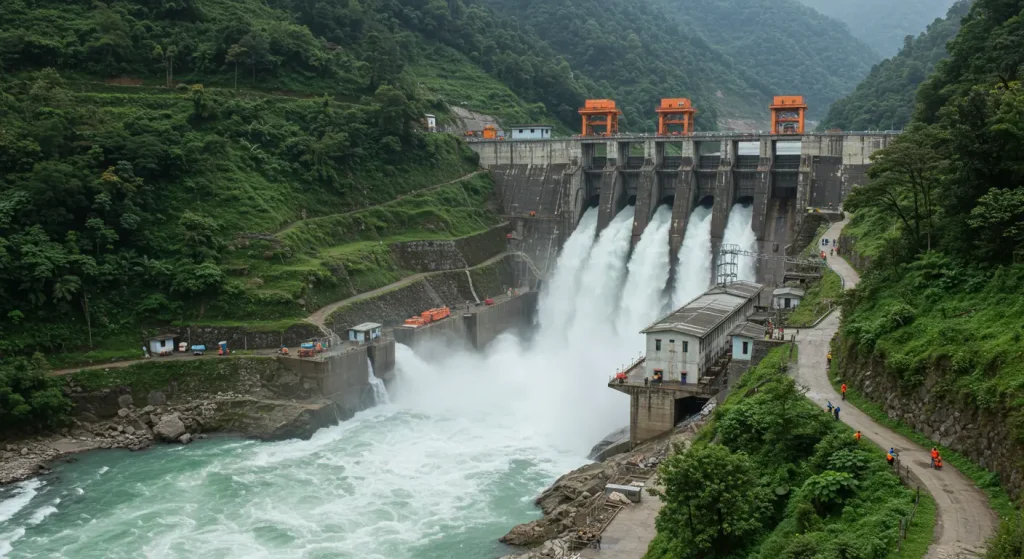
The analysis shows that India’s main interest is not so much in buying electricity as in controlling Nepal’s water resources, which are crucial for regulating flows in the Ganges basin, especially as Himalayan glaciers melt at an accelerated rate.4This control is achieved through strategic investments and political decisions.
A key step was India’s policy, adopted in 2018, to refuse to buy electricity from projects in which there is Chinese participation.4This decision, while seemingly commercial, is in fact a geopolitical masterclass. It effectively neutralizes China’s main advantage—its ability to invest in large-scale infrastructure—in Nepal’s most valuable sector. Any hydropower project with Chinese capital becomes unprofitable because it loses access to its only major market—India.
As a result, Nepal is forced to hand over key projects to Indian companies. For example, the 900 MW Arun-III mega project, which initially attracted interest from various investors, is now being developed by the Indian state-owned SJVN Limited.34A similar fate befell other major projects such as West Seti.32India has thus turned its energy market into a weapon that not only allows it to secure its own water and energy interests, but also to effectively contain Chinese influence in its strategic underbelly.
The Chinese Dragon’s Gambit: The Promises and Perils of the Belt and Road
China’s strategic offensive in Nepal is unfolding under the banner of the global Belt and Road Initiative (BRI). For Kathmandu, the BRI presents a tempting alternative to Indian hegemony, promising to transform the country from “land-locked” to “land-linked.”19This prospect is supported by large-scale infrastructure projects that could diversify trade routes and reduce critical dependence on India. But behind these promises lie serious risks: debt traps, opaque agreements, and an inevitable escalation of geopolitical tensions.2
Belt and Road: Slow Start and Big Debates
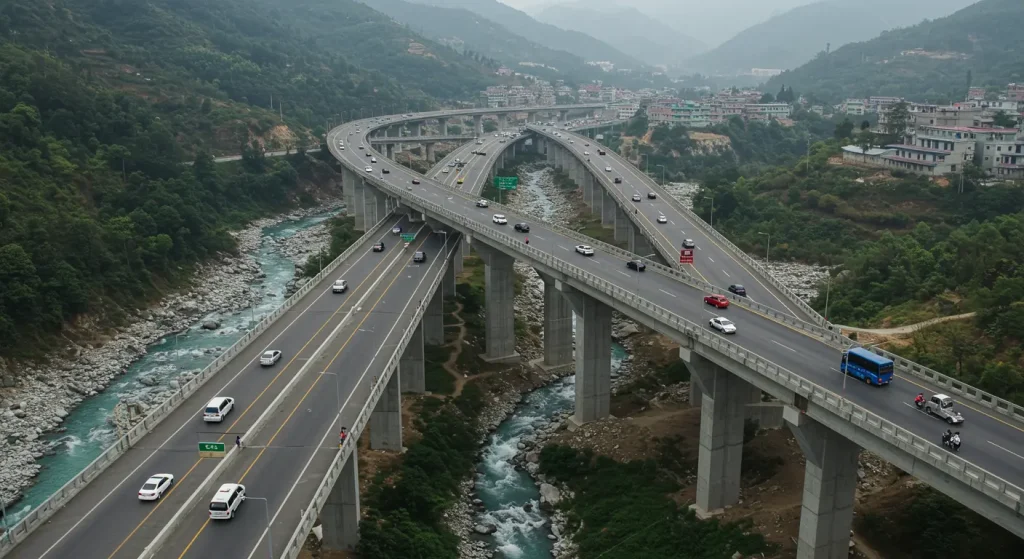
Nepal joined the BRI in 2017, but progress on projects has been slow due to political discord in Kathmandu and disputes over funding models.43It was only in December 2024, during Prime Minister Oli’s visit to Beijing, that a new framework agreement was signed, identifying ten potential projects, including the construction of roads, a cross-border railway and an industrial park.21
The main stumbling block remains the issue of financing. In Nepal, especially among supporters of the Nepali Congress Party, there are strong concerns about the “debt trap” that other countries, such as Sri Lanka, have fallen into after Chinese projects.21Kathmandu insists on grants, while Beijing offers “financial assistance” – a vague term that does not exclude high-interest loans.21
Pokhara Airport: Showcase or Trap?
The Pokhara International Airport, built with a $216 million Chinese loan, has become a symbol of both the opportunities and challenges of the Chinese presence.44Beijing is actively promoting it as a BRI success story. However, the airport faces serious commercial difficulties due to the limited number of international flights. One key reason is India’s refusal to provide new air corridors over its territory, a clear example of Indian counter-pressure.2

Moreover, the Chinese embassy’s unilateral statement that the airport was part of the BRI caused a scandal in Nepal and accusations of lack of transparency, as the Nepalese side claimed that the airport agreement was concluded before officially joining the initiative.43This case clearly demonstrates how infrastructure projects become a battleground not only for economic but also for symbolic influence.
Asymmetric trade and military cooperation
The economic relationship with China is highly asymmetrical. In the first 11 months of the 2023/24 financial year, trade turnover exceeded $700 million, but Nepalese exports amounted to only about $12.3 million, while imports from China amounted to almost $700 million.2This imbalance only increases Nepal’s economic dependence.
At the same time, China is stepping up military cooperation, which is causing concern in New Delhi. Joint exercises called “Sagarmatha Friendship” are being held, as well as military equipment supplies, including armored personnel carriers and tactical vehicles.2For China, this is a way to strengthen security on the border with Tibet and strengthen its position in the region.
China’s strategy in Nepal is thus long-term. It is not aimed at immediate economic gain but at gradually changing the geopolitical reality. By building the physical and digital infrastructure of the Trans-Himalayan Network, China aims to break India’s monopoly on Nepal’s access to the outside world. Even if alternative routes through China prove more expensive and complex than India’s, their very existence gives Kathmandu a strategic advantage and reduces the effectiveness of a potential Indian blockade. In essence, China is investing not just in roads and ports, but in fundamentally reshaping Nepal’s geopolitical constraints to weaken India’s hegemony in the long term.
The Western Joker – The US and its Indo-Pacific Strategy
The return of the United States to the Himalayan arena as a third power player has dramatically changed the balance of power. Washington’s strategy in Nepal is openly aimed at containing China’s growing influence, and its flagship project has become the Millennium Challenge Corporation (MCC). The heated debate over the MCC, and its subsequent abrupt suspension, clearly demonstrate the complexity and unpredictability of this new dimension of the “Great Game.”5
MCC: A ‘pure’ grant with geopolitical overtones
The MCC program was a $550 million grant (with an additional $197 million contribution from Nepal) to upgrade the power grid and road infrastructure.20Washington positioned it as a transparent, no-cost alternative to China’s opaque BRI loans.13The project was intended not only to improve Nepal’s infrastructure but also to strengthen its economic independence.
But MCC quickly became the center of a political firestorm after U.S. officials explicitly linked the program to the U.S. Indo-Pacific Strategy (IPS), a geopolitical doctrine aimed at containing China.12The move gave a powerful boost to opponents of the deal in Nepal — mainly leftist and communist parties, as well as China — who denounced the MCC as a covert military alliance that violated Nepal’s sovereignty and non-alignment policy. As a result, ratification of the deal was delayed for years, and took place only in February 2022, after intense political horse-trading and street protests.
The Shock of the Suspension: A Crisis of Confidence
After years of US efforts to convince Nepal of the credibility of its partnership and the need to ratify the agreement, the new Trump administration made a shocking decision in early 2025 to suspend all payments under MCC and other USAID programs for an audit.13
The move had disastrous consequences for the US position in Nepal:
- Breach of trust: The decision was seen as a betrayal and proof of the unreliability of the United States as a partner. It confirmed the worst fears of those who warned about the political underpinnings of American aid.46
- China’s propaganda victory: Beijing and its supporters in Nepal now have irrefutable proof that they are right. Now they can point out that even “free” Western money carries risks of political instability and unpredictability.46
- Creating a strategic vacuum: The suspension of key infrastructure projects threatens Nepal’s economic development and creates fiscal pressure on the government. China will inevitably try to fill this vacuum by offering its own, albeit riskier, alternatives.
The MCC story illustrates that for a small state caught between great powers, even gratuitous aid comes with a high geopolitical price. The US attempt to counter China’s BRI with a “clean” alternative failed because Washington underestimated the depth of Nepal’s political divisions and its susceptibility to being used as a pawn. In the end, by suspending its own initiative, the US not only failed to weaken China’s position, but may have pushed Nepal into its embrace – not for ideological reasons, but because of the lack of credible alternatives.
Internal Cracks: How Domestic Fragility Triggers External Pressure
While external forces are actively playing their games on Nepal’s chessboard, the real source of the country’s vulnerability lies within. It is the country’s deep internal “cracks” – chronic political instability, a fragile economy, and acute climate threats – that create the conditions that India, China, and the United States exploit to advance their interests. Nepal is caught in a “vulnerability vortex,” where political, economic, and environmental crises feed on each other, condemning the country to perpetual dependence.
Political instability: a game of musical chairs
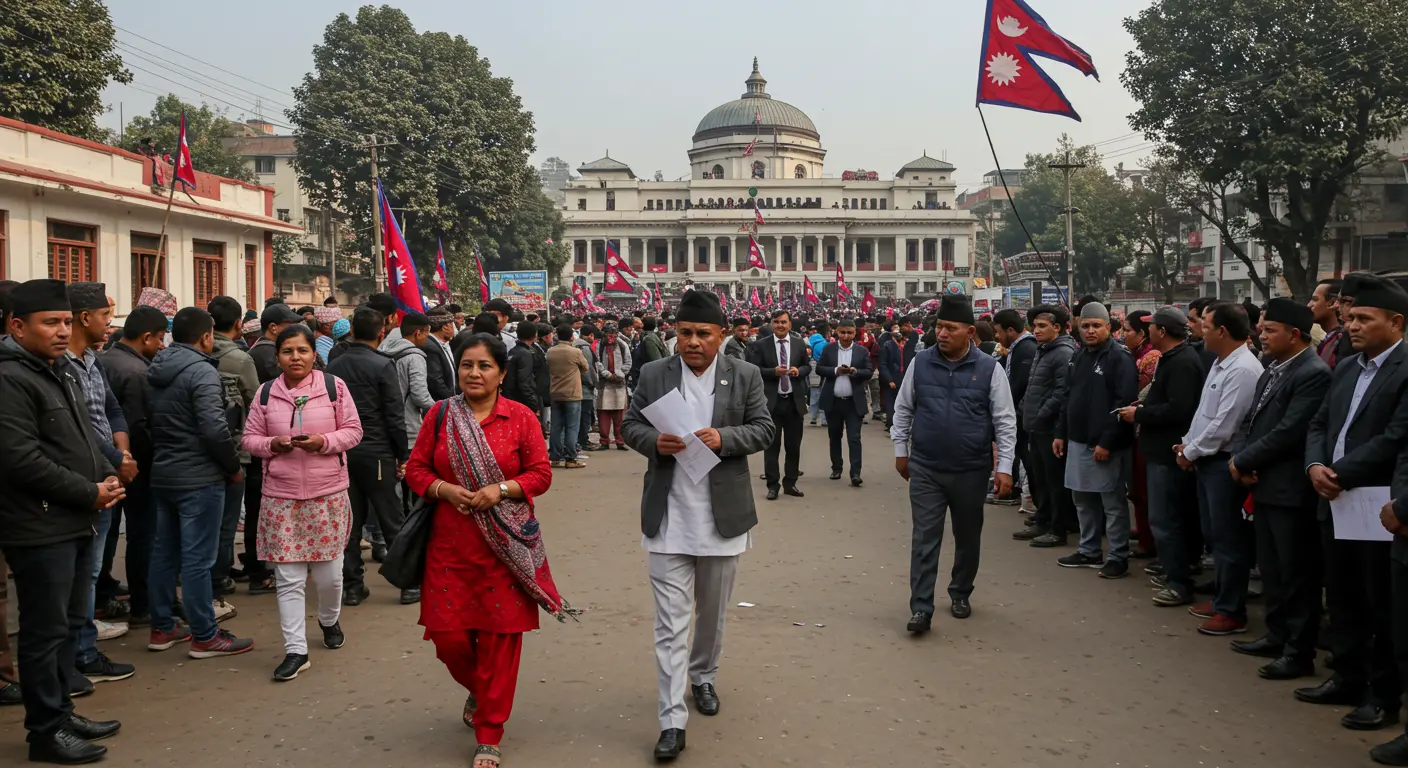
Nepal’s political system resembles a never-ending game of musical chairs, with 13 governments in the past 17 years.49This chaos leads to a lack of coherent policy, the disruption of long-term development projects and discourages both domestic and foreign investors.50Each new coalition reverses the decisions of the previous one, especially regarding large infrastructure projects financed from abroad. This instability makes Nepal an easy target for outside influence, as each of the great powers can find temporary allies among the constantly changing political elites.
The Remittance Economy and the Youth Exodus
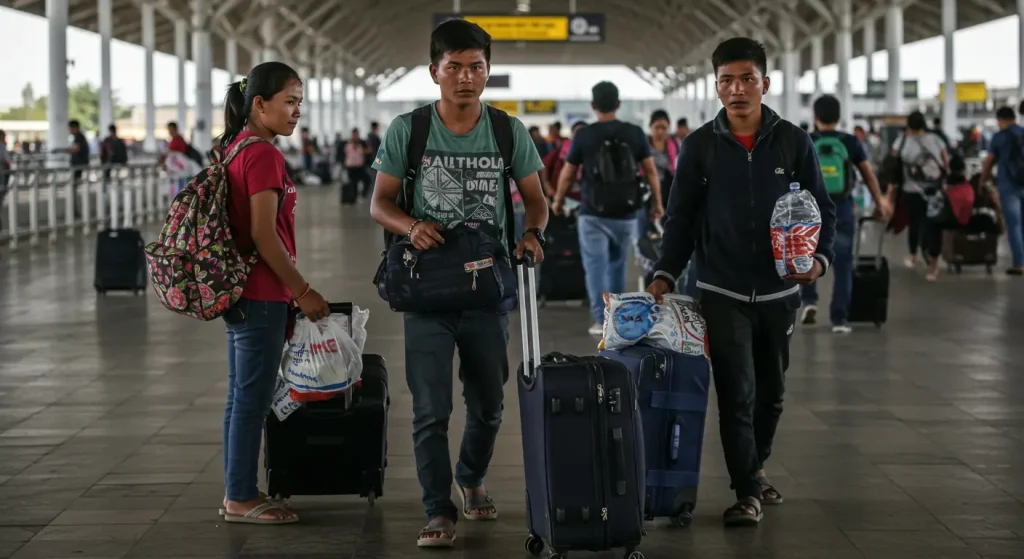
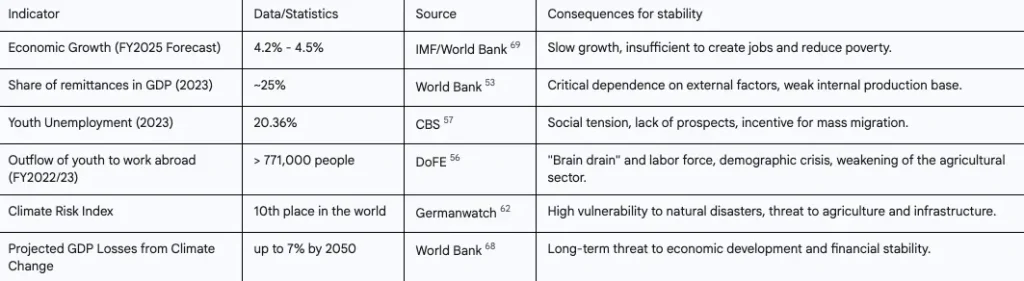
Nepal’s economy is dangerously dependent on migrant remittances, which amounted to about 25% of GDP in 2023.53This is a direct consequence of the failure to create quality jobs at home, which is causing a massive outflow of young people. In the 2022/23 financial year alone, more than 771,000 young people were granted work permits abroad.55The youth unemployment rate reached 20.36% in 2023.57
This “brain drain” and labor force deprives the country of its most valuable resource. Remittances, while saving households from poverty, at the same time preserve economic stagnation. They go mainly to consumption, not to investment in production.58As a result, the domestic production sector, especially agriculture, deteriorates and the tax base narrows, further weakening the state.60
Climate vulnerability: a threat to existence
Nepal is one of the most vulnerable countries in the world to climate change, ranking 10th on the Global Climate Risk Index.62Climate change is hitting two pillars of Nepal’s economy:
- Agriculture: Irregular monsoons, droughts and floods are already causing crop losses and threatening food security.64
- Hydropower: Melting glaciers and changing river patterns pose a threat of glacial lake outburst floods (GLOFs), which can destroy hydroelectric power plants and reduce the reliability of electricity generation during the dry season.66
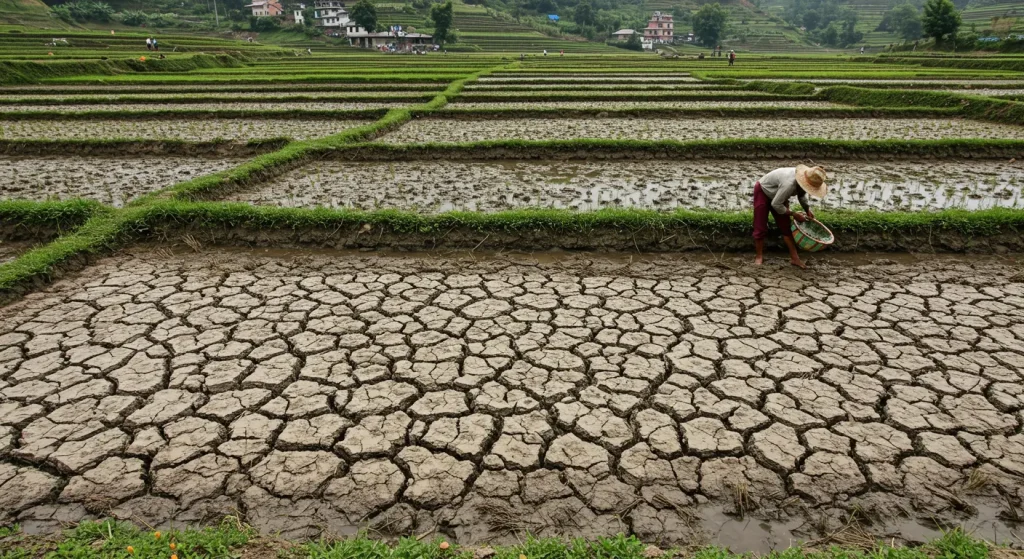
The World Bank estimates that by 2050, economic losses from climate change could amount to between 2.2% and 7% of GDP annually.62The economic loss from climate disasters over the past five years has already been estimated at 415.44 billion Nepalese rupees.64
These three factors – political, economic and climate – are intertwined. Political chaos hampers economic reform. Lack of jobs drives young people out of the country. A shrinking agricultural workforce and land degradation exacerbate the effects of climate change. And climate disasters, in turn, hit the economy and put additional pressure on the fragile political system. This vicious circle makes Nepal permanently dependent on foreign aid, meaning the Great Game will continue to play out on its soil.
Table 2: Nepal’s internal fault lines – key indicators of vulnerability
Long-term scenarios – check, stalemate or a new game?
The complex interplay of external ambitions and internal weaknesses puts Nepal at a crossroads. The country’s future is not a predetermined path, but rather a set of probabilities, the outcome of which depends on whose strategy is more successful and whether Kathmandu can find the strength to transform itself internally. Three main scenarios can be identified for the long term.
Scenario 1: Indian Encirclement (Strategic Subordination)
In this scenario, India successfully leverages its undeniable advantages – geography, economic might, and cultural proximity – to cement its dominant position. New Delhi effectively applies its energy policy, blocking Chinese investment in hydropower and becoming Nepal’s only partner in its most promising sector. The US, seeing Nepal firmly within India’s sphere of influence and distracted by other global crises, scales back its active involvement. China, faced with the impossibility of guaranteeing the profitability of its projects in Nepal, scales back its ambitions under the BRI, switching to more accommodating partners.
Result: Nepal achieves a certain level of economic prosperity through electricity exports to India and stable trade links. But this stability comes at the cost of strategic autonomy. Kathmandu’s foreign policy is tightly aligned with New Delhi’s interests, and any attempts at diversification are thwarted by economic leverage. Nepal becomes richer but less sovereign, becoming a reliable but subservient Indian outpost in the Himalayas.
Scenario 2: China’s Embrace (Risky Diversification)
This scenario becomes a reality when persistent pressure from India or an abrupt and final withdrawal of Western aid (such as the non-renewal of the MCC program) pushes a frustrated Nepal into a decisive turn toward Beijing. Tired of Indian interference and Western unpredictability, Kathmandu is banking on Chinese loans to implement transformational projects such as the trans-Himalayan railway, hoping to break the bonds of dependence once and for all.
Result: Nepal is experiencing a period of rapid infrastructure development that it has not seen for decades. New transport corridors, industrial parks and energy facilities are emerging. However, this comes at a high price. The country finds itself in serious debt dependence on China, which gives Beijing powerful levers of political influence. Relations with India are deteriorating sharply, and the border is becoming a source of constant tension. Nepal is turning from a “buffer state” into a “frontline state”, becoming an arena for direct confrontation between India and China. Economic growth is fragile and dependent on Beijing’s political will.
Scenario 3: Dangerous Balance (Motion by Inertia)
This is the most likely scenario, continuing current trends. Nepal continues its fragile and often chaotic balancing game, hesitant to make a final choice.50Governments in Kathmandu come and go with kaleidoscopic speed, using external actors for short-term political gains. Projects from all sides – China’s BRI, America’s MCC (if it is revived), and India’s hydroelectric projects – have progressed with varying degrees of success, but none have been truly transformative.
Result: Nepal manages to avoid being completely absorbed by one of the powers, but it pays for it with stagnation. The country remains in a “vulnerability vortex”: political instability slows development, the economy does not create jobs, young people leave, and climate threats grow. External forces continue to interfere in domestic affairs, supporting factions that benefit them. Nepal does not lose the game, but it does not win it either, finding itself in a state of perpetual stalemate – a strategic impasse where the country remains weak, dependent, and extremely vulnerable to any external or internal shocks.
Conclusion: The Next Move in Eurasian Solitaire
The analysis shows Nepal at the center of a geopolitical storm, where a high-stakes game is being played. India is using the levers of historical dependence to maintain its dominant position. China offers a risky but tempting alternative, promising an infrastructure revolution. The United States, meanwhile, is an unpredictable “wild card” whose actions can either strengthen or undermine the fragile balance of power.
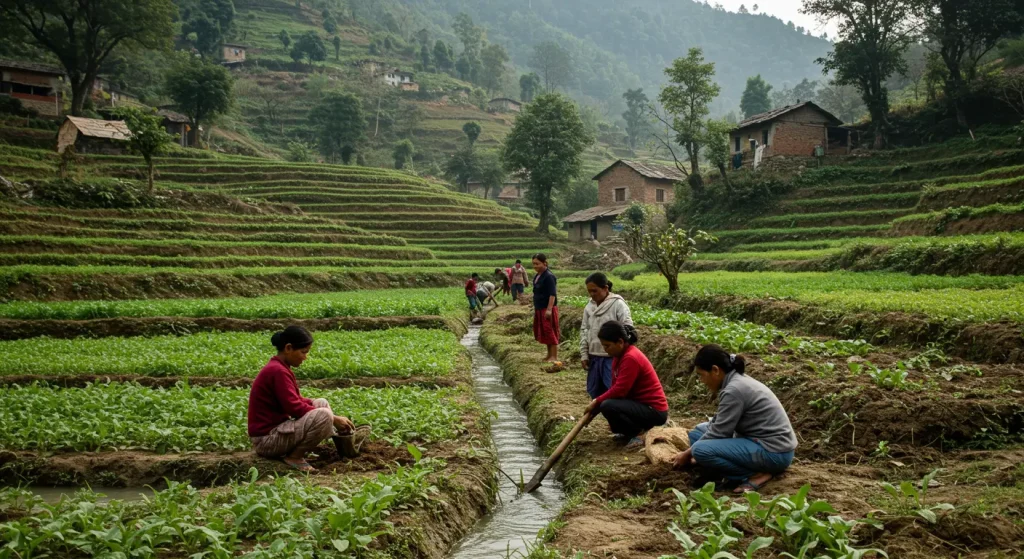
But the main conclusion of this study is that while the great powers arrange the pieces on the board, the decisive moves are left to Nepal itself. The key to escaping the “yam between two boulders” dilemma lies not in foreign policy choices – India, China, or the West – but in building domestic strength and resilience.
Achieving political stability, creating a dynamic domestic economy that can offer decent jobs to young people, and building an effective climate change adaptation system are the only long-term strategies that can give Nepal real room to maneuver. Without internal consensus and decisive reforms, the country risks forever remaining a field for someone else’s game, a pawn in the great Eurasian solitaire.
Sources used
- Foreign Policy of Nepal: Strategic Approach to Sovereignty
- China-Nepal’s Relations: Dynamics and Geopolitics
- Geopolitical rivalry between India and China in Nepal
- Geopolitics of energy in Nepal: Balancing India, China, and the US …
- Nepal’s Geopolitical Crossroads: Balancing China, India, and the United States
- Nepal’s Geopolitical Sensitivity on Great Power Rivalry: Analysing through the Lens of Schizoanalysis | Acta Humanitatis
- Everything You Need to Know About Nepal’s Foreign Policy
- The Relevanceof Nepal’s Non-Aligned Foreign Policy
- Nepal’s non-alignment foreign policy
- Nepal and Non-Aligned Movement: Navigating challenges of future relevance (Video)
- Prospects of Youth Participation in Political Landscape in Nepal
- The MCC Debate and U.S.-Nepal Ties in Flux
- As Elon Musk’s axe falls on MCC, Nepal fears the worst
- Nepal’s New Coalition and its Relations with China
- Nepal’s Foreign Policy Priorities – NUS Institute of South Asian Studies (ISAS)
- The MCC Debate, Nepali Politics and Intensifying Sino-US Rivalry in South Asia
- India’s Approach to Nepal’s New Government
- India yet to act on trade data sharing deal with Nepal
- Why BRI matters to Nepal
- Nepal urges continuation of US-halted MCC project
- Challenges In Executing BRI Projects
- Nepal rules out loans for BRI projects; emphasises grants, consensus
- The China Factor in Nepal-India Relations
- Nepal India Relations 2025 | New Spotlight Magazine
- BALANCING THE HIMALAYAN NEIGHBOURS: UNPACKING NEPAL’S PUBLIC PERCEPTION OF INDIA AND CHINA
- India’s Neighbourhood Policy Conundrum: A Case of Nepal and Sri Lanka
- Nepal Policy
- Understanding Nepal-India ties thru aid and FDI | The Annapurna Express
- Foreign Direct Investment: High Expectation, Low Achievement
- Nepal’s Foreign Trade Soars in FY 2081/82: Exports to India Surge by 82.5%, Trade Deficit Widens | NEPSE Trading
- The India-China Competition in Nepal in Recent Years
- Geopolitics of Nepal’s Hydropower: Has India Outmaneuvered China?
- GT Voice: India’s geopolitical game hurts outlook for Nepal’s hydropower
- India, Nepal Energy Ministers Jointly Visit Arun III Hydropower Project | News
- Arun-III Hydropower Project || India-Nepal Energy Cooperation || Transmission Infrastructure
- Nepal: Indian Energy Minister Khattar reviews progress of Arun-III Hydel Project
- Nepal: Indian Energy Minister Khattar reviews progress of Arun-III Hydel Project
- India-Nepal energy partnership: Arun-3 Hydro Electric Project achieves significant milestone
- Cabinet approves investment proposal for transmission component of Arun-3 Hydro Electric Project (Nepal portion) by Sutlej Jal Vikas Nigam(SJVN) Limited
- Belt and Road Initiative – Wikipedia
- Decoding China’s BRI Agreement with Nepal
- China’s Belt and Road Initiative – NIICE NEPAL
- China–Nepal strategic partnership stumbles over BRI and boundary issues
- Nepal signs framework agreement with China on Belt and Road initiative after years of delay
- China’s Belt and Road Initiative in Nepal | Taiwan Talks – YouTube
- Partnership Tested: Shuttering MCC Would Send the Wrong Signal to Nepal and Hand a Win to China | Center For Global Development
- US decision to shut down MCC riles PM Oli
- MCC Compact Fund Suspension in Nepal: Future, Key Impacts, and Everything You Need to Know
- COST OF POLITICAL INSTABILITY
- Nepal’s political and economic uncertainty
- Impact of Political Instability on Economic Growth of Nepal
- Nepal’s Political and Economic Uncertainty Likely to Continue | Hudson Institute
- Migration, remittances inflow key factor behind poverty reduction in Nepal: World Bank
- Addressing youth aspirations
- myrepublica.nagariknetwork.com
- Numbers of youths seeking foreign employment opportunities surge
- Youth Employment Issues and their Impact on the Economic Development of Nepal
- An Analysis of Remittance and Private Consumption in Nepal
- REMITTANCE IN NEPAL: STATUS, TREND AND ECONOMIC IMPACTS
- Outflow of Nepali youth: Causes and concerns
- Diversifying Government Revenue
- Climate Change in Nepal: Who Pays the Price?
- CLIMATE CHANGE TECHNICAL NOTE Nepal Disaster Resilience Second DPC with Cat DDO (NDRC) (P181344)
- Nepal’s agriculture, water resources under climate threat
- CLIMATE CHANGE AND ITS IMPACT ON NEPALESE AGRICULTURE – Nepal Journals Online
- Hydropower in Nepal A Path Toward or Away from Sustainability
- Managing environmental flows in Nepal’s rivers for a hydropowered future
- Integrating Climate Change into Nepal’s Development Strategy Key to Build Resilience, Says New World Bank Group Report
- Nepal’s Economy Expected to Remain Resilient in Face of Economic Shocks, says World Bank
- IMF Executive Board Completes the Fifth Review under the Extended Credit Facility Arrangement for Nepal