
The Two Trillion Rupees Paradox
Every day, the same scene unfolds in the departure hall of Kathmandu’s Tribhuvan International Airport, one that has decisive implications for the fate of a nation. Thousands of young Nepalese, full of hope and anxiety, say goodbye to their families and head for the planes that will take them to Malaysia, Qatar, Romania or Japan.1This daily exodus is not just a collection of personal stories; it is the country’s most significant economic process and its greatest national paradox.
At the heart of this paradox is a fundamental contradiction: a country that is being abandoned by its most viable demographic group – youth – is simultaneously being kept afloat by a financial artery that these same youth feed from abroad.3In the 2023/24 fiscal year, remittances to Nepal reached a staggering 1.445 trillion Nepalese rupees (about US$10.86 billion) – a figure equivalent to about a quarter of the country’s entire gross domestic product.5This amount exceeds foreign direct investment and official development assistance combined, and is a major stabiliser for Nepal’s fragile economy.7

This study challenges the conventional wisdom about this phenomenon. Is the exodus a catastrophic “brain drain” leading to irreversible decline, or an underappreciated “intellectual export” that, if managed strategically, could be the key to Nepal’s future prosperity? Answering this question requires a full and honest accounting of the real costs and hidden benefits, weighing the economic losses from talent shortages and foregone taxes against the social benefits of poverty reduction and investment in human capital. This analysis offers a comprehensive assessment of this complex phenomenon and a roadmap for transforming Nepal’s vast diaspora from a source of passive income into an active driver of innovation and development at home.
The Great Exodus – A Nation on the Move
To understand the depth of migration’s impact on Nepal, it is first necessary to understand its scale and dynamics. It is not just a trend, but a fundamental shift that is reshaping the country’s economic, social and demographic map.
Unstoppable Flow: Quantifying the Outcome
The figures for Nepalese migration are staggering. Every day, more than 2,000 young people leave the country in search of work abroad.1In the 2023/24 financial year alone, authorities issued over 741,000 work permits.9This is not a one-time surge, but a steady and growing process. The net migration rate (the difference between the number of immigrants and emigrants) for 2024 is projected at -401,282 people, indicating a colossal outflow of population.11
The post-pandemic period is particularly indicative. A joint report by the International Labour Organization (ILO) and the Asian Development Bank (ADB) showed that Nepal had the highest percentage increase in the outflow of migrant workers in Asia in 2019-2023 — 102%.12This proves that migration is not a temporary phenomenon, but an accelerating and deeply ingrained economic strategy for households across the country.13According to various estimates, there are about 3.5 million Nepalese working abroad, which is 14% of the total population.1More than half of all households in Nepal have at least one family member who is either working abroad or has already returned from there.1These data indicate that migration has ceased to be a private choice of individuals and has become a national phenomenon that determines the present and future of the country.
Map of the Global Nepali: From the Persian Gulf to the World
The geography of Nepalese migration is undergoing significant changes. Traditionally, the main destinations were Malaysia and the Gulf Cooperation Council (GCC) countries — Qatar, Saudi Arabia, and the UAE, which accounted for more than 85% of the official flow of migrants.13However, in recent years, a major strategic shift has taken place, with the United Arab Emirates emerging as the number one destination country.16

More importantly, new, higher-paying labor corridors are opening up to Europe (Romania, Croatia, Poland) and East Asia (Japan, South Korea).12In the 2022/23 financial year, more than 30,000 Nepalese workers went to Romania, Croatia, Malta and Poland.12This diversification is critical. While the Gulf remains the main market for low-skilled workers, European and Japanese markets are demanding higher-skilled workers. This opens up opportunities for higher per capita remittances and, more importantly, the acquisition of valuable skills. However, this shift complicates Nepal’s migration management, requiring new bilateral agreements, different mechanisms to protect workers’ rights, and tailored training programs.17
The Changing Face of the Migrant: The Brain Drain in Action
The most worrying aspect of Nepalese migration today is the changing quality of those leaving. Historically, the country has exported mostly low- and semi-skilled labor for the construction and manufacturing industries.15However, today there is a clear and growing trend towards the departure of qualified specialists.12In the 2023/24 financial year, of the 741,297 work permits issued, more than 532,000 were classified as “skilled” workers, while only 145,500 were “unskilled”.9
This “brain drain” is supported by concrete data on key professions. Of the 30,000 doctors registered with the Nepal Medical Council, only 18,000 are working in the country. More than 55% of registered engineers have also gone abroad.21This is no longer just an export of excess labor, but a depletion of the human resources needed to develop our own infrastructure, healthcare, and technology sectors.22

Diversifying migration routes is proving to be a double-edged sword. On the one hand, it opens up opportunities for “brain gain” through work experience in more developed economies. On the other, it accelerates the “brain drain,” as more skilled workers can apply for jobs in the demanding markets of Europe and Japan. Thus, the new corridors are not just an alternative; they are draining away another, more valuable segment of the labor force. This poses a difficult dilemma for the Nepalese government: should migration to these countries be encouraged to maximize remittances and skills transfer, even if this exacerbates the domestic skills shortage? Or should it focus on retention, at the risk of missing out on these valuable opportunities? This is the essence of the “brain drain” versus “brain export” debate.
The Balance of the Nation: Calculating the True Value
To understand the true significance of migration in Nepal, it is not enough to simply state its scale. A detailed cost-benefit analysis is needed, looking beyond the obvious figures and uncovering the hidden economic and social impacts of this phenomenon.
Income item: remittance economy
Remittances are the foundation on which Nepal’s entire macroeconomic stability rests. In the 2023/24 financial year, they reached US$10.86 billion, an increase of 14.5% over the previous year in dollar terms.5This amount amounts to about 25% of the country’s GDP, placing Nepal among the top five most remittance-dependent countries in the world.12These funds play a crucial role in maintaining foreign exchange reserves, stabilizing the balance of payments and financing the huge trade deficit.26
Table 1: Nepal’s Lifebuoy: Macroeconomic Snapshot of Remittances (FY2023/24)

As the table shows, the collective financial contribution of individual migrants is many times greater than the contribution of international development agencies and foreign corporations combined. This is not just part of the economy – it is its external support, which underlines the country’s extremely high dependence and the risks associated with migration.

At the micro level, remittances function as a powerful social safety net and are credited with much of Nepal’s impressive reduction in poverty over the past two decades.20World Bank research shows that migration and remittances explained up to one-fifth of the reduction in poverty between 1995 and 2004 and up to 40% between 2001 and 2011.29Households that receive remittances are not only less likely to be poor, but also spend more on key human capital investments – children’s education and health care.1
Expense Item: A Deep Look at the ‘Leak’
Behind the glare of billions of dollars in remittances lies the enormous cost to Nepalese society.
Human capital deficit and sunk costs
The most immediate and obvious loss is the exodus of skilled professionals. When more than half of the country’s engineers and a significant proportion of doctors leave, it creates a critical shortage of services within the country, undermining the health care system and holding up infrastructure projects.21Added to this are the “sunk costs” of their education. The cost of training a single MBBS doctor in Nepal can range from 4.3 million to 6.1 million rupees ($32,000 to $45,000), and a significant portion of this cost is subsidized by the government.35When these professionals leave, Nepal loses not only their services but also the government investment in training them.
Fiscal leaks
The impact of emigration on public finances is mixed. On the one hand, remittances stimulate consumption, which increases the collection of consumption-based taxes such as VAT.37On the other hand, the country loses significant income tax revenues as the highest paid and most promising workers leave.37This creates a structural distortion in the tax base, making it more dependent on consumption and imports, which in turn are fed by remittances. A vicious circle of dependency is created.
Social Scars: Family, Demography and Gender
Long-term separation takes a heavy psychosocial toll on families. Research shows high levels of anxiety (58%) and depression (25%) among family members left behind, especially wives who bear a huge burden of responsibility.39This leads to family breakdown, divorce and negatively impacts the well-being of children and the elderly.1

The mass exodus of young people (42.5% of the population are people aged 16 to 40) is causing a demographic crisis.3Villages are becoming empty, losing their able-bodied population, and it is mainly elderly people who remain in them.21This depletes social support systems and creates the threat of a future addiction crisis.
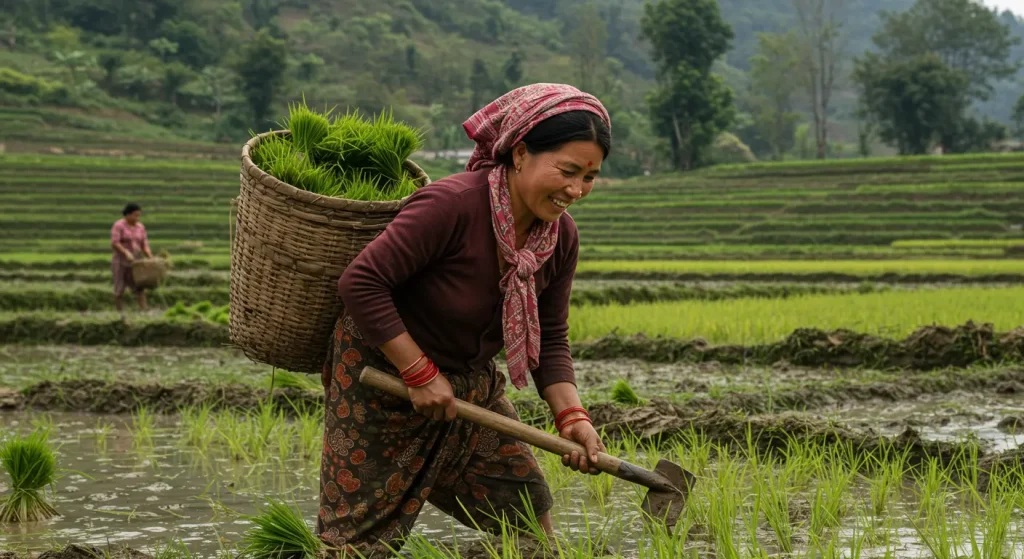
Finally, the so-called “feminization of agriculture” is taking place. In the absence of men, women are increasingly taking over agricultural work.44Although this may expand their decision-making powers41, this also doubles their workload.47Women are forced to manage farms with limited resources and within a system that is not designed for them, leading to a reduction in cultivated land and a decline in productivity.43
Remittances thus act as both a painkiller and a poison. They alleviate the acute symptoms of poverty and economic instability, but they also mask and potentially worsen the underlying disease: the lack of competitiveness of the domestic economy. This financial safety net creates a powerful incentive against structural reforms. Why take difficult and politically risky steps (improving the investment climate, fighting corruption, increasing the competitiveness of industry) if an economy based on remittances provides a stable and politically safe income?26Nepal is caught in a “remittance trap.” The short-term benefits are so great that they prevent the long-term policy measures needed to create a self-sufficient economy that can retain its talent. “Brain drain” is not only the cause of the problem, but also a consequence of the trap.
From Leakage to Influx: Activating the Diaspora as an Engine of Development
Moving from problem analysis to solution seeking requires a shift in focus. We need to stop viewing the diaspora solely as a source of remittances and start seeing it as a source of capital, innovation, and knowledge.
More than money: the power of “social transfers” and the success of repatriates
A key element of the new strategy is the concept of “social remittances” – the transfer of intangible assets: skills, ideas, work ethic and entrepreneurial thinking from the diaspora to Nepal.50This capital, although intangible, has enormous value. Its potential is clearly demonstrated by the success stories of returned migrants who have become successful entrepreneurs.

- Example in technology: Arjun KC, who returned from Hong Kong, founded the taxi-hailing app Taximandu. He brought a modern IT business model to Nepalese soil, proving that global technology trends can successfully work in the local market.53
- Example in agricultural technology: Bhoj Bahadur Tamang was trained in Israel and returned to set up a modern integrated farm. He introduced advanced agricultural technologies such as drip irrigation and tunnel growing, which allowed him to achieve high productivity and enter the market with organic products.54
- Example in the hospitality industry: Surendra Bal, who spent eight years in the hotel industry in Japan and South Korea, used his experience and training to open a successful guesthouse in Nepal. He introduced high standards of service, discipline and a farm-to-table concept using organic produce from his own farm.51
- Example of advanced training: Bikash Tripathi came to the UAE as a packer, but through self-education and extra courses paid for from his salary, he rose to become a pastry chef managing an international team. His story shows that migration can be a path to radical upskilling and professional growth.50

These examples prove that “brain circulation” is a reality. Returning migrants bring not only savings, but also invaluable human capital.
Diaspora as Investor: Unlocking Collective Capital
The Nepali diaspora, especially in high-income countries such as the United States, has significant investment potential. The average remittance per worker in the United States is estimated to be 1.5–2.3 times higher than that from the Gulf countries, indicating greater financial solvency among this group.55
The main vehicle for collective investment is the Non-Resident Nepal Association (NRNA). It initiated a 10-billion-rupee (about US$75 million) investment fund and has been involved in projects ranging from hydropower to post-earthquake reconstruction.57

However, despite this potential, investment from the diaspora remains limited. The survey found that only 13.2% of the diaspora in the US had invested in Nepal.56The main barriers are political instability, strict labor laws, lack of electricity and corruption.57There is a huge gap between the diaspora’s willingness to contribute and the government’s ability to create a credible and effective investment environment.60
Nepal’s Policy Toolkit: An Honest Assessment
The Nepalese government has taken several steps to engage with the diaspora. The Non-Resident Nepal Act 2008 and subsequent amendments have provided Overseas Nepalese (NRNs) with special status, identity cards and property ownership rights.61The Citizenship Amendment Act 2023 introduced the concept of “NRN citizenship” which provides economic, social and cultural rights.63
However, the implementation of these laws faces serious challenges. The process of obtaining NRN citizenship is considered complicated and slow.59Critics argue that the visa requirement for NRN citizens is contrary to the spirit of the law and undermines its essence.64Uncertainty remains over dual citizenship, which is not formally recognized, creating legal barriers for the diaspora in many host countries.65
The Ministry of Foreign Affairs has set up the Brain Gain Centre (BGC) to create a database of experts from the diaspora to engage them in projects in Nepal.66The idea is to turn the “brain drain” into a “brain gain”.69However, the effectiveness of the centre is questionable. There are no proactive programmes and it functions more as a passive database than as an active platform for mobilisation. There are no official state programmes to assist the reintegration of repatriates.61
To find more effective approaches, it is useful to study the experience of other countries.
Table 2: Models of engagement: global strategies for working with the diaspora
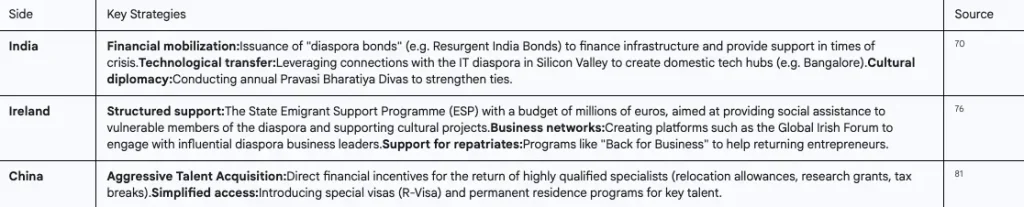
This comparative analysis shows that successful diaspora engagement is not a single measure, but a complex, multi-layered strategy. India demonstrates how to harness financial patriotism. Ireland demonstrates the power of soft power and structured support. China demonstrates an aggressive talent acquisition model. Nepal can borrow and adapt elements of each of these models to create its own hybrid strategy.
A Roadmap for an Innovative Future
Based on the analysis, clear and actionable recommendations can be formulated for the Nepalese government, private sector and diaspora organizations. The goal is to move from passively receiving remittances to actively managing smart exports.
Recommendation 1: Create a seamless highway for “brain circulation”
Action: There is a need for a major reform of the Non-Resident Nepal Act and its implementation. The aim is to create a seamless “dual status” environment. This means moving away from the cumbersome system of obtaining NRN certificates and citizenship to automatic entitlement to work, investment and property ownership (with minimal restrictions and without visas) for Nepalese nationals holding a foreign passport.64
Justification: The current system creates unnecessary barriers and demonstrates mistrust, which alienates the diaspora.59The seamless system recognizes the realities of global careers and encourages professionals to maintain active economic ties with Nepal, facilitating the transfer of knowledge and capital. This removes friction and makes return, temporary or permanent, easy and attractive.
Recommendation 2: From remittances to impact investing – launching diaspora bonds
Action: Following India’s successful model70, the government, through the Nepal Rastra Bank, should issue targeted bonds such as the Nepal Innovation Bond or the Himalayan Hydropower Bond. These securities should be targeted exclusively at the diaspora, with the proceeds going to sectors with high growth potential: tech startups, renewable energy, tourism.
Justification: Diaspora members are often willing to accept slightly lower financial returns in exchange for a “patriotic premium” – the opportunity to see their investments build a nation.70This will redirect remittance savings from pure consumption to productive national assets. This mechanism not only breaks the “remittance trap” but also gives the diaspora a real stake in Nepal’s future.
Recommendation 3: Activate the “digital diaspora” to transfer knowledge
Action:It is necessary to go beyond the passive database of the Brain Recovery Center (BGC).67The government, in partnership with private IT companies and NRNA, should launch a dynamic virtual platform. This platform should provide:
- Mentoring: Connect diaspora professionals (e.g. Nepali IT executive in the US) with university students and young entrepreneurs in Nepal.55
- Virtual Volunteering: Provide opportunities for experts to conduct online workshops, training modules and guest lectures for Nepalese institutions.84
- Joint projects: Create a platform for short-term remote consulting projects where Nepalese companies can hire talent from the diaspora to solve specific problems.
Justification:Technology has made “brain circulation” possible without physical return.86A dedicated platform can systematize and scale the spontaneous knowledge transfer that already occurs, delivering enormous value at low cost.
Recommendation 4: Professionalize reintegration and develop entrepreneurship among repatriates
Action:Having studied the experience of the Irish Emigrant Support Programme77, a well-funded, professional national reintegration service should be established. This service should become a “one-stop shop” for returnees, offering comprehensive services that go beyond the current fragmented efforts89:

- Business incubation and mentoring for those wishing to start their own business.53
- Skills Certification and recognition of qualifications obtained abroad.93
- Access to start-up capital and low-interest loans, possibly linked to income from diaspora bonds.
Justification:Many returnees face difficulties reintegrating and using their skills, resulting in high levels of unemployment or re-migration.89A professional support system can transform their return from a personal problem into a national economic opportunity, ensuring that the capital they acquire (both financial and human) is used productively in Nepal.
Conclusion: Changing the Rhetoric, Reclaiming the Future
The upshot of this comprehensive analysis is a simple but powerful conclusion. Nepal’s greatest export is not its labor force, but the talent and ambition of its citizens. The rhetoric of “brain drain” is one of helplessness and passive observation of losses. The rhetoric of “intelligence export” is one of active governance, agency, and opportunity.
The challenge facing Nepal is not to build walls to keep talent in, but to build bridges to ensure the free flow of their capital, skills and ideas back home. Today’s technology and global connectivity make this possible as never before.
By taking a strategic, multifaceted approach – reforming laws to create a seamless environment, creating modern investment instruments such as diaspora bonds, using digital connectivity to transfer knowledge, and providing professional support to its returnees – Nepal can transform its vast global diaspora from a source of livelihood into the main driver of its economic and innovative renaissance in the 21st century.
Sources used
- Labor Migration from Nepal and Effect on Socio-Economical Status – American Research Journals
- Labor Migration from Nepal and Effect on Socio-Economical Status – ResearchGate
- Young People And Demographic Dividend – The Rising Nepal
- Addressing youth aspirations – The Kathmandu Post
- Current Macroeconomic and Financial Situation of Nepal – Nepal Rastra Bank
- Remittance increases 16.5 per cent – The Rising Nepal
- Nepali Migrant Workers Risk Their Lives in Europe – Global Press Journal
- Remittances – Migration Data Portal
- Over 741000 Nepalis left for foreign employment in FY 2023/24 – myRepublica
- Foreign Employment: Loss And Benefit | New Spotlight Magazine
- Nepal Net Migration (1960-2024) – Macrotrends
- Between the pre- and post-COVID-19, Nepal experienced the …
- Full article: Drivers of overseas labour migration, migration intensity, and destination choice among farming households in Nepal – Taylor & Francis Online: Peer-reviewed Journals
- IOM in Nepal – International Organization for Migration
- www.nepjol.info
- UAE emerges top destination for Nepali migrant workers – myRepublica
- Japan, Eastern Europe emerge as new labor destinations for Nepalis – Xinhua
- IMPLEMENTATION OF THE GLOBAL COMPACT FOR MIGRATION IN NEPAL – International Trade Union Confederation
- www.mideq.org
- migration analysis nepal | ceslam
- Youth Exodus A Threat To Economy – The Rising Nepal
- Tackling the Brain Drain Trend in Nepal: Causes, Impact, and Solutions
- The Situation of Doctors in Nepal: A Profession Under Siege
- Migration data in Southern Asia
- Exporting Talent, Importing Cash: Nepal, Youth Migration and Remittances – LSE Blogs
- Contribution of Foreign Employment and Remittances to Nepalese Economy – Nepal Rastra Bank
- Nepal Overview: Development news, research, data | World Bank
- Nepal Development Update – World Bank Documents and Reports
- Publication: Work-Related Migration and Poverty Reduction in Nepal – Open Knowledge Repository
- Migration, remittances inflow key factor behind poverty reduction in Nepal: World Bank
- Publication: The Impact of Large-Scale Migration on Poverty, Expenditures, and Labor Market Outcomes in Nepal – Open Knowledge Repository
- Role of Remittances on Rural Poverty in Nepal: Evidence from Cross-Section Data
- Harnessing Remittances for Productive Use in Nepal
- NPRC Journal of Multidisciplinary Research Perception of Health Professionals on Brain Drain in Nepalese Health Sector Abstract
- An Analysis of Cost of Attending Medical Education in Nepal
- How much is the total cost to complete an MBBS in Nepal? What is the process of getting into any of the colleges? – Quora
- Emigration and Tax Revenue By: Yuanyuan Gu Jhorland Ayala-García No. 312 July, 2022 – Repositorio Banrep
- Emigration of Nepalese People and Its Impact – Nepal Journals Online
- Labour Migration: Psychological and Socio-cultural Impacts – TPO Nepal
- Psychosocial issues affect migrant workers, family members – The Himalayan Times
- The Effect of Migration on Family in Nepal: A Review on the Family Structure, Livelihood, Education, Aging Parents, Reproductive – COAS
- Forgotten health and social care needs of left-behind families of Nepali migrant workers – Nepal Journals Online
- QUALITATIVE STUDY ON YOUTH OUT-MIGRATION AND ITS IMPACT ON ELDERLY PARENTS – Nepal Journals Online
- Renegotiating gender roles and cultivation practices in the Nepali mid-hills: unpacking the feminization of agriculture | FAO
- EMIGRATION AND FEMINIZATION IN NEPALESE AGRICULTURE: IMPLICATIONS FOR FOOD SECURITY – CABI Digital Library
- Feminization of Agriculture and its Implications for Food Security in Rural Nepal
- Feminization of Agriculture in Nepal and its implications: Addressing Gender in Workload and Decision Making
- Feminization of Agriculture in Nepal and its implications: Addressing Gender in Workload and Decision Making – ResearchGate
- Nepal: World Bank Report Outlines Key Reforms to Boost Growth, Create Jobs
- Not just financial, but social remittances – Nepali Times
- Appraise migrants’ contribution to their home country’s | IOM Nepal
- Nepalese Migrant Remittances Contribute to their Country’s Development
- Setting Examples through Entrepreneurship and Startups – myRepublica
- Success stories: Microcredit loans are transforming rural entrepreneurship – The Kathmandu Post
- Nepali diaspora in the US surges to over 200,000: Report – CESLAM
- Almost 70% of the Nepali diaspora in the US migrated post-2010: a report
- NRN INVESTMENT IN NEPAL – NRNA
- Legal basis prepared for 10 billion rupees worth NRNA project – myRepublica
- ‘NRN’ is the essence of nation building- Thought – Kantipur News
- Diaspora Nepalese Entrepreneurship – ResearchGate
- Diaspora engagement mapping – NEPAL – EUDiF
- Non Resident Nepali – Sampanna Capital
- Nepal’s Citizenship Amendment Bill explained | Nepali Times
- Ensuring the Full Implementation of NRN Citizenship Rights – NRN USA
- Nepali diaspora and NRNA citizenship – The Annapurna Express
- BRAIN GAIN NEPAL
- Press Release on launching of the Brain Gain Center
- Ministry of Foreign Affairs sets up Brain Gain Centre – The Himalayan Times
- About – Ministry of Foreign Affairs
- Diaspora Bond: Meaning, Pros and Cons, Example – Investopedia
- Development Finance via Diaspora Bonds – World Bank Documents and Reports
- Diaspora Bonds Issued by India | Download Table – ResearchGate
- Diaspora: India’s invisible hand in the quest for 2047 – Times of India
- The Indian Diaspora and the Future of India: A Story of Connection, Influence, and Opportunity
- Immigration USA: How India benefits from a connected diaspora – Investing Abroad News
- Supporting Irish Communities Abroad: Emigrant Support Programme Explained
- Tánaiste reflects on 20 years of the Emigrant Support Programme – Government of Ireland
- Emigrant Support Programme | Irish Diaspora – Ireland.ie
- Exploring Diaspora Strategies: Lessons for Ireland – Rob Kitchin
- Connecting with the Diaspora and Promoting Economic Development: Two Sides of the Same Coin in 21st Century Ireland? – OpenEdition Journals
- The Employment Of Foreign Talents in China: 2025 Increasing Opportunities and Career Benefits – hiredchina.com
- How Can Overseas High-End Talents Apply for Chinese Subsidies – hiredchina.com
- Diaspora and the Non-Resident Citizenship Issue – Nepal Journals Online
- Volunteer for Digital Skills & Freelancing Training in Nepal – VIN
- Virtual Volunteering in Nepal – GozAround
- Dimensions of Nepali Diaspora – The Diplomat Nepal
- Digital Diaspora: A Game Changer – Number Analytics
- The Emigrant Support Programme | Global Forum on Migration and Development
- From Pre-Departure to Return: Understanding Labor Migration Dynamics in Nepal
- Reintegration of Returnee Migrant Works (ReMi) Project – CMC Nepal
- From migrant workers to Nepal’s future innovators – The Rising Nepal
- [suspicious link removed]
- MIGRATION AND SKILLS DEVELOPMENT – IOM Nepal – International Organization for Migration
- PROFILING RETURNEE MIGRANT WORKERS FOR LABOUR MARKET INTEGRATION – IOM Nepal