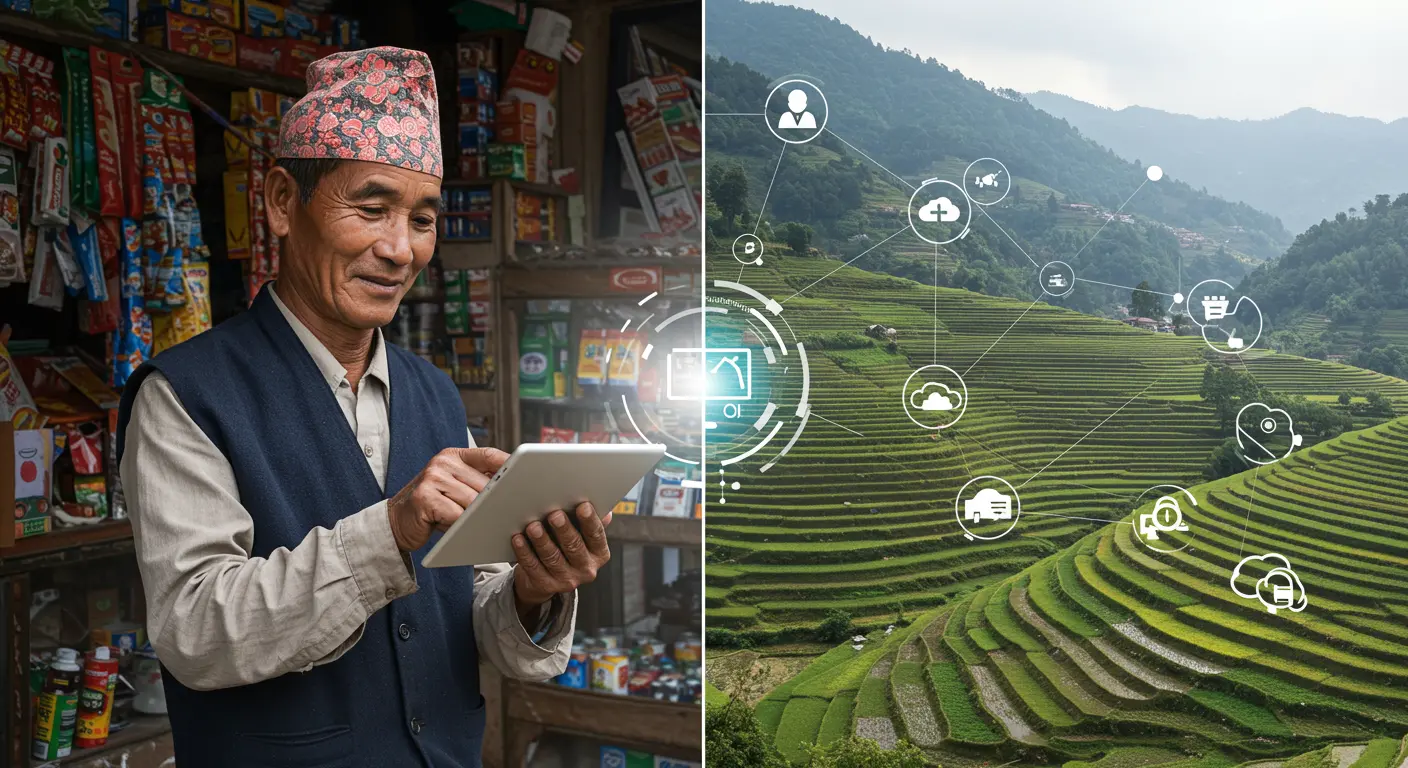
Nepal at a Digital Crossroads
Nepal’s economy is a picture of stark contrasts. On the one hand, it is a country with a growing GDP, which reached an all-time high of US$41.18 billion in 2022.1, and deep-rooted traditional sectors like agriculture, tourism and retail, which form the backbone of employment and national income. On the other hand, Nepal is on the cusp of a digital revolution, as evidenced by the government’s ambitious plans. The IT Decade programme aims to raise ICT services exports to Rs 3 trillion and create 1.5 million jobs in the IT sector over the next ten years.2This momentum is being fueled by the explosive growth of financial technology, which has already transformed the daily lives of millions of Nepalese.3
The central thesis of this study is that the future sustainability and growth of Nepal’s traditional economy depends directly on bridging the gap between its analogue present and digital ambitions. The key to this lies not only in large-scale government projects, but also in the mass adoption of accessible and affordable IT solutions by the thousands of small and medium enterprises (SMEs) that dominate the country’s economic landscape. The local IT sector, currently largely focused on international clients, has the potential to unlock this domestic potential and become a major engine of national growth.
In this article, we will analyze Nepal’s digital foundation, delve deeply into the challenges faced by traditional sectors, review the available IT tools from core systems to advanced cloud services, assess the role of the local IT industry, and finally propose a strategic roadmap for businesses, IT companies, and government agencies.
Foundation for Growth: Nepal’s Digital Awakening
To understand the potential of digital transformation, it is necessary to assess the current state of digital infrastructure and society’s readiness. The analysis shows that, despite the existing gaps, the main problem has shifted from simply access to the internet to his meaningful use.

Decoding the Data: The Reality of Internet Penetration
At first glance, internet penetration statistics in Nepal may seem contradictory. Official reports from the Nepal Telecommunication Authority (NTA) point to impressive figures exceeding 100%.2However, it is important to understand that these data are based on quantity subscriptions, not unique users. Given that many Nepalese have multiple SIM cards, the real picture is different.
Independent analysis, such as that from DataReportal, shows a more modest but still significant level of internet penetration among the population – around 49.6% at the start of 2024, rising to 55.8% by the start of 2025.7What’s really striking is the number of active mobile connections – 37.47 million at the start of 2024, equivalent to 120.6% of the total population.7This is irrefutable proof that the mobile device has become almost ubiquitous.
These figures lead to an important conclusion: the gap between the number of subscriptions and the actual number of users indicates the existence of a significant “usage gap,” a concept that is also supported by the World Bank.10This is not just a technical problem, but a socio-economic one. The challenge is no longer about laying fibre optic cables; it is about making the internet affordable, reliable and, most importantly, useful to the population. Reports show that 91% of Nepali adults cannot perform basic digital tasks such as copying and pasting text10, and there is a sharp digital divide between urban and rural areas, men and women.2Digital literacy thus becomes a cornerstone of economic policy, not just an afterthought.
Digital Nepal Framework: From Ambition to Pragmatism
The government’s flagship digitalization policy, the Digital Nepal Framework (DNF), is a shining example of this evolution in strategic thinking. The initial version, DNF 1.0, launched in 2019, was an ambitious and comprehensive plan that included 80 initiatives across eight key sectors (ranging from agriculture and health to tourism and finance) with an expected economic impact of up to NPR 800 billion.12

However, the implementation of DNF 1.0 revealed a number of systemic problems: weak coordination between departments, insufficient funding, a shortage of technical personnel, and a lack of data compatibility between different systems.14These lessons led to a strategic review and the development of an updated version – DNF 2.0.
The new version reflects a more mature and pragmatic approach. Instead of disparate initiatives, DNF 2.0 focuses on four core, cross-cutting “enablers,” grouped under the acronym FAST14:
- Future-Ready Digital Foundations: Building robust infrastructure, cybersecurity, and regulatory frameworks.
- Access to Digital Services: Ensuring inclusive and easy access for citizens to government and commercial services.
- Skills and Digital Literacy: Mass education of the population and preparation of qualified IT personnel.
- Transformation of the Digital Economy: Stimulating digital entrepreneurship and technology adoption in key sectors.
This shift shows that the government has moved from creating a “wish list” to building a foundation on which the entire digital economy can grow.
A glimpse of success: the fintech revolution
The best proof that digital transformation is possible in Nepal is the phenomenal success of fintech. Platforms like eSewa, Khalti, and the Fonepay payment network have attracted millions of users in a short time and revolutionized the country’s payments landscape.3
The success of fintech demonstrates a key principle: when a digital solution is convenient, solves a real problem (such as eliminating the need to carry cash), and, crucially, is trusted, Nepalis embrace it enthusiastically. This experience serves as a powerful proof of concept for other digital services, and shows that the barrier to adoption is not cultural but practical.
Table 1: Digital Profile of Nepal (2024–25 data)

This table clearly illustrates the “mobile-first” nature of Nepal’s digitalization and quantifies the growth in digital readiness, providing a basis for further sector-specific analysis.
Old Pillars, New Pressures: Challenges in Traditional Sectors
To understand what kind of IT solutions Nepal needs, it is first necessary to identify the operational pain points in the three largest traditional sectors of the economy. These are the problems that technology must solve.

From Farm to Fork, Digital: The Agricultural Crisis
Agriculture, which employs more than 80% of the population19, suffers from systemic problems that hinder its development. The sector is characterized by low productivity, the predominance of subsistence farming (75.9% of farmers produce mainly for their own consumption20) and high vulnerability.
Key challenges include:
- Infrastructure and market access: Poor rural infrastructure makes it difficult to get produce to market, forcing farmers to sell their harvest at low prices to middlemen. The situation is so dire that it has led to protests where farmers simply throw their vegetables on the road.21The country is experiencing an acute shortage of collection centres and modern warehouse facilities.22
- Fragmentation and inefficiency: Land holdings are small and fragmented due to inheritance laws, making commercial farming unprofitable and leading to soil degradation.22Most farmers still use traditional, inefficient methods, lacking access to modern technology, quality seeds and fertilizers.21
- Climate and information gaps: The sector is extremely vulnerable to the impacts of climate change, such as droughts and floods.21Farmers lack timely information on weather, market prices and advanced agricultural technologies, which hinders them from making informed decisions.21
Rethinking the Roof of the World: The Tourism Dilemma
Nepal’s tourism industry, which has enormous potential, remains highly vulnerable to external shocks, be it natural disasters, pandemics or political instability. Moreover, the sector has not fully utilized its potential to generate maximum revenue from tourist arrivals.24
The main problems of the sector:
- Infrastructure deficit: Poor road conditions, such as the key Mugling-Kathmandu highway, and concerns about air travel safety are major deterrents for tourists.24In terms of the quality of air transport and tourism infrastructure, Nepal is significantly inferior to its regional competitors.27
- Low value added tourism: The industry is overly dependent on “backpackers” – low-spending tourists.26The average daily expenditure of one tourist is only 41 US dollars.25Attracting wealthy tourists willing to spend more requires significant infrastructure improvements and the creation of premium offerings.
- Operational inefficiencies: Many hotels, especially smaller and family-run ones, still manage their records and reservations manually. This leads to problems such as double bookings (overbooking) and inefficient management of their offers on online marketplaces (OTAs) such as Booking.com or Agoda.28
- Marketing and branding: The lack of modern digital marketing and weak country branding prevents Nepal from effectively competing with popular destinations like Thailand, or even taking advantage of its proximity to tourism giants China and India.26
The Digital Corner Store Dilemma: Retailing in a Downturn
Nepal’s retail sector is dominated by small family-run shops known as kirana29, remains largely non-digital and currently faces serious economic difficulties.30
- Economic pressure: Rising interest rates on loans, high commercial rents and reduced consumer spending due to the economic downturn are forcing many small businesses to close.30
- Operational inefficiencies: The vast majority of such stores keep track of their inventory and sales manually, in notebooks. This makes it impossible to optimize inventory, analyze sales trends, and manage finances effectively.
- E-Commerce Confidence Crisis: While the pandemic has sparked a boom in online shopping, major platforms like Daraz and SastoDeal are now struggling.31The reason is the lack of trust on the part of consumers, who are faced with the delivery of poor quality or wrong goods, missed deadlines and complicated refund procedures. The lack of a special law on e-commerce only exacerbates this problem, leaving consumers unprotected.31
- Regulatory barriers: Businesses face a complex regulatory system, from consumer protection laws to specific standards for different types of products. Navigating this system without automated tools becomes a major challenge.32
Digital Toolkit: In-Demand IT Solutions for Nepalese Businesses
This section directly answers the main research question by offering concrete and accessible IT solutions to problems identified in traditional sectors.

Fundamental tools for efficiency: the first step towards digitalization
Digital transformation does not have to be a large and expensive project. It starts with digitizing core business processes, and there are affordable and proven tools for this.
- Point of Sale (POS) and Inventory Management Systems: These systems are the digital heart of a retail store or restaurant. They automate sales tracking, manage inventory in real time, and provide valuable data on which products are in highest demand. This is a direct solution to the inefficiency problem for thousands of kirana stores.33Local developers such as IMS Software offer POS solutions tailored to the Nepalese market.33As a more advanced step, RFID technology for automatic inventory control can be considered, which is already available in Nepal.34
- Hotel Management Systems (PMS): These are essentially ERP systems for the hotel business. They centralize and automate all key operations: booking, room management, invoicing, guest interactions and, most importantly, managing sales channels through online travel agencies (OTAs).
- Case: Hotel Heranya.This hotel in Nepal is a great example of how implementing the right IT solution can yield tangible results. After installing a cloud-based PMS system from Hotelogix, the hotel recorded revenue growth by 20% And 10% increase in direct bookings. The system solved their critical problems: manual management of room availability on OTA platforms and the constant risk of overbooking.28This is a perfect illustration of how a targeted solution delivers a quick and measurable return on investment.
The Rise of SaaS: The Great Equalizer for SMEs
Software as a Service (SaaS) model is a game changer for small and medium enterprises in Nepal.36It eliminates the need for large upfront investments in servers and expensive software licenses. Instead, businesses gain access to powerful tools on a subscription basis, with monthly or annual payments, making it ideal for environments with limited access to capital.
Examples of industry-specific SaaS solutions already operating in Nepal:
- Agri-Tech: Platforms created specifically for farmers solve the problem of information hunger. KrishiGuru — is a mobile application that provides farmers with vital information on prices, weather and agricultural practices.18Another striking example is
GeoKrishi, a platform that offers data-driven advisory services for climate-smart agriculture. GeoKrishi actively partners with farmer cooperatives to reach the maximum number of users, demonstrating how SaaS can be adapted to hyperlocal needs.38 - Retail and Sales Management: Delta Sales App — is a local SaaS solution that helps distributors and manufacturers of fast-moving consumer goods (FMCG) manage their sales representatives in the field, automate order intake, track payments and generate reports.18
- General business management: The emergence of tools like the “business assistant for SMEs” developed in Nepal and discussed on Reddit shows that there is a grassroots demand and understanding of the real needs of local businesses – combining task, client and lead management in one place.40Companies like Blanxer offer easy-to-use e-commerce website builders aimed at local entrepreneurs.41
Custom Solutions for a Unique Market: The Role of Leading IT Companies
For large enterprises or for solving unique problems on a national scale, ready-made solutions may not be enough. This is where leading IT companies in Nepal come into the picture, with experience in developing complex systems.

- F1Soft International: The company is a pioneer in the fintech sector that has built the country’s digital payments ecosystem from scratch with products such as the eSewa digital wallet and the Fonepay payment network.17Their success proves that a local company can build transformative, large-scale platforms. New solutions like a neo-banking platform and an account aggregator point to the future of the financial sector.45
- Leapfrog Technology: A globally recognized company that creates sophisticated software for international clients in the healthcare and fintech sectors.17While their primary focus is on foreign markets, their expertise in artificial intelligence and data analytics can be key to solving complex domestic problems, such as building advanced analytics systems for tourism or crop yield forecasting models for agriculture. Their involvement in local educational projects, such as the Adhyayan School, also demonstrates their commitment to developing human resources.49
- Deerhold (formerly Deerwalk): The company specializes in high-tech data analytics for the US healthcare market, but also maintains a massive development center in Kathmandu.50Their expertise in managing and analysing big data is a national asset that could be applied to address challenges in public health or other information-intensive sectors in Nepal.
Table 2: Digital Solutions for Traditional Business in Nepal
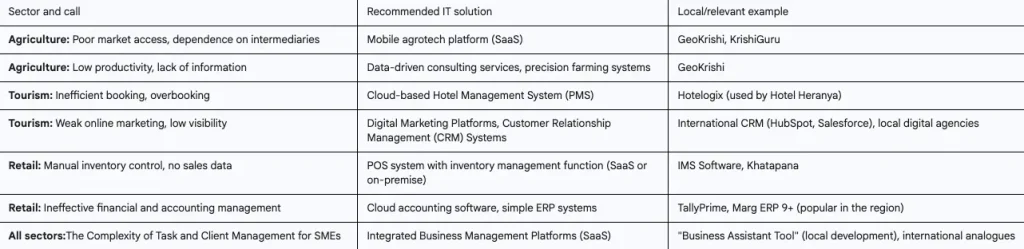
This table is the practical core of the article. It provides readers, be they hoteliers or farmers, with direct and actionable guidance. By seeing their problem listed, they can immediately identify the type of software and find a real-life example of its successful application in Nepal, making the concept of “digital transformation” tangible and achievable.
Engine Room: How the Local IT Sector Can Become an Engine of Growth
This section takes a critical look at the local IT industry. While acknowledging its impressive success on the global stage, we identify a key strategic weakness that is holding back the national economy.

The locomotive of outsourcing
The incredible success of Nepal’s IT sector in the global market cannot be overlooked. IT services exports are valued at over US$515 million and are growing rapidly.54Companies like CloudFactory, LIS Nepal, Leapfrog Technology and Deerhold are world-class players, proving the country has a highly skilled workforce capable of creating complex technology solutions.17
The Great Divide: Ignoring the Domestic Market
However, the IT sector’s focus on exports has created a dangerous blind spot: the needs of the domestic market, especially small and medium-sized businesses, are largely ignored. An analysis of sentiment and facts leads to a disappointing conclusion.
First, user reviews on platforms like Reddit show that local IT companies are often perceived as “poorly managed” when working on internal projects. The quality of their work is described by the local slang expression “tal-tul” (mess, disorder), and they are not focused on solving the real problems of the Nepali market.56
Secondly, another discussion on the same platform highlights the root of the problem: the local IT culture lacks “solution-oriented thinking” for domestic products. Instead, companies take the “easy way out” – outsourcing to foreign clients where requirements and tasks are clearly defined from the outside.57
Third, leading companies are celebrated for their work with US or global firms47, but there are virtually no widely known success stories of them creating scalable and affordable products for thousands of Nepalese SMEs. Finally, even the state program “IT Decade” is primarily aimed at export.2
This creates a paradox. Nepal has the talent to solve its own problems, but that talent is mostly used to solve other countries’ problems. The local IT sector is missing a huge opportunity to create a sustainable domestic market for its services, which would in turn make the entire economy more resilient to external shocks.
The Flywheel Effect: A New Growth Model
Instead of viewing the domestic market as a secondary one, the IT sector should see it as a major growth driver. A new strategic model is proposed – the “flywheel effect”. By creating affordable and effective SaaS products for local SMEs, IT companies can start a self-sustaining growth cycle:
- Improving the efficiency of the traditional economy: Digital tools make farmers, hoteliers and retailers more profitable and competitive.
- Creation of a new internal market: Successful SMEs are starting to pay for IT services, creating a new, large-scale and sustainable source of domestic revenue for the IT sector.
- Export of finished products: Tested in the local market and hardened in the unique conditions of Nepal, “Made in Nepal” products can be successfully exported to other developing countries with similar problems.
This virtuous cycle, or “flywheel,” is capable of spinning up the entire national economy, making it more diversified and technologically advanced.
The Way Forward: A Roadmap for Digital Nepal
The final section provides clear and actionable recommendations for three key stakeholder groups.

For traditional businesses (SMEs): start small, solve one problem
The key message for entrepreneurs is to demystify “digital transformation.” It’s not one giant, expensive leap, but a series of small, incremental steps.
Actionable steps:
- Start with free or low-cost tools. Use WhatsApp Business to communicate with customers and market, create a Google Business profile to increase your visibility in local searches – it doesn’t cost anything, but it gives immediate results.41
- Identify your biggest pain point—whether it’s inventory, bookings, or accepting payments—and find one simple, affordable SaaS solution for it.
- The goal is gradual progress and quick wins, as in the case of Hotel Heranya, which solved a specific overbooking problem and immediately got measurable results.28
For IT Sector: Build for Nepal First
This is a strategic call to IT companies to look inward.
Actionable steps:
- Allocate resources to research and development (R&D) to deeply understand the specific needs of local SMEs in agriculture, tourism and retail.
- Develop scalable, affordable, and, most importantly, mobile-first SaaS products tailored to these needs.
- Actively collaborate with industry associations to promote and implement these products.
- View the domestic market not as a distraction from exports, but as a strategic pillar for growth that will build a more resilient company and, ultimately, a stronger country.
For government agencies: Focus on the basics
The government should support the pragmatic shift enshrined in DNF 2.0 and accelerate its implementation by focusing on the fundamentals.
Actionable steps:
Encourage local adoption: Develop policies that encourage domestic companies to use Nepali-developed software. These could include tax incentives, subsidies, or government procurement requirements. This could help trigger a “flywheel effect” and create demand in the domestic IT market.59.
Bridge the Usage Gap: This is the most important task. We need to aggressively fund and roll out nationwide digital literacy programs that target rural areas, women, farmers, and small business owners.11Without skills, even the best Internet is useless.
Build trust: The long-delayed e-commerce bill needs to be passed urgently. This will create a safe and predictable environment for online businesses and protect consumers by addressing the trust deficit that currently plagues the sector.31In parallel, national cybersecurity initiatives should be strengthened.16
Ensure reliability: Fix infrastructure weaknesses that cause frequent internet outages. These outages cause direct and measurable damage to your business, costing up to 2.1% in lost annual sales.10
Source used
- Nepal – GDP | 1960-2023 Data | 2024-2025 Forecast – EN | TRADINGECONOMICS.COM, accessed June 18, 2025
- STATE-OF-DIGITAL-RIGHTS-AND-SAFETY-IN-NEPAL-2024-1-1-2.pdf, accessed June 18, 2025
- Jagdish Khadka: eSewa made digital payments a reality for all | The Annapurna Express, accessed June 18, 2025
- FinTech innovations: Transforming Nepal’s banking landscape – Onlinekhabar English, accessed June 18, 2025
- January 14, 2024 – Nepal Telecommunications Authority, accessed June 18, 2025
- Nepal’s persistent digital divide: From high penetration to inclusion – The Himalayan Times, accessed June 18, 2025
- Digital 2024: Nepal — DataReportal – Global Digital Insights, accessed June 18, 2025
- Digital 2025: Nepal — DataReportal – Global Digital Insights, accessed June 18, 2025
- Nepal smartphone market grows 78% in Q2 2024: IDC – TelecomLead, accessed June 18, 2025
- Nepal’s potential in digital sector faces regulatory, skill and cost issues, accessed June 18, 2025
- Connecting the Unconnected: Bridging the Digital Divide through Grassroot Initiatives in Sri Lanka and Women’s Empowerment in Nepal – NetMission.Asia, accessed June 18, 2025
- Digital Nepal Framework – Digital Development Site, accessed June 18, 2025
- 2019 DIGITAL NEPAL FRAMEWORK – Digital Development, accessed June 18, 2025
- DRAFT, accessed June 18, 2025
- How far has the Digital Nepal Framework come? – Nepal Economic …, accessed June 18, 2025
- Digital Nepal Framework 2.0: A Step Digitally Empowered Nepal – ICT Frame, accessed June 18, 2025
- Top IT Companies in Nepal: A Tech Landscape Overview 2025 – NecoJobs, accessed June 18, 2025
- Top 10 SaaS Companies in Nepal – Optimum Futurist, accessed June 18, 2025
- Does Nepal Have the Agriculture to Feed Its Population with a Sustainable Diet? Evidence from the Perspective of Human–Land Relationship – PMC – PubMed Central, accessed June 18, 2025
- (PDF) Overview of Agriculture in Nepal: Issues and future Strategies – ResearchGate, accessed June 18, 2025
- Opportunities, Challenges And Way Ahead – The Rising Nepal, accessed June 18, 2025
- Impediments in the Agriculture Sector of Nepal – Nepal Economic Forum, accessed June 18, 2025
- The Role of Agriculture and Agri-Tech Investments in Nepal During a Pandemic, accessed June 18, 2025
- Tourism sector faced tough year in 2081 BS – myRepublica, accessed June 18, 2025
- Insulate Tourism Sector From Setbacks – The Rising Nepal, accessed June 18, 2025
- Problem of nepali tourism industry, what do you think guys? : r/NepalSocial – Reddit, accessed June 18, 2025
- Unveiling opportunities and addressing challenges of tourism in Nepal – Sawtee, accessed June 18, 2025
- Hotel Heranya, Nepal – Hotelogix, accessed June 18, 2025
- Digitizing MSMEs: Kirana stores in Nepal – UN Capital Development Fund (UNCDF), accessed June 18, 2025
- Turning Crisis into Opportunity: Why Selling Your Business in Nepal is a Smarter Choice Than Closing – Khatapana, accessed June 18, 2025
- Back to physical stores. E-commerce falters in Nepal’s topsy-turvy business climate, accessed June 18, 2025
- Consumer Goods and Retail – Gandhi & Associates, accessed June 18, 2025
- Need of IMS POS Software for Retail Store in Nepal, accessed June 18, 2025
- Inventory Management System in Nepal – Katmatic, accessed June 18, 2025
- www.hotelogix.com, accessed June 18, 2025
- Application (IaaS, PaaS, SaaS) – Aventa-group.ru, accessed June 18, 2025
- IaaS, PaaS, SaaS: Choosing the Most Suitable Solutions for Your Business, accessed June 18, 2025
- Digitising Agriculture in Nepal: GeoKrishi | Mobile for Development – GSMA, accessed June 18, 2025
- CASE STUDY – Digitising Agriculture in Nepal – GSMA, accessed June 18, 2025
- Built in Nepal: A Business Assistant Tool for SMEs, Freelancers & Entrepreneurs — Feedback & Early Access? : r/NepalSocial – Reddit, accessed June 18, 2025
- Digital Marketing in Nepal: A Practical Guide for Small Businesses – Khatapana, accessed June 18, 2025
- F1Soft marks 21 years of fintech innovation, appoints new president, accessed June 18, 2025
- About Us – F1Soft Group, accessed June 18, 2025
- Fonepay – Business Verticals – F1Soft Group, accessed June 18, 2025
- Neobanking – F1Soft Group, accessed June 18, 2025
- Simplifying Financial Access in Nepal with Account Aggregators and Blockchain, accessed June 18, 2025
- Top 10 Tech Companies to Work for in Nepal in 2025 – Nucamp, accessed June 18, 2025
- Leapfrog Technology | AI-powered solutions for your innovation, accessed June 18, 2025
- Leapfrog+Adhyayan – Creating change that matters, accessed June 18, 2025
- What Does Deerwalk Inc. Do? | Directory – PromptLoop, accessed June 18, 2025
- Our Team – Deerhold, accessed June 18, 2025
- Deerhold Japan: About Us, accessed June 18, 2025
- Deerwalk Services Pvt. Ltd. – Mero Sewa: Find any Business and Services in Nepal, accessed June 18, 2025
- Unleashing it: advancing Nepal’s digital economy – Institute for Integrated Development Studies, accessed June 18, 2025
- Developing & Adopting Technology – The HRM Nepal, accessed June 18, 2025
- The dark side of the IT industry in Nepal. Most companies are poorly managed and just plain suck! : r/technepal – Reddit, accessed June 18, 2025
- Can We Build a SaaS Unicorn from Nepal? : r/Nepal – Reddit, accessed June 18, 2025
- Digital Transformation in Nepal: Present Benefits and Future Prospects – The Enterprise Technology Partner – Kathmandu Codes, accessed June 18, 2025
- Fastest Growing Business in Nepal – 2025 Market Analysis – Arun Tamang, accessed June 18, 2025