Chaos and Potential Kathmandu
Kathmandu is a city of contrasts. Ancient temples listed as a UNESCO World Heritage Site sit alongside chaotic urban sprawl, and the spiritual serenity of the Himalayan foothills is drowned out by the deafening noise of traffic. Nepal’s capital, once a secluded valley, is now choked by the effects of rapid and largely uncontrolled urbanization.1For millions of its residents and visitors, the daily reality is hours-long traffic jams on narrow streets, mountains of garbage on the roadsides, and paradoxical rolling blackouts in a country with colossal hydroelectric potential.3This urban chaos is not just an inconvenience, but a systemic crisis that undermines the economy, public health and the very quality of life.
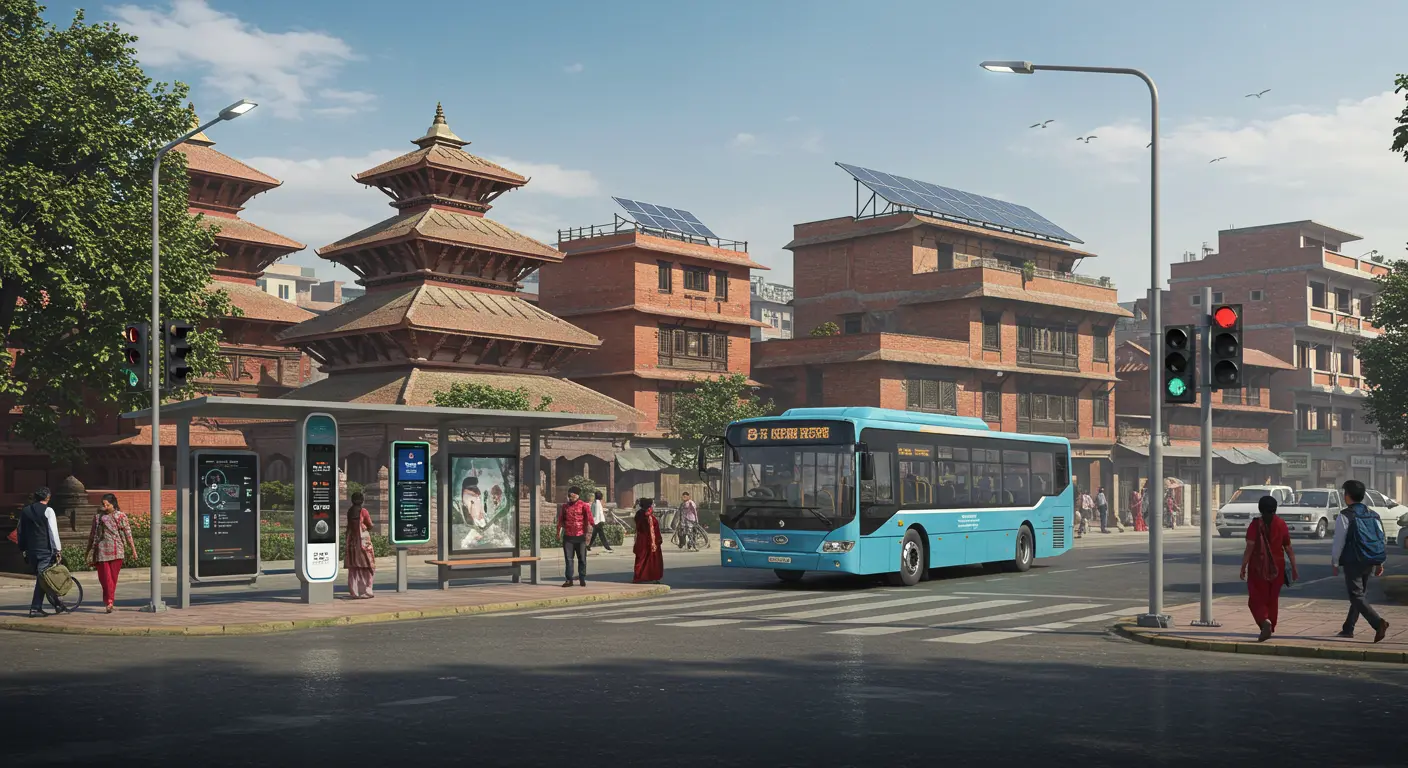
Yet it is precisely in the depths of these problems that a unique opportunity lies. Unlike many of the world’s megacities, burdened with outdated 20th-century infrastructure, Kathmandu can take a technological “generational leap.” The city can bypass the phase of incremental, costly, and inefficient modernization and embrace integrated, intelligent 21st-century solutions. In this context, the concept of a “smart city” ceases to be a futuristic fantasy or a fashionable slogan for politicians. For Kathmandu, it becomes a pragmatic and vital plan of action – a roadmap for transforming chaos into order, and problems into opportunities.
This study examines three of Nepal’s most pressing challenges – transport, waste management and energy efficiency. It demonstrates how concrete, globally proven innovative solutions can be adapted to the realities of Kathmandu. We look at how the government’s official vision, enshrined in documents such as the Digital Nepal Framework, can become the basis for real change, and what steps need to be taken to make Smart Kathmandu not a dream, but a reality that improves the lives of every citizen.
Diagnosis: Pain points of the capital’s metropolis
Kathmandu’s problems are multifaceted, but they all have one root: explosive and unregulated growth. In recent decades, the population of the Kathmandu Valley, including temporary migrants, has grown to 4-5 million people.1The infrastructure, not designed to handle such a load, found itself on the brink of collapse, giving rise to three interconnected crises that are blighting the city.1

Triad of Crises
Transport collapse. Kathmandu’s streets have become a battleground for space. The rapid growth of private vehicles, especially motorcycles and scooters, coupled with an inefficient and unsafe public transport system has led to chronic congestion.7Narrow roads, poor traffic management, lack of adequate pedestrian areas and widespread violation of traffic rules make the situation worse.9The result is not only lost hours and nerves of city dwellers, but also catastrophic air pollution, due to which Kathmandu regularly appears on lists of the dirtiest cities in the world.3The economic losses from traffic jams and excessive fuel consumption amount to huge sums, slowing down business development and reducing labor productivity.1
Garbage crisis. Kathmandu Valley produces more than 1,200 metric tons of municipal solid waste daily.4The vast majority of this volume is sent to landfills such as the overflowing Sidol and the new Banchare Danda without proper sorting and processing.4Previous attempts by the authorities to introduce waste sorting at the household level failed due to inconsistency: sorted and mixed waste were often dumped into the same garbage truck, which completely undermined public confidence in the initiative.12As a result, spontaneous dumps form on the streets and along river banks, creating serious risks to public health and causing irreparable harm to the environment.14
Energy paradox. Nepal has a theoretical hydropower potential of 83,000 MW, making it one of the richest water resources countries in the world.5In practice, however, the country has suffered from severe energy shortages for decades. Until recently, installed capacity was only about 1 GW, with most of the electricity generated by run-of-the-river hydroelectric power plants.5The output of such hydroelectric power plants drops sharply during the dry season (December to April), which has led to rolling blackouts (load-shedding) lasting up to5hours per day.5This instability causes enormous damage to industry, forcing businesses to use expensive and polluting diesel generators, and creates enormous difficulties in everyday life.
A vicious circle of interconnected crises
The key insight into Kathmandu’s problems is that these three crises do not exist in isolation. They are intertwined and form a vicious circle, with each problem exacerbating the others. Attempts to address them individually, without a comprehensive approach, are doomed to failure.
This relationship works as follows. First, transport chaos directly affects energy. Chronic traffic jams result in huge overconsumption of imported fuel, which not only places a heavy burden on Nepal’s economy but also undermines efforts to achieve energy independence.8Millions of litres of petrol and diesel wasted in traffic jams is a direct blow to the country’s energy balance.
Secondly, the energy deficit slows down transport development. Unstable power supply makes it impossible to scale up solutions such as electric public transport (electric buses, trolleybuses) or create a branched network of charging stations for electric vehicles. Modern intelligent traffic management systems that require constant power supply are also becoming vulnerable.
Thirdly, the garbage crisis is exacerbating both the energy and environmental crisis. Mountains of organic waste rotting in landfills are not only a source of disease and pollution, but also a missed opportunity.4Waste-to-Energy (WTE) technologies could turn this waste into a valuable resource. Experts estimate that recycling all of Kathmandu Valley’s waste could contribute significantly to the country’s energy grid while solving the problem of overflowing landfills.13
It is therefore clear that the strategy for transforming Kathmandu must be holistic and integrated. You cannot build smart transport without addressing the energy problem. You cannot talk about energy sustainability without ignoring the potential hidden in the mountains of waste. The solutions must be as interconnected as the problems themselves. It is this integrated approach that underlies the concept of a smart city as a real plan of action.
Nepali Dream in Digital Format: What is a Smart City for Kathmandu
Amidst worsening urban problems, the Nepalese government has formally committed to a tech-enabled future by creating a policy framework for innovative transformation. This vision, while ambitious, lays the foundation on which a “smart Kathmandu” can be built.

Official vision
Two key documents define the state approach to urban modernization:
- Digital Nepal Framework (DNF): Launched in 2019, the framework is the government’s flagship initiative for the country’s digital transformation. It covers eight sectors, one of which is Urban Infrastructure. The aim of this area is to use disruptive technologies to improve the quality of key urban services, including water management, solid waste management, public transport and traffic management.18DNF recognises that digitalisation is key to solving long-standing problems and improving efficiency.
- Smart City Indicators: The government recently took a major step away from general slogans and into specifics by approving 83 indicators to assess the “smartness level” of cities. The system is based on four main pillars: “smart citizens”, “smart economy”, “smart governance” and “smart infrastructure”.22Cities will be classified on a five-tier scale based on their scores, introducing an element of measurement and accountability into the urban development process.
The gap between vision and reality
Despite these strategic documents, the gap between ambitious plans and their implementation remains huge. Sources note that progress towards DNF targets in the urban infrastructure sector has been “unsatisfactory”.21The slogan of the “smart city” has often been used by politicians for populist purposes without a clear plan and understanding of how to implement it in practice.22This creates public skepticism, reinforced by past negative experiences such as the failure of the waste sorting program.12
The existence of official frameworks such as the DNF is a double-edged sword. On the one hand, it is a huge opportunity. These documents give legitimacy to innovative projects and allow city authorities, investors and international partners to align their initiatives with the national strategy, making it easier to obtain funding and political support.18This is the official “permission to innovate”.
On the other hand, this is a potential trap. Nepal’s history is replete with examples of much-hyped but unimplemented initiatives. If smart city projects are implemented the old-fashioned way – opaquely, without citizen participation, and without tangible results – they risk becoming another layer of bureaucracy and a source of frustration. Not only will this waste resources, but it will further undermine public trust in the government.
The success of Kathmandu’s transformation therefore depends on how this framework is used. It should not be seen as a rigid, top-down order, but as a flexible platform for support local, people-centered solutions. The “smart citizens” pillar should not just be one of four, but the foundational one. Every technological solution proposed for Kathmandu should be assessed first and foremost on its ability to bring real, visible, and immediate benefits to people’s daily lives. This is the only way to overcome skepticism and turn residents from passive observers into active participants in change.
Table 1: Action Plan for Smart Kathmandu: Challenges and Innovative Solutions

This table is a condensed action plan. It clearly links the diagnosed problems with concrete, technologically sound solutions, turning the abstract idea of a “smart city” into a clear and structured program of transformation.
Revolution on the Road: Intelligent Transport Solutions
Kathmandu’s traffic chaos calls not just for road expansion, which often only encourages more cars, but for a radical overhaul of the entire mobility management system. Smart solutions can transform streets from a source of stress into efficient arteries of urban life.

A. The brain of the system: Intelligent traffic management
The basis of the smart transport system is Intelligent Traffic Management System (ITMS) – a digital “brain” that coordinates all traffic flows in real time. Such a system consists of three key components25:
- Data collection: A network of sensors, video cameras and GPS trackers installed at intersections and public transport continuously collects information on traffic flow speed, traffic density, number of cars and congestion.
- Data Analysis: Artificial intelligence (AI) analyzes incoming data, predicts the development of the traffic situation and makes optimal decisions.
- Management and information: The system automatically adjusts traffic lights to optimize throughput and provides up-to-date information on traffic jams, accidents and alternative routes to drivers via mobile apps and information boards.
For Kathmandu, implementing ITMS would be a breakthrough. Today, many intersections are manually controlled by police officers, which is ineffective during peak traffic conditions.10ITMS is capable of dynamically changing traffic light cycles, adapting to real traffic rather than working on a preset timer. The system can instantly detect accidents or vehicle breakdowns, allowing for prompt dispatch to the scene of service and preventing a traffic jam from spreading to the entire area.33This is a direct solution to the problem of “poor traffic management” that numerous reports point to.3
B. City Arteries: Rethinking Public Transport
The main reason for the transport collapse in Kathmandu is the mass abandonment of public transport in favour of private cars and motorbikes. This is because the existing bus system is perceived as unreliable, unsafe, slow and overcrowded.7To reverse this trend, the city needs public transport that is better than private transport in every way.
The most efficient and cost-effective solution for Kathmandu is the Bus Rapid Transit (BRT) corridors. Unlike expensive and time-consuming metro construction, BRT uses the existing road network but dramatically increases its efficiency.
Role model: Curitiba, Brazil. The city is considered a global benchmark for efficient bus-based transportation. Its model includes26:
- Dedicated lanes: Buses travel along special lanes that are physically separated from the general flow of traffic, which prevents them from getting stuck in traffic jams.
- Pipe stations: Boarding and disembarking are done at special closed stations-platforms, the level of which coincides with the floor level of the bus. Payment for travel occurs at the entrance to the station, and not from the driver. This reduces the stop time from several minutes to 15-20 seconds.
- Integrated network: Different types of buses (express, regional, feeder) are painted in different colors and form a single network, allowing you to get from any point in the city to any other with convenient transfers on a single ticket.
The system in Curitiba is funded by a public-private partnership and carries more than 60% of all passengers in the city.26This is an affordable and time-tested recipe that can be adapted for Kathmandu.
Regional Experience: Thimphu, Bhutan.The capital of Bhutan, which faces similar challenges from growing motorization, is already developing a plan to create a 16-km priority bus corridor. The project includes the introduction of ITMS (automatic bus location, passenger information, electronic fare collection system) and pedestrianization of central streets.36This proves that such solutions are relevant and feasible in a geographical and economic context similar to Nepal.
C. One-Click Convenience: Unified Mobility Platform
To make public transport truly attractive, it needs to be made convenient. This is where the concept comes in “Mobility as a Service” (MaaS). This is a single digital platform, most often in the form of a mobile application, that unites all available modes of transport: city buses (including BRT), ride-sharing services (such as the local Pathao and InDriver), taxis, and, in the future, bicycle or scooter rentals.24
This application allows the user to build the optimal route from point A to point B in real time, using different modes of transport, see the exact time of arrival of the bus, book the trip and pay for it online. This eliminates the main drawback of the current system – uncertainty and inconvenience. MaaS turns disparate transport services into a single, seamless and predictable service that can compete with a personal car.
Implementing a smart and efficient public transport system is not just a technical task of moving people. It is a powerful tool for achieving economic equality and social justice. Today’s transport chaos in Kathmandu hits the poor the hardest, as they spend a significant portion of their time, energy, and modest income getting to work or school.1The system, which is oriented towards private cars, is inherently unfair and serves the interests of the wealthier “comfort class”.1Affordable, reliable and fast public transport, such as Curitiba’s BRT, with its single fare for all distances, breaks down these barriers. It gives residents of remote and poor areas equal access to jobs, education and health services in the city centre. It is an investment not just in asphalt and buses, but in human capital, in increasing productivity and stimulating economic activity throughout the city.
From Waste Crisis to Circular Economy: Innovations in Waste Management
Kathmandu’s waste crisis, like the transport collapse, requires not extensive measures (finding new places for landfills), but intensive ones – the introduction of a smart system that views waste not as a problem, but as a resource. Technologies can help build an efficient chain from collection to recycling, turning the city into an example of a circular economy.

A. Foundation of Cleanliness: Smart Collection and Logistics
The main reason for the failure of previous attempts to improve waste management in Kathmandu is the broken trust between residents and municipal services.12People will not sort waste if they see that their efforts are in vain. Therefore, the first step is to create a completely reliable, transparent and effective collection system.
The solution lies in smart, data-driven logistics:
- “Smart” containers: Garbage bins equipped with ultrasonic sensors that monitor their filling level in real time. The information is transmitted to the central control room. The garbage truck is sent only to those containers that are actually full.27This eliminates the situation with overfilled tanks and at the same time saves fuel and time, eliminating the need to drive around half-empty containers.
- Route optimization: Special software, using data from GPS trackers on garbage trucks and information from “smart” containers, builds the most efficient collection routes for each day. This allows for reduced mileage, lower operating costs and increased productivity.28
Role model: Indore, India. This city has achieved phenomenal success, transforming itself from one of the dirtiest to the cleanest city in India. Its model is based on two pillars: technology and community engagement. Indore has implemented 100% door-to-door waste collection with mandatory segregation into several fractions. The entire process is monitored with GPS trackers on garbage trucks. But the key to its success has been a massive and continuous awareness campaign, backed by strong political will and strict monitoring.43Residents saw that the system worked and began to actively participate in it. This experience proves that technology is only effective when it is backed by trust and participation of citizens.
B. Turning Trash into Treasure: The Potential of Waste-to-Energy
Once the waste has been effectively collected and sorted, the question of its disposal arises. Simple burial at landfills is a dead end. The innovative solution is waste-to-energy (WTE). Modern WTE plants burn unsorted and non-recyclable waste at high temperatures and use the generated heat to generate electricity.13This allows us to simultaneously solve two key problems of Kathmandu: reduce the volume of waste sent to landfills by 80-90% and generate much-needed electricity for the city.
The Kathmandu Valley with its high organic waste content in total waste (more than 60%) is an ideal candidate for WTE, especially for anaerobic digestion biogas production technologies.13Experts believe that the energy potential of the valley’s waste could make a significant contribution to the national energy grid.13
Of course, there are obstacles along the way. WTE technologies require significant initial investment, an effective waste sorting system (to keep valuable recyclable materials out of the furnace), and clear government policies, including green energy tariffs.13However, global experience shows that these problems can be solved. Successful WTE plants have been operating for many years in Southeast Asian countries such as Thailand (Bangkok), Singapore and Sri Lanka, often with financial and technical support from international institutions such as the Asian Development Bank.47
The introduction of a smart waste management system can radically change the economic model of this sector. Today, for the Kathmandu municipality, waste disposal is an extremely expensive budget item, absorbing significant funds.15A smart approach transforms this industry from a cost center to a profit center.
Firstly, smart logistics dramatically reduces operating costs: less fuel, less equipment wear and tear, less working time.28Secondly, and most importantly, multiple revenue streams are created. Sorted recyclable materials (plastic, paper, metal, glass) are sold on the secondary market.12The compost produced from organic waste is sold to farmers, and the electricity generated at the WTE plant is sold to the national grid, providing a stable income.49
Thus, the waste stream turns into a stream of resources and money. This makes the sector attractive to private investors and public-private partnerships (PPP). When an investor sees a clear business model with clear payback periods, he is ready to invest. PPP is the key to overcoming the main barrier to WTE – high initial investments.
Energy for Growth: Building a Resilient and Smart Energy System
Nepal’s energy sector is on the cusp of transformation. Moving away from the old model of seasonal fluctuations and imports to a diversified and smart system is key to not only the comfort of citizens but also sustainable economic growth.

A. Quick Win: LED Street Lighting
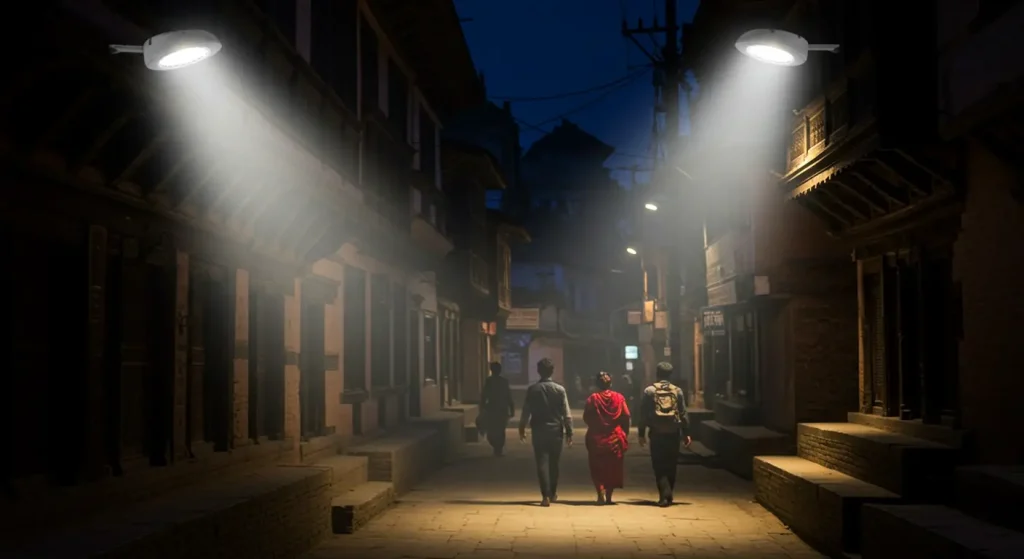
One of the fastest and most effective steps towards energy efficiency is a complete modernization of the street lighting system with the transition to LED technology This is a so-called “quick win” with many proven benefits.30:
- Energy efficiency: According to the World Bank, LED lights consume 40-60% less electricity than traditional sodium or mercury lamps.
- Saving money: Reducing energy consumption and maintenance costs (LED lamps last at least four times longer) results in huge budget savings. In some cities, street lighting costs account for 5% to 20% of the entire municipal budget. Kathmandu will be able to use the freed-up money for other urgent needs: schools, hospitals, sanitation.
- Increased security: According to research, high-quality and uniform street lighting can reduce crime rates by up to 20% and the number of road accidents at night by up to 35%.30
The high initial cost of modernization is often an obstacle for municipalities. However, global experience offers effective financing models. For example, contracts with energy service companies (ESCOs) or PPP, in which the private investor takes on all the costs of replacing the equipment, and receives a return on investment and his profit from a share of the achieved energy savings. Thus, the project pays for itself, without creating a burden on the city budget.30
B. Energy system of the future: Smart grids and solar energy

A deeper and more strategic challenge is to modernize the electrical grid itself. Nepal’s current power system suffers from high technical and commercial losses, as well as instability due to the variable nature of hydroelectric generation.5The solution is to move to “smart” power grids (Smart Grids).
Smart Grid is not just wires, but an intelligent system that uses digital technologies for two-way communication between energy producers and consumers. It allows for real-time monitoring, analysis and management of electricity flows, which provides a number of key benefits29:
- Reducing losses: The system instantly detects leaks and unauthorized connections and optimizes the load, which can significantly reduce losses, which reach 30% in some developing countries.
- Increased reliability: Smart Grid automatically identifies and isolates damaged areas of the grid, rerouting power flows and minimizing the duration and extent of outages.
- Integration of renewable sources: This is the most important advantage for Nepal. The country has a huge potential for solar energy – about 300 sunny days a year.53However, solar generation, like hydropower, is unstable. A smart grid is needed to balance these fluctuations and effectively integrate thousands of sources into the overall system – from large solar farms to panels on the roofs of private homes.
The Nepalese government is already moving in this direction by offering subsidies and launching incentive programs for solar energy through Alternative Energy Promotion Center (AEPC).31Successful pilot projects for the implementation of Smart Grids in India (for example, in the cities of Surat and GIFT City) and Brazil (Buzios) have already demonstrated their ability to dramatically reduce losses and efficiently manage renewable energy sources.29
For Nepal, building a smart and diversified energy system is not only an economic or environmental issue, but also a national security issue. Over-reliance on one type of generation (run-of-river hydropower plants) makes the country vulnerable to the vagaries of the weather, as the dry season crisis clearly demonstrates.17Dependence on electricity imports from India during these periods creates a strategic vulnerability.17Reliance on imported fossil fuels for transport and backup power exposes economies to the risk of global price shocks.5
A smart grid, combined with a diversified portfolio of renewable sources (hydro, solar, and waste-to-energy), creates a much more sustainable and self-sufficient system. It allows the country to make the most of its own resources – water, sun, and waste – while reducing the need for imports. Investing in a smart grid is therefore an investment in Nepal’s long-term energy independence, economic sovereignty, and strategic stability.
Conclusion: Kathmandu 2.0 – The Path to Realization

An analysis of Kathmandu’s problems and global experience shows that a “smart city” is not an abstract concept, but a concrete, integrated action plan. The proposed solutions in the areas of transport, waste management and energy are not independent initiatives; they create a synergistic effect, where success in one area contributes to progress in others. Smart electric public transport reduces the load on the energy grid and improves the environment. Waste-to-energy solves the landfill problem and simultaneously generates electricity. Energy-efficient lighting and smart grids free up resources and create a reliable basis for all other digital innovations.
However, it is important to understand that technology is only a tool. The most advanced sensors and algorithms will be useless without the right conditions for their implementation. The implementation of the ambitious Kathmandu 2.0 project depends on three non-technical but crucial factors:
- Political will and consistency. City and national leaders must not only declare a commitment to innovation, but also ensure consistent implementation of policies that go beyond short electoral cycles. It is necessary to avoid the mistakes of the past, when good initiatives were cut short by changing priorities or lack of control, undermining citizens’ trust.
- Strategic public-private partnerships (PPP). The scale of the required investments exceeds the capacity of the state budget alone. Attracting private capital, experience and management competencies through transparent and well-structured PPP models is an absolute must. The state’s task is to create clear and stable “rules of the game” that will make long-term investments in Kathmandu’s infrastructure attractive to businesses.
- Citizen Engagement (“Smart Citizens”). Ultimately, a city is its residents. The success of a transformation depends on their acceptance and active participation. Any decision, from waste sorting to using a new mobile app for transport, requires public support. This can only be achieved if projects are initially focused on people, their benefits are obvious and clearly communicated to people, and the implementation process itself is open and inclusive.
The path ahead for Kathmandu is complex, but it is clear. By using innovative technology not as an end in itself, but as a means within a holistic, people-centered plan, Nepal’s capital can transform its current chaos into a model for a sustainable, resilient, and prosperous 21st-century metropolis. The city has a unique opportunity not just to catch up, but to set an example of how to build a smart future on an ancient land.digital Nepal, but a financially accessible Nepal for all.
Source used
- Coping with the urban chaos in Kathmandu
- Smart Cities in Nepal: The Concept, Evolution and Emerging Patterns
- Traffic Congestion: A growing menace in Kathmandu Valley
- Assessment of Current Waste Management Practices in Nepal: Challenges and Opportunities for a Circular Economy
- Economics of unreliable power supply: lessons from the 2006-2017 Nepal power crisis
- Kathmandu – Wikipedia
- Kathmandu Sustainable Urban Transport Project (RRP NEP 44058 …)
- EVALUATION AND MITIGATION OF TRAFFIC RELATED CONCERNS IN KATHMANDU VALLEY
- Kathmandu’s Traffic Is Getting Worse: What’s the Solution? : r/NepalSocial
- (PDF) Traffic problem in Kathmandu and Use of GIS in Urban Traffic Management
- Transportation Challenges in Nepal: Consequences and Solutions
- Kathmandu’s problematic solid waste (mis)management
- Turning Trash into Treasure: Nepal’s Emerging Waste-to-Energy …
- Converting Urban Waste into Energy in Kathmandu Valley: Barriers and Opportunities
- Solid Waste Management in Kathmandu Metropolitan City – Free Essay Example
- (PDF) Energy Crisis and Nepal’s Potentiality
- Navigating Energy Crisis During Dry Season
- nepalinfrastructuresummit.com.np
- Digital Governance in Nepal: Challenges, Progress & Future Insights
- Dimensions of Digital Nepal Framework and Appropriate Roadmap
- How far has the Digital Nepal Framework come? – Nepal Economic …
- Govt finalizes smart city indicators – myRepublica
- Making Nepali Cities Smart
- For a smart and sustainable city
- A study on intelligent traffic management using IoT for urban congestion control
- FRONTLINE/WORLD Fellows . Brazil – Curitiba’s Urban Experiment …
- A Sample Proposal on “Smart Waste Management Solutions for a …
- Optimizing Waste Collection with Efficient Route Planning Software
- Implementing Smart Grid Technology in Developing Countries …
- LED street lighting: Unburdening our cities – World Bank Blogs
- Nepal solar power grant: $20 Million for Extraordinary Energy Expansion
- Intelligent Traffic Management System Case Study – Aeologic …
- Reducing Traffic Congestion and Emission in Chinese Cities
- Sustainable Urban Planning (Curitiba City) | Department of Economic and Social Affairs
- Bus Rapid Transit and Urban Planning in Curitiba – Green City Times
- Bhutan Green Transport Project | Thimphu Thromde
- Policies, Plans and Strategies – Ministry of Infrastructure and Transport
- Urban parking reforms in Thimphu to promote sustainable transport …
- Smart Transport: A Key to Building Smarter Cities in Asia
- The Innovative Benefits Of Smart Waste Management Solutions
- Municipal and City Waste Management Software – Routeware
- Waste Collection Routing Software – Route Optimization Consultants
- INTEGRATED SOLID WASTE MANAGEMENT IN INDORE DISTRICT: A REVIEW OF CURRENT PRACTICES AND FUTURE DIRECTIONS
- Sustainable Waste Management In Indore: A Case Study – Earth5R
- Solid Waste Management – Smart City Indore
- Waste to energy in Kathmandu Nepal—A way toward achieving sustainable development goals
- As waste-to-energy incinerators spread in Southeast Asia, so do concerns
- Southeast Asia looks to its growing piles of trash as new energy source
- IMPACT STORY: Sri Lanka’s first waste-to-energy power plant turns mountains of trash into clean electricity
- Energy-Efficient Street Lighting PPPs Public Private Partnership
- Smart Grid Development in India – A Case Study
- Smart Grids for Improved Grid Performance in Developing Countries
- Nepal Energy Situation
- Renewable Energy Subsidy Policy of Nepal
- Promotion of Solar Energy in Rural and Semi-urban Regions of …