Executive Summary
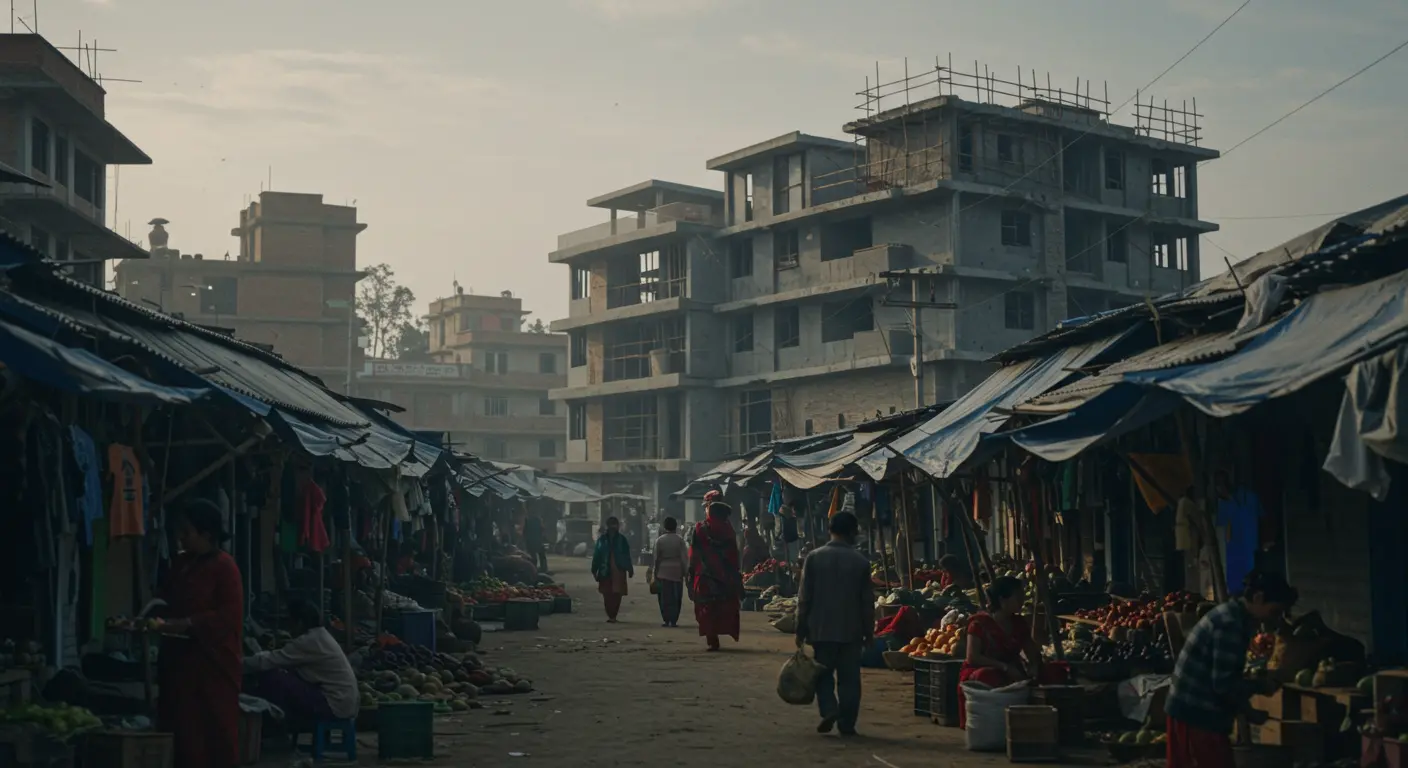
Nepal’s economy presents a profound paradox. On the one hand, the country has made impressive strides in reducing poverty, virtually eliminating extreme poverty in recent decades – an achievement aided by a huge influx of remittances from millions of citizens working abroad.1On the other hand, Nepal remains one of Asia’s slowest growing economies, stuck in a low-growth trap, unable to create enough quality jobs for its young and growing population.3At the heart of this paradox lies the vast, multifaceted and largely unaccounted for “shadow” or informal economy.
This investigation by Alpha Business Media delves into this hidden sector to quantify its scale and analyse its contradictory impact on Nepal’s gross domestic product (GDP), employment and social stability. Our findings show that the informal economy is not just a side effect, but a dominant feature of Nepal’s economic landscape, serving as both a lifeline and an anchor.
Key findings:
- The scale is staggering: Estimates of the size of Nepal’s informal economy range from 38.7% to 51% of GDP, which in monetary terms amounts to about 2.2 trillion Nepalese rupees.4What is even more striking is that this sector employs more than 80% of the country’s workforce, making it the de facto major employer in Nepal.6These figures mean that official macroeconomic indicators give a distorted picture of the economic reality faced by most Nepalis.
- Structural driving forces: Informality in Nepal is less a choice than a rational response to deep-rooted structural failures. Chronic political instability, cumbersome bureaucracy, and corruption make the formal sector an expensive and risky place to do business.7At the same time, the formal economy is unable to create the jobs needed to absorb the 400,000 to 500,000 young people entering the labour market each year, pushing them either into the informal sector at home or into labour migration abroad.10
- Dual role: The informal economy plays a dual role. On the one hand, it acts as a critical, albeit ineffective, social safety net, providing livelihoods for millions of people and absorbing economic shocks. Remittances flowing into this sector have become a major driver of poverty reduction.1On the other hand, it constrains national development. Low productivity of informal firms, vulnerability of workers without social protection, and erosion of the tax base limit Nepal’s growth potential and weaken the state’s ability to invest in infrastructure and human capital.12
- New Digital Frontier: In the shadow of traditional informality, a new, dynamic sector is emerging: the digital “gig economy.” IT services exports, valued at US$515 million and run largely by young freelancers, represent a highly skilled, export-oriented form of informality.14However, its growth is hampered by archaic internal barriers, most notably the lack of access to international payment systems such as PayPal, which forces this promising sector to remain in the shadows.15
Strategic imperative: Policies that seek to violently eradicate informality are doomed to fail because they ignore its role as a vital survival mechanism. Instead, Nepal stands at a crossroads that requires a measured approach. Policy recommendations should focus on reducing workers’ vulnerability by expanding social protection, facilitating and incentivizing formalization, and, most importantly, addressing the root causes by creating a conducive investment climate that can generate quality jobs in the formal sector. Particular attention should be paid to addressing the bottlenecks holding back the digital economy, which is the low-hanging fruit with enormous potential for formal growth. Ultimately, the question for Nepal is not how to eradicate the informal economy, but how to transform it from a hidden resource for survival into a visible engine of sustainable and inclusive growth.
Part I: Measuring the Invisible: The True Scale of Nepal’s Informal Economy
To understand the true impact of the informal sector on Nepal’s economy, it is first necessary to try to measure its size. This is an inherently difficult task, since informal activity, by its very nature, is not recorded in official statistics. However, by pulling together data from various studies and reports, it is possible to piece together a picture of a sector that is not just a sideline, but a fundamental component of the national economic landscape.

The Billion Dollar Question: Quantifying the Unquantifiable
Estimating the size of the informal economy is a subject of ongoing debate, with different methodologies yielding different figures. However, they all point to one thing: the enormous scale of the phenomenon in Nepal.
Data and analysis:
- Share in GDP: Estimates of the informal economy’s contribution to Nepal’s GDP vary widely, which is an indication of how difficult it is to measure. One recent report based on International Monetary Fund (IMF) data and published by VisualCapitalist.com listed Nepal as one of only three countries in the world where the informal economy exceeds 50% of GDP, with an estimate of 51%.4More conservative, but still very high, estimates come from a study conducted by the Central Economics Department of Tribhuvan University, with support from Nepal Rastra Bank (NRB). According to this study, the average size of the informal economy over the decade from 2010/11 to 2020/21 was between 40.06% and 42.66% of GDP. The most recent data for 2020/21 shows a range of 38.66% to 41.31%.5
- Monetary value: Translating these percentages into absolute figures, one can estimate the colossal value of this sector. With the total size of Nepal’s economy at 5.381 trillion Nepali rupees, the share of the informal economy is about 2.2 trillion Nepali rupees per year.5This amount is comparable to or even exceeds the contribution of many formal sectors of the economy.
- Employment: The employment figures are even more telling. According to the World Bank, a staggering 82% of Nepal’s workforce is employed in the informal sector, significantly higher than the global and regional averages.6Other sources, such as the Central Bureau of Statistics (CBS), put the figure at 62.2%.17, and earlier studies suggested that this figure could be as high as 96% of the economically active population.18Regardless of the exact figure, it is clear that the vast majority of Nepalese make their living in the informal economy.
These figures have profound implications. When up to half of economic activity and more than four-fifths of jobs are outside the formal system, official macroeconomic indicators such as GDP growth, unemployment, and inflation cease to be reliable indicators of the real state of affairs in a country. Policy decisions based solely on formal sector data risk being ineffective or misguided, as they ignore the dynamics that govern the lives and livelihoods of the majority of the population. This gap between official statistics and reality explains why many ambitious government plans, such as the 16th Five-Year Plan, often fail to achieve their goals in practice.19
Anatomy of Informality: Deconstructing the Shadow
Nepal’s informal economy is not monolithic. It is made up of various sectors, each with its own dynamics and reasons for remaining in the shadows.

Data and analysis:
- Agriculture: This is the basis of informality in Nepal. A study by Tribhuvan University found that 96.48% of the agricultural sector operates informally, as most of the production takes place at the household level.20This is critical because agriculture still employs more than 60% of the population and contributes about 24% to the country’s GDP.21
- Real estate: This sector is almost entirely shadowy (99.97% informal) and is characterized by undervaluation of transactions, making it a channel for laundering “black money”.20This indicates a close link between informality and illicit financial flows.
- Other sectors: A significant part of the service sector, especially in accommodation and food services (50.42% informality), consists of unregistered family guest houses and tea houses.20Construction and small business are also key sources of informal employment.8
- Enterprise level: The 2018 Economic Census found that about 50% of all businesses in Nepal are informal.17The definition used in the World Bank’s 2024 Informal Sector Survey classifies a business as informal if it is not registered with the Inland Revenue Department (IRD), highlighting the tax-related nature of the formal-informal sector divide.23
An analysis of these data reveals two distinct faces of informality. The first is a low-productivity, subsistence-based survival economy, mostly in agriculture, driven by necessity. The second is a high-income, accumulation-oriented economy, especially in real estate, which appears to be a deliberate strategy for tax evasion and wealth concealment. Any effective policy must distinguish between these two types of informality, since a one-size-fits-all approach to formalization is doomed to failure.
Productivity and Income Gap
One of the most significant consequences of the dominance of the informal sector is its impact on the overall productivity of the economy and the ability of the state to generate revenue.
Data and analysis:
- Performance: Globally, the productivity of informal firms is only about a quarter of that of formal firms.25In developing countries, the gap is even more striking: productivity in the informal sector is 79% lower than in the formal sector.12This is due to lack of access to modern technology, dependence on unskilled labour and limited access to markets and finance.
- Loss of tax revenue: The huge size of the informal economy means significant losses in potential tax revenue for the state.13The situation is aggravated by deliberate tax evasion through under-invoicing and other schemes.26The narrow tax base, with less than 5% of the population paying taxes, is a direct consequence of this.26This creates a revenue deficit that forces the government to run a budget deficit and limits its ability to finance key development areas.13
These two factors—low productivity and lost income—create a vicious circle. Low productivity is both a cause and a consequence of informality. Firms remain informal because they are not productive enough to bear the costs of formalization. Informality, in turn, traps them in low productivity, cutting them off from formal credit, technology, and markets. Loss of tax revenue, in turn, deprives the state of funds for investment in infrastructure and education, which are needed to boost productivity. This vicious circle is one of the main reasons for Nepal’s overall low economic growth, as the World Bank has repeatedly pointed out.3
Table 1: Quantitative assessment of the informal economy in Nepal (2020-2024)

Part II: The Engine: Why Does Nepal’s Informal Economy Survive?
The persistence and dominance of the informal economy in Nepal cannot be explained by a single factor. It is the result of a complex interaction of governance failures, structural weaknesses in the formal economy, and deep-rooted social realities. Understanding these drivers is critical to developing effective policies.

The Burden of Governance: Political Instability and Bureaucracy
For many Nepalese entrepreneurs and workers, informality is a rational response to an unfavorable and unpredictable formal environment. The costs and risks of interacting with state institutions often outweigh the potential benefits of formalization.
Data and analysis:
- Political instability: Nepal has a history of chronic political instability, with 13 governments in the past 17 years.7Such frequent changes of power lead to policy inconsistency, disrupt long-term planning and undermine investor confidence.28This uncertainty is a major constraint on foreign direct investment (FDI) and formal business growth.30
- Bureaucracy and corruption: Businesses face cumbersome bureaucracy, complex registration procedures and high administrative costs, which constitute a significant barrier to formalization.3Corruption is widespread and is seen as one of the main obstacles to economic growth.9
- Tax system: The tax system is perceived as complex, with high and numerous taxes, which creates incentives for evasion and for businesses to remain outside the tax system.26
Taken together, these factors make interactions with the formal state costly, risky, and often unprofitable. The formal system imposes costs (taxes, compliance, bureaucratic red tape) without providing commensurate benefits such as stability, protection of property rights, or efficient public services. In this context, working in the informal sector becomes not an aberration but a logical strategy for survival and doing business. This reframing of informality—not as a problem of “non-compliance” but as a symptom of a “dysfunctional” formal system—is central to understanding Nepal.
The Failure of the Formal Sector: The Crisis of Quality Job Creation
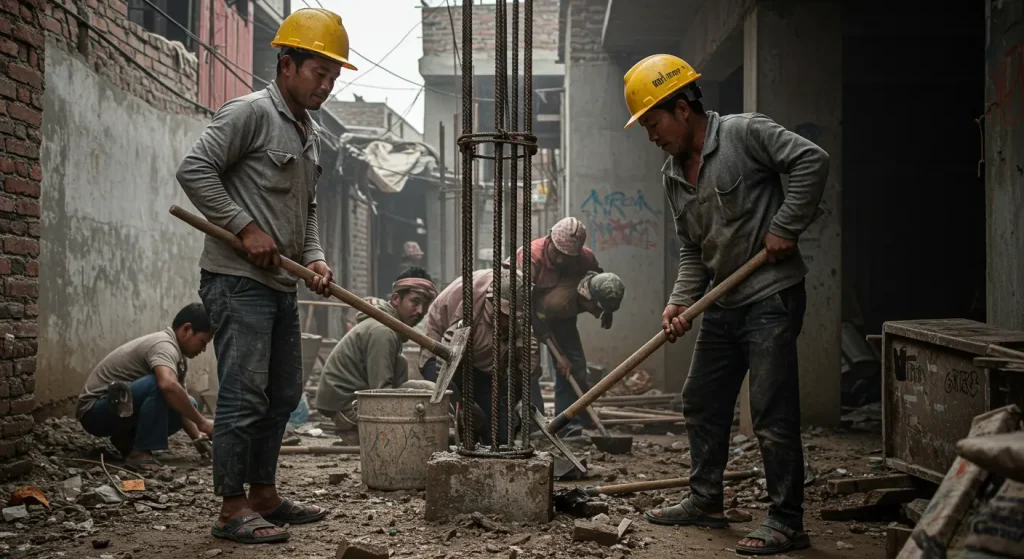
If governance problems explain why firms choose to remain informal (supply), then the failure of the formal economy to create jobs explains why millions of workers are forced to seek their livelihood in the informal sector (demand).
Data and analysis:
- Lack of opportunities: The main driving force behind both informality and migration is the acute shortage of sufficient and suitable employment opportunities in the domestic formal economy.34The World Bank notes that Nepal’s economic growth has not resulted in the creation of quality jobs.6
- Youth Unemployment: The youth unemployment rate is alarming at 20.36% (in 2023), which is significantly higher than the national average.11Every year, between 400,000 and 500,000 young people enter the labour market, but the formal economy is unable to absorb them.10
- Skills Mismatch: There is a striking gap between the education system and the needs of the labour market, with outdated curricula and inadequate vocational training.34As a result, graduates are poorly prepared for the modern requirements of employers.
In the absence of a functioning formal labour market, the informal economy is the default employer for most of Nepal’s youth. In fact, it is the country’s largest (and most underfunded) youth employment and social inclusion programme. Without this sector, Nepal would face a catastrophic youth unemployment crisis and enormous social tensions. This insight is crucial to the “hidden resource” argument: the informal sector, for all its shortcomings, performs a vital social function that the state is unable to fulfil.
Part III: The Double-Edged Sword: Impact on the Nation
Nepal’s informal economy has profound and contradictory effects on the country. It is both a source of social resilience and a drag on long-term development. Analyzing these two sides of the coin reveals the central paradox of the Nepalese economy.
Hidden National Resource: The Basis of Social Stability
Despite its shadowy nature, the informal sector makes an undeniable positive contribution to the socio-economic fabric of Nepal by performing functions that formal institutions cannot provide.
Data and analysis:
- Poverty Reduction: Remittances, which largely flow into the informal consumer economy, have been the “main driver” of Nepal’s impressive success in reducing poverty, helping to halve the poverty rate in seven years.1
- Employment and livelihood: The informal sector provides livelihoods for millions of people, acting as a critical shock absorber, especially for the poor and vulnerable.18It offers flexibility and a low barrier to entry for those without capital or formal skills.
- Social protection: In the absence of a comprehensive public social protection system, the informal economy and associated remittances function as a de facto social safety net, providing income support and reducing the vulnerability of millions of households.42
- Entrepreneurship:The sector serves as an incubator for grassroots entrepreneurship, enabling people to create their own jobs and income sources with minimal capital.43
Remittances have made a dramatic difference to poverty and social stability in Nepal. However, because these funds primarily fuel consumption in the informal economy rather than being channeled into formal, productive investment, they create a stable but stagnant economic model. The country becomes more stable and less poor, but also more dependent on migration and less able to generate sustainable domestic growth. The informal economy is the central channel through which the positive effects of remittances manifest themselves. The paradox is that this process, while stabilizing society, simultaneously strengthens the informal sector and hinders the transition to a formal, investment-driven growth model, as the World Bank notes.47
The Burden of the Shadow: A Brake on National Development
Along with the positive aspects, the dominance of the informal sector imposes serious limitations on Nepal’s development.
Data and analysis:
- Vulnerability of workers: Informal workers lack formal contracts, social protection and legal guarantees, making them vulnerable to exploitation, unfair treatment, low and irregular wages and poor working conditions.8Women suffer disproportionately from this.41
- Lack of social protection: Despite the existence of the Social Security Fund (SSF), which provides schemes for informal workers, coverage remains extremely low. Only 21% of the population has effective social security coverage.48, and only 9.9% of the working-age population has access to income support.49This leaves the vast majority of workers vulnerable to economic shocks.
- Limited performance and growth: As established in Part I, low productivity of informal firms reduces a country’s overall economic performance.12Competition from untaxed informal enterprises can also undermine the market share and profitability of formal firms by discouraging them from investing and innovating.25
- Fiscal weakness: The massive loss of tax revenue due to the informal sector weakens the state’s ability to invest in public goods such as infrastructure, education and health care, which are essential for long-term development.13
The failure of the state to provide a robust social protection system, in turn, strengthens the informal economy. Workers see little point in formalising if it means contributing to a system that offers little protection. The government’s attempt to bridge this gap with the SSF is a step in the right direction, but its low popularity among informal workers reflects a huge trust and awareness deficit. This highlights that formalisation is not just about registering; it is about offering workers better and safer terms than they have in the informal sector.
Part IV: The New Frontier: Digitalization and the Gig Economy
A new, high-tech, and globally integrated shadow economy is emerging in Nepal amid traditional low-skill informality. The youth-driven digital gig economy represents both vast untapped potential and a shining example of how outdated domestic policies are holding back the country’s most modern sectors.

From labor export to services export: the rise of the digital freelancer
While hundreds of thousands of young Nepalese go abroad for physical labor, another, increasingly significant group remains at home, exporting their intellectual services to the global market.
Data and analysis:
- Scale and cost: Nepal’s IT services exports were valued at US$515 million in 2022, up 64.2% from 2021. The sector already accounts for 1.4% of the country’s GDP and 5.5% of its foreign exchange reserves.14
- Labor force: The sector consists of over 106 IT companies and a huge army of freelancers comprising of 14,728 IT professionals and 51,781 IT services (ITeS) freelancers.14
- Youth dominance: It’s a youth-driven phenomenon, with 83.5% of freelancers aged between 20 and 29.14They are highly educated: 79.5% have a bachelor’s degree.14
- High earning potential: While starting salaries in local IT companies are low (NPR 17,000-35,000 per month), experienced freelancers working for foreign clients can earn significantly more, reaching NPR 200,000-300,000 per month and even more than US$2,000.53
This digital gig economy represents a new paradigm of informality. Unlike traditional informal employment, it is highly skilled, high-income, globally integrated, and export-oriented. It challenges the traditional view of the informal sector as exclusively low-productivity and domestically oriented. It is the “hidden resource” in its purest form. If traditional informality is caused by low productivity, this “high informality” is caused by the failure of the state to provide the necessary infrastructure for a highly productive sector to function.
The PayPal Problem: How Infrastructure Is Holding Back the Digital Boom
Despite its enormous potential, Nepal’s digital sector faces serious obstacles that force it to remain in the shadows.

Data and analysis:
- Payment gateways: A critical barrier is the lack of access to international payment gateways such as PayPal in Nepal.15This forces freelancers and IT companies to receive payments through informal or unofficial channels (e.g. all of them) or keep income abroad.55
- Incomplete declaration of income: Because of these payment problems and the desire to avoid taxes and bureaucracy, a significant portion of the US$515 million in IT services exports is believed to flow through informal channels.55
- Infrastructure gaps: Beyond payments, the sector is hampered by unreliable electricity and internet supplies, as well as a lack of clear data protection and intellectual property policies.57
A digital paradox emerges: Nepal’s youth are successfully competing in the global knowledge economy, but are held back by archaic domestic rules and infrastructure. The government’s ambition is to turn the country into an “IT hub”58and implement the Digital Nepal program59directly contradicted by its failure to solve basic problems like payment processing. This is a huge, self-imposed obstacle to the formalization of one of the country’s most promising export sectors. The government proclaims a digital future, but fails to provide the most basic tools for digital commerce, forcing its most innovative citizens to work in the shadows.
Table 2: Profile of Nepal’s Digital Informal Sector (2022 data)

Part V: The Human Dimension: Youth, Migration and the Social Contract
Behind the dry figures of GDP and employment statistics lies a deep human drama playing out among Nepal’s youth. Their choices, their aspirations, and their frustrations are both the cause and the consequence of the dominance of the informal economy.
Choice of a generation: migration or informality?
Nepal’s young generation faces a stark choice that will determine not only their own destiny, but also the future of the country.
Data and analysis:
- Youth boom: Nepal is experiencing a significant “youth boom,” with people between the ages of 16 and 40 accounting for nearly 40% of the population.37This demographic dividend presents both an opportunity and a challenge.
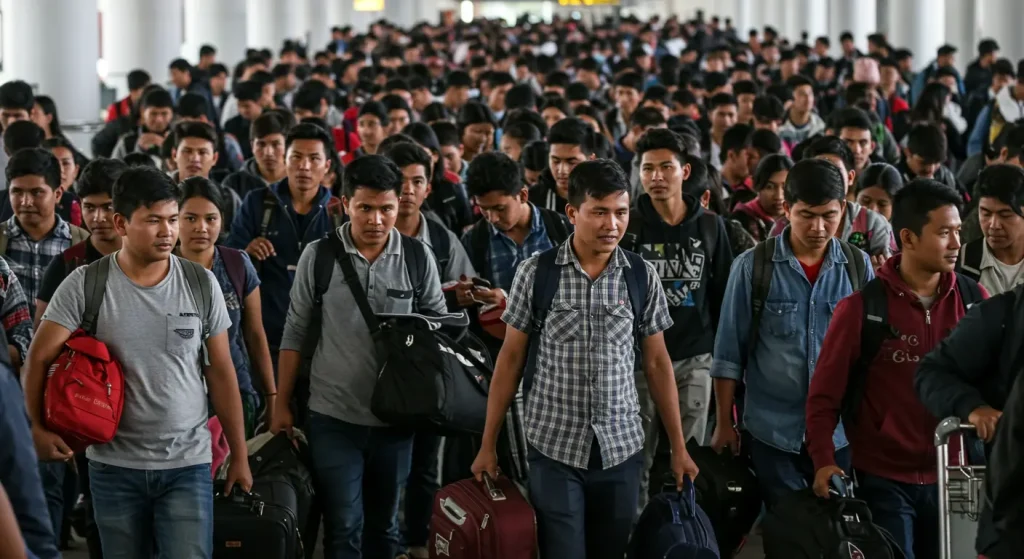
- Mass outflow: Faced with a lack of opportunities at home, young people are leaving the country in staggering numbers. In the 2022/23 financial year, more than 771,000 people were granted work permits abroad.62On average, 1,500 to 2,500 young people leave the country every day.10This process is driven by economic conditions, educational aspirations and the presence of social networks.64
- Disappointment: This outflow is fueled by deep disillusionment with the country’s political and economic systems, which are perceived as corrupt and unstable.10Young people feel that their potential is either ignored or exploited for selfish purposes.10
For Nepali youth, the informal economy and labour migration are not two separate phenomena, but two major responses to the same core problem: the formal state’s failure to provide a decent future. One is an “inward exit” into the domestic informal economy; the other is an “outward exit” into foreign labour markets. Both represent a vote of no confidence in the formal system. These are not two separate issues, but a single “youth response” to a systemic crisis, which is a powerful narrative for the human dimension of this report.
The remittance paradox: a lifeline that feeds informality
Remittances from migrants play a complex and paradoxical role in Nepal’s economy, simultaneously supporting and preserving the existing structure.
Data and analysis:
- Economic lifeline: Remittances are a cornerstone of Nepal’s economy, accounting for about a quarter of GDP.1They are a stable source of foreign exchange and have become a key factor in poverty reduction.1
- Consumption focus: However, about 80% of remittances are used for consumption (household goods, daily needs) rather than for productive investment.68These expenses occur mainly within the informal economy.
- Negative correlation with agriculture: Research shows negative correlation between remittances and agricultural GDP70, suggesting that households receiving remittances may reduce their participation in subsistence agriculture, further changing the economic landscape.
These facts form a self-perpetuating cycle. The lack of formal jobs drives youth migration. Migration generates remittances. Remittances fuel consumption in the informal economy, creating the appearance of prosperity but leading to little formal investment. The lack of formal investment means that no new formal jobs are created, which in turn drives further youth migration. The informal economy is at the heart of this self-perpetuating cycle, which explains Nepal’s unique development path of “poverty reduction without growth.”
Part VI: Navigating the Future: Policy, Potential, and the Way Forward
The problem of informality in Nepal is not a technical glitch but a deeply rooted structural characteristic. Its solution requires not punitive measures but a balanced and multifaceted strategy that recognizes the dual role of the sector and addresses its root causes.
Limitations of Current Policy: Assessing the Effectiveness of Formalization
The Nepalese government acknowledges the problem of informality and has taken a number of policy steps to address it. However, the gap between intentions and results remains huge.
Data and analysis:
- 16th Plan: The government’s 16th National Development Plan (2024/25-2028/29) explicitly sets the goal of reducing informal employment from 62% to 40%.49This indicates recognition of the problem at the political level.
- Social Security Fund (SSF): The SSF is the government’s flagship policy to extend social protection. It includes a voluntary scheme for informal and self-employed workers, where they contribute 9.37% of their income and the government doubles that amount.71
- Gaps in implementation: Despite these measures, their implementation remains weak. Relief measures during the COVID-19 pandemic did not reach informal workers because municipalities did not have mechanisms to identify them.42Participation in SSF among informal workers remains low due to lack of awareness and mistrust.73The same barriers that support informality (bureaucracy, costs) also prevent informal actors from gaining access to formalization programs.
There is a huge gap between policy intentions and reality. The government has good plans, but lacks the capacity, data and credibility to implement them effectively. The policies developed in Kathmandu do not take into account the realities of the informal sector and the deep-rooted mistrust of state institutions. The problem is not the absence of policy, but the absence ofstate capacity And trustto implement it. This is a fundamental difference, which suggests that the solution lies not only in writing better laws, but in building a more effective and trustworthy state, which is a much more difficult task.
Table 3: Policy Assessment – Formalization Initiatives in Nepal

Strategic recommendations for a balanced approach
Based on a comprehensive analysis, it is clear that a frontal assault on the informal economy is counterproductive. Instead, a pragmatic and step-by-step approach is required to reduce vulnerability and create incentives for voluntary formalization.
Recommendation 4: Address the root cause – encourage the creation of formal jobs.
Ultimately, the informal economy will only shrink when the formal economy offers better alternatives. This requires addressing key structural issues: improving the investment climate through political stability and policy coherence, investing in quality education and training that meet market needs, and developing key productive sectors such as hydropower and sustainable tourism.3 Only by creating sufficient quality jobs can Nepal break the cycle of informality and migration and embark on a sustainable development path.
Recommendation 1: Simplify and encourage formalization.
Instead of penalizing informality, formality needs to be made more attractive. This includes radically simplifying business registration, reducing administrative costs, and creating a multi-tiered tax system for micro-enterprises that is simple and unburdensome.8 The goal is to reduce barriers to entry into the formal sector to a minimum.
Recommendation 2: Bridging the social protection gap.
SSF participation should be aggressively promoted and subsidized for informal workers. Large-scale information campaigns should be launched, using mobile technology to simplify registration and contributions. The main goal is to first reduce vulnerability, which in turn will make formalization more attractive. Once workers see real benefits from the formal system (e.g., health insurance, pension savings), they will be motivated to join.49
Recommendation 3: Build “digital rails”.
There is an urgent need to prioritize creating a supportive ecosystem for the digital economy. This means working with international partners to implement payment gateways like PayPal, clarifying tax laws for freelancers, and investing in robust digital infrastructure. This is the low-hanging fruit for formalizing a high-value sector that can become a driver for the entire economy.74
Sources used
- Climbing Higher: Toward a Middle-Income Nepal
- Migration, remittances inflow key factor behind poverty reduction in Nepal: World Bank
- Nepal: World Bank Report Outlines Key Reforms to Boost Growth, Create Jobs
- Nepal’s informal economy estimated at 51% of GDP, global average rests at 11.8%
- Nepal’s informal economy is 41 percent of GDP
- Nepal Overview: Development news, research, data | World Bank
- COST OF POLITICAL INSTABILITY
- Best Understanding informal Work Environment in Nepal
- Nepal’s long-term growth may stall below 4 percent, World Bank warns
- Outflow of Nepali youth: Causes and concerns – Metakhabar
- Youth Employment Issues and their Impact on the Economic Development of Nepal
- Addressing Informality: Transitioning to the Formal Economy
- Diversifying Government Revenue – myRepublica
- Unleashing it: advancing Nepal’s digital economy
- How real is the dream of earning high from IT in Nepal? | The Annapurna Express
- Challenges of IT Freelancers in Nepal – TikTok
- (PDF) SIZE OF INFORMAL ECONOMY IN NEPAL
- Measuring Informal Sector Economic Activities in Nepal
- The Sixteenth Plan – MOEST eLibrary
- Informal economy worth Rs 1.44trn: Study – The Annapurna Express
- (PDF) The Role of Agriculture in Nepal’s Economic Development: Challenges, Opportunities, and Pathways for Modernization
- Nepal’s agriculture, water resources under climate threat – The Kathmandu Post
- Nepal – Informal Sector Enterprise Survey 2024 – Microdata Library (Study Description)
- Nepal – Informal Sector Enterprise Survey 2024 – Microdata Library
- Casting a Shadow: Productivity of Formal Firms and Informality
- Tax Evasion and its Effects on the Economy – Nepal Journals Online
- Day 2 Nepal.pdf – Addis Tax Initiative
- Nepal’s political and economic uncertainty – GIS Reports
- Impact of Political Instability on Economic Growth of Nepal
- FOREIGN DIRECT INVESTMENT IN NEPAL: A STUDY ON ITS IMPACT ON EMPLOYMENT
- Revisiting foreign direct investment in Nepal: problems and prospects
- 2023 Investment Climate Statements: Nepal – State Department
- 2024 Investment Climate Statements: Nepal – State Department
- Youth Employment Issues and their Impact on the Economic Development of Nepal (ResearchGate)
- Rise of Foreign Employment and Challenges Faced by Nepali Youth in the Domestic Job Market – MultiTech Publisher
- Youth Employment in Nepal – World Bank Documents and Reports
- Nepal’s Youth Employment Scenario: Exploring Opportunities and Challenges
- Youth Employment Policy Brief: Nepal
- Stay or go: Migration should be a choice – InfoStories – International Labour Organization
- NEPAL (ILO)
- Informal sector workers crying for formal recognition
- What next for Nepal’s informal economy actors? – Nepal Economic Forum
- NEPALI STARTUP ECOSYSTEM : The Growth So Far & The Future – Tangent Waves
- Youth Entrepreneurship Development Volunteer in Nepal: Empowering Tomorrow’s Innovators
- (PDF) Motivating Factors to the Success of Youth Enterprise Startups: A Study of Nepali Enterprises
- Challenges and Prospects of Youth Entrepreneurship in Dhangadhi Sub-Metropolitan City, Nepal
- Unlocking Nepal’s Growth Potential : Nepal Country Economic Memorandum 2025
- Nepal Advances Social Protection, Faces Climate Challenges | Mirage News
- Nepal | ILO – social-protection.org
- Nepal’s Export of IT Services : Making Big Strides
- Digitalization and the Future of Trade: Empowering Least Developed Countries – Nepal Economic Forum
- Nepal makes strides in IT service exports | The Annapurna Express
- Salary of IT professionals in Nepal – Share your experience (Mega Thread) : r/technepal
- Can Nepalis Make A Fortune In IT Industry? – The Rising Nepal
- Nepal’s income from IT service exports surges by 20.28 percent in first four months of current FY – myRepublica
- Nepal’s income from IT service exports increases by over 20 percent – Vishwanews
- Nepal’s potential in digital sector faces regulatory, skill and cost issues
- ‘300,000 youth to get jobs in IT industry in three years’ – The Rising Nepal
- How far has the Digital Nepal Framework come?
- 2019 DIGITAL NEPAL FRAMEWORK
- Call for Applications: Youth Leadership Challenge Fund, USAID Civil Society and Media Activity – The Asia Foundation
- myrepublica.nagariknetwork.com
- Numbers of youths seeking foreign employment opportunities surge – myRepublica
- (PDF) Analysis of Determinants of Youth Migration Intentions in Nepal
- Analysis of Determinants of Youth Migration Intentions in Nepal
- Youth struggles in Nepal amid political instability: A call for change
- Role of Remittances on Rural Poverty in Nepal: Evidence from Cross-Section Data
- An Analysis of Remittance and Private Consumption in Nepal
- Remittances and Household Expenditure in Nepal: Evidence from Cross-Section Data
- REMITTANCE IN NEPAL: STATUS, TREND AND ECONOMIC IMPACTS
- Nepal’s Social Security Fund (SSF): Registration, Contribution …
- Detailed Guide to Nepal’s Social Security Fund (SSF) – MeroCompany
- Leaving no parent behind: Lessons from family friendly policies in Nepal – World Bank Blogs
- Nepal to launch five-year digital nomad visa for global remote workers