Key Takeaways
- Regenerative agriculture is not an environmental charity; it is a direct investment strategy for de-risking Nepal’s agricultural sector by building intrinsic climate resilience and breaking dependency on volatile international fertilizer markets.
- The most significant untapped asset in Nepali agriculture is carbon; by adopting regenerative practices, farmers can transform soil into a quantifiable carbon sink, creating a new, multi-million dollar revenue stream through international carbon credit markets.
- The primary obstacle is not technology but policy inertia; current government subsidies for chemical fertilizers create a direct financial disincentive against adopting regenerative methods, effectively paying farmers to degrade their most critical long-term asset—the soil.
Introduction
What if Nepal’s entire food future depended on something we walk on every day? For decades, our national agricultural strategy has focused on what grows above the ground—paddy, maize, wheat—while neglecting the very foundation of our food system: the soil itself. This strategic oversight has now matured into a full-blown economic vulnerability. Rising fertilizer import bills drain our foreign reserves, erratic monsoons expose the fragility of our yields, and declining land productivity threatens the livelihoods of nearly two-thirds of our population. We are servicing a mounting “soil debt,” and the interest payments are becoming unbearable.
But a revolution is happening beneath our feet. Quietly, in the terraced hills of Ilam and the fertile plains of the Terai, a new agricultural paradigm is taking root. It’s called regenerative agriculture. This is not simply a rebranding of organic farming; it is a fundamental redesign of the agricultural operating system. It shifts the focus from feeding the plant with external inputs to empowering the soil to feed the plant itself. It treats the farm not as a factory but as a dynamic, living ecosystem.
This article moves beyond the headlines to deconstruct the economic machinery of this soil health revolution. We will analyze how leading the charge in regenerative practices is not an ideological choice but a strategic imperative for Nepal’s food security, economic sovereignty, and climate resilience. For the nation’s CEOs, investors, and policymakers, understanding this subterranean shift is no longer optional. It is the key to unlocking the next wave of value creation in our most vital sector.
The Crumbling Foundation: Deconstructing Nepal’s Soil Debt
For over half a century, Nepal’s agricultural policy has been dominated by the ghost of the Green Revolution. The model was simple and, for a time, effective: high-yield variety seeds, irrigation, and, most critically, intensive application of synthetic NPK (Nitrogen, Phosphorus, Potassium) fertilizers. This approach delivered a short-term boost in yields, staving off Malthusian fears. However, it did so by liquidating our most precious natural capital: our soil. We have, in effect, been operating our farms on credit, and the bill is now due. This “soil debt” is not a metaphor; it is an economic liability with measurable consequences.
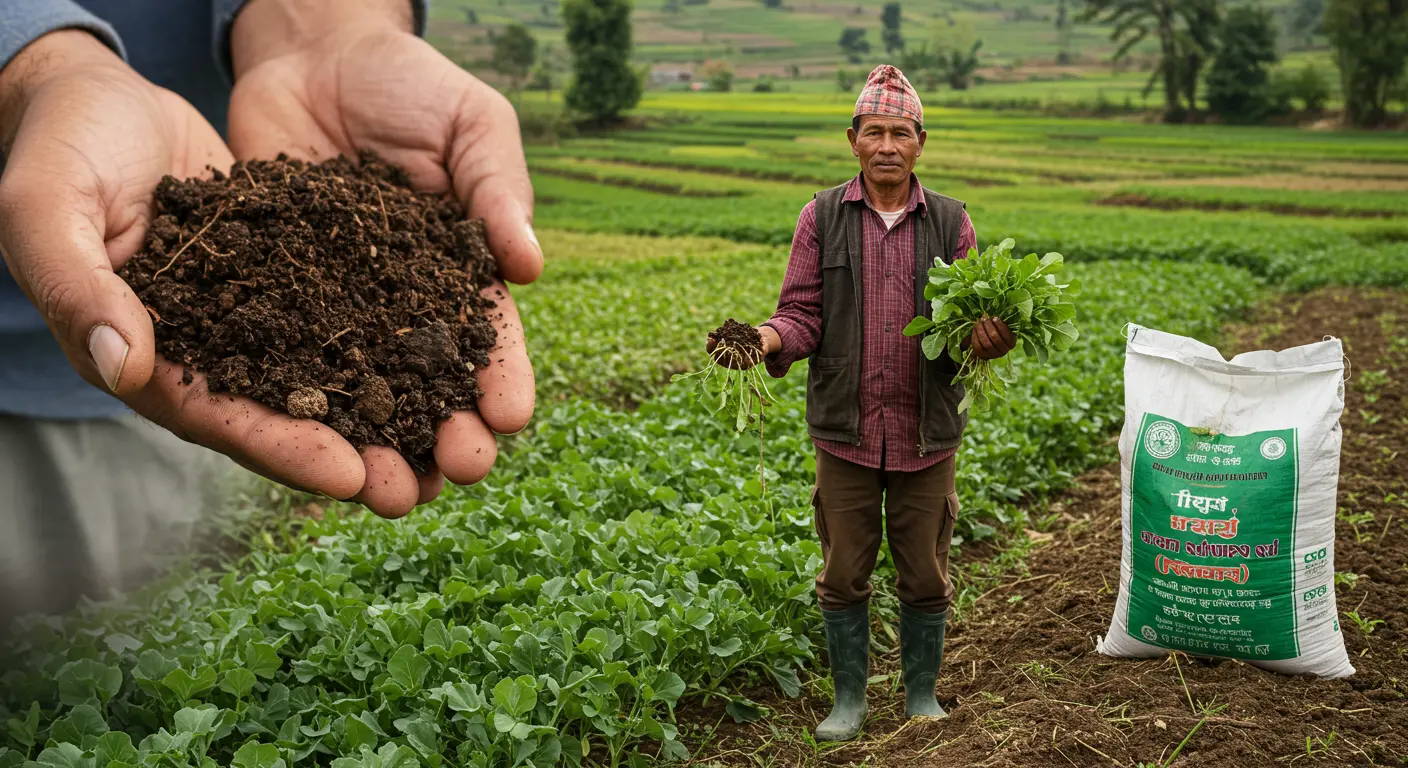
The primary symptom of this debt is the degradation of Soil Organic Matter (SOM). SOM is the living component of soil, the dark, rich humus that acts as the soil’s engine. It retains water, binds nutrients, and provides a habitat for the microbiome that makes those nutrients available to plants. Decades of tilling and chemical application have oxidized and destroyed this carbon-based asset. According to studies by the Nepal Agricultural Research Council (NARC), soils in many parts of the Terai and mid-hills now have SOM levels below 1%, a critical threshold below which a soil ecosystem begins to collapse. This is akin to a company’s working capital dropping to near-zero; its ability to function crashes.
The economic impact is direct and severe. Degraded soil has a lower Cation Exchange Capacity (CEC), a measure of its ability to hold onto essential nutrients. Consequently, a larger and larger share of the expensive, imported fertilizer we apply simply leaches away into waterways, unused by the crop. Farmers are forced to apply more chemicals just to maintain the same yield, a classic case of diminishing returns. This has fueled a vicious cycle of dependency. In the fiscal year 2022/23, Nepal’s fertilizer import bill soared past NPR 30 billion, a significant drain on our already stressed foreign currency reserves. We are, in essence, exporting our wealth to pay for inputs that are becoming less effective each year because the underlying asset—the soil—is broken.
This crumbling foundation also magnifies our climate vulnerability. Healthy soil with high SOM acts like a sponge, absorbing and retaining vast amounts of water. Regenerative farms can hold up to 20 times more water than their conventional counterparts. In a country like Nepal, where agriculture is overwhelmingly rain-fed and subject to increasingly erratic monsoons, this is a critical resilience mechanism. When our soil is degraded, it loses this capacity. Heavy rains result in rapid runoff, causing topsoil erosion and downstream flooding. The devastating landslides in the hills and the flash floods in the Terai are not just climate events; they are symptoms of a national soil health crisis. Conversely, during dry spells, the same degraded soil cannot supply stored moisture to crops, leading to widespread drought-induced failure. The risk profile of Nepali agriculture is thus artificially inflated by poor soil management.
The Regenerative Mechanism: An Economic Engine, Not an Ideology
Understanding regenerative agriculture requires a mental model shift. It’s not about what we *add* to the soil, but what we *stop doing* to it. The core philosophy is to minimize disturbance and maximize biological activity, allowing the soil’s natural self-regulating systems to function. While there are dozens of practices, four principles form the economic core of the regenerative engine for Nepal.
First is the principle of minimal soil disturbance, primarily through no-till or reduced-till farming. Conventional ploughing, while culturally ingrained, is economically and ecologically destructive. It breaks up soil aggregates, severs fungal mycorrhizal networks (the soil’s nutrient-delivery infrastructure), and accelerates the oxidization of SOM. From an economic perspective, ploughing is a direct cost in fuel, labor, and machinery depreciation. Transitioning to no-till, where seeds are directly drilled into the residue of the previous crop, immediately slashes these operational expenditures. More strategically, it allows the soil structure to rebuild. This increases water infiltration, dramatically reducing erosion and runoff. For a farmer in the mid-hills, this means their precious topsoil stays on their terrace instead of washing into the river. For an investor, it means lower irrigation costs and a significantly reduced risk of crop failure during the monsoon’s increasingly frequent dry spells.
The second principle is keeping the soil covered, always. Bare soil is an anomaly in nature and is highly vulnerable. Cover cropping—planting crops like buckwheat, clover, or sunnhemp between main cash crop cycles—acts as a living mulch. This “green armor” protects the soil from the erosive power of rain and sun, suppresses weeds (reducing herbicide costs), and, most importantly, continuously feeds the soil microbiome with carbon via its roots. In the context of Nepal’s three distinct agro-ecological zones, this is highly adaptable. In the Terai, a fast-growing cover crop can protect the soil during the hot, dry season. In the hills, it can stabilize terraces between maize and millet seasons. The economic mechanism here is asset protection and enhancement. Instead of leaving the soil (the primary asset) exposed and depreciating for months, cover crops work to appreciate its value by building SOM.
Third is the mandate of increasing biodiversity, both above and below ground, through crop rotation and intercropping. Monoculture farming, the backbone of the Green Revolution, is efficient in the short term but creates fragility. It provides a feast for specific pests and depletes a narrow band of soil nutrients. Regenerative systems champion diversity. Planting legumes like lentils (daal) or beans alongside or in rotation with maize, for example, is not just about having a second crop to sell. The legumes are nitrogen-fixing powerhouses; symbiotic bacteria in their roots pull atmospheric nitrogen (which is free and abundant) and convert it into a plant-available form in the soil. This is a direct, biological substitute for synthetic urea fertilizer, an imported commodity whose price is dictated by geopolitical events in the Persian Gulf and Black Sea. By diversifying, a Nepali farmer is not just creating multiple income streams and breaking pest cycles; they are insourcing their a key input, thereby decoupling their profitability from volatile global supply chains.
Finally, the principle of integrating livestock closes the system’s nutrient loop. In the traditional Nepali model, livestock was always part of the farm. The Green Revolution model separated them, turning animal manure from a valuable resource into a waste problem. Regenerative agriculture reintegrates them strategically. Well-managed grazing stimulates plant growth, and the manure and urine return nutrients to the soil in a bio-available form. This transforms a cost center (waste management and fertilizer purchase) into a value-creating loop. For the millions of Nepali smallholders who already own a few goats, a cow, or buffalo, this isn’t a radical new technology; it’s a return to and optimization of a deeply embedded, resource-efficient model that was always more economically sound.
Monetizing Mero Mato: The Carbon Farming Opportunity
While reduced costs and increased resilience are powerful drivers, the most disruptive economic opportunity presented by regenerative agriculture is the ability to transform soil into a new, monetizable asset class: carbon. The concept, known as “carbon farming,” positions Nepali farmers to become key suppliers in the burgeoning global market for carbon offsets, a market projected to reach over $250 billion by 2030.
The science is straightforward. Through photosynthesis, plants draw carbon dioxide (CO2) from the atmosphere. In a conventional system, much of this carbon is released back into the atmosphere when the soil is ploughed or left bare. In a regenerative system, the principles of no-till, cover cropping, and biodiversity work in concert to pump more of this carbon deep into the soil, where it is stored in a stable form as Soil Organic Matter. The soil literally becomes a “carbon sink,” removing atmospheric CO2 for long periods. This process of sequestration is measurable, verifiable, and, crucially, valuable.
The business model works as follows: A farmer or, more likely, a cooperative of farmers, adopts a verified set of regenerative practices. An independent third-party entity uses a combination of soil sampling and remote sensing models to measure the baseline soil carbon level and then tracks the increase over time. This measured increase in sequestered carbon—one ton of CO2 equivalent stored in the soil—is certified as one carbon credit. These credits are then sold on voluntary carbon markets to corporations in Nepal or abroad (e.g., tech companies, airlines, banks) that need to offset their own unavoidable emissions to meet regulatory requirements or corporate social responsibility goals. The revenue from the sale flows back to the farmers, providing a completely new income stream derived from the same parcel of land.
This is not a distant theoretical concept; it is happening now. In neighboring India, companies are already aggregating thousands of smallholders for carbon farming projects, with credits being sold to global giants like Microsoft. For Nepal, this opportunity is even more profound. It has the potential to fundamentally alter the economics of smallholder farming. A conservative estimate suggests that a well-managed regenerative hectare in Nepal could sequester between 1 to 3 tons of CO2e per year. At a modest price of $20 per ton (prices on some exchanges are already much higher), this translates to an additional NPR 2,600 to NPR 7,800 per hectare annually. For a smallholder farmer with two hectares, this could represent a 15-20% increase in net income, earned simply for farming in a way that makes their land more productive and resilient anyway.
Nepal’s unique advantage lies in its social infrastructure. Our long-standing community forestry user groups and agricultural cooperatives provide the perfect institutional vehicles for aggregating tens of thousands of fragmented smallholders into a single, bankable carbon project. This solves the scale problem that often plagues such initiatives. By organizing at the cooperative level, farmers can collectively bear the costs of measurement, reporting, and verification (MRV) and have greater bargaining power when selling their credits. The government’s role is not to run these projects, but to create a streamlined, low-cost national framework for MRV and to legally clarify that the farmer who sequesters the carbon owns the resulting credit. Doing so would unleash a wave of private and cooperative-led investment in turning our “mato,” our soil, into a globally traded, high-value commodity.
The Strategic Outlook
The path forward for Nepal’s agriculture is at a clear inflection point. The choices made by policymakers and investors in the next 24-36 months will determine whether we slide further into dependency and fragility or embark on a trajectory of resilience and prosperity. Three distinct scenarios emerge.
Scenario 1: The Inertia Trajectory. In this scenario, the status quo prevails. The government, fearing the political backlash from farmers, maintains and even increases the subsidy on chemical fertilizers. Regenerative agriculture remains a niche topic, championed by a few NGOs and boutique exporters. Without a change in the core economic incentive structure, widespread adoption is impossible. We will see a continued decline in soil health, leading to stagnating yields despite rising input use. Our food import bill will continue to climb, and our agricultural sector’s vulnerability to climate shocks—droughts, floods, landslides—will intensify. This is the path of least resistance, and it leads to a slow-motion hollowing out of our rural economy and a permanent state of food insecurity.
Scenario 2: The Fragmented Private-Sector Push. In this future, the government remains largely passive, but private actors—agri-tech startups, premium food exporters, and international development partners—accelerate their efforts. We see the emergence of successful, vertically integrated “regenerative supply chains” for high-value crops like coffee, tea, and large cardamom. These pockets of excellence will prove the model works, delivering premium prices for farmers and creating resilient micro-economies. However, without enabling policy, these successes remain isolated islands. The vast majority of staple crop farmers (rice, maize, wheat) will be left behind, still trapped in the old subsidy model. The result is a two-tiered agricultural system: a small, prosperous, regenerative export sector and a large, struggling, conventional domestic sector. The national impact on food security and economic resilience remains marginal.
Scenario 3: The Strategic National Alignment. This is the most ambitious but most rewarding path. It begins with a courageous policy shift: the government announces a phased, five-year plan to transition from an NPK fertilizer subsidy to a “Soil Health Performance” payment. Instead of subsidizing an imported input, the government pays farmers directly for verified improvements in soil organic matter. This single move realigns the entire system. It creates a powerful financial incentive for farmers to adopt regenerative practices. Simultaneously, the state partners with private and cooperative entities to establish a low-cost, national standard for soil carbon verification, clarifying ownership rights and positioning “Made in Nepal” carbon credits on the global market. This policy clarity unleashes a flood of private investment into farmer training, soil testing technology, and the development of carbon aggregation platforms. This scenario triggers a nationwide revolution, boosting farmer income from both improved yields and carbon credits, dramatically reducing our import bill, and making our entire food system fundamentally more resilient to climate change. This is how Nepal becomes a world leader in regenerative agriculture.
The Hard Truth: The greatest obstacle to achieving this strategic alignment is not a lack of technology, scientific knowledge, or willing farmers. It is the political difficulty of dismantling the current fertilizer subsidy regime. This system functions as a powerful, albeit counterproductive, political tool. The transition requires a government that is willing to trade short-term populist appeal for long-term national strategic security. It demands leadership that can articulate a new vision—one where the government stops giving farmers a fish (a bag of subsidized urea) and instead helps them build a better fishing rod (healthy, regenerative soil). The revolution beneath our feet is ready to scale; it is waiting for a policy revolution from above to unlock it.