Key Takeaways
- The Airport Paradox: Nepal’s newest international airports, built with Chinese loans, are not symbols of progress but stark warnings. Their financial underperformance reveals a critical flaw in Nepal’s strategy: an inability to distinguish between infrastructure construction and viable economic asset creation, turning potential gateways into debt anchors.
- India’s New Leverage: Forget blockades and political meddling; India’s most potent strategic tool in Nepal is now its energy grid. As the primary, and soon to be indispensable, buyer of Nepal’s hydropower surplus, Delhi has woven a web of economic interdependence that offers a powerful counterweight to Beijing’s infrastructure diplomacy.
- The 2025 Fiscal Cliff: The November 2025 deadline is not about a summit or a project inauguration. It marks the projected end of grace periods on several major Chinese loans. This is when the abstract concept of “debt” becomes a concrete, recurring line item in the national budget, forcing a painful reckoning with the true cost of years of geopolitical indecision.
Introduction
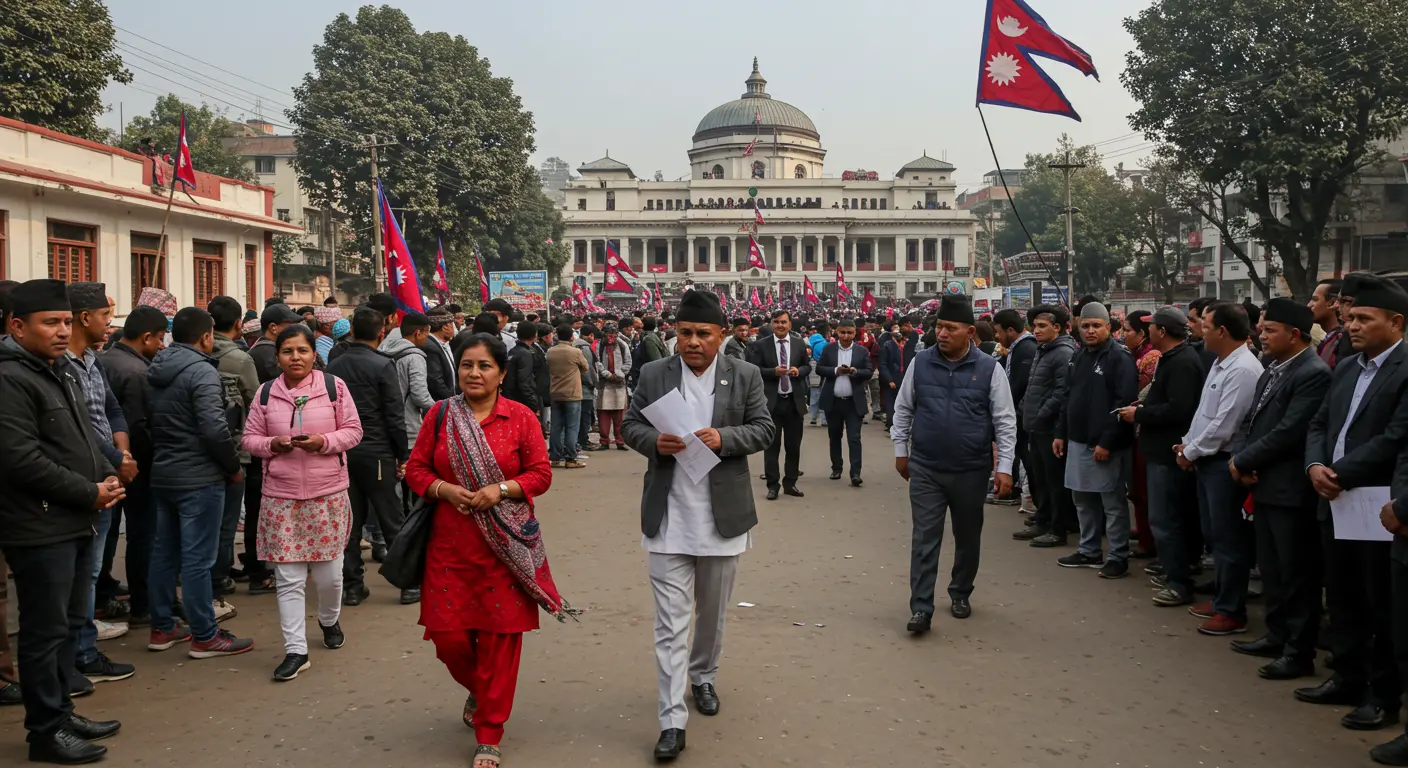
Nepal isn’t just Mount Everest; it’s the next critical flashpoint in the new Silk Road. Forget what you think you know about this seemingly quiet nation. We’re going to expose the high-stakes geopolitical game Nepal is playing, a game that could redefine South Asian power dynamics and global trade by November 2025. For decades, the world has viewed Nepal through a simplistic lens: a tranquil Himalayan buffer state, a land of Sherpas and spirituality, trapped geographically and economically between the Asian behemoths of India and China.
This perception is now dangerously obsolete. The landlocked nation has transformed from a passive buffer into an active, contested arena for the defining rivalry of the 21st century. The game is no longer about maintaining a delicate neutrality. It is about navigating a torrent of competing investment proposals, strategic overtures, and security concerns, each carrying the potential for unprecedented prosperity or catastrophic economic servitude. China’s Belt and Road Initiative (BRI) offers a tantalizing vision of escaping India’s gravitational pull with trans-Himalayan railways and highways. Simultaneously, the United States and India present an alternative path, paved with grants like the Millennium Challenge Corporation (MCC) and anchored in energy trade.
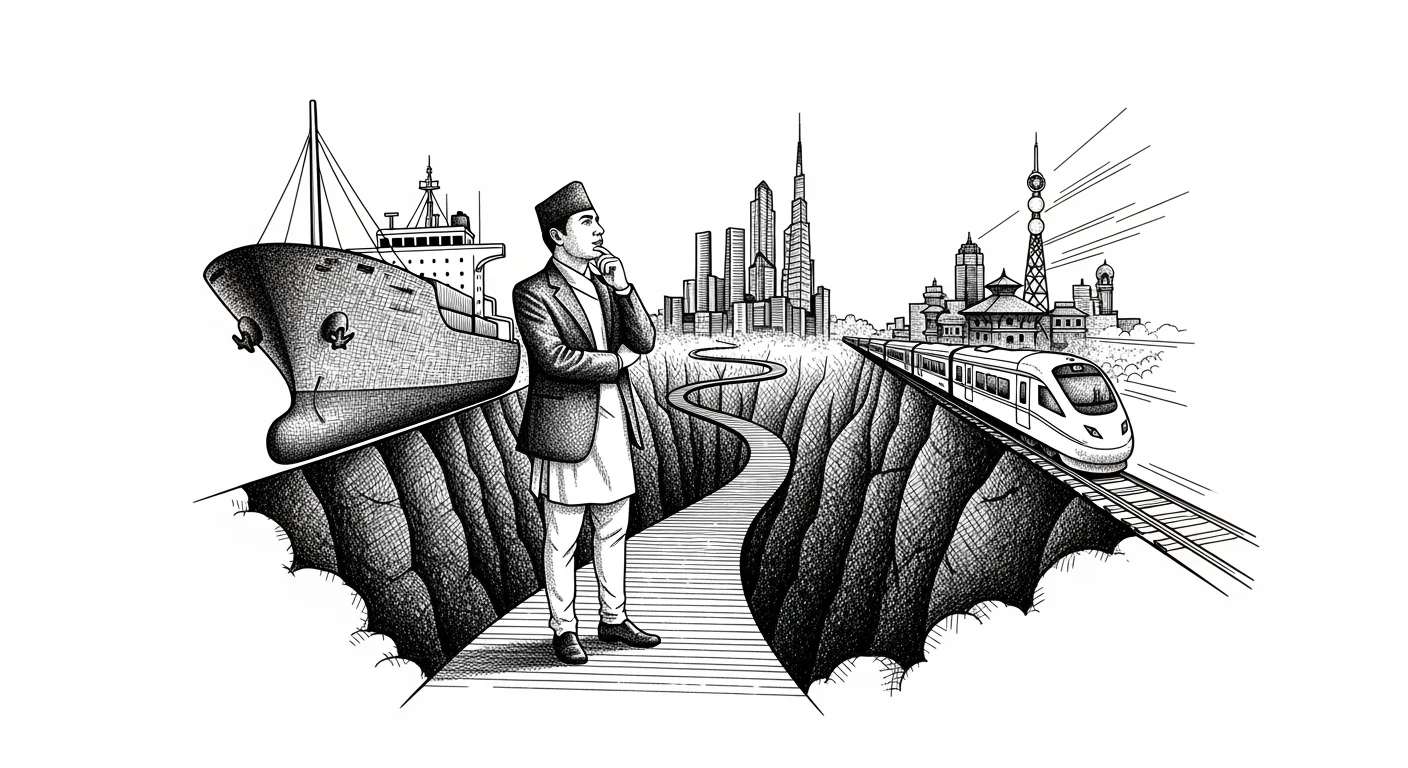
Caught in this crosscurrent, Nepal walks a geopolitical tightrope. Every decision on a port, a power line, or a railway is now an act of strategic alignment with profound consequences. For the CEOs, investors, and policymakers reading this, understanding this dynamic is not an academic exercise. It is the single most important variable determining market access, supply chain stability, and investment risk in Nepal and the broader South Asian region for the next decade. The clock is ticking towards a moment of truth, and the decisions made now will determine whether Nepal becomes a vibrant economic bridge or a cautionary tale of a nation crushed between two boulders.
The Dragon’s Gambit: Infrastructure Dreams and a Balance Sheet Nightmare
China’s proposition to Nepal, packaged under the ambitious Belt and Road Initiative (BRI), is revolutionary on paper: to surgically sever the country’s suffocating reliance on India for transit and trade. The centerpiece, the Trans-Himalayan Multi-Dimensional Connectivity Network, envisions a high-speed railway burrowing through the Himalayas to connect Kerung in Tibet to Kathmandu, and potentially onward to Pokhara and Lumbini. For a nation where logistics costs can account for up to 30% of a product’s final price due to dependence on the port of Kolkata, the promise is intoxicating. Direct access to Chinese ports could slash shipping times, diversify supply chains, and theoretically, recalibrate Nepal’s entire economic geography away from the south and towards the north.
This vision, however, collides with a brutal reality best illustrated not by a future railway, but by a present-day airport. The Pokhara International Airport, inaugurated in January 2023, stands as a pristine, $216 million monument to flawed strategic execution. Financed with a loan from China’s EXIM Bank, it was intended to be a bustling hub for tourism. Today, it operates no scheduled international flights. The reasons are a masterclass in the complexities of mega-projects. Airlines cite the airport’s high operational costs, a direct result of its construction price tag, making it commercially unviable. More critically, the project was pursued without securing the necessary bilateral air service agreements or robust market assessments, a catastrophic failure of planning. It’s a classic case of building the hardware without developing the software—the diplomatic, commercial, and regulatory frameworks—to make it functional.
This exposes the core of the “debt trap” narrative, which is often misunderstood. The danger is not that China will maliciously seize assets, as in the simplistic Sri Lankan Hambantota port story. The true trap is more subtle and far more likely in Nepal: the assumption of enormous sovereign debt for projects that fail to generate the revenue required to service that debt. The Pokhara loan is largely concessional, meaning it has a lower interest rate and a grace period. But it is not a grant. When the repayments begin, the Nepali state, not a Chinese bank, will bear the full weight of a non-performing asset. The same story is unfolding at the Gautam Buddha International Airport in Bhairahawa, another Chinese-built facility struggling to attract carriers. Nepal is not falling into a debt trap; it is meticulously constructing one for itself, project by project, by prioritizing the geopolitical “win” of a new project over the painstaking work of ensuring its economic viability.
The Elephant’s Embrace: From ‘Big Brother’ to Power Broker
While Beijing sells a future of northern connectivity, New Delhi is executing a potent and more immediate counter-strategy in the south, leveraging a resource more powerful than concrete: electrons. For years, India’s relationship with Nepal was defined by its overwhelming structural power—a shared open border, deep cultural ties, and a near-monopoly on trade and transit that could be weaponized, as seen during the 2015 blockade. This “big brother” dynamic often fostered resentment in Kathmandu. Today, that strategy has evolved from coercive leverage to collaborative interdependence, with the energy sector at its heart.
Nepal has a technically feasible hydropower potential of over 42,000 megawatts, a staggering figure for a country whose peak demand is less than 2,000 MW. India, its power-hungry neighbor, is projected to need an additional 450 gigawatts of capacity by 2030, much of it from renewable sources. This supply-demand equation has fundamentally altered the geoeconomic landscape. In mid-2023, the two nations signed a landmark agreement for India to import 10,000 MW of electricity from Nepal over the next ten years. This is not just a trade deal; it is a strategic anchor. For Nepal, it provides a guaranteed, high-value export market that can generate billions in revenue, stabilize its balance of payments, and fund further development. For India, it secures a clean energy source and, critically, ensures Nepal’s economic trajectory remains deeply intertwined with its own.
This energy nexus provides crucial context for the fierce political battle over the $500 million U.S. Millennium Challenge Corporation (MCC) compact. The MCC, a grant and not a loan, was primarily designed to build 315 kilometers of high-voltage transmission lines and upgrade key roads. While funded by the U.S., its strategic purpose was clear: to create the physical infrastructure necessary to facilitate large-scale electricity trade between Nepal and India. The years-long, toxic domestic debate over its ratification, fueled by disinformation that it was a veiled American military pact to counter China, perfectly encapsulated Nepal’s tightrope act. The resistance was a proxy battleground for pro-Beijing and pro-Delhi factions within Nepal’s political establishment. The ultimate ratification of the MCC signaled a pragmatic tilt towards the southern economic anchor, recognizing that while Chinese railways are a distant promise, Indian electricity payments are imminent revenue.
The Kathmandu Conundrum: When Domestic Politics Becomes a Foreign Policy Liability
The greatest risk to Nepal’s future is not the strategic design of Beijing, the reaction of New Delhi, or the influence of Washington. It is the volatile and fragmented nature of its own domestic politics. Nepal’s external vulnerabilities are a direct reflection of its internal fractures. The country’s political system is characterized by a perpetual cycle of unstable coalition governments, where Prime Ministers change with bewildering frequency. This constant churn creates a critical condition that investors fear most: policy discontinuity.
A government led by one coalition may sign a framework agreement for the BRI, initiating studies and signaling commitment to Beijing. A year later, a new government, dependent on partners with different ideological leanings or foreign allegiances, may deprioritize those projects, placing them under “further review” while pivoting to engage with MCC or Indian-backed initiatives. This stop-start approach to national strategy turns long-term infrastructure planning into a political football. The result is a landscape littered with half-started, delayed, or perpetually debated projects, each one accumulating costs and uncertainty. It paralyzes decision-making, as the bureaucracy becomes hesitant to implement any major project for fear that the next administration will reverse it.
This political instability moves beyond inconvenience to become a direct foreign policy liability. It allows external powers to exploit the divisions, cultivating relationships with individual parties and leaders rather than engaging with the state as a unified entity. A Chinese delegation can secure an audience and commitment from one leader, while an Indian envoy does the same with their rival. This prevents the emergence of a singular, coherent national interest. Prithvi Narayan Shah’s famous 250-year-old metaphor of Nepal as a “yam between two boulders” implied a strategy of delicate, unified neutrality. Today, the “yam” itself is fragmented, with different pieces pulling in different directions. For any significant business leader or investor, this internal political risk now outweighs almost any external or market risk. It means that contracts can be questioned, licenses can be revoked, and the entire regulatory environment can shift based not on economic logic, but on the latest backroom coalition deal in Kathmandu.
The Strategic Outlook
As Nepal progresses towards the November 2025 fiscal inflection point, when the bill for past indecisions begins to come due, the nation’s trajectory will likely follow one of three scenarios. Recommendations are futile in a climate of strategic paralysis; instead, business leaders must understand the potential futures and position themselves accordingly.
Scenario 1: Muddling Through (High Probability). Nepal continues its current path of strategic ambiguity. It will undertake a few small, symbolic BRI projects (like dry port upgrades) to appease Beijing, while primarily deepening its energy and trade relationship with India to maintain cash flow. Major transformative projects like the Kerung-Kathmandu railway will remain indefinitely stalled in the “feasibility study” phase. For businesses, this means a predictable but slow-growth environment. The economy remains tethered to India, electricity exports provide a stable but insufficient revenue stream to fuel a broader boom, and the rising cost of servicing debt on underperforming assets like the Pokhara airport will begin to strain public finances, potentially leading to higher taxes or reduced public investment elsewhere.
Scenario 2: The Northern Pivot (Low Probability). A future government, likely driven by a strong nationalist or left-leaning coalition, makes a decisive and rapid commitment to the trans-Himalayan railway and other major BRI projects. This would require taking on tens of billions of dollars in new sovereign debt from China. The immediate effect would be a construction-led economic boom. However, this would trigger an immediate and severe strategic backlash from New Delhi and Washington. We could expect India to use non-tariff barriers to limit access for Nepali goods and potentially slow down or introduce new complexities into its energy purchasing agreements, testing the very foundations of Nepal’s economic stability. This scenario represents a high-risk, high-stakes gamble that could either break Nepal’s chains or bankrupt it.
Scenario 3: The Southern Anchor (Medium Probability). Nepal formally or informally shelves large-scale BRI ambitions, focusing exclusively on maximizing its geoeconomic position relative to India. This would involve fast-tracking all projects related to hydropower generation and transmission, improving road and rail connectivity to the south, and aggressively pursuing deeper integration into Indian value chains. The result would be steadier, more predictable growth and a more stable fiscal position. It would, however, mean sacrificing the long-term vision of becoming a true trade bridge and accepting a future as a specialized satellite economy to India.
The Hard Truth: The entire debate framing Nepal’s choice as one between India and China is a dangerous simplification. The real, underlying crisis is institutional. Nepal lacks a powerful, politically insulated, and technically competent national planning or investment board capable of assessing mega-projects on their economic, financial, and engineering merits alone. Until such an institution exists—one that can greenlight or reject a project regardless of whether the funding comes from Beijing, Washington, or New Delhi, and ensure its continuity across election cycles—every opportunity will carry the seed of failure. Without fixing this internal mechanism, Nepal’s Silk Road ambition will remain just that: an ambition, navigated on a tightrope, with a very long way to fall.