Key Takeaways
- The most impactful agri-startups are not consumer-facing brands but invisible B2B platforms fixing deep-seated market failures in procurement, logistics, and information asymmetry, creating value long before produce reaches a retail shelf.
- Venture capital’s ‘growth-at-all-costs’ model is often a poor fit for Nepal’s agri-tech sector, which requires ‘patient capital’ focused on sustainable unit economics and resilience to physical-world shocks like weather and infrastructure gaps.
- The single biggest non-capital bottleneck is the absence of a modern, easily enforceable legal framework for contract farming. This prevents startups from de-risking production for farmers and securing scalable, bankable offtake agreements.
Introduction
What if the future of food security in Nepal wasn’t in traditional farming, but in the hands of young, tech-savvy entrepreneurs? This isn’t a hypothetical question. It’s the central economic drama unfolding across the country, from the fertile plains of the Terai to the terraced hills surrounding the Kathmandu Valley. For decades, Nepal’s agricultural narrative has been a paradox: an agrarian nation with over 60% of its population in farming, yet increasingly dependent on food imports, which surpassed NPR 300 billion last fiscal year. The conventional model of fragmented landholdings, multi-layered intermediaries, and chronic information gaps has created a low-equilibrium trap, yielding subsistence, not surplus.
Now, we are uncovering how a new wave of agri-startups is revolutionizing the industry, turning these very challenges into their core business model and feeding a nation in innovative ways. This new cadre of entrepreneurs, often armed with MBAs, engineering degrees, and a digital-native mindset, are not just introducing new farming techniques. They are re-engineering the entire value chain. They are building platforms, not just farms. They are arbitraging information, not just produce. A spotlight is cast upon this burgeoning agri-startup scene, exploring the journey of these entrepreneurial ventures from initial concept to tangible impact on food security. This article does not report on their existence; it analyzes the economic mechanisms they exploit, the structural barriers they face, and the strategic implications for investors, policymakers, and the future of Nepal’s economy.
Beyond the Plough: Deconstructing Nepal’s Agri-Puzzle
To understand the genius of these new ventures, one must first diagnose the disease they are treating. Nepal’s agricultural sector is not failing simply due to a lack of tractors or fertilizer; it is plagued by profound market failures. The two most critical are crippling information asymmetry and extreme market fragmentation. These are not academic terms; they are the daily, costly reality for millions of Nepali farmers. Information asymmetry means the farmer in Dhading growing tomatoes has no real-time data on the wholesale price in the Kalimati market, nor the demand from hotel chains in Pokhara. He sells to the first local collector, who sells to another, and so on—with each layer adding a margin and opacity. The final price paid by consumers bears little relation to the pittance received by the grower.
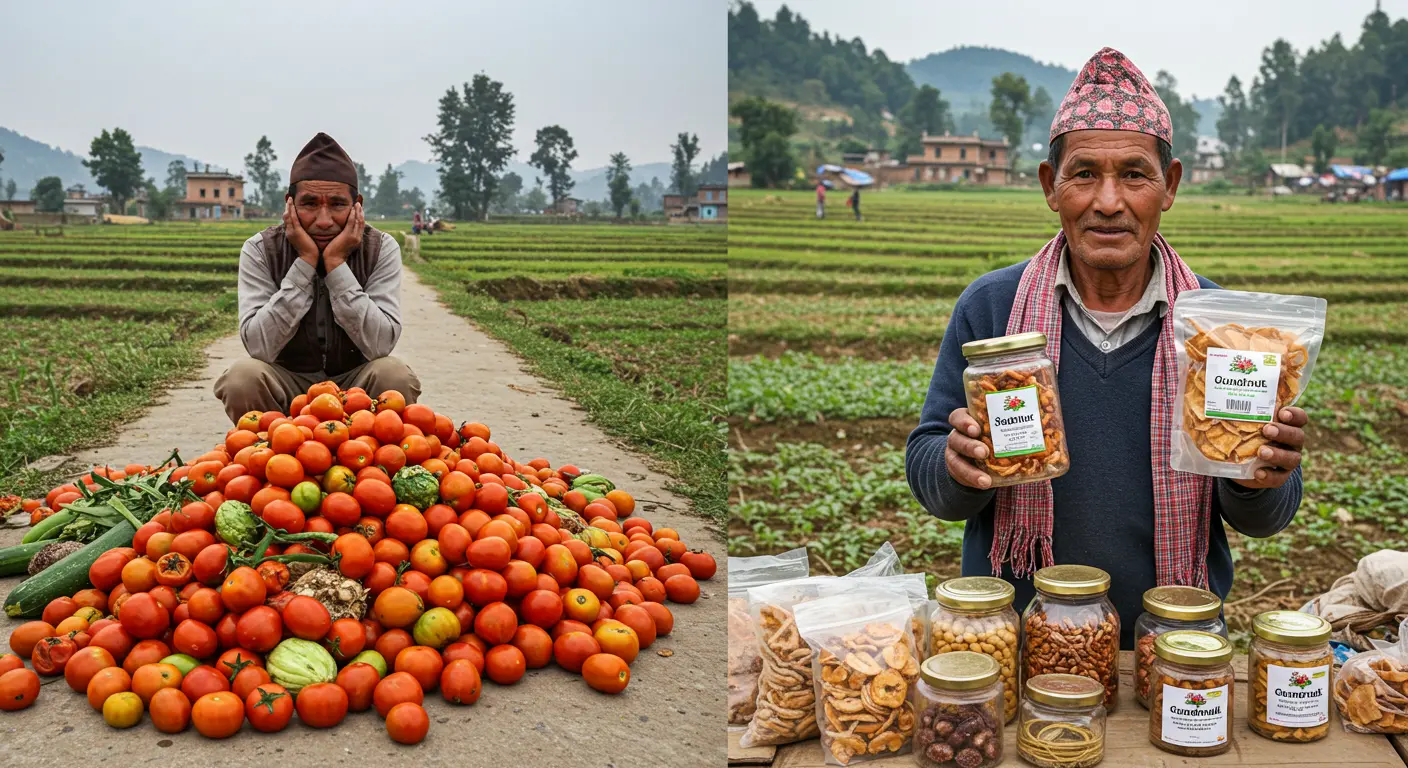
Market fragmentation is the physical manifestation of this data chaos. With average landholdings under one hectare, no single farmer can produce the volume or consistent quality required by a large buyer like a supermarket chain or a food processing company. The cost of collecting produce from hundreds of tiny, geographically dispersed farms—what economists call ‘transaction costs’—is prohibitively high for large, organized players. This vacuum is filled by informal, inefficient middlemen. The result is a system that perversely incentivizes low-risk, low-yield subsistence crops and guarantees post-harvest losses as high as 40% for certain perishables. Farmers are trapped, unable to access credit because they cannot guarantee sales, and buyers are frustrated, unable to secure consistent, quality supply.
This is the landscape where agri-startups are building their empires. They understood that the most valuable commodity in Nepali agriculture isn’t the potato or the lentil; it’s verifiable, actionable data. Ventures like Upaya City Cargo or newer, more specialized platforms are not primarily logistics companies or farms. They are tech-enabled aggregators. Their core product is coordination. By using simple mobile technology—from sophisticated apps to basic SMS queries—they can aggregate demand from dozens of urban businesses (B2B) and then push that demand signal out to a network of hundreds of farmers. They solve the transaction cost problem. For the first time, a hotel in Sauraha can place a single order for 200 kg of graded tomatoes, 100 kg of cucumbers, and 50 kg of bell peppers, and have it fulfilled by a coordinated network of 30 farmers whose harvests are aggregated, sorted, and delivered. The startup’s profit is not just a trading margin; it’s a fee for creating an efficient market where one did not exist.
The New Agri-Playbook: From Production to Platform
The strategic brilliance of Nepal’s emerging agri-tech leaders lies in their deliberate rejection of capital-intensive, asset-heavy models. While a previous generation might have sought a large government grant to build a massive cold storage facility, the new generation builds an ‘asset-light’ platform that optimizes the use of existing, underutilized cold storage capacity. This is the crucial pivot from production to platform, a business model that prioritizes agility and scalability over physical ownership. This approach is fundamentally more resilient in a capital-scarce environment like Nepal.
Consider the contrast. The traditional model involves owning land, hiring labor, and selling produce. It’s linear and scales with massive capital expenditure. The platform model, however, is a network. A startup like DV Excellus’ “Kheti” doesn’t own the farms; it partners with them. It doesn’t own a fleet of trucks; it partners with independent logistics providers. Its primary assets are its technology, its database of farmers and buyers, its quality control protocols, and its brand trust. This creates a powerful flywheel effect: every new farmer on the platform makes it more valuable to buyers, and every new buyer makes it more valuable to farmers. This is the network effect, a concept borrowed from Silicon Valley, applied to the terraced farms of Nepal.
Their focus is ruthlessly on unit economics. For a B2B platform, the key metric is not the number of app downloads, but the net margin per kilogram of produce transacted. This requires a granular understanding of the entire chain: the optimal price point to incentivize a farmer to grow a specific crop, the most efficient aggregation route, the cost of quality control and rejection, and the final price a corporate buyer is willing to pay for reliability. Successful startups are those that can manage this complex equation to ensure that the farmer gets a better price than the local middleman can offer, the buyer gets a better or more reliable product than they could source themselves, and the platform retains a healthy margin. This focus on B2B is a critical insight; while consumer-facing “farm-to-table” models are popular, the real, scalable money is in fixing the deeply broken backend supply chains for hotels, restaurants, and institutions (the HORECA sector).
This model is also transformative in how it manages risk. By aggregating demand, the startup can provide farmers with a quasi-guarantee of offtake for higher-value crops, encouraging them to shift from growing rice for subsistence to growing zucchini for the Kathmandu market. Some startups are introducing soil testing as a service, using data to advise farmers on optimal inputs, thus de-risking the production cycle itself. They are, in effect, becoming outsourced chief operating officers for hundreds of small-farm CEOs, providing them with market intelligence, operational guidance, and a guaranteed sales channel.
Navigating the Terai to the Cloud: Policy, Capital, and Digital Rails
The current agri-startup boom did not emerge from a vacuum. It is built upon two foundational ‘rails’ that have matured over the last decade. The first is Nepal’s surprisingly deep digital penetration. With mobile phone saturation exceeding 130% and rapidly growing smartphone adoption, the channel for a tech-based solution now reaches almost every potential farmer. The concurrent rise of digital payment platforms like eSewa and Khalti provides the second rail: a low-cost, reliable mechanism for financial transactions, bypassing the cumbersome and often inaccessible formal banking system for small-value, high-frequency payments to farmers.
The second enabler is human capital. A wave of Nepalis, educated or having worked abroad in markets like India, Europe, or the US, has returned with exposure to modern business models. They combine this global perspective with a deep understanding of local context, resulting in solutions that are technologically informed but practically grounded. They are not trying to copy a Bangalore or Shanghai model wholesale; they are adapting it to the unique constraints of Nepali topography and market structure.
However, these enablers are running up against formidable structural barriers. The most significant is not a lack of entrepreneurs or technology, but a deficit in enabling public policy. The glaring hole is the absence of a modern, streamlined, and legally enforceable Contract Farming Act. While some frameworks exist, they are often vague and lack teeth. For an agri-startup, a contract to offtake a farmer’s entire harvest of high-value broccoli is its most valuable asset. But if that contract is not easily enforceable in a court of law, it is nearly worthless as collateral for a bank loan. This single piece of missing legislation prevents startups from scaling their commitments to farmers, which in turn caps their ability to guarantee supply to large buyers. A robust law would transform the risk profile of the entire sector overnight, unlocking formal credit for both the startup and the farmer.
The nature of capital is another major hurdle. The standard venture capital model, which seeks 10x returns in 5-7 years through hyper-growth, is a dangerous mismatch for agriculture. Agri-tech is subject to real-world frictions—monsoons, landslides, fuel shortages, and crop diseases. Growth is often lumpy and seasonal, not exponential and smooth. The sector desperately needs ‘patient capital’ from investors who understand agriculture’s cycles and prioritize building a resilient, profitable business over chasing unsustainable growth metrics. Impact funds and dedicated Nepali private equity firms are beginning to fill this gap, but the flow of capital remains a trickle, not a flood. A lesson can be drawn from India, where government-backed funds-of-funds specifically for agri-tech helped de-risk early-stage private investment and signal the sector’s strategic importance.
The Strategic Outlook
Looking ahead, Nepal’s agri-startup ecosystem stands at a strategic inflection point. The path forward will be determined by the interplay between entrepreneurial dynamism and policy evolution. Two distinct scenarios emerge for the next five years.
The first is the ‘Boutique Scenario.’ In this future, the policy environment remains largely static. Startups, unable to secure the legal frameworks or the patient capital needed for massive scale, will flourish in high-margin, defensible niches. We will see highly successful companies providing organic vegetables to Kathmandu’s expatriate community and high-end hotels, exporting specialty teas and coffees, and supplying gourmet mushrooms to premium restaurants. These businesses will be profitable and inspirational, but their macroeconomic impact on national food security and agricultural trade balance will be marginal. They will prove the model’s viability but remain islands of efficiency in an ocean of traditional practice.
The second, more hopeful path is the ‘Systemic Scenario.’ This future is contingent on targeted government action. If the forthcoming budget session sees the introduction and passage of a robust, SME-friendly Contract Farming Act, it would act as a powerful catalyst. If Nepal Rastra Bank, in turn, creates a special refinancing facility for loans made against these contracts, it would unlock a torrent of formal credit. And if the Investment Board of Nepal partners with the private sector to create a co-investment fund for building out a national cold chain, startups could finally solve the post-harvest loss problem at scale. In this scenario, today’s startups could evolve from serving dozens of hotels to serving entire cities. They would integrate backward into providing inputs and finance, and forward into food processing, fundamentally reshaping the agricultural economy and making a material dent in food imports.
The Hard Truth: Technology is a powerful accelerant, but it cannot create the road on which to travel. The hard truth for Nepal is that these brilliant, driven entrepreneurs are essentially building sophisticated software to run on outdated hardware. The “hardware” is the nation’s physical infrastructure (roads, reliable electricity, cold storage) and its legal infrastructure (laws governing contracts, land, and food safety). While startups can create clever workarounds, they cannot single-handedly pave the highway or rewrite the commercial code. The ultimate success of this new agricultural revolution will not depend on the entrepreneurs alone. It will depend on a strategic partnership where innovators build the engines of growth, and the state finally commits to building the tracks on which they can run.