Navigating Nepal’s Red Ocean for SMEs
The term “red ocean” describes a market environment saturated with competitors offering similar products or services. In such an environment, competition for customers becomes intense, often resulting in price wars, which inevitably leads to reduced profits and makes survival difficult, especially for small and medium enterprises (SMEs). In Nepal, this situation is exacerbated by the tendency for businesses to concentrate in established and seemingly profitable sectors such as tourism, retail, and agriculture.1This leads to further market saturation and increased competitive pressure.
One of the major challenges for Nepalese SMEs in this “red ocean” is the rapid imitation of their successful ideas by larger, resource-rich players. Once a small business identifies a promising direction or offers an innovative product, larger companies can quickly replicate the idea, robbing the SME of its initial advantage and making it difficult to get a fair return on its investment. This challenge creates significant barriers to innovation, as SMEs may be wary of investing in new ideas unless they see ways to protect their unique offerings. Thus, the “red ocean” in Nepal is characterized not only by multiple competitors, but also by the high vulnerability of SME innovations to rapid imitation. This makes developing sustainable, hard-to-copy differentiation strategies not just desirable, but critical to survival and prosperity.
The purpose of this article is to provide Nepali SMEs with practical, locally adapted strategies for differentiation and niche discovery. These strategies are designed to help them not only survive in a highly competitive environment but also find opportunities for growth and development. Differentiation can help create a “blue ocean” – a new, unrivaled market space – or at least make the SME a much stronger and more visible player in an existing “red ocean”. The focus will be on approaches to differentiation that are inherently difficult to replicate quickly, such as deep customer relationships, a unique service culture, or highly specialized local market knowledge.
Nepal’s Competitive Arena: Understanding Local Dynamics
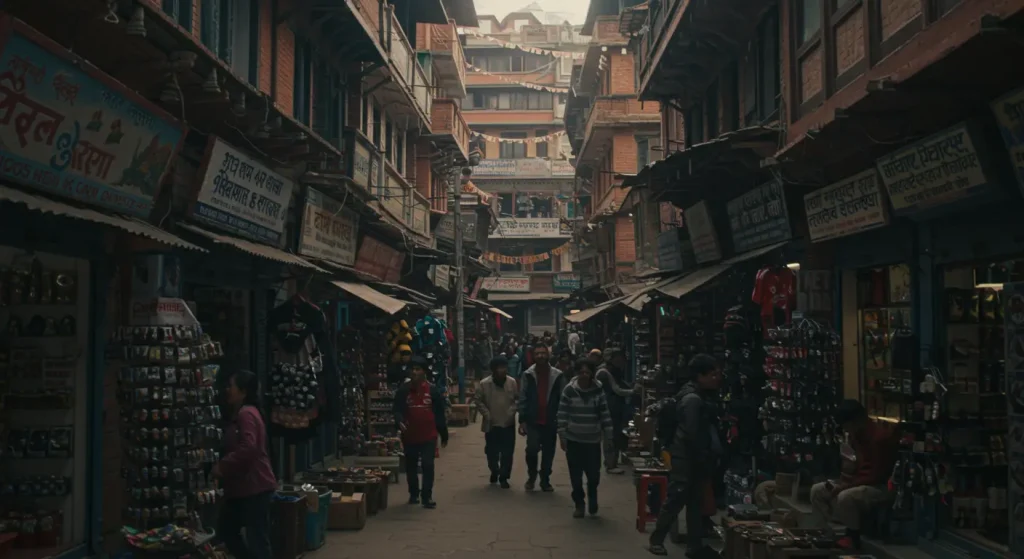
Competitive markets in Nepal have a number of unique features. SMEs are active in key sectors such as tourism, retail, agriculture and services.1However, their activities are often complicated by problems common to the country: limited infrastructure, including difficult road conditions and the inaccessibility of some regions.3, as well as potential corruption.3These factors create special “rules of the game” in Nepal’s “red ocean,” creating both obstacles and, perhaps, unexpected opportunities for those who can adapt to them.
Cultural Context: The Invisible Hand in Nepalese Business
Nepal’s cultural characteristics play a huge role in doing business and can be the key to successful differentiation for SMEs.
- Relationships and Trust: Doing business in Nepal is deeply based on personal relationships and trust.5Trust is built not so much through formal contracts but through long-term personal communication and interaction. As noted, “business negotiations in Nepal are often relationship-oriented… Establishing a personal connection and trust is often a prerequisite for successful business transactions.”6SMEs, being more flexible and often more closely connected to the local community, have an advantage in building such deep and lasting connections. This “relational” advantage can be a powerful and difficult to replicate differentiator, especially when compared to larger, more formal and impersonal companies that may rely on purely transactional, pricing strategies. “Relationship capital” becomes a key defensive asset.
- Hierarchy and respect: Nepalese society is characterized by a pronounced hierarchical nature, which is also reflected in the business environment.6Decisions are often made at the highest level6, and respect for those senior in age or position is a non-negotiable rule. This affects both internal management in companies and interactions with partners and clients. SMEs must be able to navigate these hierarchical structures, building relationships with key decision makers. At the same time, if large organizations become too bureaucratic and slow due to their hierarchy, SMEs can gain an advantage by providing faster and more personalized service through well-trained and appropriately (within cultural norms) empowered staff. The key here is to find a balance between empowering employees and respecting hierarchy.
- Communication styles: In Nepal, an indirect, polite style of communication prevails.5Direct confrontation is avoided in order to maintain harmony and “face”. Non-verbal cues such as body language, facial expression and tone of voice are of great importance.6For example, shaking your head from side to side can mean “yes.”10The ability to “read between the lines” and understand customers’ unspoken needs is becoming a vital skill. SMEs whose employees master this art of empathic listening and interpreting subtle signals can tailor their offerings more effectively than competitors who rely solely on explicit data.
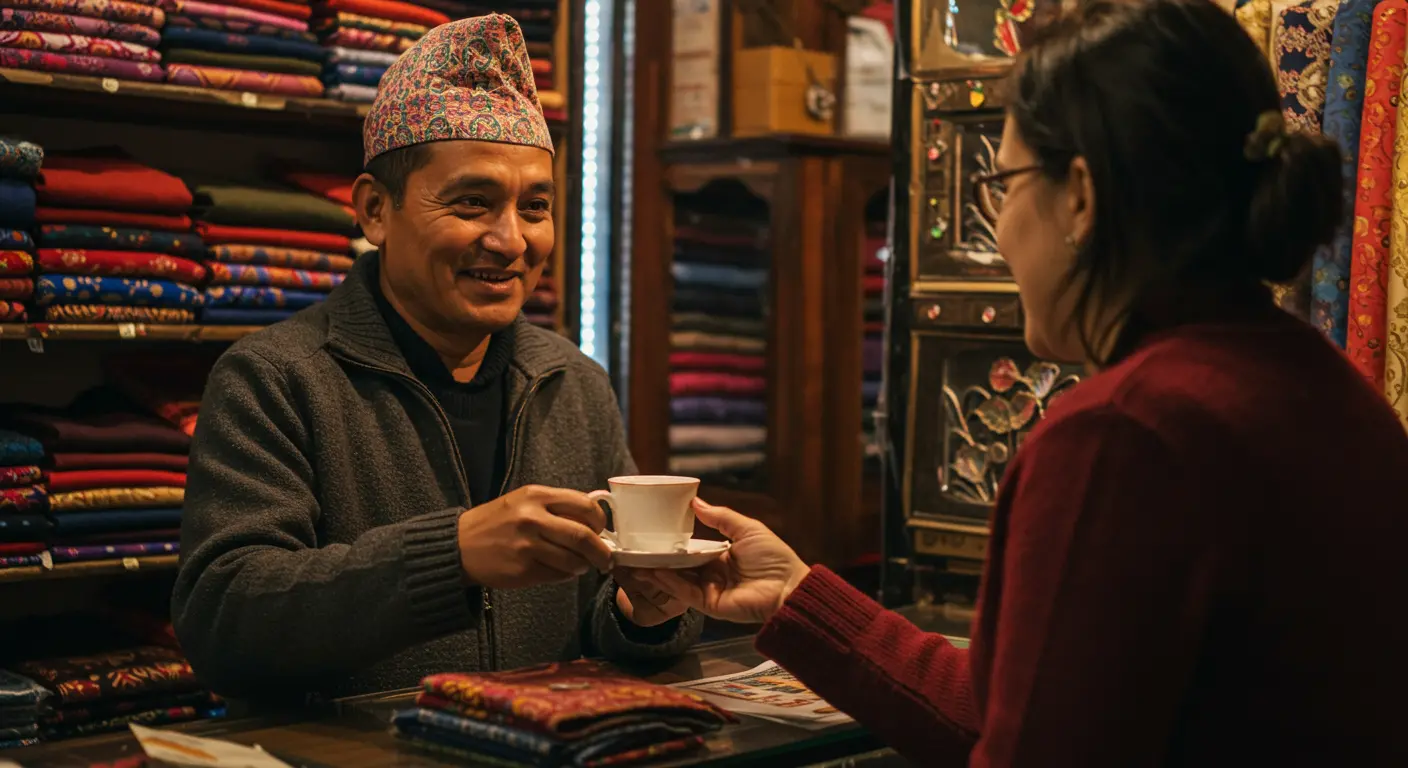
- Hospitality: Showing hospitality, such as offering tea to guests, is a standard practice and a sign of respect that helps build relationships.6
Understanding consumer behavior
Nepalese consumers consider many factors when making purchasing decisions. While price is certainly important, as evidenced by the price competitiveness issues of major retailers such as Bhat-Bhateni11, no less important role is played by the quality of the product, the level of service, convenience and trust in the seller.13Research shows that reasonable price, timely delivery, product quality and return policy have a positive impact on customer satisfaction in Nepal.11Shoppers at Bhat-Bhateni supermarket, for example, appreciate the wide range of products, prices and quality, as well as the cleanliness and friendly atmosphere.13
There has been a rise in the popularity of online shopping, especially in urban centres such as the Kathmandu Valley.11This is being driven by the falling cost of technology products, the availability of internet services, convenient payment methods and interactive shopping apps. However, traditional markets still play an important role, indicating the hybrid nature of the consumer base. This means that SMEs need to consider both online and offline channels of customer interaction.
Differentiation Strategies: How to Stand Out When Everyone Looks the Same

In a “red ocean” where competitors offer similar products and services and big players quickly copy successful ideas, SMEs in Nepal must find unique ways to stand out. Differentiation is not just about offering something different, but about creating tangible value for the customer that is difficult or unprofitable to imitate.
A. Using the “Nepali Style” of Customer Focus: More Than Just a Transaction
One of the most powerful and difficult to replicate strategies for Nepalese SMEs is building deep, trusting relationships with customers based on cultural values.
Building deep trust and loyalty:
Trust in Nepal is cultivated through consistency, reliability and demonstrating genuine concern for the client.6The traditional greeting “Namaste” means “in you I greet God”14, is not just a formality, but an expression of deep respect that can set the tone for the entire interaction.15When SMEs genuinely integrate this spirit of respect and care into their service culture, it creates an emotional connection that is difficult for larger, more standardized companies to replicate. This genuine customer focus, rooted in cultural values, becomes a unique customer experience and a powerful competitive advantage.
Personalization as a key force:
SMEs can succeed by offering highly personalized products and services. An example is Above the Himalaya Trekking, a travel company that offers “tailor-made treks designed for each client” and “a customized itinerary that will suit your needs.”16They claim to know “the lodge owners, their rooms and their menus,” allowing them to create a unique experience for each guest. Another example is Dwarika’s, which focuses on the holistic well-being of its guests, creating a “sanctuary for those seeking harmony” and using “local materials and traditional craftsmanship.”17SMEs can achieve this level of personalization by remembering customer preferences, offering personalized advice, and being flexible in their service. This creates the sense that the business truly cares about each customer as a unique individual, which is extremely difficult to replicate on a mass scale.
B. Uniqueness of Products and Services: Creating Distinctive Value

Unique value propositions:
- Local authenticity: SMEs can focus on products and services that reflect Nepal’s unique culture and traditions. This could include handicrafts created by local artisans, the use of traditional knowledge, or unique local ingredients and materials.19For example, small shops run by villagers offering authentic goods, or hand-woven clothes and pashmina shawls.
- Specialized knowledge or skills: Deep expertise in a specific area, such as Above the Himalaya Trekking in organizing treks16, can become the basis of a unique offer.
- A thoughtful combination of tradition and technology: The introduction of modern technologies must be careful not to compromise the authenticity that many consumers value.20Technology can improve the experience, for example through personalization or increased efficiency, but should not replace human warmth and traditional hospitality.
- Focus on quality and reliability: In markets where product quality can be variable, consistently offering high-quality goods and services can be a strong differentiator.11Ensuring reliable delivery and fulfillment of commitments, especially given the potential logistical challenges in Nepal4, also increases the value of the offer in the eyes of customers.
Q. Brand and Marketing Differentiation: Tell Your Unique Story

Storytelling that resonates with Nepalese values:
Creating a brand with a story linked to local community, tradition, authenticity or social responsibility can resonate with consumers. An example is Above the Himalaya Trekking’s positioning as an “environmentally and socially responsible tour operator.”16
Smart use of digital channels (balance online and offline):
Internet and social media penetration in Nepal is increasing, opening up new opportunities for SMEs. As of early 2024, Nepal had 15.40 million internet users, accounting for 49.6% of the total population.23 The number of active social media users has reached 13.50 million, or 43.5% of the population.23 Facebook remains the dominant platform with 13.50 million users, followed by Facebook Messenger (10.85 million users in ad reach) and Instagram (3.60 million users).23
Table 1: Key statistical figures for Nepal (early 2024)

SMEs can use messenger marketing to interact with customers: chatbots to answer routine queries, personalized newsletters with information about promotions, creating group chats based on interests and collecting feedback.[24, 25]
However, it is important to remember that a significant portion of the population (50.4%) still remains offline.[23] Therefore, a purely digital differentiation strategy is unlikely to be optimal for most Nepalese SMEs. A more effective approach would be a hybrid, “phygital” approach that combines the convenience of digital channels with tangible personal touches and traditional promotion methods such as word of mouth and participation in local events. Technology should be used to *enhance*, not replace, the personal interactions that are so valued in Nepalese culture.
Differentiation based on authentic local craftsmanship, knowledge or ingredients [16, 19] can be very powerful if effectively promoted. It appeals to the global trend towards uniqueness and support for local communities, creating a story that is difficult for large mass-market players to replicate.

Finding Your Niche: Thriving in Untapped or Underserved Markets
A niche strategy is a focus on a specific, well-defined market segment with unique needs or preferences that are not being adequately met by mainstream competitors. Rather than trying to be everything to everyone, an SME can become the best choice for a small but loyal group of customers.
Identifying missing segments and unmet needs in Nepal
SMEs should look for opportunities outside the obvious markets. These could include:
- Specific demographic groups: for example, older people, working mothers, certain youth subcultures.
- Clients with specialized interests: for example, tourists looking for off-the-beaten-path adventures, or consumers interested in organic and eco-friendly products.
- Geographic areas underserved by major players: Given Nepal’s diverse geography and varying levels of infrastructure development4, niche strategies targeting specific, perhaps remote, geographic areas or communities can be particularly viable. This requires deep local knowledge and tailored logistics, which can be challenging for larger companies targeting easily accessible urban centers.
- Eliminating the “pain points” of existing solutions: For example, if large supermarkets suffer from “overcrowding and long queues at the checkout”12, a niche player may offer a smoother, faster shopping experience, perhaps at a higher price.
Market Segmentation Strategies in Nepalese Context
Segmentation should not be limited to simple demographics. It is important to consider:
- Psychographics: lifestyle, values, interests.
- Behavioral segmentation: frequency of product use, loyalty level.
- Cultural understanding: Cultural Diversity of Nepal26suggests that niches may be defined not only by demographics or geography, but also by specific cultural or subcultural needs and preferences that may be overlooked by larger companies with their more uniform marketing campaigns. For example, a business specializing in the cuisine of a particular ethnic group or offering services tailored to the needs of a religious community during festivals.
Benefits of a Niche Strategy
- Reducing direct competition at the initial stage.
- Opportunity creating strong loyalty inside the niche.
- Potentially higher rate of profit, if the niche values a specialized offer.
- Niches are often less attractive for copying by major players due to the smaller market size, which makes them more defensible for SMEs.
Table 2: Comparison of approaches to differentiation and niche finding for Nepalese SMEs

Creating Protective Barriers: How to Make Your Success Hard to Copy

Even the best differentiation strategy or the most attractive niche can be vulnerable if competitors can easily copy your success. Therefore, SMEs in Nepal need to actively build defensive barriers.
The Power of a Strong, Trusted Brand
A brand is much more than just a logo or a name. It is the sum of all the experiences and perceptions that customers have when interacting with a company. In Nepal, where business is built on relationships and trust5, a strong brand based on a consistent positive experience becomes a powerful defense. Customers who are loyal to a brand they trust are less likely to switch to a competitor because of minor price or feature advantages. Such a brand, built on deep, genuine community integration and trust, becomes a kind of “reputational moat” that is much harder for larger, potentially less agile, or less locally rooted competitors to cross than a product- or price-based advantage.
Developing unique, difficult to replicate capabilities
- Deep Local Networks: Leveraging community connections and relationships that have been built over years is not available to outsiders or new major players.6These networks can provide access to resources, information, or clients.
- Specialized employee skills and service culture: Investing in staff training and developing a unique service culture that employees genuinely share and embody (e.g. the guides at Above the Himalaya)16or the responsiveness of the Bhat-Bhateni staff13), create a significant advantage. This is especially true in Nepal given the existing challenges in human resource management, such as low wages, shortage of skilled workers and their retention.26SMEs that can overcome these challenges, for example by creating a better working environment, offering meaningful work27, or by implementing profit sharing systems, gain a significant advantage. Their human capital becomes a key, difficult-to-copy asset.
- Unique operational processes: Developing highly efficient or customized service or manufacturing processes adapted to local conditions that are difficult for larger, more standardized companies to replicate.
- Own knowledge/technologies: Particularly relevant for craft businesses or businesses based on traditional skills.
Continuous Innovation and Adaptation: The Moving Target Strategy
No differentiation lasts forever. SMEs must continually evolve, improve their offerings and innovate to stay ahead. This means actively collecting customer feedback (e.g. via messaging apps)25), monitoring market trends and being flexible to adapt quickly. If large players copy one idea, SMEs should ideally already be moving on to the next innovation or improvement. For Nepalese SMEs, innovation must not only involve new products but also deepening relationships, improving services based on subtle local feedback, and adapting to subtle changes in the local socio-cultural or economic landscape. This makes them a “culturally flexible” moving target that is difficult for less nimble competitors to keep up with.
Overcoming Obstacles: Addressing SME Challenges in Nepal

Nepalese SMEs face a number of unique challenges that can make it difficult to pursue differentiation and niche strategies. However, understanding these issues and finding targeted solutions can turn them into sources of competitive advantage.
Talent Management and Retention Strategies in a Challenging HR Situation
The SME sector in Nepal faces significant challenges in the area of human resource management. These include low wages, lack of employment opportunities, mismatch between academic education and market needs, shortage of management talent, problems in retaining skilled employees, and brain drain.26For example, it is noted that “supply of competent and qualified human resources was the biggest challenge, especially at the management level”26, and hotel management graduates often lack sufficient management skills.27
Potential solutions for SMEs include:
- Investment in internal training and skills development: Creating a culture of a “learning organization” where continuous upskilling and talent development within the company becomes the norm can help bridge the gap between education and real business needs, turning a national weakness into a unique competitive advantage.
- Creating a positive and motivating work culture: Meaningful work may be a more important retention factor than material incentives.27
- Offering non-monetary benefits: Recognition of merit, training opportunities, flexible hours (where possible).
- Strengthening team cohesion and loyalty: Reflecting the collectivist aspects of Nepalese culture.31
Overcoming logistical challenges for reliable delivery
Logistics in Nepal presents significant challenges: difficult mountainous terrain, poor road conditions, traffic congestion in cities such as Kathmandu, high transportation costs and limited warehousing capacity.4For example, “in cities like Kathmandu, traffic congestion can be a major challenge for large delivery vehicles,” while “small trucks are ideal for maneuvering through narrow streets.”22
SMEs may find it more effective to use “hyperlocal” logistics solutions and collaborations rather than trying to replicate the centralized models of large companies. This includes:
- Strategic partnerships with local couriers or transport companies: Leveraging a network of local partners with deep knowledge of their local areas.4
- Route optimization and load management.4
- For e-commerce: Consideration of options for pick-up points or localized order fulfillment centers.
- Use of appropriate transport: For example, small trucks like the Tata Ace EV for urban conditions or the Tata Yodha for mixed terrain.22
A balance between traditional approaches and smart technology adoption
A hybrid model should be pursued, where technology supports and enhances personal service and efficiency, rather than replacing human connection where it is valued. The decision on which technologies to adopt and how to integrate them should be made in light of Nepal’s cultural preference for personal interaction.6
Examples of smart use of technology:
- CRM systems (even simple ones): to remember customer preferences and personalize service.
- Messengers: for effective communication, customer support and feedback collection.23
- Digital ordering systems in restaurants: to improve efficiency.21
- IoT (Internet of Things): for “smart” systems in the hotel business.21
The goal is to improve customer experience and operational efficiency without losing the “Nepali touch.” It is important to remember that technologies that depersonalize critical customer touchpoints can be detrimental, while technologies that empower staff to deliver better, more personalized service (“tech-enhanced human touch”) can be beneficial.20
Conclusion: Charting a Course to SME Success in Nepal
Competing in Nepal’s “red ocean” poses challenges for SMEs, especially when large players are quick to copy their successful ideas. However, analysis shows that Nepalese SMEs have unique opportunities to differentiate and carve out a niche by leveraging the country’s cultural characteristics and demonstrating strategic flexibility.
Key strategies for success include:
- Building deep customer focus based on Nepalese culture: Genuine respect, personal connections and trust can create loyalty that is difficult to buy or copy.
- Creating unique value propositions: Emphasis on authenticity, local flavor, quality and reliability.
- Thoughtful branding and marketing: Telling a unique story that resonates with local values and a smart mix of digital and traditional channels.
- Finding and developing niches: Focusing on underserved market segments, whether geographic, demographic or cultural niches.
- Creating protected competitive advantages: Strong brand, unique team skills, strong local networks and difficult to replicate processes.
- Continuous adaptation and innovation: Continuous development and readiness to change in response to market challenges.
Despite existing challenges such as personnel and logistical difficulties, Nepal’s unique cultural strengths and entrepreneurial spirit create fertile ground for SMEs that are willing to be strategic, adaptable, and put the customer at the center of their business. The ultimate and most defensible strategy for Nepalese SMEs in the “red ocean” is to truly embody and operationalize key Nepalese cultural values – respect, the importance of relationships, community focus – in a way that creates a superior, personalized customer experience. It is this cultural immersion and authenticity that makes it nearly impossible for larger, less culturally attuned players to replicate.
SMEs in Nepal are called upon to take a close look at their unique strengths and the specific needs of their communities to find their own path to prosperity, even in the most competitive waters.
[elementor-template id=”1573″]
Source used
- Economy of Nepal: Agriculture, Energy, Tourism
- General Statistics: Basic Information about Nepal – Nomad’s Land
- Reasons that hinder the development of small business
- Top 5 Nepal cargo challenges and Our Solutions
- A Guide to Business Etiquette in Nepal | ClickUp™
- Cultural Considerations in Nepal – Rivermate
- Caste – Wikipedia
- Embracing Nepali Culture and Basic Etiquette – Asian Heritage Treks & Expeditions
- History of Nepal – Wikipedia
- Nepal’s Cultural Do’s and Don’ts – Natural Habitat Adventures
- A Study on Customer Satisfaction towards Online Shopping in Nepal – ResearchGate
- SWOT Analysis of Bhatbhateni Explained in 2025:Key Insights – IIDE
- NPRC Journal of Multidisciplinary Research Exploring Consumer Satisfaction and Service Quality at Bhatbhateni Supermarket
- Nepali Phrasebook – WordPress.com
- Namaste – Wikipedia
- Why Travel With Us | The Best Travel Company for …
- Review: The Dwarika’s Resort In Dhulikhel, Nepal – Luxury Travel Diary
- The Dwarika’s Hotel – Kathmandu – Skyscanner
- Kathmandu Shopping Delights – Must Have Products and Top Shopping Destinations
- Blending digital and physical experiences in luxury wine hospitality: an experiential approach to technology integration | Emerald Insight
- Digital Transformation in Hospitality: Strategies and Trends – Number Analytics
- The Role of Small Cargo Trucks in E-commerce and Last-Mile Delivery – Tata Motors Nepal
- Digital 2024: Nepal — DataReportal – Global Digital Insights
- Six ways to use instant messengers in business – Cossa.ru
- What is Messenger Marketing and Why Does Business Need It – Pact
- View of Human Resource Management Challenges in the Hospitality Industry: Insights from Nepal
- Employee Retention Practices in Hospitality Industry in Nepal: Investigating the Moderating Effect of Management Hierarchy, Age Group and Gender | Request PDF – ResearchGate
- Mysterious Nepal – Moskovskaya Street
- Nepal: Addressing the Employment Challenge through the Sectoral Pattern of Growth – International Labour Organization
- The Nepal Administrative Staff College – Its Challenging Origin and Future Demands
- Hofstede’s Cultural Dimensions – Think Insights
- Hofstede’s Cultural Dimensions Theory | Cambridge Marketing College