
Nepal’s Digital Rise – Smart Innovation in a Unique Journey
Nepal, home to the majestic Himalayas, is increasingly making a name for itself on the world stage not only as a tourism gem but also as a nation determined to navigate its way into the global digital economy.1The pursuit of socio-economic transformation through digitalization is becoming one of the key vectors of the country’s development. In a global context, artificial intelligence (AI) and automation are fundamentally changing industries around the world, but the paths to their implementation vary significantly.
In this landscape, Nepalese companies are showing a distinctive approach. They are not simply copying global trends, but innovating “Nepali style” – pragmatically adapting AI and automation to achieve measurable growth. The central question this article explores is how they do this, and, crucially, how they avoid the large and costly mistakes that often plague global corporations on their digital transformation journeys. One potential success factor may be “latecomer advantage.”4, allowing Nepal to skip over outdated technologies and immediately implement more modern solutions.
Notably, the concept of “digital transformation” in a developing country like Nepal is inextricably linked to broader socio-economic goals such as poverty reduction and inclusive growth.1This differentiates the motivations and priorities of Nepali companies from the purely commercial interests of corporations in developed countries. National development imperatives are likely to shape the “Nepali way,” influencing technology choices and success criteria – for example, financial inclusion through services such as eSewa5, may be as important as the bottom line. Moreover, the very fact of trying to avoid “costly global mistakes” may be a defining feature of this path, pointing to a cautious, watchful, and resource-saving approach to innovation. Resource constraints in developing economies make large-scale failures especially painful, which in turn may encourage more careful planning and phased implementation of technologies.7, unlike some of the risky “big leaps” typical of global players.9Thus, “learning from the mistakes of others” becomes an active strategy rather than passive observation.
Global Giants’ Mistakes: Lessons from Costly Digital Transformation Mistakes

Before analyzing the successes of Nepalese companies, it is important to understand what mistakes they manage to avoid. Global corporations, despite their vast resources, often face serious challenges in digital transformation. Research reveals a number of common miscalculations9:
- Lack of clear strategic vision and leadership: A significant proportion of projects (64%) begin without a clear roadmap, and in 56% of cases, senior management does not provide adequate support for the initiatives.12There is often a lack of global understanding of the essence, goals and technologies of digitalization.10
- Ineffective data practices: Organizations are often unprepared to adapt data to new digital realities, top management does not pay enough attention to the analysis and correct use of data, and low-quality data is used in the digitalization process.11Data silos hinder progress 62% of the time.12
- Mismatch with customer needs: Surprisingly, 76% of digital transformation projects are not aligned with customer needs, and companies are too focused on internal processes.12
- Inefficient use of technology: “Expensive” technologies are often used inefficiently10, and existing IT systems hinder transformation in 69% of cases.12
- Ignoring the human factor: Despite the recognition that 83% of digital transformation success is as much about people as technology, 74% of failures are due to poor change management.12Incorrectly formed commands are also a cause of failures.10
- Specific examples of failures: Stories of companies like Ford’s premature move to a mobile services model, Procter & Gamble’s difficulty converting digital investments into business results, Target’s failed expansion into Canada due to a misalignment between its digital and logistics strategies, Nike’s $100 million loss due to a supply chain disruption, and Kodak’s delay in adopting digital photography all serve as compelling examples.9
These mistakes result in significant financial losses – the average cost of a digital transformation project is $10.9 million, with 37% of projects failing.12– and strategic failures. This stands in stark contrast to the more frugal and adaptive approaches that appear to be being taken in Nepal.
One of the recurring themes in global failures is the disconnect between technology adoption and fundamental changes in the business and organization. Technology is often seen as a “silver bullet” without addressing underlying issues in strategy, culture, or processes.10Lack of understanding of the “essence, goals and technologies”10and “insufficient readiness of the organization to adapt data”11point to this. The fact that most failures are due to poor change management, despite recognition of the importance of the human factor12, highlights this gap. Perhaps Nepalese companies, due to tighter structures or direct management involvement, more naturally integrate technology with business strategy or immediately feel the consequences of its absence.
In addition, the principle of “the bigger the company, the more painful the fall” often comes into play. Large corporations have complex legacy systems and entrenched cultures that make agile transformation difficult; existing systems inhibit change in 69% of cases.12Smaller, more agile Nepalese companies, especially young tech firms, may initially avoid these deep-rooted complexities. This “clean slate” allows for a more straightforward adoption of modern architectures and technologies, as illustrated by the concept of “latecomer advantage.”4Thus, the scale and history of global giants create specific vulnerabilities that new players in emerging markets like Nepal may not (yet) face to the same extent.
Laying the Foundation: Digital Nepal and the Country’s Tech Ecosystem

A successful digital transformation cannot be achieved without a solid foundation. In Nepal, the government’s Digital Nepal Framework (DNF) is intended to be such a foundation.
Digital Nepal Framework (DNF): Vision and Goals
Initiated in 2019, with the DNF 2.0 project presented in March 2025, this program is the government’s strategic plan for a multi-faceted economic revolution through digitalization.1DNF 2.0 focuses on four key factors13:
- Future-ready digital foundations: Building high-speed internet connectivity, cloud computing, cybersecurity and digital identity systems to ensure a sustainable digital ecosystem.
- Access to digital services: Making public services, healthcare, education and financial services more accessible through digital platforms, reducing the digital divide between urban and rural areas.
- Skills and digital literacy: Skill development programs, coding training and digital entrepreneurship initiatives to prepare Nepal’s workforce for the digital age.
- Transformation of the digital economy: Promoting the development of e-commerce, fintech, agritech and IT startups to stimulate innovation, job creation and economic growth.
The programme’s ambitious goal is to move Nepal into the middle-income category by 2030, prioritising eight key sectors including health, education and agriculture.1Importantly, the government is actively engaging the public in discussions on DNF 2.0, demonstrating an inclusive approach to policy-making.13
Current Digital Landscape of Nepal: Strengths and Weaknesses
- Connection: Despite reports of high internet penetration1, there is a significant digital divide between the city and the countryside.1
- Mobile penetration: High level of mobile phone usage1 is a key asset for service delivery.
- IT personnel: More than 15,000 IT specialists graduate annually15, however, there are problems of “brain drain” and the need for advanced training.1The government’s Decade of Information Technology (2024-2034) initiative aims to create 1.5 million jobs and export IT services worth NPR 3 trillion.15
- Emerging technology hubs: IT parks are being developed and infrastructure is being improved.15
Recognizing fundamental problems
Nepal faces several challenges in its digitalization journey: geographical constraints and socio-economic disparities1; cybersecurity vulnerabilities (government server hacks, outdated Electronic Transactions Act of 2063) and slow progress with Cybersecurity Act1; low levels of digital literacy in certain segments of the population14; and the risk of a “splinternet” (internet fragmentation) due to the proposed National Internet Gateway.1

The DNF programme, especially its second version, demonstrates a mature understanding that digital transformation is not just about technology, but also about the fundamental prerequisites: infrastructure, skills, services and the economy. This holistic view is critical for sustainable development.13The four pillars of DNF 2.0 cover a broad spectrum from physical infrastructure to soft skills and economic drivers. This sets Nepal’s approach apart from earlier, less successful global digitalization efforts that may have been too narrowly focused on technology deployment. The emphasis on “Skills and Digital Literacy” and “Access to Digital Services” recognizes the human and social dimensions, which is essential to avoiding the “people” failures seen in global transformations.12
There is a potential tension between DNF’s ambitious top-down strategic goals and the realities faced by local, often resource-constrained businesses from below. Successful adoption of AI and automation is likely to occur where these two forces coincide, or where businesses find creative ways to work within existing constraints. DNF sets ambitious goals1, but Nepal also faces challenges such as digital divide, lack of infrastructure and limited resources for small and medium enterprises.1Companies like eSewa and Khalti1, have succeeded by leveraging high mobile penetration – an example of bottom-up adaptation to an existing infrastructure landscape. This suggests that the most effective AI and automation solutions will be contextually relevant, addressing specific Nepalese problems using available resources, rather than simply abstractly implementing DNF directives.
Government announces “Decade of Information Technology”15signals a strong political will that1 identifies as critical. This, combined with DNF 2.0, could create a more favourable environment for investment and innovation, potentially accelerating the positive trends observed.1it is stated directly: “Strong political will must promote digital processes.” “The Decade of IT”15provides long-term commitment and political focus. Such commitment can attract investment, stimulate talent development, and ease regulatory barriers, addressing some of the existing challenges.1Therefore, this policy support can be a significant catalyst for the “Nepali way” of digital transformation to flourish.
AI and automation in action: Nepalese companies pioneer real growth
Despite the challenges, Nepalese companies across sectors are actively adopting AI and automation, achieving tangible results.
Table 1: Snapshot of AI and automation adoption in key sectors in Nepal

A. Fintech at the forefront: Revolutionizing payments and financial services
The fintech sector has become the driving force behind Nepal’s digital transformation. The company F1Soft International is a pioneer in this field17, having developed such iconic products as in Sewa (Nepal’s first digital wallet17) And Fonepay. F1Soft offers a wide range of solutions: digital banking, neobanking, digital lending (Foneloan), payment processing, money transfers (eSewa Money Transfer), loyalty platforms, and also explicitly lists “Big Data and AI” as one of its areas of focus (eXtensoData vertical created in 2018).19The company’s evolution from SMS banking (2007) to sophisticated AI-based platforms20demonstrates its adaptability and growth. These platforms process millions of transactions, democratizing financial services and facilitating their widespread adoption.20
eSewa, a subsidiary of F1Soft, dominates the digital wallet market with 15 million users (under the F1Soft Group22) and strives to create a cashless economy.23The service allows you to pay utility bills, top up mobile accounts, book tickets, make bank transfers and payments to retail outlets.22eSewa’s key innovation is AI agent.21The concept goes beyond simple search to handle complex, multi-layered analytics queries. Agentic AI acts as a personal assistant, for example, when planning travel: it helps with budgeting, scheduling, preferences, booking tickets, recommending hotels and even offering “buy now, pay later” options. At the core of the technology is the Multi-Agent Collaboration Platform (MCP) server, which includes an API gateway, state store, agent registry, message broker and authentication server, allowing different services (payments, support, travel, finance) to interact and learn from each other. For users, this means saving time, reducing stress and making data-driven financial decisions. For service providers, it means automating processes (e.g. reviewing loan applications), personalized recommendations and improving operational efficiency. eSewa is also an active promoter of financial inclusion.5

Khalti – another major player in the digital wallets market.1The company offers cost-free school fee payment systems and technical integration for educational institutions.24Khalti provides real-time dashboards, report downloads, and uses secure SSL technology.24An open API allows you to automate processes such as paying school fees or integrating with WHMCS.24The company focuses on ease of use for both merchants and users.
Overall, in Nepal’s fintech sector, AI is finding application in credit scoring systems for previously underserved populations.3The global AI market in banking is growing rapidly and Nepal is part of this trend.21
B. E-Commerce Gets Smarter: Personalization and Efficiency
Nepal – the leading e-commerce platform in the country1, which introduced Nepalese consumers to online shopping by offering a wide range of products and holding big sales (such as 11.11).26The company uses digital tools such as chatbots and social media to provide personalized interactions with customers.26Daraz makes data-driven decisions by tracking popular products and analyzing customer demographics to optimize inventory, pricing, and marketing strategies.26While there is no direct mention of a sophisticated AI-powered recommendation engine or logistics automation like Alibaba’s Cainiao37, is missing from the provided materials37, data-driven personalization involves the use of AI/ML.
Other platforms such as SastoDeal (budget proposals), HamroBazar (bulletin board for used goods) and Shopify (allows small businesses to create their own online stores) also contribute to the development of the sector.26E-commerce removes geographical barriers, providing nationwide reach for businesses and helping to increase sales (for example, a clothing store in Kathmandu increased sales by 30% through online trading).26
C. Tourism Transformation: Improving Guest Experiences and Operations

AI has significant potential for Nepal’s tourism industry. The technology can enhance the visitor experience through virtual tour guides, chatbots, and AR/VR apps to explore the country’s cultural heritage.3AI can also improve diagnostic accuracy and expand telemedicine services to remote areas, which is important for the safety and health of tourists.3
Hotel management automation is actively developing:
- AaryatmHMS 27 – is a comprehensive cloud-based hotel management software. It includes modules for front desk, point of sale (POS), costing, housekeeping, inventory management, accounting, ERP, sales and marketing. The system optimizes the processes of reservations, guest check-in/check-out, invoicing, inventory tracking (food, linen), room pricing and HR management (payroll, time tracking). The goal is to optimize operations, improve guest service and increase profitability.
- eZee Absolute 28 – another online hotel management system. Its features include housekeeping management, reporting and analytics, mobile app, rate management, night audit and guest self-service portal (check-in, billing, payment). The system integrates with booking engines and channel managers to update availability and prices in real time on online travel agency (OTA) platforms. Implementation of such systems centralizes tasks, automates processes (e.g. QR menu29), improves efficiency and enables data-driven decision making.2738notes that Hyatt Place uses kiosks for check-in and tablets for food ordering. AI can also contribute to sustainable tourism, for example by improving the safety of mountain expeditions.2
D. New shoots of innovation: Agrotech and EdTech
- Agrotech:
DNF 2.0 is actively promoting the development of agritech.13 AI is finding applications in commercial farming, weather forecasting, and pest identification to improve productivity.3 Investments in agritech can increase crop yields, reduce post-harvest losses, and ensure food security, which is especially relevant in light of supply chain disruptions caused by the pandemic.30 Solutions include digital platforms, precision farming, and supply chain innovation.30 An example is Shreenagar Agro Farm (SAF), which aims to be a “one-stop solution for farmers” by providing seeds, feed, services, and market linkages. Their Shree Kisan Innovation Hub aims to promote farming technologies and practices.31 - EdTech (Educational Technologies):
DNF 2.0 promotes coding and digital entrepreneurship education.13 Personalized AI-powered learning platforms can bridge the education gap for rural students.3
Mentorlab Education 32 partners with global platforms (upGrad, Codingal) to offer pre-K to professional courses, career-focused certifications, coding training for kids, and AI-powered mentoring. The company aims to expand its technology infrastructure and educational accessibility.
Blackboard Nepal 32 is known for its Blackboard Learn+ school management app (online classes, QR attendance tracking, digital tuition payments, bus tracking, performance analytics). The company plans to cover underserved areas.
Other EdTech companies like Gurubaa, Digital Gurkha, Neema Academy, Ambition Guru, Mero School, Sikuman, E-Tutor Class 33 offer personalized learning, online materials and interactive courses, making education more accessible and effective.
E. Engine of Progress: IT Companies Fueling Nepal’s AI Potential
The development of AI and automation would not be possible without a strong IT sector.
- CloudFactory 17 specializes in AI-powered workforce solutions (data annotation, content moderation, automation support) for global technology companies. The company combines human intelligence with AI and has a strong social mission.
- Leapfrog Technology 17 has expertise in AI, healthtech, and financial technology. The company collaborates with global startups and enterprises to build scalable and secure applications (machine learning, big data analytics, cloud solutions). In4 highlighting their view on the need for the government to trust local industry and prioritise mobile, scalable and secure solutions.
- Fusemachines 35 provides enterprise AI products and services. The company runs an AI Fellowship (Microdegree™) program to train AI and data science professionals in Nepal, covering generative AI, machine learning, deep learning, natural language processing, computer vision, query engineering, and MLOps. The goal is to democratize AI through education and empower people to harness its potential. Other IT service providers such as LIS Nepal (custom software development, offshore development for an American company), Flexprint Nepal (managed IT and printing solutions) and IME Group IT Services (money transfer and banking solutions)17, and also TechKraft 15, which builds engineering teams for global companies (such as Abacus Insights), also play an important role. These companies are critical both for developing AI solutions and for building the human capital needed for sustainable AI growth.
Fintech, especially mobile payments, has become a Trojan horse for greater digital adoption and AI experimentation in Nepal. The success of this sector creates a foundation of user trust and digital literacy that other industries can build on. eSewa and Khalti have achieved significant user penetration1, solving pressing everyday problems (paying bills, transfers) and promoting the formation of digital habits.22Implementation of advanced features such as Agentic AI by eSewa21, on a familiar platform, lowers the barrier to adoption of more sophisticated AI services. This is the widespread adoption of fintech17creates digital literacy among the population, which becomes more receptive to AI innovations in other areas, such as e-commerce or tourism.

There is a strong undertone of “social impact” or “development-focused” in the application of AI, particularly in sectors like agrotech, EdTech, and even in the talent development missions of companies like CloudFactory and Fusemachines.3This is in line with national development goals.3explicitly mentions AI for rural students, underserved populations, improving agricultural productivity, and disaster management.30emphasizes the role of agrotechnology in ensuring food security, and32(Mentorlab, Blackboard) focuses on education accessibility. CloudFactory17has a mission of social impact, and Fusemachines35aims to “democratize AI” and build local capacity. This suggests that AI adoption is driven not only by market factors, but also by the desire to solve social problems, which can lead to the emergence of unique, context-specific AI solutions.
While there are AI use cases, many are still in the early or nascent stages (e.g., automation in hotels, basic data analytics in e-commerce). Truly transformative, deep AI integrations (like Agentic AI) are still in their infancy, indicating significant potential for growth and sophistication. Hotel automation27focuses on operational efficiency through PMS, which is automation but not necessarily advanced AI. Personalization at Daraz26data-driven, but the depth of AI use is not fully explored. AgTech and EdTech show promise, but are described as “nascent” or with companies “eager” to adopt cutting-edge technologies.30Agentic AI by eSewa21stands out as a more advanced, explicitly AI-focused innovation, suggesting that it is a harbinger and other sectors may follow this path towards deeper AI integration.
Developing local AI capabilities (e.g. Fusemachines Fellowship program)35, focus DNF 2.0 13) is a critical factor. Without it, even the best AI strategies will fail. This internal capacity building is the key difference from simply importing ready-made global solutions.1 And 14point to a shortage of skilled workers and “brain drain” as problems. Initiatives like the Fusemachines AI Fellowship directly address this issue by training local professionals in advanced AI skills. DNF 2.0’s focus on “Skills and Digital Literacy”13confirms this. Building local talent ensures that solutions are contextually relevant, sustainable, and reduce reliance on external expertise, helping to create a truly “Nepali” AI ecosystem.
“The Nepali Way”: Pragmatic Strategies for Successful Digitalization

The analysis shows that Nepalese companies are developing their own pragmatic approach to digital transformation that allows them to achieve growth while avoiding the costly mistakes common to global corporations. This “Nepali way” can be characterized by several key strategies.
A. Problem First, Technology Later: Focus on Tangible Local Needs
Nepalese companies appear to be adopting AI and automation to solve specific, existing problems rather than for the sake of technology itself. Examples abound: eSewa and Khalti are tackling the problem of convenient digital payments and financial inclusion1; Hotel Management Systems (AaryatmHMS, eZee) Eliminate Operational Inefficiencies in the Hotel Sector27; agritech startups aim to improve farmer productivity and market access3; and EdTech platforms make education more accessible in remote areas.3This approach contrasts with the mistakes of global corporations that invest in “expensive” technologies without clear goals or understanding of their essence.10
B. Phased and Flexible: Gradual Implementation, Learning and Adaptation
The development trajectory of companies such as F1Soft (from SMS banking to AI platforms)20), indicates a step-by-step approach. The advantages of this approach7 include risk management, data collection, employee onboarding, early problem identification and resolution, and feedback consideration. This is especially relevant in resource-constrained settings. Dissertation Research on AI for SMEs in Nepal16proposes a “phased, context-sensitive strategy for AI adoption” for resource-constrained regions. This approach helps avoid the failures of the “great leap forward,” where large investments are made up front without vetting.7CTO of Leapfrog Technology4notes that because Nepal has not made huge investments in legacy systems, it can now create “better solutions using available technology,” which implies a more flexible approach that focuses on modern technology.
C. People-Centred Growth: Investing in Local Talent and Digital Literacy
Strong DNF 2.0 focus on ‘Skills and Digital Literacy’13and continuing education programs are a cornerstone. Initiatives such as the Fusemachines AI Fellowship35, are critical to building a local AI talent pool. CloudFactory’s model to provide jobs and skills development in data science17, also contributes to this. This focus on human capital development is vital for sustainable digital transformation, in contrast to global approaches that sometimes overlook change management and skills shortages.12Focus on Nepali language friendly services4, and recommendations for multilingual support14also point to a human-centered approach.
D. Leveraging Existing Strengths: Capitalizing on Mobile Penetration
High mobile phone usage in Nepal1 has become a key factor, especially for fintech services (eSewa, Khalti). This allows companies to reach a wide audience even where fixed internet infrastructure is lacking, effectively bypassing a common obstacle in other developing countries. The prioritization of mobile services is a pragmatic adaptation to the local context.4
E. Learning from the World: Analysis of Best Practices and Mistakes
Source 1suggests learning from Estonia’s X-Road e-government platform and being cautious about the data vulnerabilities seen in India’s Aadhar/UPI systems. This demonstrates awareness of global experience. The very nature of the user’s request (avoiding global errors) implies that this is a conscious consideration. “Latecomer’s Advantage”4 allows Nepal to observe what has worked and failed in other countries and implement more mature, proven technologies and strategies.
The Nepal Way appears to be an emergent strategy, born out of necessity (resource constraints, infrastructure gaps) and opportunity (latecomer advantage, high mobile penetration). It is less a formal doctrine than a set of pragmatic adaptations. Resource constraints16naturally leads to cost-effective innovation and problem-solving approaches. High mobile penetration1 offered an alternative way to provide digital services with weak fixed infrastructure. “The advantage of the latecomer”4 allows you to learn from the costly trials and errors of others. These factors combine to form an approach that is inherently cautious, adaptive, and focused on immediate value, as opposed to potentially more speculative or trend-driven investments elsewhere.

A strong sense of community and focus on solving local problems appears to drive innovation, particularly in SME-focused solutions (e.g. Khalti’s low-tech school payments24, agrotech for local farmers31). These bottom-up innovations can be more sustainable and relevant than solutions imposed from above. Khalti’s proposal for schools24directly addresses a local need with a very low barrier to entry. Agro-innovative initiatives30aimed at empowering local farmers. DNF 2.0 Call for Public Discussion13also hints at the value of community input. This contrasts with global corporate approaches that may develop solutions centrally and then try to adapt them to local markets, sometimes unsuccessfully (e.g. Target in Canada9).
Focus on developing local talent13– is not just about creating jobs, but about building “digital sovereignty” – the ability to develop, manage and adapt technologies locally, reducing dependence on foreign expertise and ensuring that solutions are culturally and contextually appropriate. The alternative to developing local talent is to rely on expensive foreign consultants or ready-made solutions that may not be suitable. Fusemachines35clearly aims to “democratize AI” and build local capacity to “lead Nepal’s AI excellence in the global tech ecosystem.” This fosters a sense of ownership and enables more nuanced applications of AI by understanding local languages, customs, and challenges.3This is a proactive step to not just become consumers of global technologies, but to become their creators and adapters.
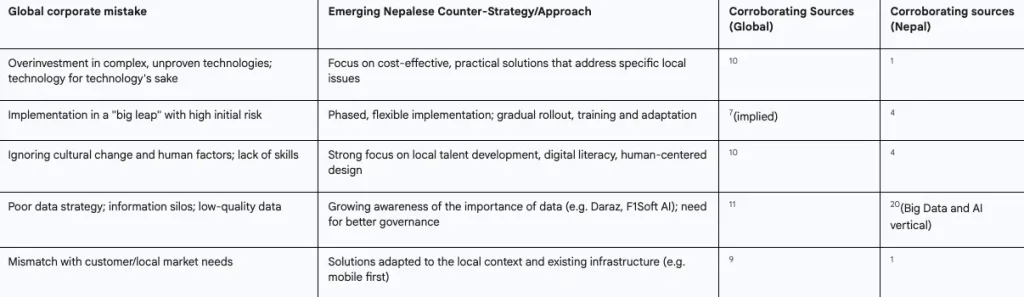
Table 2: Comparison of global digital transformation failures and Nepalese approaches
The Road Ahead: Addressing Key Challenges for Sustainable Digital Progress

Despite the progress made, Nepal still faces a number of significant challenges to achieve sustainable digital development.
- PBridging the digital divide and improving rural infrastructure:
Despite progress, significant gaps in internet access and quality remain, particularly in rural and mountainous areas.1 Continued investment is needed to expand broadband access to all municipalities, with priority given to connecting schools and health centres.14 The potential role of initiatives such as Elon Musk’s interest in satellite internet 1 could be explored as data becomes available. - Strengthening cybersecurity measures and data protection frameworks:
Cybersecurity is a major concern, as evidenced by incidents such as hacks of government servers.14 The Electronic Transactions Act 2063 is outdated.1 The proposed Cybersecurity Bill needs to be implemented effectively and in a timely manner, given concerns about privacy and data protection.1 A National Data Protection Authority needs to be established and investment in secure cloud storage and digital forensics needs to be made.14 - Scaling Digital Literacy Programs Effectively:
The overall literacy rate is around 71%, but digital literacy is significantly lower.14 Many government employees, especially in rural areas, lack technical skills.14 National digital literacy programmes, promotion of women’s participation in technology, subsidies for internet access in remote areas, simplified user interfaces, multilingual support and local digital help centres are needed.1 - Creating a favorable environment for innovation and investment:
There is a need to remove bureaucratic hurdles and provide clear and supportive policies.115 mentions government incentives such as tax breaks and rent discounts. It is important to promote a startup-friendly environment with financial incentives and address issues such as the 20% ownership cap for international companies if this is a barrier.1
These challenges are interconnected. For example, improving rural infrastructure is necessary to scale up digital literacy, and both are prerequisites for the success of the DNF goal of providing digital access to services. Addressing them separately will be less effective. The need for connectivity to infrastructure is obvious for digital literacy programs to have an impact. Without both, the DNF goal of “Access to digital services”13cannot be fully realized, especially in rural areas. This implies the need for a coordinated, multi-faceted strategy to address these issues simultaneously.
The problem of cybersecurity is not only technical, but also legislative and institutional. Delay in the implementation of a reliable cybersecurity system1 could undermine trust and make it difficult to adopt more advanced digital services, especially those that involve sensitive data (such as AI in healthcare or finance).1 And 14highlight outdated laws and slow progress in passing new cybersecurity legislation.14mentions data breaches at NITC as alarming. As AI and digital services become more sophisticated (e.g. eSewa’s Agentic AI, which processes personal/financial data21), user trust in data security becomes paramount. Failure to address this issue could become a major obstacle to the implementation of the DNF 2.0 pillar “Transforming the Digital Economy”.13
Although the “brain drain”14is a challenge, the rise of remote work and Global Competence Centers (GCC) in Nepal15may offer a counter-trend by allowing Nepali talent to work on global projects from Nepal, thereby retaining skills and attracting foreign exchange. It may also help in upskilling.14identifies the “brain drain” in IT as a problem.15highlights Nepal’s emergence as a GCC hub, with companies like TechKraft building large teams for U.S. clients. This model allows Nepali IT professionals to gain international experience and competitive salaries without emigrating. This could mitigate the brain drain, help achieve DNF’s goals of exporting IT services15and create a virtuous cycle of talent and opportunity development in Nepal.
Conclusion: Charting a Course to Nepal’s Digital Future

Digital transformation in Nepal is not just about following global trends, but about forging a unique path based on pragmatism, adaptability, and a deep understanding of local needs. The Nepal Way is characterized by a “problem first, technology second” approach, a phased implementation of innovation, a focus on human capital development, and the clever use of existing strengths such as high mobile penetration. This approach allows Nepali companies to achieve real growth while minimizing the risk of costly failures that are so common in the global arena.
The potential of AI and automation guided by this “Nepal Way” is enormous. It can drive inclusive and sustainable economic development, improve service delivery and enhance the quality of life of citizens, which is fully in line with the objectives of DNF.1The future of AI in Nepal looks promising, with opportunities to automate routine tasks, develop superintelligence to solve complex problems (climate change, medicine), and improve various sectors of the economy.3
To move forward on this path, concerted efforts are needed:
- For business: Continue to focus on solving real local problems, welcome incremental innovation, invest in upskilling employees, collaborate with academic institutions, and prioritize data security and the ethical use of AI.
- For politicians: Accelerate infrastructure development (especially in rural areas), finalize and implement robust cybersecurity and data protection laws, scale digital literacy initiatives with a focus on inclusivity, continue to create a supportive regulatory and investment climate for tech startups, and actively promote Nepal as an AI innovation hub.

Close collaboration between government, the private sector, academia and citizens will remain a key factor for success.1
The Nepali path to digital transformation, if carefully nurtured, could become a model for other developing countries facing similar challenges and opportunities. Its emphasis on frugal innovation, local adaptation, and human capital development is highly replicable. Many developing countries share challenges such as resource constraints, infrastructure gaps, and the need for inclusive growth. The strategies identified (problem-oriented, incremental, mobile, talent-focused) are not unique to Nepal’s geography but represent sound principles for any developing economy. Documenting and sharing Nepal’s successes and lessons could provide valuable knowledge at the global level.
The true test of Nepal’s digital transformation will be its ability to translate localized successes into broad-based, equitable national impact, effectively bridging the digital divide and ensuring that the benefits of AI reach all segments of society, not just the urban elite or select industries. The digital divide remains a persistent challenge.1While fintech is seeing widespread adoption, the benefits of AI in sectors such as agriculture or rural healthcare are still nascent.3The success of DNF depends on inclusivity.1Future progress must therefore be measured not only by technological achievements but also by its contribution to the equitable development of the entire nation.
Nepal is moving confidently towards a future where digital technology is an integral part of life, leveraging its unique strengths to chart its own successful path in the era of artificial intelligence.
Source used
- Digital Nepal—A Dream In Progress – The Rising Nepal
- ARTIFICIAL INTELLIGENCE IN TOURISM SECTOR IN NEPAL – TUCL Repository
- This is how Nepal can be made an AI hub: Dr. Rajan Thapaliya’s views – Singhadarbar.com
- Driving Digitalization in Nepal: Insights from Himal Karmacharya, President of Leapfrog Technology – YouTube
- SWOT Analysis of eSewa: What to Know in 2025
- Financial Literacy and Digital Payment System in Nepal – ResearchGate
- Pros and Cons of Incremental Change vs. the “Big Bang” Approach – WalkMe
- Incremental Model: Efficient Development Strategies – Plutora
- 15 Digital Transformation Failure Examples [2025] – DigitalDefynd
- 7 Reasons Behind Most of the Problems on the Path to Digitalization and Digital Transformation
- The Digital Transformation Challenges Every CDTO Faces
- Digital transformation cost and failures – PEX – Process Excellence Network
- Digital Nepal Framework 2.0: A Step Digitally Empowered Nepal
- Digital Governance in Nepal: Challenges, Progress & Future Insights
- Why Global Tech Leaders Are Turning to Nepal for Their Next GCC – Techkraft Inc
- ROLE OF AI IN BUSINESS DECISION MAKING PROCESS OF COMPANIES IN NEPAL – Theseus
- Top IT Companies in Nepal: A Tech Landscape Overview 2025 – NecoJobs
- What are the Top IT Companies in Nepal? – DataMites Offical Blog
- What is the best IT company in Nepal? – Quora
- About Us – F1Soft Group – F1Soft International
- eSewa’s Agentic AI: A New Era of Intelligent Assistance – F1Soft Group
- Sending Money To Nepal: eSewa International Money Transfer Service – CompareRemit
- Esewa Nepal SWOT analysis | PPT – SlideShare
- Online School Fee Payment for School, College & Institutes – Khalti
- How to integrate Khalti WHMCS online Payment Gateway Plugin?
- The Rise of E-commerce in Nepal: Transforming Business for the Digital Age – Cyberlink Pvt.Ltd.
- Hotel Management System Nepal | Hotel Management Software in …
- Best Hotel Software in Nepal | Robust Tech at Budget-Friendly Price – eZee Absolute
- Nepal: A Land of Wonders – Arbus
- The Role of Agriculture and Agri-Tech Investments in Nepal During a Pandemic
- Shreenagar – Integrated Agri Business
- NIIC 2 Supports Mentorlab Education and Blackboard Nepal in Advancing EdTech Solutions in Nepal – One to Watch
- Edtech in Nepal – Falano College
- Software Company in Nepal | PDF | Mass Media | Information And Communications Technology – Scribd
- Fusemachines opens registration for AI Fellowship 2025 in Nepal – The Himalayan Times
- Fusemachines Announces AI Fellowship 2025 in Nepal | Press Release
- COMPETITIVENESS OF B2C E-COMMERCE RETAIL BUSINESS IN KATHMANDU – TU e-Thesis (Thammasat University)
- Role of Information and Communication Technologies on Tourism: Nepal Case Study Sameer Kharel*