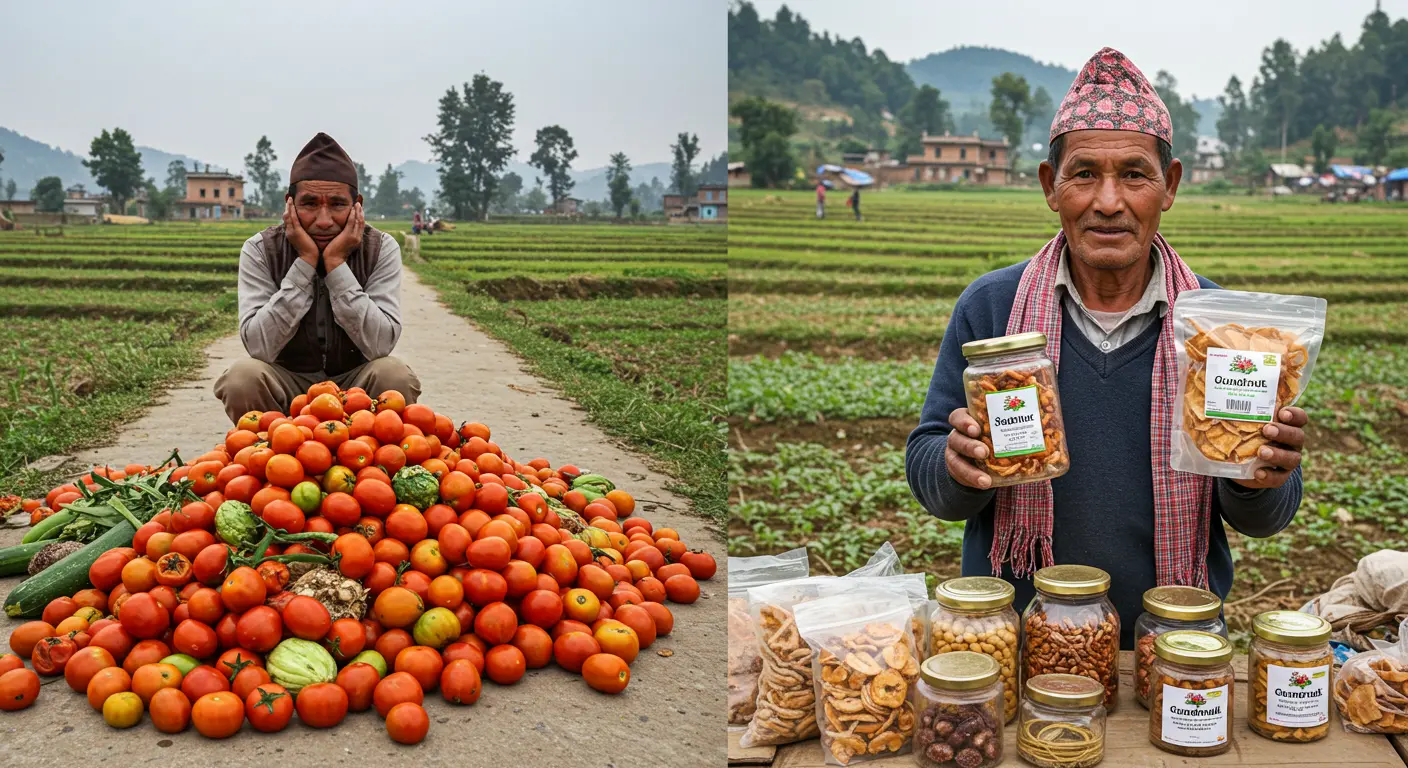
The Farmer’s Paradox in the Himalayan Country
Imagine a farmer in Nepal’s Chitwan district. After months of hard work, he harvests a bountiful crop of tomatoes. But the local market is so oversupplied that the price drops below cost. In desperation, he is forced to throw some of his harvest on the side of the road.1Meanwhile, in Kathmandu, just a few hours away, a supermarket shopper pays five times more for the same tomatoes.2This stark contrast is not fiction but a harsh reality that illustrates a deep paradox at the heart of Nepalese agriculture.
Agriculture is the backbone of Nepal’s economy. The sector employs more than 60% of the workforce and contributes about 24% of the country’s gross domestic product (GDP).3Despite this fundamental role, the millions of smallholder farmers who form the backbone of the sector live in a state of constant economic vulnerability. Their incomes are subject to sharp fluctuations due to price volatility, inefficient supply chains, and lack of access to modern inputs and markets.6

This study gets to the heart of this paradox by examining the structural weaknesses, policy failures, and market dynamics that suppress farmers’ incomes. At the same time, it highlights four key pathways to empowering farmers: strengthening agricultural cooperatives, implementing fair contract farming, generating additional value through local processing, and using digital tools. All of these strategies are considered in the context of a strategic shift to more sustainable, organic production systems that can free Nepali farmers from dependence on imported inputs and build a more equitable and prosperous agricultural future.
Table 1: Farmers’ Problems and Empowerment Strategies in Nepal

The Great Squeeze: Why Farmers Get Only a Small Share of the Final Price
This section takes a detailed look at the systemic issues that leave Nepalese farmers in a position of economic vulnerability.
A Labyrinth of Middlemen and a Price Gap

The agricultural market structure in Nepal is disorganized and unbalanced, dominated by numerous middlemen.8The supply chain from farm to consumer can include up to seven levels of intermediaries, each adding its own markup.9This leads to a huge gap between the price the farmer receives and the retail price. A report by the Department of Trade, Supply and Consumer Protection found that a product with a farm gate price of NPR 10 is eventually sold to the consumer for NPR 70.9A study conducted at a wholesale market in Pokhara found that the average price spread for fresh vegetables was 57.33%, leaving the producer’s share of the final price at only 42.67%.10Specific examples illustrate the problem: the wholesale price of local tomatoes in Kalimati market in Kathmandu is NPR 12 per kg, while they are sold at NPR 60 per kg in retail shops in Koteshwor area.2
This system has taken root because of structural market deficiencies. Most farmers in Nepal are smallholders, geographically dispersed across hilly and mountainous terrain.7For an individual farmer, it is logistically difficult and economically unprofitable to transport small batches of perishable products to central markets.2The lack of proper infrastructure such as paved roads and, crucially, cold storage facilities means that produce must be sold immediately after harvest, which greatly weakens the farmer’s bargaining power.10This infrastructure and logistics vacuum is naturally filled by a multi-tiered system of intermediaries. First, local collectors or agents buy produce from farmers, then resell it to wholesalers, who in turn supply it to retailers.2At each stage, a markup is added to the price to cover costs, risks (such as spoilage) and profit. The result is a highly inefficient system for the economy, but profitable for the middlemen, which not only deprives farmers of a fair profit, but also undermines their motivation to continue farming, creating a long-term threat to the country’s food security.8
Double Trap: Dependence on Imports and Inputs

Nepalese farmers’ vulnerability is compounded by a dual dependence on imports, both for finished goods and for essential agricultural inputs. The country runs a large and growing trade deficit in food products.13The uncontrolled flow of cheap agricultural products from India creates fierce price competition in which local producers often lose out.8For example, potato production in Nepal costs farmers NPR 25 per kg, but cheaper imported potatoes from India result in losses for Nepalese farmers.8
At the same time, Nepal is completely dependent on imported chemical fertilizers. The country’s annual requirement is estimated at about 550,000–600,000 metric tons, but supplies often fall short of this demand.15The government spends huge amounts of money to subsidise these supplies – NPR 107.66 billion has been allocated over the past five years, with more than 83% of the total agricultural subsidy budget going towards chemical fertilisers.16
This dependence creates a double vulnerability. On the one hand, farmers’ prices are suppressed by cheap imports. On the other, their production is held hostage to unreliable and often untimely supplies of imported fertilizers, the prices of which are subject to extreme global volatility. For example, the war between Russia and Ukraine led to a sharp jump in the world price of urea from $390 to $1,025 per ton.19Thus, the government’s fertilizer subsidy policy, intended to support farmers, is in fact a strategic vulnerability for Nepal’s entire agricultural sector. It creates a vicious circle of dependency, environmental degradation, and economic fragility. Massive subsidies on imported chemicals actively undermine the economic viability of using local organic alternatives, which the government declares to promote in its own policy documents.20This is a direct policy contradiction, where one government measure (subsidies) hinders the achievement of another goal (the transition to sustainable agriculture), preserving a high-risk and low-sustainability model of farming.
The Safety Net Illusion: Ineffective Government Measures
The Nepalese government has repeatedly tried to intervene in the market to protect farmers. One such measure is the setting of a minimum support price (MSP) for crops such as paddy.8However, these initiatives often remain on paper due to the lack of a clear legislative basis for regulating pricing and effective enforcement.8MSP is often set before the start of the planting season and does not take into account production risks, input price fluctuations and market dynamics during the season, making it ineffective.8
Other support programs also face implementation challenges. For example, an initiative to allocate an additional 25 percent of the budget to local governments that promote organic farming was widely praised, but its implementation has been extremely weak.20This recurring pattern of strong policy statements followed by weak or non-existent implementation reveals a fundamental governance gap. It undermines farmers’ trust in public institutions and prevents the state from playing its role as an effective market regulator. The problem is not a lack of ideas, but a lack of institutional capacity and political will to consistently implement them.9
Taking Back Control of the Value Chain: Paths to Prosperity
Despite serious systemic problems, there are real and proven solutions that can help Nepalese farmers escape poverty and insecurity. These solutions are based on collective action, fair partnerships, value addition, and the use of modern technology.
Strength in Unity: The Rise of Agricultural Cooperatives

Agricultural cooperatives are becoming a powerful tool for small farmers to overcome market failures. By joining together, farmers are able to bargain collectively, which greatly increases their bargaining power. Research shows that cooperative members can receive prices for their produce that are 10-20% higher than independent farmers.22Cooperatives also help reduce marketing costs, for example by reducing transport and commission costs, and shorten the supply chain by eliminating unnecessary intermediaries.23In addition, they provide access to vital services such as credit, procurement of quality inputs and technical training.22
Success story: Dairy cooperatives
A striking example is the women’s dairy cooperative Shree Kamalamai. Starting with 13 small self-help groups, the women set up a milk collection centre, partnered with Heifer International for training and access to finance, and secured a stable market for their produce through a major processor, Sujal Dairy. As a result, daily milk collection increased from 500 to 1,300 litres, providing members with a reliable market and stable payments, making a real difference to their lives.26 Similar success stories are being shared by other women’s cooperatives, such as Atipriya and Bihani, proving that collective action can not only increase incomes but also overcome social barriers, empowering women.27
Success Story: Vegetables and Tea
The Janagarathi Vegetable and Fruit Cooperative Society (JVFPACL) in Chitwan acts as a middleman between farmers and traders, negotiating higher prices for its members – on average NPR 16.40 per kg higher than through other channels.29 In the tea sector, the Central Tea Cooperative Federation (CTCF) represents over 6,200 smallholder farmers, providing them with technical assistance, helping them obtain organic certification and access to international markets.30
Innovation in Action: The Kisan Ko Poko Model
The Nepal Central Agricultural Cooperative Federation (NACCFL) has developed an innovative model, Kisan Ko Poko (Farmer’s Pack). It is a cooperative-to-cooperative (C2C) marketing approach that creates a direct link between rural producer cooperatives and urban consumer markets, bypassing multiple intermediaries.32
Successful cooperatives in Nepal are more than just collective marketing outlets. They function as complex “support ecosystems” for their members, addressing multiple challenges simultaneously: access to markets, finance, resources, and training. Their success is often catalyzed by strategic partnerships with NGOs and international organizations that provide seed capital, expertise, and networking. The cooperative becomes a central hub for rural development, addressing complex issues that would be impossible for an individual farmer.
Contract Farming: A Bargain for a Better Future?

Contract farming (CF) is a model in which a farmer and a purchasing company enter into a preliminary agreement. The company typically provides the farmer with inputs (seeds, fertilizers), technical assistance, and undertakes to purchase the future harvest at a pre-agreed price.33The system is seen as a way to reduce price and market risks for farmers.34
Benefits for farmers
Research in Nepal shows significant benefits from participation in CFs. In paddy seed production, contract farmers reported profits that were 23% higher than independent farmers.35 In the ginger sector, contract farmers reported net profits that were 58% higher than those who did not participate in contracts. This increase was due to higher prices, as well as access to quality seeds and training.36 CFs can thus provide a guaranteed market, stable income, and access to technology and credit, making smallholders more competitive.34
Risks and Disadvantages
However, contract farming is a double-edged sword. The main disadvantage for the farmer is the loss of bargaining power, as the buyer, with greater power, can set lower prices.34 Farmers are tied to one buyer and cannot take advantage of higher prices on the spot market. There is a serious risk that large agribusinesses will use their dominant position to shift production risks to farmers and create a new form of dependency.37
Legal vacuum
A key issue in Nepal is the lack of a clear legal framework to regulate contract farming. Despite references in various policy documents such as the Trade Policy 2009, there is no specific, enforceable law in the country that regulates contract terms, protects the rights of small farmers, and provides a dispute resolution mechanism.33
In the current legal vacuum, contract farming in Nepal is a risky proposition. While it offers a proven path to increased income and market integration, the potential for exploitation is enormous. The success of this model depends directly on the creation of fair and enforceable legal protections. Without the intervention of the state as an arbiter that sets clear rules of the game, the expansion of CFs may not lead to farmers’ empowerment, but to their entrenched dependence on large companies.
From Harvest to High Value: The Power of Local Processing

A significant portion of farmers’ potential income is lost due to high post-harvest losses and the sale of produce as unprocessed raw material.1Simple and traditional processing methods can significantly increase income. Examples include cooking
gundruka (fermented leafy vegetables), quantity (dried radish slices), as well as various pickles and dried fruits (titaura, though).39These methods transform a perishable, low-value commodity into a non-perishable product with higher value and a longer shelf life.
Available technologies
Access to technology is key. The Nepal Agricultural Research Council (NARC) has developed low-cost plastic solar dryers made from UV-stabilized tarpaulin and local materials such as wood and bamboo. These dryers are ideal for small-scale drying of apples, vegetables, spices, and coffee in remote areas without reliable electricity.39 Other simple technologies, such as hand-held coffee berry peelers and ginger washers, are also available.39
Organized value chains
Government and non-governmental programmes such as One Village One Product (OVOP) and projects to support ginger and citrus value chains demonstrate a successful model for promoting community-based processing.39 The establishment of cooperative packing houses for sorting, grading and packaging of produce is another important step to increasing its market value.42
Processing is the most direct way for farmers to move up the value chain and capture a larger share of the final price. The barrier is often not a lack of knowledge (traditional methods exist) but a lack of access to low-cost processing technologies and organized distribution channels for finished products. By giving a farmer access to a simple solar dryer, we fundamentally change his relationship with the market. He is no longer a hostage to the daily price of fresh produce, but gains control over when and to whom he sells his product, reducing risk and increasing potential income.
Digital Assistant: Bridging the Information Gap

Digital platforms are emerging in Nepal to combat information asymmetry. GeoKrishi provides farmers with access to hyperlocal weather forecasts, climate-smart farming advice, up-to-date market prices, and an “ask an expert” function via a mobile app.43Government platforms such as Krishi Bazaar and e-Haat Bazaar aim to directly connect farmers with markets.44FAO’s Digital Village initiative is piloting tools such as the Tele Plant Doctor app to identify plant pests and diseases.45
Implementation issues
Despite the enormous potential, adoption rates of these technologies are extremely low. A study in rural Nepal found that only 3.5% of farmers were actively using agricultural apps.46 Key barriers include:
- Infrastructure and cost: Limited internet access (only 39% of respondents) and high costs of mobile data are major barriers.46
- Digital Literacy: More than 45% of rural residents surveyed are illiterate, and 95% have never received training in the use of agricultural applications.46Many people find the application interface too complicated.43
- Gender Gap: Women have less access to mobile phones and the financial resources to purchase them.46
- Application design: Many apps are not adapted to local conditions and lack offline functionality, voice commands or video content.46
Digital tools cannot simply be transplanted into the rural Nepalese context without building a fundamental, people-centred support system. The failure lies not in the technology itself, but in the implementation strategy, which often ignores deeply rooted barriers of literacy, infrastructure and trust. A more successful model, as GeoKrishi has shown, is to partner with trusted local institutions such as cooperatives.43Cooperative staff can be trained to use the digital tool and then disseminate the information to farmers through traditional, trusted channels (meetings, face-to-face interactions). This hybrid, physical-digital approach bridges the digital divide by harnessing the power of digital information while taking into account the realities of rural Nepal.
Conclusion: Towards a Fairer Harvest

The analysis shows that no single solution is a panacea. The path to sustainable and profitable agriculture for Nepalese farmers requires a comprehensive, integrated approach. The most successful initiatives, such as dairy cooperatives, combine several solutions, linking market access with finance, technical training, and collective bargaining.
Achieving self-sufficiency is becoming a strategic imperative for Nepal. Moving away from dependence on volatile imported inputs, especially chemical fertilizers, and toward local, sustainable organic practices—such as vermicomposting, green manure, and biofertilizers like Jholmol—is not just an environmental choice, but a critical strategy for economic stability and food security.48These practices not only reduce costs and dependency, but also help restore soil health, increasing its long-term productivity and resilience to climate change.
Based on the analysis conducted, the following actionable recommendations can be formulated:
For politicians and government agencies:
- Eliminate the political contradiction: Government subsidies need to be redirected away from imported chemical fertilizers to support the transition to organic farming. This includes supporting the production and distribution of local inputs such as vermicompost and biofertilizers, and providing farmers with compensation during the transition period.52
- Create a legal framework for contract farming: Urgently develop and implement clear legislation regulating contract farming, with mechanisms to protect the rights of small farmers and resolve disputes.33
- Invest in basic infrastructure: Priority should be given to developing rural roads, cold storage networks and reliable internet coverage in rural areas.10
For development partners and NGOs:
- Promote a “physical-digital” approach: When implementing technologies, use trusted local partners such as cooperatives as intermediaries to bridge the digital divide and ensure broad reach.43
- Support the establishment of cooperative recycling centres: Promote the establishment of cooperative-based packaging and processing plants to stimulate local added value.42
For farmers:
- Join forces through cooperatives: Actively participate in cooperatives to strengthen market power and gain access to resources.23
- To develop the processing and production of organic fertilizers: Implement low-cost methods of processing products and producing their own fertilizers on their farms to reduce costs and increase income.48
Ultimately, Nepal’s farmers have the potential to turn their vulnerability into strength. By combining collective action, equitable partnerships, innovation, and a return to sustainable practices, they can grow not only crops, but a more equitable, sustainable, and prosperous future for themselves and their country.
Source used:
- Analysis of Efficient Supply Chain Models of Vegetables: Case of Nepal
- Valley’s vegetable bazaar remains a seller’s market – The Kathmandu Post
- In Nepal, farming families stick together
- ORGANIC AGRICULTURE IN NEPAL: POLICIES AND PRACTICES
- Nepal – Food and Agriculture Organization of the United Nations
- How Commodity Markets can Empower Nepal’s Agricultural Ecosystem – B360
- The Commercialization of Smallholder Farming—A Case Study from the Rural Western Middle Hills of Nepal – MDPI
- Dynamic support price for farmers- Views – Kantipur News – ekantipur
- Middlemen rake it in while farmers and consumers suffer
- study on arrivals and pricing situation of major vegetables in pokhara wholesale market, nepal – ResearchGate
- Climate-Smart Agriculture in Nepal
- Unlocking Potential or Sticking to Tradition in Agri-Value Chain: An Insight from Farmers of Surkhet – GMC Nepal
- Food and Agricultural Markets in Nepal – NeKSAP
- Nepal Value chains for Inclusive Transformation of Agriculture Project Design Report Main report and annexes
- Chemical fertiliser shortage is a perennial problem. It stems from multiple factors
- Nepal still awaits chemical fertilizer factory after four decades of delay – myRepublica
- Despite 107 billion in subsidies, Nepal’s agricultural production suffers decline
- What cost for organic farmers to conserve nature? – The Annapurna Express
- Fertiliser crisis could spell economic disaster, experts warn – The Kathmandu Post
- Promotion Of Organic Agriculture – The Rising Nepal
- NPRC Journal of Multidisciplinary Research Challenges of Seasonal Green Vegetable Marketing in Nepal: A Study of Chitwan Distric
- Cooperatives as Pillar of Economy to Improve Agriculture Production and Marketing
- Marketing System of Agricultural Cooperatives in Nepal – Society of Interdisciplinary Business Research
- Role of Cooperatives in Poverty Alleviation of Small Holding Rural Farmers of LDCs: A Case of Nepal | Open Access Journals – Research and Reviews
- A CASE STUDY OF SFACL SALANG, DHADING – FinDev Gateway
- Women Pioneering Change in Kamalamai’s Model Dairy …
- From Struggles to Strength: The Journey of Atipriya Women’s Cooperative | Heifer International
- The Women of Bihani Dairy in Nepal Give Back to Community, Adapt to Pandemic Changes
- A Case Studies of Janagarathi Vegetable and Fruit Producer …
- Central Tea Cooperarive Federation (CTCF) – HOME
- Central Tea Cooperative Federation – Agriterra
- Empowering Agricultural Cooperatives and Small … – NACCFL
- (PDF) Contract farming for commercializing Nepalese agriculture – ResearchGate
- Contract Farming: Risk Mitigating Approach for Strengthening Farm Security – ResearchGate
- Impact of contract farming of paddy seed on smallholder farm profits: evidence from Nepal
- Markets and value chains – FAO Knowledge Repository
- Impact of Contract Farming on Farmers’ Income in the Food Value Chain: A Theoretical Analysis and Empirical Study in Vietnam – MDPI
- Evidence from High-Value Crop Production
- IMPORTANCE OF VALUE ADDITION IN HORTICULTURE ABSTRACT
- Adoption of post-harvest handling practices by ginger farmers in Palpa district, Nepal – Innovations in Agriculture
- Value Chain Analysis of Ginger subsector in Nepal – ANSAB
- Postharvest Management of Horticultural Crops in Nepal
- 237,3k 51,5k 97% – GSMA
- Digital Landscape in Nepal’s Agriculture Sector – Nepal Economic Forum
- Nepal | Digital Villages Initiative in Asia and the Pacific | Food and Agriculture Organization of the United Nations
- Bridging the Digi-Tech Gap for Female Farmers in Rural Nepal …
- (PDF) Constraints on the use and adoption of information and communication technology (ICT) tools and farm machinery by paddy farmers in Nepal – ResearchGate
- Jholmal for small-scale farmlands – ICIMOD
- Changunarayan Vermi-Composting Training for Farmers
- Exploring agroecological farming for Karnali Province, Nepal – ICIMOD
- Going organic for a sustainable future – ICIMOD
- Organic Agriculture in Nepal: Policies and Practices – ResearchGate
- The Relative Efficiency of Organic Farming in Nepal – Sandee
- Impact of Contract Farming on Profits and Yield of Smallholder Farms in Nepal: An Evidence from Lentil Cultivation – IDEAS/RePEc
- World Bank Documents and Reports