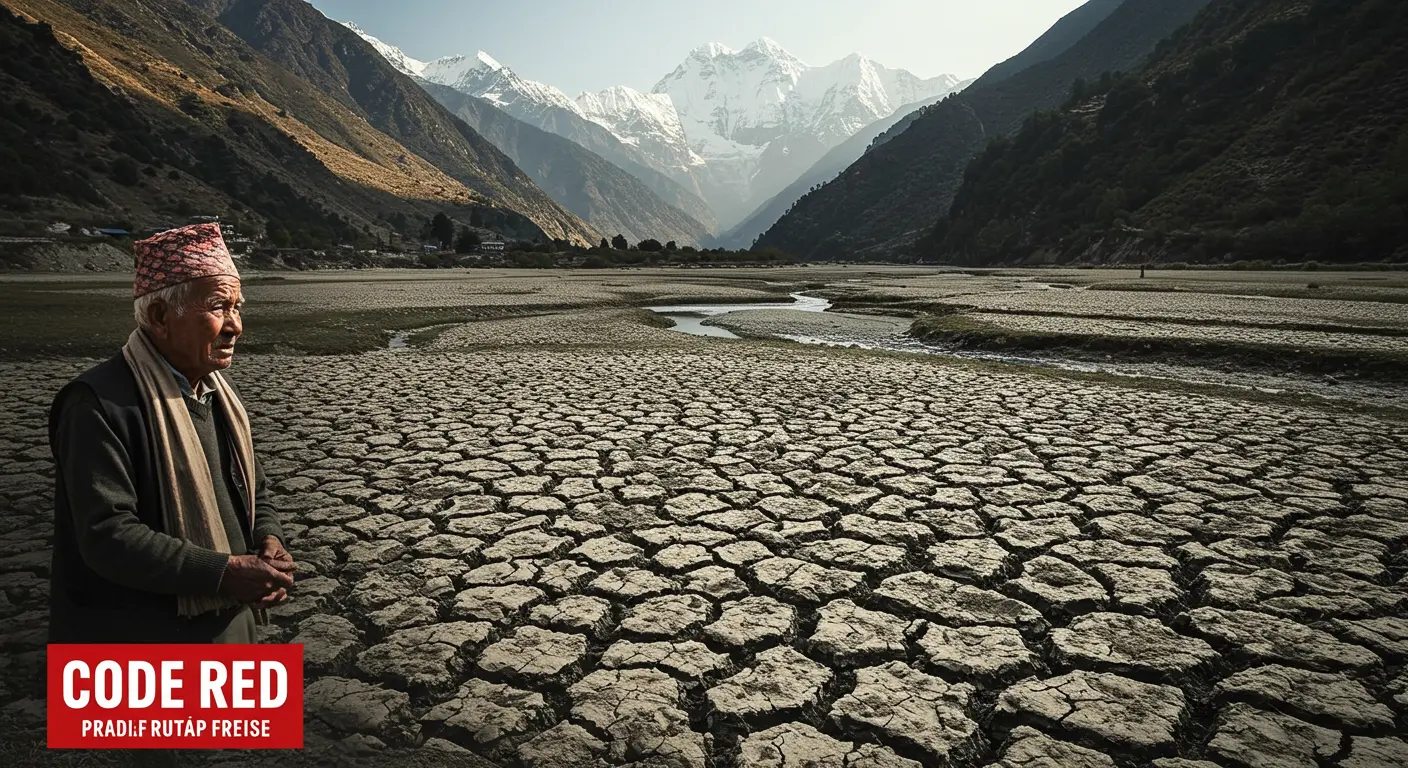
Nepal on the threshold of a new era
Imagine two scenes unfolding simultaneously. The first is on the slopes of Annapurna, where an experienced Sherpa guide, drawing on knowledge passed down through generations, leads a group of trekkers along a tried-and-true route, reading the weather from the wind and clouds. The second is in a bustling office in Kathmandu, where a young data scientist, a local university graduate, uses predictive analytics and machine learning models to optimize that same trekking route, calculating avalanche risks and offering clients personalized plans based on their fitness.
This contrast is not a fantasy, but a vivid illustration of the reality Nepal is on the cusp of. Artificial intelligence (AI) is no longer a distant concept from Silicon Valley, but a powerful force capable of fundamentally reshaping both traditional and cutting-edge sectors of the Nepalese economy.
Nepal is at a unique point in its development, having recently graduated from the category of least developed countries (LDCs) to the category of lower middle income countries.1, the state faces a double challenge. On the one hand, it needs to address the classic development problems of fighting poverty, developing infrastructure, and strengthening institutions. On the other hand, the country finds itself at the epicenter of a global technological revolution that is not waiting for old problems to be solved. With a GDP of about $40.91 billion in 2023,2Nepal’s economy is small by global standards, making it both more vulnerable to external shocks and potentially more flexible for rapid transformation.
For Nepal, AI is both an existential threat to the traditional, vulnerable labor market and a unique opportunity to leapfrog outdated economic models and build a modern, sustainable, and globally integrated economy. The outcome of this race with machines depends on the strategic decisions that government, education, and business leaders must make today.
The Economy at a Crossroads – Today’s Labor Market
Before looking to the future, it is necessary to take a sober look at the present. Nepal’s labour market is a complex mosaic of traditional ways of life and modern trends, where the overall figures hide deep structural problems.

Two-speed economy
An analysis of the GDP structure shows a clear shift towards services. The service sector now generates about 51% of GDP, while the share of agriculture, once dominant, has fallen to 24.5%.1However, if you look at the employment structure, the picture changes dramatically. Agriculture remains the largest employer, providing jobs for every fifth Nepali (21.5%).3This creates a so-called “two-speed economy”: on one side, a growing urban service sector, on the other, a huge, predominantly rural, agricultural sector where labor productivity remains low.
Dominance of informality and vulnerability
A key characteristic of the Nepalese labour market is its total informality. According to the latest Nepal Labour Force Survey (NLFS III), 62.2% of all employment is in the informal sector.3Moreover, a staggering 84.6% of all workers are in “informal employment,” meaning they lack basic social protections such as paid vacation, sick leave, or employer contributions to social security funds.3The problem is so serious that the government in its 16th development plan has set a target of reducing the share of the informal sector to 40%.4
World Bank data paint an even bleaker picture. The rate of “vulnerable employment” – a measure that includes the self-employed and unpaid family workers who are least protected from economic shocks – is sky-high in Nepal: 91.2 percent for women and 71.5 percent for men.5This situation is exacerbated by deep gender inequality. Women’s labor force participation rate (27.6%) is almost half that of men (53.7%).5Women earn on average only two-thirds of what men earn, and their representation in leadership positions is negligible – just 13.2%.3
This combination of high informality, vulnerable employment and gender inequality creates an extremely fragile labour market. It is not just background statistics, but a set of pre-existing conditions that will act as a powerfulamplifierthe devastating effects of automation. In a developed economy with strong social protection systems, job losses due to AI are a serious problem, but they can be mitigated with retraining programs and benefits. In Nepal, where the vast majority of workers have no safety net, automation threatens not just job losses, but an economic collapse. Since the sectors most at risk (administrative work, services) where many women are traditionally employed are precisely those at risk, the AI revolution without special measures could not only increase poverty, but also catastrophically widen the gender gap. This turns a technological challenge into an urgent social and political crisis.
Table 1: Nepal Labour Market Profile: Vulnerabilities and Realities (based on NLFS-III, 2017/18 and World Bank, 2023)

The Specter of Automation – Which Jobs Are Under Threat?
Global forecasts from the World Economic Forum (WEF) are clear: roles involving repetitive, routine and rules-based tasks are most vulnerable to automation.6Globally, 41% of companies expect to reduce their workforce in the next five years due to AI implementation.7For Nepal, these global trends take on particular significance.

Risk groups: who is the first to leave?
The biggest blow will fall on clerical and administrative workers. The WEF reports directly indicate the following professions:6:
- Data entry specialists: Their functions are almost completely automated by modern text recognition and data processing systems.
- Administrative and Executive Secretaries: Planning, calendar management, basic correspondence – all of this is already being effectively performed by AI assistants.
- Accountants and bookkeepers: Routine operations of accounting, reconciliation and reporting are increasingly coming under the control of smart software solutions.
- Cashiers (in banks and retail): The spread of mobile banking, QR payments and self-service checkouts is making this profession extinct.
- Postal workers: Automation of sorting and logistics reduces the need for manual labor.
Sectors under attack in Nepal
Applying these global trends to the Nepalese economy highlights several key sectors that will be at the forefront of transformation:
- Finance and banking: The sector will be the “springboard” for the AI revolution in Nepal, although the rollout is still cautious due to issues with legacy systems and a shortage of personnel.8, the global trend towards automating the functions of bank tellers, operators and back office specialists is undeniable. The growth of digital payments, actively supported by the central bank of Nepal (Nepal Rastra Bank), will only accelerate this process.10
- Trade and services: This is a huge sector of the Nepalese economy, with almost 24% of all workers employed in the “service and sales sector”.3Development of e-commerce, implementation of AI chatbots for customer support12and automated inventory management systems pose a direct and often underestimated threat to salespeople, consultants and warehouse workers.
- Industry: In the short term, the threat here is less, but in the long term, robotization and automation of production lines, which 58% of WEF respondents named as a key trend14, will inevitably affect Nepalese enterprises as well.
Direct job losses are just the first, most obvious effect. A far more serious consequence could be the “washing out” of entry-level and mid-skill jobs. Being a bank teller, an administrative assistant in an office, or a salesperson in a store is not just a source of income. For many young Nepalis, it is the first step into the formal economy, a chance to gain basic skills and begin to advance in their careers. Automating these roles does more than just eliminate jobs; it removes a critical rung on the economic ladder. This threatens to polarize the labor market, with highly skilled and highly paid AI specialists at one pole and low-skilled manual labor at the other, with a shrinking “middle class.” Such changes carry profound risks for social mobility and long-term inequality in the country.
New Horizons – Professions of the Future Born in the Digital Age
Amid alarming predictions about the disappearance of professions, it is important to see the other side of the coin. The same technological wave that brings destruction also creates new opportunities. The WEF predicts that by 2025, the world will have 97 million new jobs adapted to the new division of labor between humans, machines, and algorithms.6

New Guard: AI Economy Specialists
These new professions require a completely different set of skills, centered on the ability to work with data and intelligent systems. Among the most in-demand professions of the future are:7:
- Artificial Intelligence and Machine Learning Specialists (AI/ML Specialists): Developers who create, train, and deploy AI models.
- Data Scientists & Analysts: Professionals who extract valuable insights from vast amounts of data to make business decisions.
- Prompt Engineers and AI Trainers: A new caste of specialists who “train” neural networks by creating precise and effective requests (prompts) for them to obtain the desired result.
- AI Product Managers: Strategists who determine where and how to apply AI to create new products and services.
- AI Ethics & Safety Specialists: Experts who ensure responsible and safe use of technology, preventing algorithmic bias and other risks.
Nepal’s Secret Weapon: IT Outsourcing Boom
For Nepal, these global trends are not just theory. The country already has a powerful, if not always noticed, asset – a rapidly growing IT outsourcing sector. This is the main argument in favor of an optimistic scenario for the future.

The growth of this sector is phenomenal. According to a study by the Institute of Integrated Development Studies (IIDS), Nepal’s IT services exports reached US$515 million in 2022, showing a 64% increase over the previous year. The sector already contributes 1.4% to the country’s GDP.17The driving force behind this growth is a young, technologically literate, English-speaking and cost-competitive generation. 83.5% of freelancers working for export are young people between the ages of 20 and 29.17
The Nepalese government has recognized the strategic importance of this sector by including IT and business process outsourcing (BPO) in the list of priority export sectors.18Nepalese companies such as Cloud Factory, F1Soft, Leapfrog and Verisk are already successfully serving clients from Europe, the US and Australia, creating thousands of high-paying jobs in the country.18Democratization of access to the global marketplace through platforms like Upwork and Fiverr has further accelerated this process, allowing individual Nepalese professionals to work for global companies without leaving their homes.18
This is where Nepal’s unique opportunity lies. Unlike developed countries that have to go through the painful process of “creative destruction” by dismantling old industrial giants, Nepal is not burdened with a heavy industrial legacy.19Its economic landscape is cleaner, but the country also has a demographic dividend – a huge pool of young people for whom digital technology is their native environment.17The IT outsourcing boom is the first compelling evidence that this combination allows Nepal to plug directly into the global digital economy, bypassing the traditional industrial stage of the 20th century. This is not just about creating new jobs. It is a fundamental shift in the country’s economic model, from exporting low-skilled labor (migrant workers) to exporting high-value digital services. This could potentially trigger a “brain rebirth” as high-paying tech jobs become available domestically.
Rebooting Education – Preparing Personnel for Tomorrow
The ability to make a technological leap depends directly on the ability of the education system to prepare the workforce needed in the new economy. Here, Nepal faces serious challenges, but also demonstrates impressive examples of proactive action.
Fundamental challenges
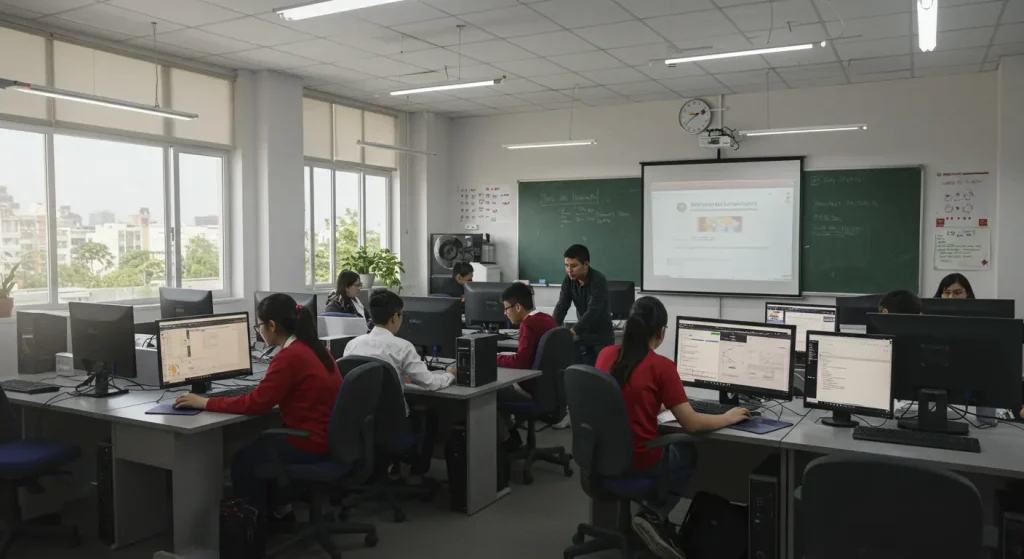
Nepal’s education system has historically struggled with serious problems, and the country still has relatively low adult literacy rates.21There is a huge digital divide between urban and rural areas, where lack of reliable electricity and internet access remains a major barrier to the adoption of technology in schools.22Even in countries with better infrastructure, education systems are struggling to adapt to the rapid pace of technological development, according to UNESCO reports.23In Nepal, the problem is even more acute. Uneven distribution of digital skills is a key issue: in developing countries, levels of basic digital literacy in urban areas can be twice as high as in rural areas, and among high-income earners, it is nine times higher than among the poorest.23Without addressing these basic issues, any strategy to prepare for the AI economy risks remaining the preserve of a narrow elite.
Beacons of Hope: Universities on the Front Lines
Despite these challenges, Nepal’s leading universities have already begun to take action, demonstrating remarkable foresight.
Kathmandu University (KU) has been a true pioneer. Its launch of full-fledged four-year undergraduate programs in B.Tech in Artificial Intelligence and B.Sc. in Data Science is a game-changer.25An analysis of their curriculum shows that they are fully future-proof. Students study machine and deep learning, big data analytics, natural language processing, and computer vision, while an emphasis on project-based learning allows them to apply knowledge to real-world problems.28
Tribhuvana University (TU), the country’s largest university, has also embarked on a path of reform. Its ambitious “Vision 2030” plan aims to improve the quality of education, develop research, strengthen ties with industry and introduce market-oriented courses.31Although progress here is slower, the very intention to reform the cumbersome structure and the desire for greater autonomy are key factors that can speed up adaptation to new realities.33
The parallel development of a dynamic IT industry and advanced university programs creates the potential for a powerful, self-sustaining flywheel that could drive Nepal’s knowledge economy. Growing IT companies are experiencing a huge demand for skilled workers.18Universities, primarily KU, are starting to graduate specialists with exactly the skills that the market needs.25These graduates, in turn, fuel the growth and sophistication of the IT sector, allowing it to take on more complex and higher-paying projects. A more developed IT sector creates even greater demand for talent and provides universities with feedback on curriculum needs, leading to even better training. This virtuous cycle is the model for building a sustainable high-tech industry in a developing country. The key to success is to maximize the links between academia and industry through internships, joint research, and industry participation in curriculum development. However, there is a risk of creating a “two-tier” system, where only graduates of elite programs receive advantages. Therefore, in parallel with training top-notch specialists, it is critical to improve the general level of digital literacy across the country, starting in schools.37
Business Strategies in the Age of AI – How Nepali Companies Can Win the Race
Adapting to the new reality is a challenge not only for the state and the education system, but also, first and foremost, for the private sector. Nepalese companies, from large banks to small businesses, must develop clear strategies to avoid being left behind by technological progress.
Fintech Lessons and the IT-BPO Model
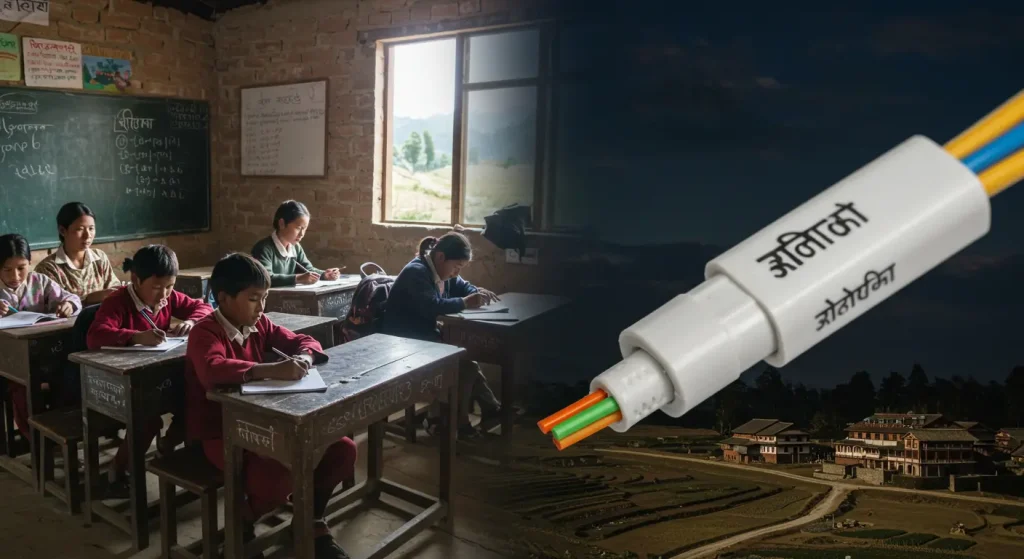
Nepal’s financial sector offers valuable lessons. The cautious but steady adoption of digital technologies such as mobile banking and QR payments, accelerated by the pandemic and supported by the regulator, shows that transformation is possible.10At the same time, the sector also exhibits key barriers: outdated IT systems, a shortage of qualified personnel and regulatory uncertainty are holding back the full-scale implementation of AI.8However, experts note that Nepal has a unique opportunity to leapfrog traditional models and build an AI-based financial system right away.19
In turn, the IT outsourcing sector can serve as a model of flexibility and global competitiveness. Its success is based on the use of a cost-effective workforce, favorable time zones and a growing talent pool.20The digital services export model is something that other sectors of the Nepalese economy can learn from.
Roadmap for Business
For Nepalese companies to compete successfully in the AI era, they need to take action on several key fronts.
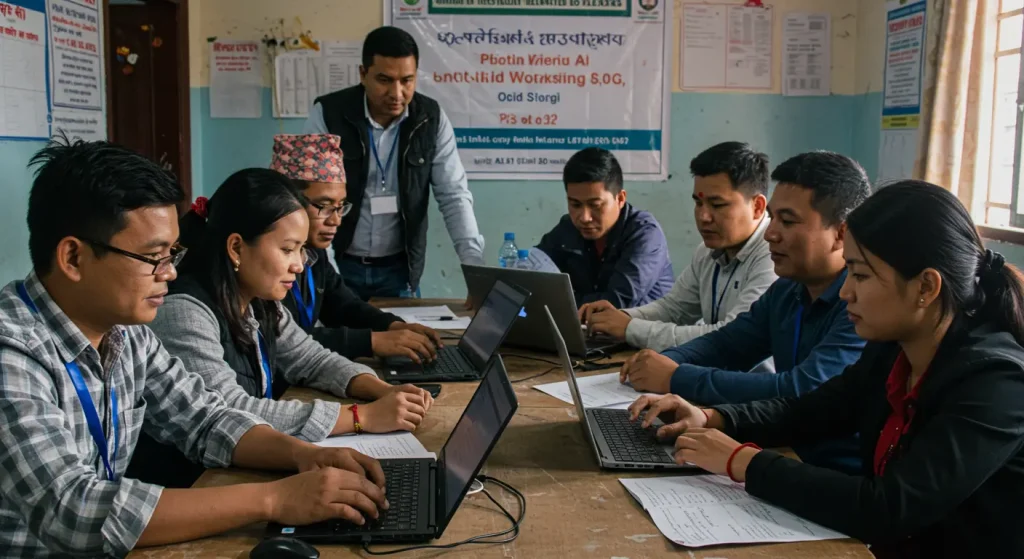
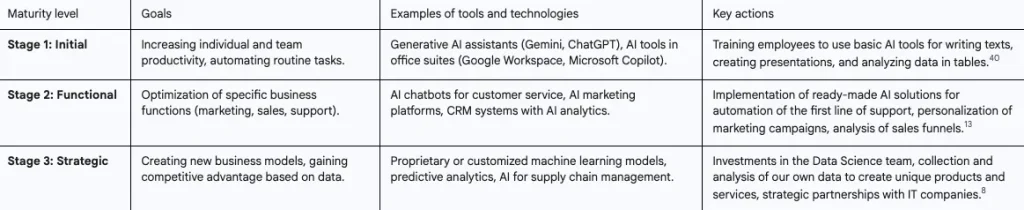
- Investing in people is a top priority. According to the WEF, 77% of companies worldwide are ready to retrain their employees to work with AI.39This should be the number one strategy for Nepalese businesses. Instead of simply cutting the workforce whose functions are being automated, forward-thinking companies will invest in upskilling them.
- Start small, scale smart. Businesses don’t have to build complex and expensive AI systems right away. They can start with easily accessible generative AI tools (like Gemini for Workspace or ChatGPT) to improve marketing efficiency, create content, analyze sales data, and automate routine office tasks.40This will free up human capital for more creative and strategic work.
- Focus on augmentation, not just automation. The most effective approach is to use AI not to replace humans, but to augment them. For example, AI can analyze customer data and provide valuable tips to a salesperson, making their work more efficient. AI consultants can automate the first line of support, allowing human specialists to solve only the most complex problems.13
True economic transformation will not happen when a few large corporations adopt AI, but when it becomes a mass phenomenon among the thousands of small and medium enterprises (SMEs) that form the backbone of Nepal’s economy. Today, SMEs often lack the capital and expertise for large-scale AI projects.41However, the emergence of a new generation of inexpensive and easy-to-use AI tools is changing this.40These solutions can help a small hotelier optimize pricing, a craftsman create social media marketing materials, or a farmer get a crop forecast. The key challenge at the government level is to promote the mass adoption of these affordable technologies among SMEs through education programs, subsidies, and information campaigns. Empowering the entire SME sector with AI is the key to increasing productivity across the economy, not just in pockets of cutting-edge technology.
Table 2: AI Implementation Roadmap for Nepalese Business
Conclusion: Nepal’s Choice
The AI revolution is inevitable for Nepal. It brings with it a duality of risks and opportunities. On the one hand, a fragile labour market, burdened by informality and inequality, is extremely vulnerable to automation. On the other, a dynamic youth, a booming IT sector, and forward-thinking educational institutions offer a clear path to building a modern, high-tech future.

Success in this race is not guaranteed. It requires a coordinated, focused effort by the entire nation—an approach that could be called “Team Nepal.” This approach must integrate and synchronize the strategies of the government (investing in digital infrastructure, creating a favorable regulatory environment), the education system (training in-demand talent at all levels, from basic digital literacy to elite AI specialists), and the private sector (investing in technology and, most importantly, in people).
Nepal stands at a historical crossroads.19It can remain a passive observer, risking worsening poverty and inequality, or it can be proactive, seizing the chance to build a 21st-century economy. The choice is not whether to race the machines, but how to race them – and win.
Sources used
- The Determinants of Sectoral Employment in Nepal
- Nepal – GDP | 1960-2023 Data | 2024-2025 Forecast
- Report on the Nepal Labour Force Survey 2017/18
- Nepal | ILO
- Nepal – Gender Data Portal – World Bank
- The Future of Work: How AI and Automation Will Change Job Roles by 2025
- WEF Report: 4 out of 10 Companies to Cut Jobs Due to AI
- The Slow Rise of AI in the Banking Sector: Challenges and Opportunities – Sunway College
- The Use of Artificial Intelligence and Machine Learning in the Nepalese Financial Sector
- Digital Financial Services in Nepal – International Finance Corporation
- Fintech Revolution in Nepal: Advancing Toward Inclusive Finance
- How neural networks create new professions
- Part 2.1. Examples of AI implementation in other industries
- The Future of Professions: World Economic Forum Forecast
- From trainer to engineer: 6 new IT professions for those who want to work with neural networks – Skillfactory media
- Top 7 in-demand AI-related professions of the future — AI on vc.ru
- Unleashing it: advancing Nepal’s digital economy
- Nepal’s Booming IT Sector
- ‘Nepal’s banking future depends on AI, decentralised payments, and digital finance’
- Top 5 Reasons for Outsourcing to Nepal
- No computers and fresh air. How they study in Nepal: tikandelaki
- OLE-Nepal — Field of digital didactics
- Technologies in Education: – GCED Clearinghouse
- Technologies in Education – 2021/2 GEM Report
- Master of Technology in Artificial Intelligence – Kathmandu University
- Bachelor of Technology in Artificial Intelligence – Kathmandu University
- Bachelor of Data Science (BDSc) – Kathmandu University
- KU-AICC202-Intro-to-Data-Science – GitHub Pages
- Bachelor of Data Science – Kathmandu University – Edusanjal
- Bachelor of Technology in Artificial Intelligence – Department of Computer Science and Engineering | Kathmandu University
- tribhuvan university – vision 2030
- Institute Of Engineering – Tribhuvan University
- Dedicated to Excellence: A Vision and Action Plan for Transformation of Institute of Engineering (IOE), Tribhuvan University (TU)
- Strengthening Higher Engineering Education: Technical Assistance Completion Report – Asian Development Bank
- Reforms at the Institute of Engineering – Tribhuvan University, Nepal (English)
- Information Technology Outsourcing in Nepal: Strengths, Challenges, and Priorities
- The Education Crisis: Going to School Doesn’t Mean Learning – World Bank
- IT Outsourcing-Why is Nepal Emerging as an IT Outsourcing Hub in 2025? – NepOps
- WEF: 170 million new jobs will have to be created for artificial intelligence
- AI for Small Business | Google Workspace
- Types of Artificial Intelligence – Their Features and Applications
- Future Opportunities: 10 Best AI-Based Business Ideas for 2025 – Habr
- WHO IS TIME TO CHANGE THEIR PROFESSION: World Economic Forum forecast – Huxley
- The prevalence of informal economic activity in developing countries is likely to slow their economic recovery from the COVID-19 pandemic – World Bank