At the Crossroads of a Nepalese Farmer
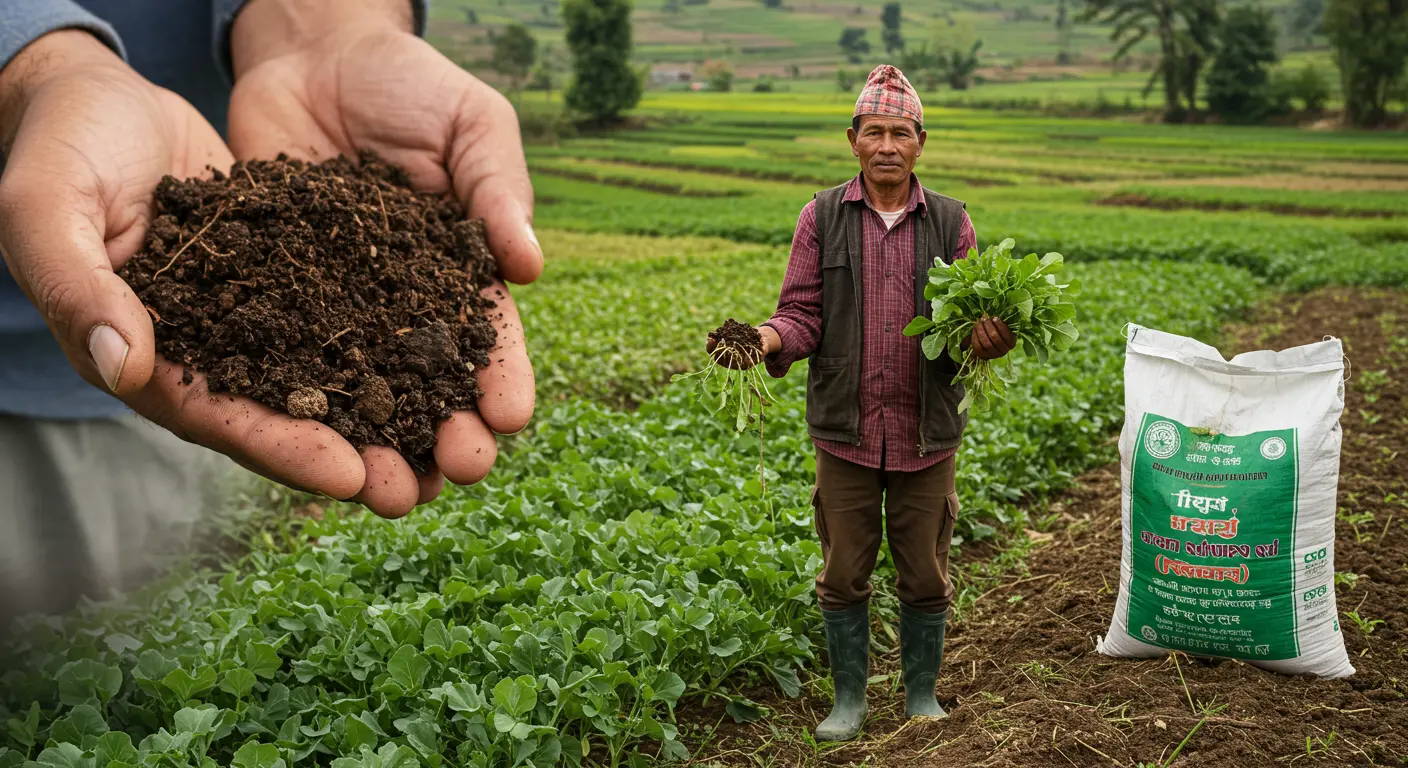
Agriculture has long been the backbone of Nepal’s economy and way of life. The sector still provides employment for about 62% of the country’s households, forming the social and cultural fabric of rural communities.1However, these figures hide a disturbing reality. Agriculture’s contribution to the country’s gross domestic product (GDP) has been steadily declining, falling from over 36% in the past to around 23-24% in recent years.3This decline is not the result of rapid growth in other sectors, but rather reflects a deep productivity crisis within agriculture itself.
The Nepalese farmer today faces a complex of interrelated problems. Labor productivity remains low due to the widespread use of traditional farming methods that have been passed down from generation to generation but no longer meet the requirements of the modern world.2Land holdings are highly fragmented, with almost 75% of households cultivating plots of less than one hectare, making commercial production extremely difficult.6Access to markets and year-round irrigation remains limited, leaving farmers dependent on unpredictable monsoon rains and volatile prices.5
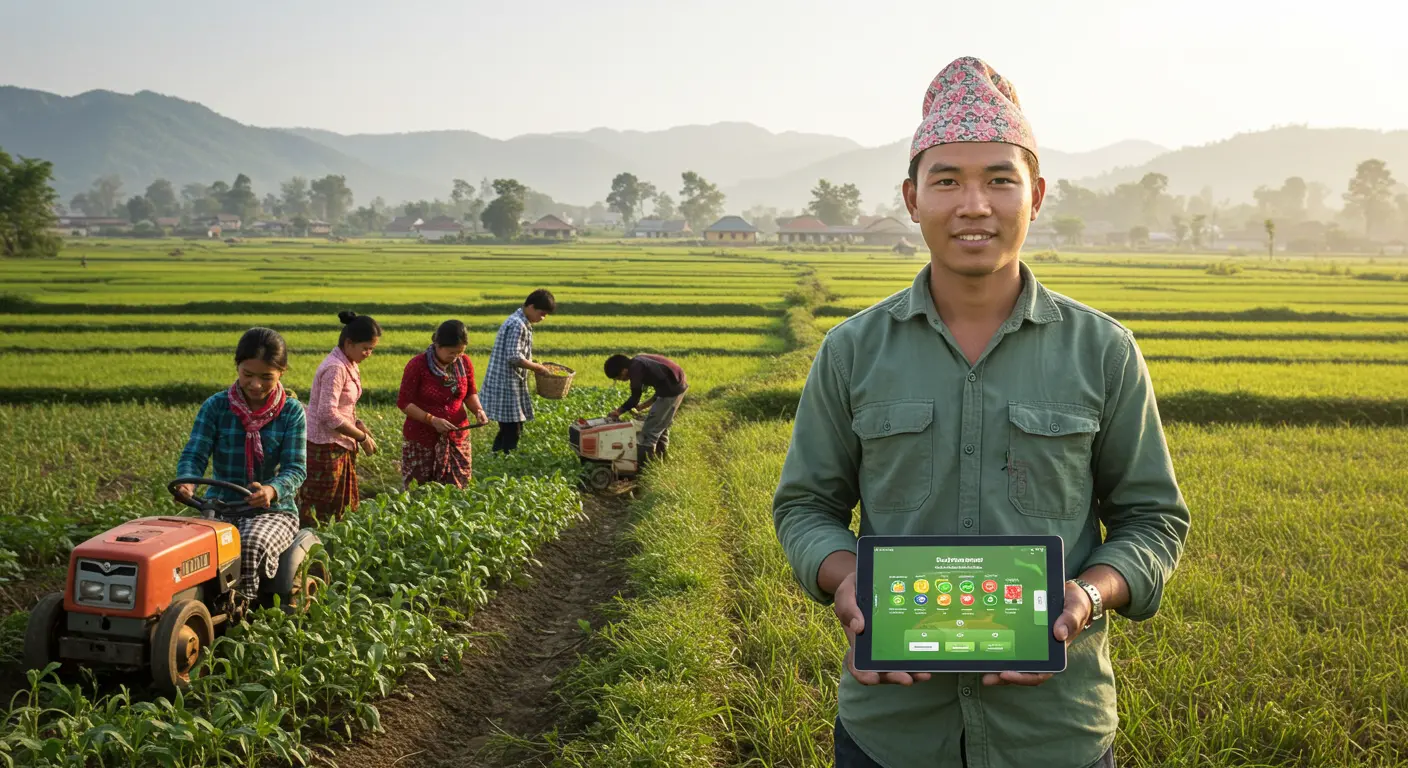
To these long-standing problems has been added a new, even more acute one: the shortage of labor. The mass labor migration of young people, mainly men, in search of higher earnings abroad has bled dry rural areas.5This has led not only to a shortage of labour during peak seasons, but also to an increase in the cost of hired labour and an increased burden on women, who bear the brunt of agricultural work.7As a result, vast areas of fertile land remain uncultivated across the country, a tragic paradox for a nation increasingly dependent on food imports.9

This tangle of problems has created what might be called the “productivity paradox”: despite the fact that agriculture employs the majority of the population, its economic returns are constantly declining. This means that millions of people put in enormous effort, but receive an ever-decreasing share of the country’s economy. The problem is not a lack of hard work, but a lack of efficiency. It is this paradox that puts the Nepalese farmer at a crossroads. Continuing along the beaten path of low yields and high labor costs is a path to stagnation. The alternative is to introduce technologies that can break this vicious circle.
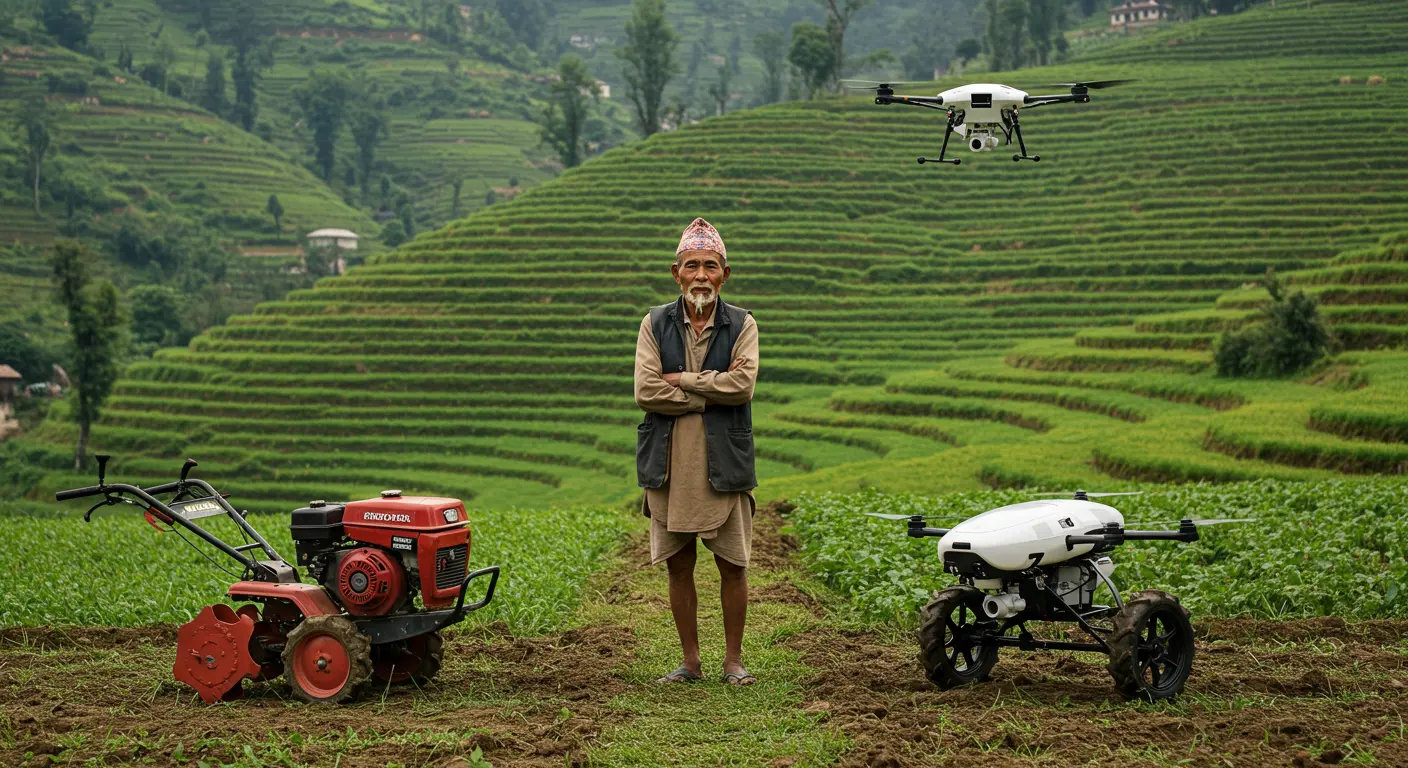
Today, this choice comes down to two main paths: traditional mechanization, symbolized by the tractor, and advanced precision farming technologies, represented by agricultural drones. This is not just a choice between two machines. It is a fundamental business decision that will determine the future of individual farms and the entire agricultural sector in Nepal. In this article, we will conduct a comprehensive analysis of both paths, assessing their real availability, cost effectiveness, and practical applicability for small and medium-sized farmers in Nepal to help farmers make informed and economically sound choices.
The Good Old Worker: An Analysis of Traditional Mechanization
For decades, the tractor and its little brother, the power tiller, have been symbols of agricultural progress. For many farmers in Nepal, mechanization still evokes the idea of this machine. It promises a significant reduction in manual labor, faster soil cultivation, and increased productivity. However, the path to mechanization is not as simple as it seems. For the Nepalese farmer, it is divided into two very different economic models: full ownership of the machine, which almost always means buying on credit, and access to it on a rental basis through specialized centers. Let’s look at both models in detail.

The Path to Ownership – Buying on Credit
Purchasing your own equipment is a major investment that requires careful financial planning. For most small and medium-sized businesses, this decision involves the need to borrow funds.
Cost of equipment:
Prices for farm machinery in Nepal vary widely. Basic, low-powered walk-behind tractors can be purchased for between 50,000 and 90,000 Nepalese rupees (NPR). More powerful, versatile models suitable for most small-scale farming tasks cost between 150,000 and 250,000 NPR and up.10 Full-fledged tractors, such as the regionally popular Solis models imported from India, are considerably more expensive, starting at 745,000 NPR (around US$5,600) for basic models, putting them out of reach for the vast majority of small farmers, but giving an idea of the price range for heavier equipment.14
Purchase financing:
The key financial institution supporting the agricultural sector is the Agricultural Development Bank of Nepal (ADBL). The bank offers specialized loan products such as the Agro-Tools Purchase Loan.16 The terms of the loan directly affect the final cost of the equipment to the farmer. ADBL offers two main interest rate options:

- Floating rate: It is calculated as the Bank’s Base Rate plus a premium of up to 3%. At the time of writing this analysis (Baisakh 2082 Nepali calendar data), the ADBL Base Rate was 6.08%.18Thus, the real floating rate for a farmer could be around 9.08% per annum.
- Fixed rate: For loans with equal monthly instalments (EMI), the bank offers a fixed rate, which currently stands at 10.65% per annum.16
These figures turn the abstract price of a tractor into a concrete long-term financial obligation that the farmer will have to service over several years.
Government support:
The Nepalese government recognizes the importance of mechanization and has tried to encourage it through various programs. The most significant of these is the Prime Minister’s Agricultural Modernization Project (PMAMP). This ten-year project, with a total budget of about US$90 million for mechanization, provides subsidies, often amounting to 50 percent of the cost of machinery.8 However, there is an important caveat: the subsidies are mostly given not to individual farmers, but to organized groups, cooperatives, and machinery sharing centers.8 Moreover, there are increasing reports and press stories about the misuse of subsidies and how financial assistance does not always reach small farmers in genuine need, but ends up in the hands of politically connected individuals.24 This creates a significant barrier for individual farmers who are not members of cooperatives or who are unable to navigate bureaucratic hurdles.
Access Without Ownership – The Rise of Community Rental Centers (CHC)

For farmers who cannot or do not want to take on the burden of a loan, there is an alternative model – equipment rental. This “pay-per-use” model is actively promoted by both the government and international organizations.
Shared Use Centers (CHC) Model:
The idea behind Custom Hiring Centers (CHCs) is to create a fleet of machinery (tractors, tillers, combines, seeders) that farmers can rent on an hourly or shift basis. This model aims to address the inefficiencies associated with small and fragmented land holdings by making expensive machinery accessible to all.25 The PMAMP project and the Food and Agriculture Organization of the United Nations (FAO) are actively supporting the establishment of such centers across the country.22
Rental price:
For the farmer, the key metric is the rental cost. Research shows that this model is cost-effective for CHC owners: the average rental cost of a tractor is about NPR 440 per hour, while the operating cost for the owner is only NPR 220 per hour.29 This creates a sustainable business model and ensures supply in the market. According to the official tariffs of the Department of Roads (DoR), which are often used as a benchmark, the rental of a tractor up to 85 hp (excluding fuel) is NPR 300 per hour.30 These figures allow the farmer to accurately calculate his operating costs for mechanized tillage.
Problems and challenges:
Despite the attractiveness of the CHC model, its implementation faces challenges. One of the main problems is the lack of clear operational guidelines and regulations, which results in many centres operating inefficiently.21 The success of CHCs often depends on good organisation at the cooperative level, which can be a barrier for farmers who prefer to farm individually.23
Thus, choosing traditional mechanization is not simply a decision to “buy a tractor.” It is a choice between two different financial strategies. The first is investment strategy (purchase) — is associated with a high initial barrier, debt obligations and risks, but provides full control over the asset and potential additional income from leasing equipment. The second — operating expense strategy (rent) — offers flexibility, a low financial entry threshold and no long-term risks, but makes the farmer dependent on the availability and rates of rental centers.
Moreover, the current subsidy system through PMAMP, which aims to facilitate access to machinery, may in practice exacerbate inequality. Since subsidies are mainly channelled through cooperatives and groups, individual farmers, especially in remote areas, are often left out of this support system. For them, market rental of machinery from CHCs, albeit without subsidies, becomes the only viable option to access mechanization. This fact highlights the gap between stated policies and the actual availability of technology for the most vulnerable categories of farmers.
New Horizon: Drones in the Skies Over Fields
While some farmers are weighing the pros and cons of buying a tractor, a completely different technology is on the horizon that could change the game. Agricultural drones are not just another tool. They are a fundamentally new approach to farming based on precision, efficiency, and, most importantly for Nepal, a service economy. Instead of owning an expensive asset, farmers get access to cutting-edge technology as a service.

Farming-as-a-Service economy
For a Nepalese farmer, the key difference between a drone and a tractor is the economic model. A drone is not something you buy. It is a service that can be ordered to perform a specific task, such as spraying fields with pesticides, applying fertilizer, or monitoring crop health.
Unavailability of ownership:
The cost of owning a professional agricultural drone puts it out of reach for the vast majority of small and medium-sized farms. For example, the price of a sprayer drone with a 10-liter tank in Nepal is about NPR 1,700,000 (approximately US$12,700).32 More powerful platforms can cost between US$30,000 and US$40,000.33 These figures clearly demonstrate that the only realistic model for using drones for farmers is to rent or hire services from specialized companies.
Availability of the service and its profitability:
It is the service model that makes this technology accessible. Instead of a huge capital investment, the farmer pays for a specific result. The cost of a drone spraying service in Nepal is between NPR 750 and NPR 950 per acre (approximately NPR 1,875 to NPR 2,375 per hectare).35 These are clear and predictable operating costs.
But the real value of drones is not just their affordability, but also their amazing cost effectiveness. Return on investment (ROI) analysis shows direct benefits:
Saving resources:
- Fertilizers and pesticides: Thanks to precision spraying technology, the drone allows you to reduce the consumption of expensive chemicals by 25-30%.35He applies the preparations exactly where they are needed, and in strictly measured quantities, avoiding overspending.
- Water: The use of fine mist nozzles allows the drone to reduce water consumption by 80-90% compared to traditional sprayers.35This is critical for regions with limited access to irrigation.
Saving time and labor:
- Speed: The drone can process one acre (about 0.4 hectares) in 5-7 minutes. For comparison, with manual spraying, one worker can process no more than 3-4 acres in a whole day.35This is not just an acceleration of the process, but an opportunity to carry out processing within optimal agronomic timeframes, which directly affects the health and yield of the crop.
- Labor costs: The drone almost completely eliminates the need for manual labor for spraying, which is a solution to the problem of labor shortages and high labor costs.
- Increased yield: Precise and timely application of fertilizers and plant protection products, as well as the ability to quickly identify disease outbreaks or nutrient deficiencies through monitoring, directly leads to increased yields. Research shows that the introduction of precision farming technologies can increase yields by up to 20%.37Research is already underway in Nepal to use drones to accurately estimate and model rice and wheat yields, a first step toward systematically increasing them.38
Who provides these services in Nepal?
The concept of “farming as a service” is not a futuristic fantasy, but an existing business reality in Nepal. A number of licensed companies have entered the market offering farmers access to drone technology, proving that the ecosystem of service providers is actively forming.

Among the pioneers of this market, we can highlight the following companies:
- Madhukaa Drone Services: One of the first licensed companies offering a wide range of services including crop monitoring, mapping, exploration and spraying. The company already has experience working with large clients such as Lumbini Seed Company, which confirms its professionalism.42
- Geovation Nepal: The company also identifies agriculture as one of its key areas, offering spraying and spreading services (such as seeds or granular fertilizers).44
- Drone Hub Nepal: Specializes in agricultural monitoring and consulting, helping farmers analyze drone data to make better management decisions.45
- Dronepal and Airlift Technology: While these companies are more focused on construction and mapping, their presence in the market is indicative of the overall growth and maturity of the drone technology industry in Nepal.43
The presence of these companies means that a farmer can not just dream about drones, but call and order the service today, gaining access to the most modern agricultural technologies without having to delve into the complexities of piloting, servicing equipment and obtaining flight permits.
Comparing the two technology paths reveals a fundamental economic difference. Buying a tractor is capital expenditure (CapEx). This is a large, one-time investment that requires a loan and creates long-term financial obligations. Renting a drone is operating expenses (OpEx). This is a “pay as you go” model, where costs are directly tied to a specific production operation. For a smallholder farmer with unstable cash flows and limited access to credit, managing large debts is a huge risk. Paying for a service only when it is needed is a much more manageable and less risky financial model. Thus, the main advantage of the drone for the Nepalese farmer is not only its technical precision, but also its business model. It democratizes access to technology by removing the main barrier – the barrier of capital ownership.
Moreover, this presents a unique opportunity for Nepal to make a “technological leap”. The country’s agriculture has historically lagged behind in traditional mechanization due to difficult terrain, small field sizes and high cost of machinery.46Instead of spending decades trying to build the infrastructure and capital to deploy tractors everywhere (a model that has already proven limited in Nepal’s context), the country can skip that step and move straight to a flexible, data-driven, and services-driven 21st-century model. Drones can deliver key mechanization benefits (tilling, seeding, monitoring) without the need for the physical and financial infrastructure required by the 20th-century model. This is a strategic opportunity for the country’s entire agricultural sector.
How to Make the Right Choice for Your Farm: A Comparative Analysis
The decision to implement new technologies is not a one-size-fits-all solution. What works best for one farm may not work for another. The right choice depends on a thorough analysis of your farm’s specific conditions. This section is a practical guide to help you, as a farmer and entrepreneur, assess your needs and resources to determine which technology path – traditional mechanization or drone-based services – makes the most economic sense for you.

To make an informed decision, you need to analyze four key factors:
- Farm size and relief: The geography of your farm is the starting point. For large (by Nepalese standards) and flat farms, located mainly in the Terai region, buying your own walk-behind tractor or even a small tractor may be worth it. Frequent use of equipment over large areas allows you to recoup your initial investment faster. However, for the vast majority of farms in hilly and mountainous areas, with their small, scattered and terraced fields, using large equipment is physically impossible or extremely inefficient.6In such conditions, the only real options for mechanization are renting a maneuverable mini-tiller or using drone services that do not depend on the terrain.
- Main crops grown: The economic return on technology depends directly on what you grow. For labor-intensive crops like rice, where planting and processing require significant human resources, mechanization (using a walk-behind tractor for plowing and planting) provides huge savings on labor costs.50On the other hand, for high-margin crops such as vegetables or spices, where labor savings are not as important as the quality and safety of the harvest, precision farming plays a key role. Precision spraying with drones, which reduces the consumption of expensive pesticides and fertilizers, provides a faster return on investment for such crops.
- Access to capital and cooperatives: Your financial situation and organizational structure play a decisive role. If you are a member of a well-organized and active cooperative, you have a real chance of accessing government subsidies under the PMAMP program for the purchase of equipment.8In this case, the ownership route becomes much more attractive. However, if you are an individual farmer, have limited savings and cannot count on subsidies, then the “pay for use” models are much more realistic and less risky for you – renting equipment from CHC or ordering drone services.
- Degree of labor shortage: If your farm is suffering from a severe labor shortage, then the main criterion is saving time and labor. In this case, it is necessary to directly compare your current expenses on hired workers with the costs of renting equipment or services. Both a walk-behind tractor and a drone can reduce labor costs many times over, and the choice will depend on which stage of production (soil cultivation or crop care) is the most problematic for you.8
To make this analysis more concrete, let’s look at two comparative tables that translate general discussions into the language of specific numbers.
Table 1: Walk-behind tractor decision – Buy vs. Rent
This table will help you understand at what volume of work buying your own walk-behind tractor becomes more profitable than renting it. For example, let’s take a walk-behind tractor of the average price category costing 150,000 NPR, a loan from ADBL at a fixed rate of 10.65% per annum for 5 years and an average rental cost from CHC of 400 NPR per hour.

Analysis of table 1: As you can see from the calculations, the break-even point is somewhere between 100 and 150 hours of use per year. If you plan to use the walk-behind tractor less than 120 hours per year, renting will most likely be more profitable for you. It saves you from initial costs, risks of breakdowns and the need for maintenance. If your need for the equipment exceeds 150-200 hours per year (for example, you have a large farm or you plan to sublet the walk-behind tractor to neighbors), then buying on credit becomes economically justified, despite the high initial costs. This calculation turns a complex financial decision into a simple question: “How many hours per year will I really use this machine?”
Table 2: Drone Advantage – Cost Benefit Analysis per Hectare
This table clearly demonstrates the cost-effectiveness of using a drone for spraying compared to the traditional manual method. Calculations are given for one hectare.

Analysis of table 2: At first glance, a direct savings of 55 NPR per hectare may seem insignificant. However, this figure does not tell the whole story. The main advantages of the drone lie outside the direct cost comparison:
- Timeliness: The ability to treat fields at ideal agronomic times can prevent crop losses that are many times greater than the cost of the service.
- Processing quality: Uniform coverage and better penetration of the product increase its effectiveness, leading to healthier plants and higher yields.
- Reducing health risks: The farmer and his family are not exposed to harmful chemicals.
- Saving your own time: The freed up time can be spent on other work or managing the household.
Thus, the real economic benefit of using a drone is much higher than simple calculations show. For a farmer growing high-margin crops, where timely crop protection is critical, the service model of using drones offers not just savings, but an effective tool for risk management and increasing profitability.
Conclusion: The Future of Farming is Smart and Shared

An analysis of two paths to technological modernization for Nepal’s farmers—traditional mechanization and drone-assisted precision farming—leads to a clear conclusion: there is no single “best” solution. The optimal choice depends on each farm’s unique set of circumstances. However, broad trends and economic realities suggest several strategic conclusions about the future of Nepalese agriculture.
The main conclusion is that there is a fundamental shift from product-centric model (ownership) to service-centric model (access). For the vast majority of Nepal’s small and medium-sized farmers, who are capital-constrained and work on small, scattered plots, the future of advanced technology lies not in purchasing expensive machinery but in accessing it through “pay-per-use” models. Shared machinery centers (CHCs) and drone service providers are democratizing access to technology that was previously the preserve of large agribusinesses. These service models minimize financial risk for the farmer by turning huge capital outlays into predictable operating costs.
This presents Nepal with a unique opportunity to make a “technological leap.” Rather than attempting to replicate the long and costly mechanisation journey that Western countries took in the 20th century – a journey that Nepal already faces significant geographic and economic hurdles – the country can jump straight to building an agricultural sector based on 21st-century principles: efficiency, data analytics, and resource sharing. Drones, with their ability to operate in difficult terrain and affordability through a service model, are a prime example of such a “technological leap.”
Ultimately, the choice between buying a tractor on credit or renting a drone is a choice that the farmer must make himself, acting as a competent manager of his business. The task is to honestly assess his farm: its size, terrain, crops grown, access to finance and labor. Armed with the data presented in this analysis, each farmer can calculate which path will bring him the greatest economic benefit.
The future of Nepali farming is smart and collaborative. It is a future where technology is not a status symbol but a tool for increasing profitability. It is a future where farmers form cooperatives not only to receive subsidies but also to jointly commission high-tech services. It is a future where access to innovation is more important than ownership. Building such a future will not only increase the income of individual farms but also ensure food security and sustainable development of the entire agricultural sector in Nepal, turning it from a source of problems to an engine of economic growth.an grow not only crops, but a more equitable, sustainable, and prosperous future for themselves and their country.
Source used:
- Agriculture in Nepal – Wikipedia
- (PDF) The Role of Agriculture in Nepal’s Economic Development: Challenges, Opportunities, and Pathways for Modernization – ResearchGate
- Nepal’s Agricultural Landscape: Assessing the Government’s Stance – Nepal Economic Forum
- ROLE OF PRIME-MINISTER AGRICULTURE MODERNIZATION PROJECT ON MAIZE VALUE CHAIN DEVELOPMENT AND TECHNOLOGY ADOPTION (A CASE STUDY – Index Copernicus
- The Commercialization of Smallholder Farming—A Case Study from … – MDPI
- Agricultural Productivity and Poverty Reduction in Nepal – Eastern Illinois University
- Smallholder farmers in Nepal: A brief review | cesar
- Labor-Saving Farm Technology in Nepal – Policy Brief 9 [A4]
- Modernising Agriculture – The Rising Nepal
- Power Weeder/Mini Tillers – Muktinath Krishi Company
- Power Tiller/ 22 HP/ Diesel – Kheti
- Buy Tiller Machine Online Nepal – Hardware Pasal
- SKT KISHAN – Kheti
- Solis Tractor Price in India 2025, All Solis Tractors Model – Tractor Junction
- Solis 5015 E Tractor Price, Specifications, Mileage & Reviews 2025 – Tractor Junction
- Interest Rates Effective From Baisakh 01, 2082 (14April, 2025) – ADBL Bank
- Latest Interest Rates – ADBL
- Base Rate – ADBL Bank
- Interest Rate Effective From Chaitra 01 (14 March, 2025) – Agricultural Development Bank
- The Government of Nepal (through the Prime Minister?s Agricultural Modernization Project in Banke’s Rice Super Zone) provided a 50% subsidy to farmers for farm mechanization… – CGSpace
- Role of PMAMP in Agricultural Mechanization in Nepal – CSISA
- Standard Expression of Interest (EOI) Document for Shortlisting of Consultants and Consulting Services – kisan.aitc.gov.np
- (PDF) Review of and recommendations for Custom Hiring Centers for mechanization in Nepal and the Asian region – ResearchGate
- 107 billion rupees spent on agricultural subsidy in five fiscal years | The Farsight Nepal
- Sub Mission on Agricultural Mechanization – agriwelfare.gov.in
- About us – Custom Hiring Centre – Bardibas Krishi
- Review of and recommendations for Custom Hiring Centers for mechanization in Nepal and the Asian region – Food and Agriculture Organization of the United Nations
- Review of and recommendations for Custom Hiring Centers for mechanization in Nepal and the Asian region – FAO Knowledge Repository
- Economics of Custom Hiring of Tractor and Tractor Driven Farm Implements in the Sunsari District of Nepal – CABI Digital Library
- DOR Equipment Hire Rate – dor.gov.np
- Custom Hiring Centres a top priority for Nepali Provincial Government – ACIAR Research
- Drone Sprayer(10Ltr) – Muktinath Krishi Company
- Drone assignment: A costly investment, consider pros and cons – Fruit Growers News
- Drones help scout crops, but growers must consider costs – Vegetable Growers News
- (PDF) DATAVEILLANCE MANAGEMENT USING MICRO DRONE TECHNOLOGY FOR AGRICULTURE PURPOSE IN NEPAL – ResearchGate
- How Drone Technology Can Help Improve Farming System – Green Network Asia
- How the gig economy can transform farms in the developing world | World Economic Forum
- Correlating the plant height of wheat with aboveground biomass and crop yield using drone imagery and crop surface model, a case study from Nepal – The University of Melbourne
- YIELD ESTIMATION OF RICE USING MULTISPECTRAL IMAGERY FROM UAV – fig.net
- Correlating the Plant Height of Wheat with Above-Ground Biomass and Crop Yield Using Drone Imagery and Crop Surface Model, A Case Study from Nepal – ResearchGate
- Growth Monitoring and Yield Estimation of Maize Plant Using Unmanned Aerial Vehicle (UAV) in a Hilly Region – MDPI
- Madhukaa – Home – MADHUKAA DRONES | A COMPLETE DRONE SERVICES IN NEPAL
- Drones over Nepal | Nepali Times
- Geovation Nepal – Redefining Possibilities with Drones
- Contact us – Drone Hub Nepal
- Prospects for farm mechanization in mid-hills of Nepal: Stakeholder experiences and vision – cgiar.org
- The contributions of scale-appropriate farm mechanization to hunger and poverty reduction: evidence from smallholder systems in Nepal | Emerald Insight
- Responsible Agricultural Mechanization Innovation for the Sustainable Development of Nepal’s Hillside Farming System – MDPI
- Determinants of Farm Mechanization in Nepal – Turkish Journal of Agriculture – Food Science and Technology
- Scale-appropriate mechanization impacts on productivity among smallholders: Evidence from rice systems in the mid-hills of Nepal – PMC – PubMed Central
- Assessment of Government Policies, Farm Subsidies, and Agriculture Growth – Nepal Journals Online