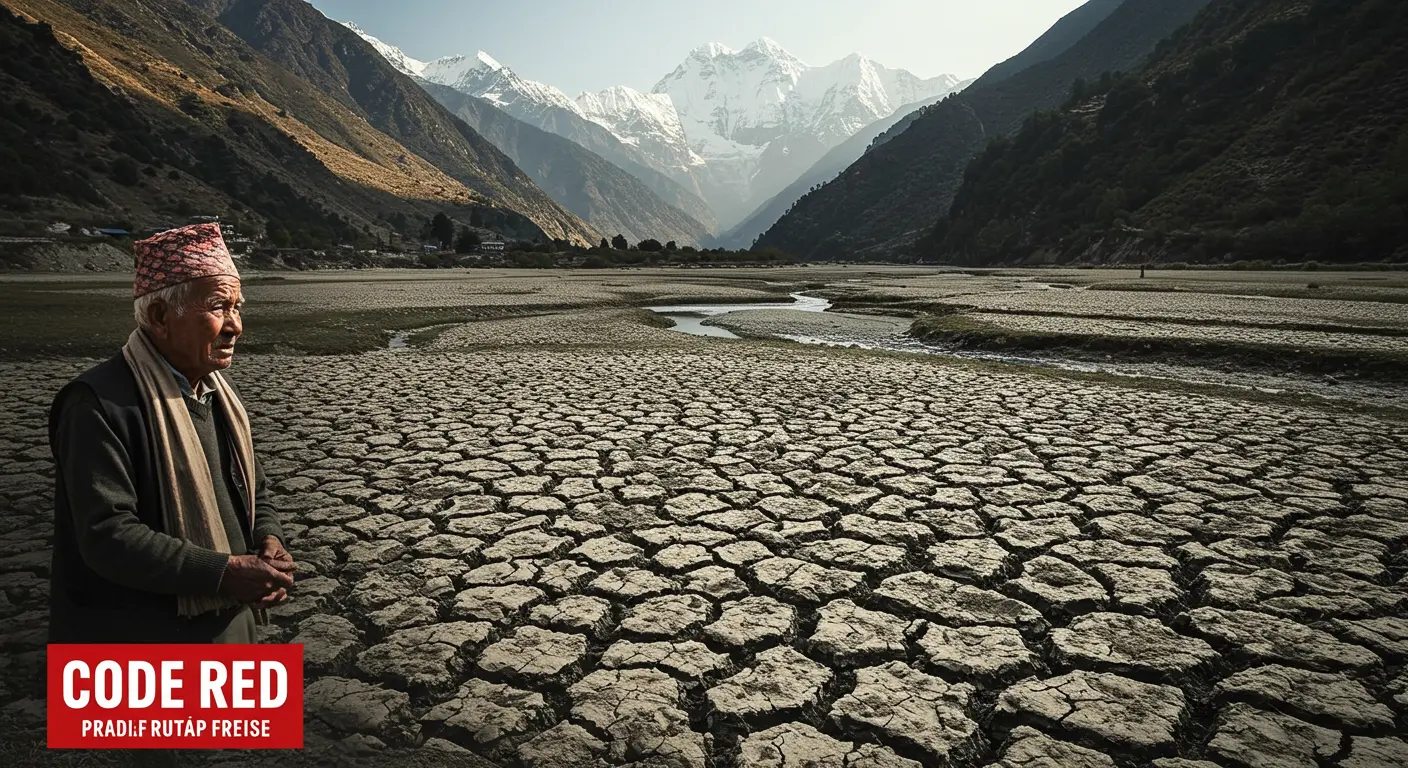
The roof of the world is on fire
In Mustang, a dry trans-Himalayan region of Nepal once famed for its juicy apples, farmers watch their orchards wither as winters grow warmer and the snow that has fed their land with meltwater for centuries falls less.1This is not an isolated incident. It is a harbinger of a crisis that is engulfing the entire country. For Nepal, located in the heart of the Himalayas, climate change is not an abstract threat of the future, but a harsh reality today.
While global headlines often focus on melting glaciers, the real catastrophe is unfolding below, in the valleys and plains where most of the population lives and works. Nepal’s climate crisis is not just an environmental problem; it is a cascading failure that is systemically destroying the foundations of the nation’s economy and society.
Nepal is extremely vulnerable. According to the Global Climate Risk Index, the country is among the top 10 countries in the world most affected by climate disasters.2Forecasts show that warming here will occur much faster than the global average: by the 2080s, temperatures could rise by 1.2°C–4.2°C.3The economic impact could be devastating. Without decisive adaptation measures, Nepal could lose between 2.2% and 7% of its annual GDP by 2050, according to estimates from the Asian Development Bank (ADB) and the World Bank.2Already today, about 80% of the country’s population faces climate threats.2

Table 1: Climate Vulnerability Profile of Nepal. Data from reports from the World Bank, Germanwatch and other international organizations demonstrate the country’s extreme vulnerability to climate shocks.
This exclusive report from Alpha Business Media (ABM) goes beyond melting glaciers to explore how climate change is already causing a chain reaction, transforming four vital sectors in Nepal: agriculture, hydropower, tourism and health. We show how a breakdown in one system triggers a crisis in another, creating a compounding threat to the nation’s future.
Dust Harvest: Agriculture on the Edge
Agriculture is the backbone of Nepal’s economy and social fabric. The sector employs more than 60% of the workforce and contributes about 24% of the country’s GDP.7For millions of rural people, farming is not just a job, it’s a way of life. Yet it is this pillar of the nation that is now under direct attack from the climate.

Unreliable monsoon and worsening drought
Traditional Nepalese agriculture relied for centuries on predictable monsoon rains. Today, that predictability has disappeared. The monsoons have become irregular: they can start late, bring too much rain too quickly, causing floods, or be too weak, leading to drought.9Rice production, the main food crop, is extremely sensitive to these fluctuations. Research shows that a change in monsoon rainfall of just 1% results in a 0.34% change in agricultural GDP.10
At the same time, winters are becoming warmer and drier, reducing winter crop yields and increasing food insecurity for millions of people.11But the most alarming trend is the disappearance of water resources. A national survey conducted in Nepal found that over the past 25 years, 78.3% of households have noticed the shallowing of streams and rivers, and 55% have noticed the drying up of wells and springs.8This is a direct threat to 75% of Nepalese agriculture, which depends on rain-fed irrigation and does not have access to modern irrigation systems.3
Rising Plague: New Pests and Diseases

Climate warming is opening the door to agricultural threats in regions that were previously protected by cold. As temperatures rise, pests and diseases migrate to higher altitudes. Over the past quarter century, about 50% of Nepalese households reported the emergence of new crop diseases, and 53.9% reported the infestation of new insect pests.8Mountainous areas are particularly hard hit, with 68.7% of households experiencing the problem, indicating that once safe high-mountain ecosystems are becoming new hotbeds of agricultural risk.8
Economic collapse and population exodus
These environmental changes have direct and devastating economic and social consequences. Direct economic losses in agriculture and related industries over the past five years have been estimated at a staggering 415.44 billion Nepalese rupees (about 3.1 billion US dollars).8

This economic devastation is a major “push” factor for migration. When agriculture, the only source of income for 60% of the population, stops being profitable, people have no choice. Research in areas like Mustang shows a direct link between climate-induced water shortages, falling crop yields, and people’s decision to leave their homes.1This is supported by broader research that links land degradation and declining productivity to increases in both internal and external migration.13
Thus, a vicious circle is created. Climate change leads to the decline of agriculture. Economic despair forces young and working people to leave villages in search of work in cities or abroad to send remittances home.15This exodus is wiping out the rural workforce, leaving behind the elderly and children. The abandoned lands degrade even faster, and the remaining agriculture becomes even more vulnerable. Climate drives migration, and migration in turn exacerbates the vulnerability of the agricultural system to climate. It is a self-perpetuating cycle that threatens the long-term viability of rural Nepal.
Energy Paradox: Nepal’s Risky Bet on Hydropower
Nepal’s National Development Strategy is making a bold bet on “green gold” – hydropower. The government has ambitious plans to increase installed capacity from the current ~3,500 MW to 28,500 MW by 2035 of this, 15,000 MW is planned to be exported to neighboring countries such as India and Bangladesh, which should become the engine of economic growth.17But this strategy, designed to ensure energy security and mitigate the effects of climate change, has itself come under attack from it.
Threat #1: The Fury of GLOFs (Glacial Lake Outburst Floods)

The most acute and catastrophic threat comes from melting glaciers. Accelerated warming in the Himalayas is creating thousands of new, unstable glacial lakes, held in place only by loose moraine dams—banks of rock and ice.20Nepalese authorities have already identified more than 20 such lakes as posing a high risk of bursting.
A Glacial Lake Outburst Flood (GLOF) releases a gigantic torrent of water, mud, and boulders that rushes down a valley, destroying everything in its path for up to 100 km. This mudflow has the potential to destroy multi-billion dollar hydroelectric plants, power lines, and entire communities downstream.21Historical examples such as the 1985 GLOF at Dig Tso Lake, which destroyed the nearly completed Namche Dam, serve as grim reminders of this destructive force.22
Threat #2: Unreliable River (flow variability)

The second, more chronic threat is the increasing unpredictability of river flows. Climate change is making them more extreme. Forecasts show that while monsoon flows may increase (increasing the risk of flooding), winter and spring flows will decrease significantly.24
This is a critical issue for Nepal’s power system, which is dominated by run-of-river hydropower plants that lack large reservoirs. These plants are highly efficient during the wet monsoon, but their output drops sharply during the dry season. As a result, Nepal, with its huge hydro potential, is forced to import electricity from India to cover the deficit during the winter months.26Studies on rivers such as the Budhigandaki show that due to flow variability, losses in power generation during individual dry seasons can be as high as 40%, creating huge uncertainty for investors and undermining the economic viability of projects.26
Geopolitical pressure

These climate risks are compounded by a complex geopolitical environment. Nepal’s main power market is India, with which it has an agreement to purchase 10,000 MW over the next decade.19However, India has a policy prohibiting the purchase of power from projects that Chinese companies have helped build or finance.29
This policy leaves Nepal with a difficult choice: either attract Chinese capital and technology, risking losing access to the Indian market, or focus entirely on India, limiting its strategic and economic opportunities.
Nepal’s national development strategy thus rests on a dangerous paradox. The chosen path to a green economic future through hydropower is itself extremely vulnerable to climate change. This creates systemic investment risk that is multiplied by regional geopolitics. For international investors and lenders such as the World Bank or the ADB, this means that the country’s main energy asset is exposed to both catastrophic one-time failure (GLOF) and chronic inefficiency (flow variability). This increases the risk premium, making financing more expensive and difficult to obtain. In this context, India’s restrictive policies gain enormous influence. India can effectively sideline Chinese competitors by pointing out not only political but also very real climate and market risks. The climate crisis thus becomes a tool in the geopolitical game between India and China, and Nepal finds itself squeezed between the two giants.
Vanishing Frontier – Tourism in an Unrecognizable Landscape
Tourism is another vital artery of the Nepalese economy, providing a significant share of GDP and hundreds of thousands of jobs, especially in remote mountain communities, for whom it is virtually the only source of income.33But climate change is hitting the very “product” Nepal offers the world – its unique Himalayan landscapes and treks.
Disappearing Landscapes

Nepal’s global brand as a tourist destination is built on the image of the majestic, snow-capped Himalayas. But that image is fading. Rising temperatures are rapidly retreating glaciers and reducing snow cover. The famous “white” peaks are increasingly revealed as bare, black rocks.35The Khumbu Glacier, located on the route to Everest Base Camp, has thinned significantly in recent decades and is retreating at a rate of about 30 meters per year.35This fundamental change undermines Nepal’s long-term attractiveness as a premier mountain tourism destination.
High-risk trails
Along with the aesthetic degradation, the physical danger to trekkers is also growing. Melting permafrost is destabilizing mountain slopes, leading to a sharp increase in landslides, rockfalls, and avalanches on popular routes in the Everest and Annapurna regions.35
The weather is becoming increasingly unpredictable. Unexpected snowstorms and storms can now strike even during the peak tourist season. The tragic 2014 Annapurna Circuit snowstorm, which killed 43 people, was a vivid example of this new, dangerous reality.33These threats not only put the lives of tourists and locals at risk, but also make routes impassable, disrupt travel plans and increase the cost of rescue operations.
Disrupted ecosystem and impact on local residents
The effects extend beyond the trails themselves. Flora and fauna are forced to migrate to higher altitudes, changing the biodiversity that attracts ecotourists. New species, such as mosquitoes, appear in the highlands that were never there before.35
The economic impact on local communities—Sherpas, guides, porters, and guesthouse owners—is direct and devastating. Their livelihoods depend entirely on a steady flow of tourists and predictable natural conditions. Climate change is destroying this fragile economic ecosystem.33
In this context, climate change is not just an environmental problem, but a factor brand destruction. It undermines Nepal’s unique selling proposition and threatens to collapse narrowly specialized local economies. The economies of regions like the Khumbu, Annapurna and Langtang are not diversified. They are mono-economies built entirely around the trekking and mountaineering industry. Unlike a city, which can reorient itself, a village at 4,000 meters has few alternatives. When the trails become too dangerous and the scenery loses its appeal, guesthouses empty out, guides and porters lose their jobs. This leads to local economic collapse, which in turn fuels further migration, closing the circle and linking the tourism crisis to the nationwide problem of depopulation and “brain drain.”
Invisible Epidemic – Nation’s Health in Crisis
Nepal’s health system, especially in rural and mountainous areas, is under-resourced and has always been vulnerable to shocks.39Today, climate change is hitting it from an unexpected direction, creating new crises for which it is completely unprepared.

Fever creeping into the mountains
The most striking evidence of the impact of climate on health is the spread of vector-borne diseases. Mosquito-borne diseases, previously confined to hot tropical lowlands, are now spreading to high-altitude areas.
Dengue fever cases have risen sharply. The 2022 epidemic was the largest in the country’s history, with cases reported in all 77 counties, including highland regions previously considered too cold for the mosquitoes that carry the disease.39Experts from the Intergovernmental Panel on Climate Change (IPCC) confirm that this is a direct consequence of global warming.39
At the same time, waterborne diseases such as cholera and diarrhoea are on the rise. Heavy monsoon rains pollute drinking water supplies, and droughts concentrate pollutants in the remaining water bodies.43
Psychological scars of a changing world
Beyond physical ailments, the climate crisis leaves deep psychological scars. Farmers who lose their harvests and communities forced to leave their homes because of floods and landslides experience extreme stress. Terms such as “eco-anxiety” (chronic fear of environmental disaster) and “solastalgia” (melancholy and bitterness caused by the loss of one’s native environment) have entered scientific circulation.45These conditions are associated with increased rates of depression, anxiety disorders and even suicide, especially among vulnerable rural people who are losing not only their livelihoods but also their identity.45
System overload
New health threats are putting enormous strain on the national health system. The medical infrastructure in the mountains is not equipped to deal with outbreaks of “tropical” diseases such as dengue. There is a shortage of diagnostic equipment, medicines and trained personnel.39The financial costs are enormous. According to Nepal’s National Adaptation Plan (NAP), US$500 million will be needed by 2030 just to strengthen preparedness for climate-sensitive diseases.39
Climate change acts as Disease vector and stress multiplier, creating new health crises for which Nepal’s system is neither structurally nor financially prepared. This transforms climate adaptation from an environmental challenge into an urgent national security imperative. A systemic mismatch emerges: the health infrastructure in the mountains is designed to treat colds and provide basic care, not to cope with complex tropical fever epidemics. The chain reaction affects the entire system: an outbreak of dengue in a remote village not only affects the sick, but also overwhelms the local health centre, depletes medicine stocks, and requires an expensive emergency response from the central government. At the same time, mental health becomes a hidden crisis multiplier: a farmer whose crops have been lost to drought may become depressed, while his family may suffer from malnutrition. If they are forced to relocate, they will end up in temporary shelters with poor sanitation, increasing the risk of contracting water-borne diseases. The climate crisis thus creates a complex, interconnected web of physical and psychological problems that places an unbearable burden on the nation.
Conclusion: Overcoming the Cascade is the Path to Sustainability
The analysis shows that climate change in Nepal is not a collection of isolated problems, but a single systemic crisis causing a devastating chain reaction. The same factor – warming – is triggering a cascade of failures: agricultural failures lead to migration and malnutrition; vulnerable hydropower threatens energy security and investment; the degradation of the tourism sector is devastating local economies; and new diseases are overloading fragile health systems.
The Nepalese government is aware of the threat and has drafted ambitious documents such as National Adaptation Plan (NAP) 2021-2050 and the goal is to achieve carbon neutrality.6However, there is a huge gap between plans and their implementation, due to two main factors:
- Financial restrictions: To adapt and mitigate impacts by 2030, Nepal needs, according to various estimates, 46 to 47.4 billion US dollars. This is a colossal amount, and the existing funding gap is huge.50
- Institutional weakness: Constant political instability, bureaucratic obstacles and lack of coordination between different levels of government hinder the effective implementation of projects and policies.52
The way forward requires not just adaptation, but a fundamental rethinking of the development model. For investors, policymakers and international partners, this means a shift in focus:
- Invest in resilience, not just infrastructure: Instead of building traditional hydropower plants, there is a need to diversify the energy portfolio, including small, decentralized projects and energy storage systems that are less vulnerable to GLOF and flow fluctuations.
- Rethinking Agriculture: Promote investments in climate-smart agriculture: drought- and flood-tolerant crop varieties, efficient irrigation technologies and the establishment of sustainable local seed banks.12
- Diversify the tourism product: Reduce dependence on high-altitude trekking by developing cultural, health and other types of tourism at lower altitudes that are less exposed to climate risks.
- Create a climate-resilient healthcare system: Integrate climate risks into the national health agenda. This means strengthening surveillance in high-altitude areas, conducting public awareness campaigns on emerging threats, and investing in mental health support for affected communities.
For Nepal, the climate crisis is no longer a question of saving glaciers for future generations. It is a question of saving its economy, its communities, and its future – today. The path forward requires not just adaptation, but turning a cascade of failures into a cascade of resilience.knowledge, and providing professional support to its returnees – Nepal can transform its vast global diaspora from a source of livelihood into the main driver of its economic and innovative renaissance in the 21st century.
[elementor-template id=”1573″]
Sources used
- Induced Impacts of Climate Change on Livelihood and Migration in Upper Himalayas: A Case of Mustang, Nepal
- Climate Change in Nepal: Who Pays the Price?
- IDU-a6b7751e-0e3c-4435-a5c9-3a740a4c1c89.txt
- CLIMATE CHANGE TECHNICAL NOTE Nepal Disaster Resilience Second DPC with Cat DDO (NDRC) (P181344)
- CLIMATE RISK COUNTRY PROFILE
- Integrating Climate Change into Nepal’s Development Strategy Key to Build Resilience, Says New World Bank Group Report
- (PDF) The Role of Agriculture in Nepal’s Economic Development: Challenges, Opportunities, and Pathways for Modernization
- Nepal’s agriculture, water resources under climate threat
- Crop Situation Update
- Climate change led erratic Monsoon and global disruptions threaten food production, experts call for self-dependency
- Climate risk and food security in Nepal:
- Climate Change and Agrobiodiversity in Nepal
- Environmental Change and Out-Migration: Evidence from Nepal
- Climate shocks, agriculture, and migration in Nepal: Disentangling the interdependencies
- Transnational Work Migration of Nepali Youths
- Nepal Development Update
- Nepal’s Roadmap to Produce 28500 MW by 2035
- Securing Nepal’s Energy Future: A Blueprint for Reliable Electricity
- Nepal Sets Ambitious Target to Generate 28,500 MW of Hydroelectricity by 2035
- Glacial Lakes and Glacial Lake Outburst Floods in Nepal – HimalDoc
- Nepal: Global warming swells glacial lakes, endangering thousands
- Glacial Lakes and Glacial Lake Outburst Floods in Nepal – ICIMOD
- Glacial Lakes and Glacial Lake Outburst Floods in Nepal – World Bank Documents and Reports
- Climate change will exacerbate seasonal flow variability in the Karnali River Basin: implications for water, energy, and agriculture sectors
- Hydropower in Nepal A Path Toward or Away from Sustainability
- (PDF) Impact of Flow Variation on Hydropower Projects in Budhigandaki River Basin of Nepal
- Hydropower in Nepal: A long overdue potential flooded with challenges
- Nepal lights up South Asia
- Geopolitics of energy in Nepal: Balancing India, China, and the US
- GT Voice: India’s geopolitical game hurts outlook for Nepal’s hydropower
- Unlocking the Geopolitics of Hydropower in Nepal
- Geopolitics of Nepal’s Hydropower: Has India Outmaneuvered China?
- The path to climate-resilient tourism in Nepal
- The impact of the pandemic on the hospitality and tourism sector, and its recovery
- How Climate Change is Affecting the Everest Region: Must Know
- Impacts of Global Warming in the Everest Region of Nepal
- How does climate change impact trekking in Nepal?
- How Does Climate Change Impact Trekking in Nepal?
- Nepal: Dengue Surge Exposes Climate Risk
- A major dengue epidemic in 2022 in Nepal: need of an efficient early-warning system
- In Nepal, climate change is shadowed by two decades of surging dengue
- Three Climate and Health Lessons from Nepal Ahead of COP28
- Ensuring healthy cities in the face of climate change: Lessons on urbanization, waste and infectious diseases in Nepal
- Climate Change and Health in Nepal: A Battle for Survival in the Shadow of Melting Glaciers
- Climate change in South Asia and impact on mental wellbeing
- impact of climate change on mental health among vulnerable groups: a systematic literature review
- Research and Action Agenda on Climate Change and Mental Health for Small Farmers and Fisher Peoples
- Nepal’s National Adaptation Plan 2021-2050
- national adaptation plan (nap)
- Capitalising Green Finance for Nepal
- Nepal’s financing needs to fight climate change
- COST OF POLITICAL INSTABILITY
- Climate-Smart Agriculture in Nepal
- ICIMOD responds to UN study finding ‘Food, Water, Energy and Livelihood security in jeopardy in the Hindu Kush Himalaya’
- Risk of water shortages builds-up as Hindu Kush Himalaya faces 23-year-record-low snow persistence in the third consecutive year of below-normal seasonal snow
- Nepal Overview: Development news, research, data
- The Sixteenth Plan
- Nepal ranks 69th in climate risk index; experts call the findings unbelievable
- Climate Risk Index 2025